Bad Wheel Bearing Danger: What You Need to Know Now
How Dangerous Is a Bad Wheel Bearing?
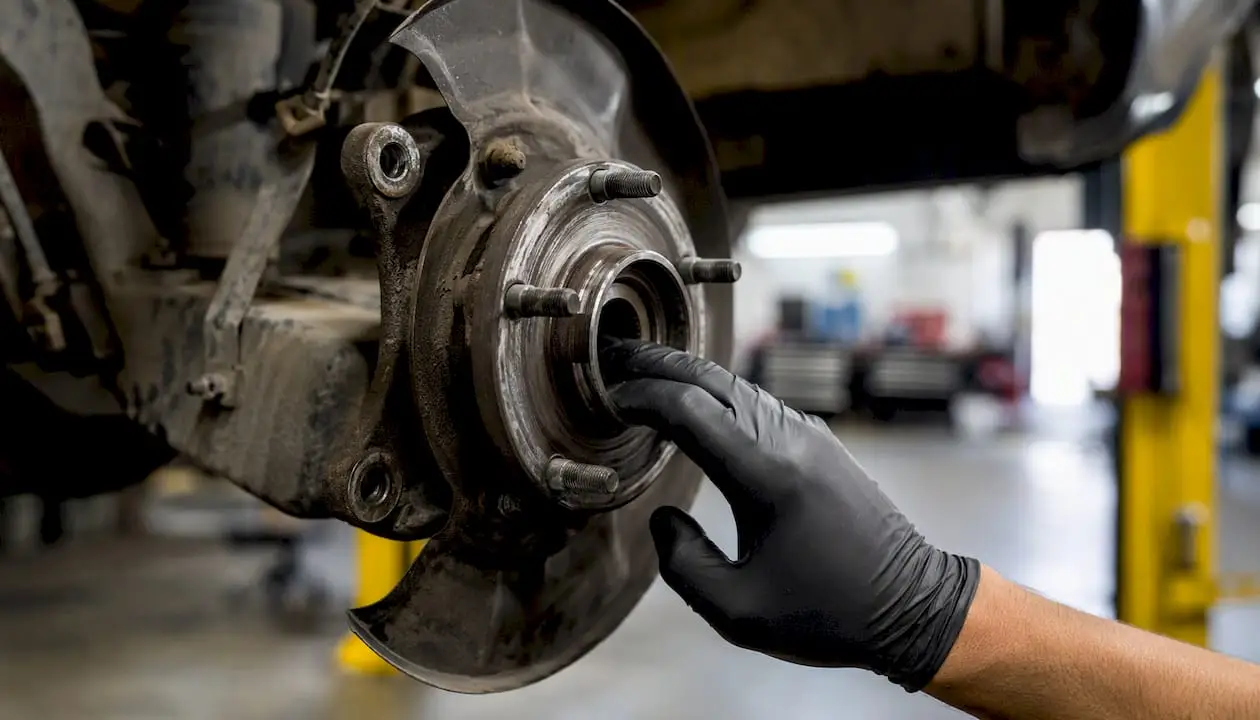
A failing wheel bearing is a genuine safety hazard, not a “watch and wait” situation. At its worst, a degraded bearing can seize, lock a wheel mid-drive, or allow the hub assembly to separate from the vehicle entirely — outcomes that controlled vehicle testing confirms produce sudden, severe loss of control. If you are hearing grinding, feeling steering wobble, or noticing an ABS warning light, treat it as urgent.
Here is what to do right now if you suspect a bad bearing:
Reduce speed immediately. High-speed driving accelerates heat buildup inside the bearing and shortens the time before failure.
Avoid hard braking. A compromised bearing can affect rotor contact and ABS sensor signals, making emergency stops less predictable.
Pull over safely if you feel heavy vibration, hear loud grinding, or notice the steering pulling sharply to one side.
Call for a tow when grinding, visible heat shimmer near a wheel, or steering instability is present. Do not attempt to drive to a shop under those conditions.
Schedule an inspection immediately even if symptoms are mild. A low hum today can become a seized hub tomorrow with no additional warning.
Warning: Bearing failure is unpredictable. A bearing that hums quietly for a week can deteriorate to grinding and seizure within a single highway trip. Treat any bearing symptom as urgent, not optional.
Pro Tip:If the noise changes pitch or intensity when you gently swerve left and right at low speed, that load-shift response is a strong indicator the sound is coming from a wheel bearing rather than a tire or road surface.
Key Takeaways
A failing wheel bearing can progress from a quiet hum to a seized hub or wheel separation with little warning, making prompt inspection the single most important action a driver can take.
Point
Details
Treat any symptom as urgent
Grinding, vibration, or an ABS light means stop driving and call for an inspection or tow.
Distance limits are unpredictable
A noisy bearing may last a few hundred to a few thousand miles, but highway speeds can trigger sudden failure within a single trip.
Secondary damage multiplies cost
Delayed repair turns a bearing swap into a hub, rotor, or knuckle job costing significantly more.
Proper torque prevents most failures
NTSB investigations identify improper wheel-fastener torque as a leading cause of wheel separations.
Kwik Kar Oil Change & Auto Care
ASE-certified technicians in Richardson, TX, perform full bearing inspections with transparent pricing and warranty coverage.
What are the warning signs of a bad wheel bearing?
Wheel bearings fail gradually, but the signals they send are specific enough to recognize early. Knowing what to listen and feel for can be the difference between a straightforward bearing swap and a much larger repair bill.
Audible cues
The most common bad wheel bearing symptoms are noises that track with vehicle speed rather than engine RPM:
Humming or growling that rises in pitch as you accelerate and fades when you coast.
Grinding that persists regardless of speed — a sign the bearing’s rolling elements are already damaged.
Clicking or snapping during turns, which can indicate a bearing with significant play or a worn CV joint (the two are often confused).
Squealing at low speeds, particularly after the vehicle has been sitting, can point to a dry or contaminated bearing.
Tactile and visual cues
Vibration felt through the steering wheel or floorboard that worsens with speed.
The vehicle pulling to one side without steering input, especially under light braking.
Uneven or scalloped tire wear on the affected corner.
Visible wobble at the wheel when viewed from outside while someone else drives slowly in a parking lot.
Dashboard warnings
Modern hub assemblies often integrate ABS tone rings directly into the bearing unit. As the bearing wears, the tone ring can produce erratic wheel-speed signals, triggering ABS or traction-control warning lights. A lit ABS light combined with any of the noises above is a strong combined indicator.
Pro Tip:A quiet cabin at highway speeds can mask early-stage humming. Roll down your windows and listen at 40–60 mph on a smooth road. The hum from a failing bearing typically changes when you shift your weight slightly by steering gently left or right — a tire noise usually does not.
How dangerous is a bad wheel bearing, really?
The short answer: more dangerous than most drivers assume. The failure chain that starts with a worn bearing can reach far beyond an annoying noise.
The mechanical failure sequence
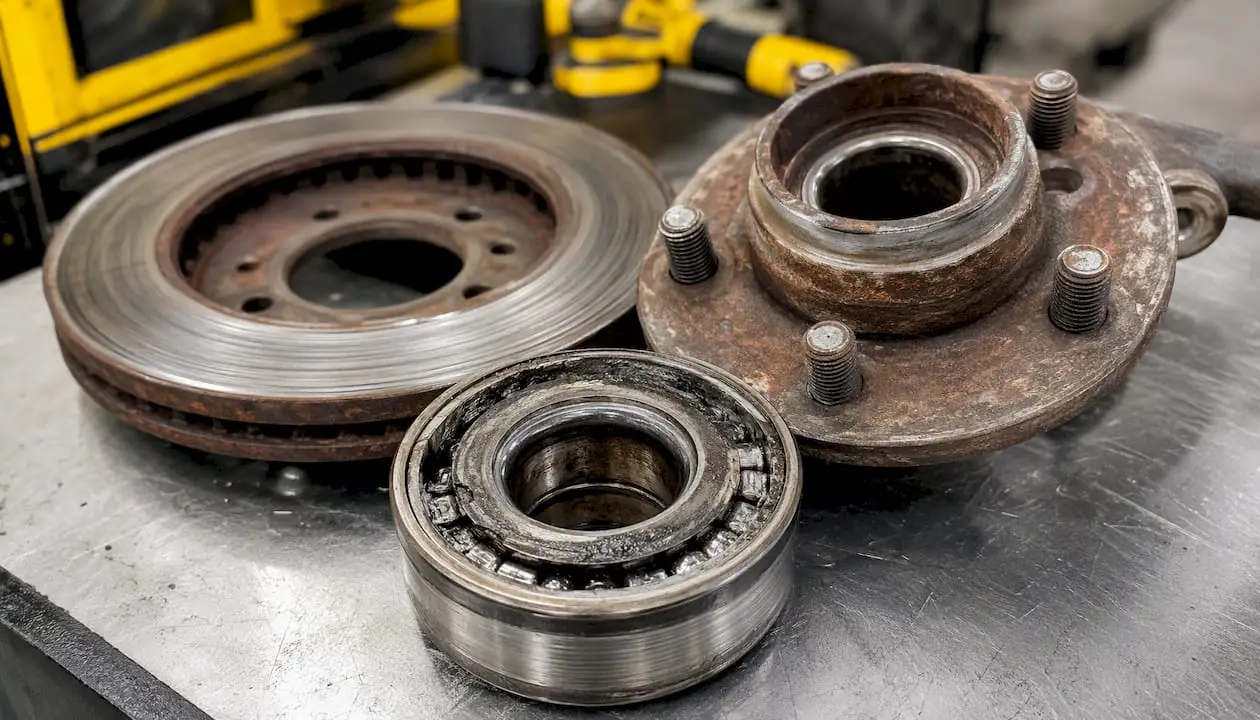
A wheel bearing carries the entire rotational load of the wheel and tire against the hub. When the bearing’s internal races and rolling elements wear down, three things happen in sequence. First, play develops in the hub, which stresses the axle shaft and rotor. Second, friction generates heat that accelerates grease breakdown and metal fatigue. Third, the bearing can seize entirely, locking the wheel or, in severe cases, allowing the hub to separate from the knuckle.
NTSB investigations into wheel separations identified bearing failure and improper wheel-fastener maintenance as leading causes of wheel separations and serious crashes, particularly in commercial truck fleets. The NTSB recommended industry-wide inspection guidelines and education on proper torque and bearing inspection intervals as a direct result.
Controlled laboratory and full-vehicle testing has documented that hub and rotor separations produce loss of vehicle control with damage patterns that match real-world crash-scene evidence — confirming that high-speed bearing failure is not a theoretical risk but a documented, reproducible outcome.
Secondary damage that compounds the danger
Even short of full separation, a failing bearing causes secondary damage that raises the stakes:
Rotor warping and scoring from hub play, which reduces braking effectiveness. Inspecting brake rotors alongside a bearing diagnosis is standard practice for this reason.
ABS sensor failure from a damaged tone ring, which can reduce braking predictability in emergency stops.
Hub and knuckle damage from prolonged operation with excessive play, turning a bearing replacement into a full hub assembly or knuckle repair.
While wheel separation is rare in passenger vehicles, the NTSB’s findings make clear that bearing failure combined with deferred maintenance is the most common path to that outcome. The risk is real and avoidable.
How far can you safely drive on a bad wheel bearing?
There is no safe mileage number that applies to every situation, and that unpredictability is itself the most important thing to understand.
The spectrum from hum to grind
A bearing that produces only a faint hum at highway speeds, with no vibration and no ABS light, may tolerate a short, low-speed trip to a nearby shop. Mechanic guidance is consistent on this point: once noise appears, the remaining lifespan ranges from a few hundred to a few thousand miles, but that range is not predictable from the outside. A bearing that hummed for two weeks can deteriorate to grinding within a single 30-minute highway run.
Grinding, heavy vibration, or a steering pull are different. Those symptoms indicate the bearing has already lost significant structural integrity. Independent shop guidance advises against driving more than a few miles on a confirmed bad bearing showing those signs, and never at highway speeds.
Here is a practical decision framework:
Faint hum only, no vibration, no ABS light: Drive slowly (under 45 mph) to the nearest shop. Avoid the highway.
Hum with mild vibration or a slight pull: Do not drive more than a few miles. Call ahead and go directly to a shop or schedule a tow.
Grinding, heavy vibration, steering instability, or ABS light: Do not drive. Call for a tow.
Any symptom while towing a trailer or carrying a heavy load: Stop immediately. Load multiplies bearing stress and can trigger sudden failure.
Any symptom in an EV or performance vehicle: EVs deliver instant torque that stresses wheel-end components harder than conventional drivetrains; treat symptoms as more urgent, not less.
Pro Tip:Heat is the accelerant. A bearing that feels manageable at city speeds can reach failure temperature within 20 minutes of sustained highway driving. If the wheel area feels warm to the touch after a short drive — not just from brake heat — the bearing is already in advanced distress.
What should you do the moment you suspect a bad wheel bearing?
Acting quickly and correctly protects both you and your vehicle. Follow these steps in order.
Slow down and stay calm. Reduce speed gradually without hard braking. Avoid sudden lane changes.
Find a safe place to stop. A parking lot or wide shoulder is ideal. Turn on your hazard lights.
Perform a quick visual check. Look at the wheel area for heat shimmer, visible wobble, or any fluid or grease on the inside of the wheel. Grease on the wheel face can indicate a failed bearing seal.
Perform a wheel-rock test — only on a flat, stable surface with the vehicle on jack stands. With the wheel lifted, grip it at 12 and 6 o’clock and try to rock it. Any detectable play indicates significant bearing wear. Repeat at 9 and 3 o’clock to check for lateral play.
Decide: drive or tow. If the visual check or rock test reveals play, grease loss, or heat, call roadside assistance. If symptoms are mild and the shop is close, drive slowly on surface streets only.
Call ahead to the shop. Let them know what you observed so they can prepare for the inspection.
When in doubt, tow. The cost of a tow is a fraction of the cost of a hub assembly, knuckle repair, or rotor replacement caused by driving on a seized bearing.
Pro Tip:Never jack a vehicle on uneven or soft ground to perform a wheel-rock test. An unstable jack stand is more dangerous than the bearing itself. If you cannot safely lift the vehicle, skip the test and call for a tow.
How does a mechanic diagnose a bad wheel bearing?
A thorough bearing diagnosis goes beyond listening to the noise. Here is what a qualified shop does, and why each step matters.
The diagnostic sequence
A technician will typically start with a road test to confirm and localize the noise, noting which direction of steering load changes the sound. From there, the vehicle goes on a lift for a hands-on inspection.
Wheel-off inspection: The wheel is removed to examine the hub, bearing seal, and surrounding components for grease loss, corrosion, or visible damage.
Lateral and vertical play check: The technician grips the rotor or hub and checks for play in both axes. Any detectable movement in a properly torqued assembly points to bearing wear.
Spin test: The hub is spun by hand while the technician listens and feels for roughness, grinding, or uneven resistance.
Infrared temperature check: After a road test, an infrared thermometer pointed at each hub can reveal a bearing running significantly hotter than its neighbors.
ABS sensor scan: On vehicles with integrated tone rings, a scan tool reads wheel-speed data to identify erratic signals from the affected corner.
Distinguishing bearings from similar problems
Bearings are frequently confused with CV joint wear and tire noise. The diagnostic table below shows how shops separate them.
Diagnostic method
What it detects
Key advantage
Limitation
Visual / seal inspection
Grease loss, corrosion, physical damage
Fast, no tools required
Misses internal wear with intact seals
Lateral/vertical play check
Hub looseness, bearing race wear
Definitive for advanced wear
May not detect early-stage wear
Spin test (by hand)
Roughness, grinding, uneven drag
Feels subtle internal damage
Requires wheel removal
Infrared temperature scan
Heat from friction in a worn bearing
Non-invasive, comparative
Requires a recent drive; brake heat can interfere
ABS/wheel-speed sensor scan
Erratic tone-ring signals
Catches sensor-related faults early
Requires scan tool; not all shops include it
What does wheel bearing repair cost, and what are your options?
Repair cost depends on the bearing design, the vehicle type, and whether secondary damage has occurred. Understanding the options helps you evaluate quotes accurately.
Repair types
Serviceable (press-in) bearings are separate components pressed into the hub or knuckle. Replacing them requires a hydraulic press and more labor time, but parts cost less. These are common on older vehicles and many trucks.
Sealed hub assemblies combine the bearing, hub, and ABS tone ring in a single unit. Replacement is faster because the whole assembly bolts on, but the part itself costs more. Most modern passenger cars use this design. Since these bearings are sealed and non-serviceable, once internal wear begins, the entire assembly is replaced rather than repacked.
When additional work is required: If the hub or knuckle is damaged from prolonged bearing failure, the repair scope expands significantly. A knuckle replacement can double or triple the total cost.
Typical U.S. cost ranges
J.D. Power’s cost guidance notes that replacement costs vary by vehicle type and design, with passenger cars generally falling in the low-to-mid hundreds range per wheel and trucks or assemblies with integrated sensors running higher. Labor rates in your area and whether the shop uses OEM or aftermarket parts also affect the final number.
Factors that push costs higher:
Integrated ABS tone ring in the hub assembly (common on front-wheel-drive and AWD vehicles)
Four-wheel-drive or AWD hubs with additional sealing and torque requirements
Secondary rotor or pad damage requiring brake service at the same time
High local labor rates
Pro Tip:Before authorizing a repair, ask your shop to check NHTSA’s recall database for your vehicle’s year, make, and model. Some manufacturers have issued recalls or technical service bulletins covering premature bearing failure, which can shift part or all of the cost to the manufacturer.
Delaying repair consistently leads to higher total costs. A bearing replacement that costs a few hundred dollars today can become a hub assembly, knuckle, and rotor job costing two to three times as much if the vehicle is driven on a failed bearing for weeks.
What causes wheel bearings to fail prematurely?
Most bearing failures are not random. They trace back to specific, identifiable causes, many of which are preventable.
Impact damage: A hard pothole strike or curb impact can crack bearing races or dent rolling elements, starting internal wear that shows up as noise months later.
Contamination: Water, road salt, and sand that bypass a worn or damaged seal accelerate corrosion and abrasive wear inside the bearing. This is especially common after off-road driving, boat ramp launches, or flood exposure.
Improper installation torque: Incorrect axle-nut torque, either too loose or over-tightened, preloads the bearing incorrectly and shortens its life. The NTSB’s investigation specifically identified improper wheel-fastener torque as a leading cause of wheel separations, making correct torque procedures a primary prevention strategy.
Overloading or towing beyond rated capacity: Sustained overload compresses the bearing beyond its design limits, accelerating fatigue in the races and rolling elements.
Aftermarket wheels or oversized tires: Wider tires and heavier wheels increase the moment arm and load on the bearing, particularly during cornering.
Lack of lubrication: On older serviceable bearings, missed repacking intervals allow grease to dry out and oxidize, leaving metal-on-metal contact.
EV torque spikes: Electric vehicles deliver maximum torque from a standstill, placing higher instantaneous stress on wheel-end components than equivalent combustion vehicles.
Shop-level diagnostics consistently point to contamination past seals and impact damage as the most common field findings, with improper installation torque close behind.
How can you prevent wheel bearing failure?
Prevention is straightforward once you know what bearings are sensitive to. A few consistent habits extend bearing life significantly.
Inspect wheel seals during every brake service or tire rotation. A cracked or leaking seal is an early warning that contamination is entering the bearing. Catching it early costs almost nothing; ignoring it costs a bearing.
Clean wheel wells after off-road driving, boat ramp use, or driving through deep water. Salt and sand that pack into the wheel area work their way past seals over time.
Avoid aggressive curb strikes and pothole impacts. When a hard impact is unavoidable, have the affected corner inspected within a few weeks.
Follow manufacturer torque specifications for lug nuts and axle nuts after any wheel-off service. Retorque after the first 50–100 miles following a wheel removal.
Request a bearing check during brake service. A technician already has the wheel off and can check for play and seal condition in minutes.
Choose quality parts. OEM or reputable aftermarket bearings with proper sealing ratings outlast budget alternatives, particularly in wet or salty climates.
Keep tires and alignment within spec. Misaligned wheels create uneven load distribution across the bearing, accelerating wear on one side of the race.
Pro Tip:Ask your shop to include a wheel bearing inspection as part of your routine maintenance checklist. It takes under five minutes with the vehicle on a lift and can catch early play before it becomes a safety issue.
Why Kwik Kar Oil Change & Auto Care is qualified to inspect your bearings
When a bearing issue is suspected, the shop you choose matters. Diagnosis requires the right tools, the right training, and a commitment to honest reporting.
ASE-certified technicians perform every inspection and repair at Kwik Kar Oil Change & Auto Care, meaning the technicians working on your vehicle have passed nationally standardized competency exams in automotive systems, including wheel-end and brake components.
RepairPal and CARFAX recognition reflect independent verification of the shop’s service quality and pricing transparency, not just self-reported claims.
Transparent digital reporting means you see exactly what was found, what was measured, and what the recommended repair involves, before any work is authorized.
Warranty coverage on qualifying repairs gives you confidence that the work is backed beyond the day you drive out.
Special discounts for military personnel and first responders reflect the shop’s commitment to the Richardson community.
At Kwik Kar Oil Change & Auto Care, a wheel bearing inspection follows the same sequence a dealership uses: road test, lift inspection, play check, spin test, and ABS sensor scan when applicable. You get a complete picture of what is happening at every corner of your vehicle, not just the one making noise.
Kwik Kar Oil Change & Auto Care’s ASE-certified team is equipped to handle everything from a straightforward hub assembly swap to a full wheel-end repair when secondary damage is present.
The cost of waiting is almost always higher than the cost of acting
The pattern we see repeatedly is this: a driver notices a hum, assumes it is a tire, and keeps driving. Three weeks later, the grinding starts. By the time the vehicle arrives at the shop, the rotor is scored, the hub has play, and what would have been a single bearing replacement has become a multi-component repair.
The bearing itself rarely gives a second warning. It goes from manageable noise to sudden failure without a clear transition point, and that transition can happen at the worst possible moment — merging onto a highway, braking hard in traffic, or navigating a curve. The mechanical evidence from controlled vehicle testing confirms what experienced technicians already know: when a hub separates at speed, the driver has almost no time to respond.
Prompt action is not overcaution. It is the only reliable way to stay ahead of a failure mode that does not announce itself before it becomes dangerous.
Schedule your bearing inspection at Kwik Kar Oil Change & Auto Care
A confirmed bad wheel bearing is not a repair to schedule for next month. Kwik Kar Oil Change & Auto Care offers same-day inspections when available, performed by ASE-certified technicians who use the full diagnostic sequence: road test, lift inspection, play check, spin test, and ABS sensor scan. Pricing is transparent before any work begins, and repairs come with warranty coverage on qualifying services.
If your vehicle is showing grinding, vibration, or a pulling sensation, the safest next step is a professional inspection today. Schedule your appointment or call Kwik Kar Oil Change & Auto Care in Richardson, TX, to arrange a tow-in if driving is not safe. Military personnel and first responders receive special discounts. For ABS or wheel-speed sensor concerns tied to bearing wear, the shop’s engine diagnostics team can pull sensor data and confirm whether the bearing or the sensor itself needs attention.
How long can you safely drive on a bad wheel bearing?
There is no fixed safe distance. A bearing producing only a faint hum may tolerate a short, low-speed trip to a nearby shop, but mechanic guidance is clear that once grinding or vibration appears, the bearing can fail suddenly, and highway driving accelerates that timeline dramatically.
Can you drive a vehicle with a bad wheel bearing?
Briefly and at low speed to reach a shop, only if symptoms are mild (faint hum, no vibration, no ABS light). Grinding, heavy vibration, steering pull, or an ABS warning means you should not drive the vehicle; call for a tow instead.
What is one of the first signs of bearing failure?
A speed-dependent humming or growling noise that changes pitch when you gently steer left or right is typically the earliest indicator. KBB’s guidance lists this load-shift response as one of the most reliable early signs of a failing wheel bearing.
What can be mistaken for a bad wheel bearing?
Tire noise, CV joint wear, and wheel alignment issues all produce symptoms that overlap with bearing problems. A CV joint typically clicks during turns rather than humming at speed, while tire noise usually does not change when you shift steering load. A lift inspection with a play check and spin test separates these reliably.
Does a bad wheel bearing affect braking?
Yes. A worn bearing with an integrated ABS tone ring can produce erratic wheel-speed signals that trigger ABS or traction-control faults, reducing braking predictability. Hub play from an advanced bearing failure also stresses the rotor, which can cause uneven pad contact and reduced stopping power.

 A failing wheel bearing is a genuine safety hazard, not a “watch and wait” situation. At its worst, a degraded bearing can seize, lock a wheel mid-drive, or allow the hub assembly to separate from the vehicle entirely — outcomes that controlled vehicle testing confirms produce sudden, severe loss of control. If you are hearing grinding, feeling steering wobble, or noticing an ABS warning light, treat it as urgent.
Here is what to do right now if you suspect a bad bearing:
A failing wheel bearing is a genuine safety hazard, not a “watch and wait” situation. At its worst, a degraded bearing can seize, lock a wheel mid-drive, or allow the hub assembly to separate from the vehicle entirely — outcomes that controlled vehicle testing confirms produce sudden, severe loss of control. If you are hearing grinding, feeling steering wobble, or noticing an ABS warning light, treat it as urgent.
Here is what to do right now if you suspect a bad bearing:
 If your vehicle is showing grinding, vibration, or a pulling sensation, the safest next step is a professional inspection today. Schedule your appointment or call Kwik Kar Oil Change & Auto Care in Richardson, TX, to arrange a tow-in if driving is not safe. Military personnel and first responders receive special discounts. For ABS or wheel-speed sensor concerns tied to bearing wear, the shop’s engine diagnostics team can pull sensor data and confirm whether the bearing or the sensor itself needs attention.