Stop Overpaying on Car Battery Replacement Cost $45–$250, ASE Tested
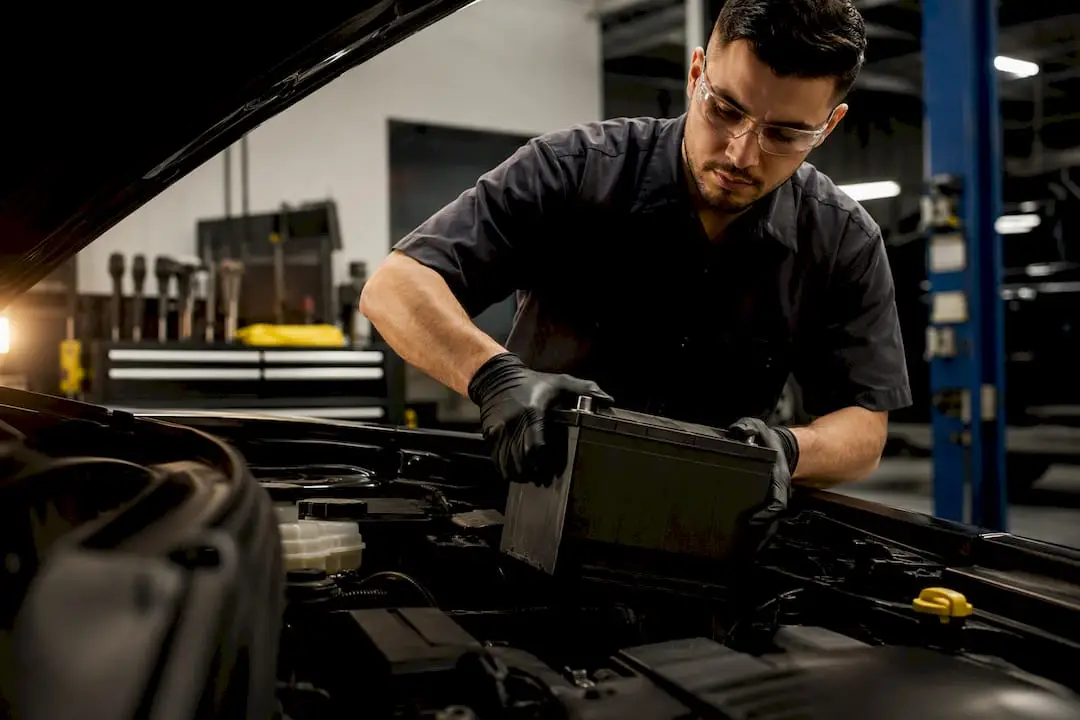
A replacement car battery typically runs between $45 and $250 for the part alone, with most drivers paying somewhere in the middle once installation is included, according to Kelley Blue Book. Vehicle fit, battery technology, and where you get it installed explain most of that spread. The next sections break down exactly where your money goes and how to avoid overpaying.
TL;DR:
- Most replacement car batteries cost between $45 and $250, with the average around $156, depending on vehicle type and installation fees.
- AGM batteries, required for many newer vehicles, can be 40% to 100% more expensive than flooded batteries, especially for stop/start systems.
- Larger batteries for trucks and SUVs and higher CCA ratings significantly increase the price, often adding hundreds of dollars.
- Proper installation, including battery resets and system checks, is crucial, as DIY or cheap options may lead to costly issues later.
- A full-replacement warranty and checking the manufacturing date can save money by preventing premature failures and mismatched parts.
Table of Contents
- Price ranges explained: low, average, and high cost examples
- What changes the price: five key cost drivers
- Installation options: DIY, auto-parts stores, mobile service, and repair shops, costs and trade-offs
- Warranty, date codes, and buying tips that reduce total cost
- Technical notes: BMS resets, vehicle compatibility, and maintenance that affect longevity
- Why a professional test matters, Kwik Kar’s diagnostic value
- Author perspective: what we see most often and practical expectations
- Local service option: battery testing and replacement in Richardson
- Sources
- FAQ
Price ranges explained: low, average, and high cost examples
Not every battery costs the same, and the gap between the cheapest option and the most expensive one can be several hundred dollars depending on your vehicle and where you shop.
At the low end, basic flooded lead-acid batteries for older sedans and compact cars sit near the bottom of the $45 to $250 range that Kelley Blue Book tracks. These work fine for simpler electrical systems without stop/start technology, and they’re often the right call if you’re keeping an aging vehicle on a tight budget.
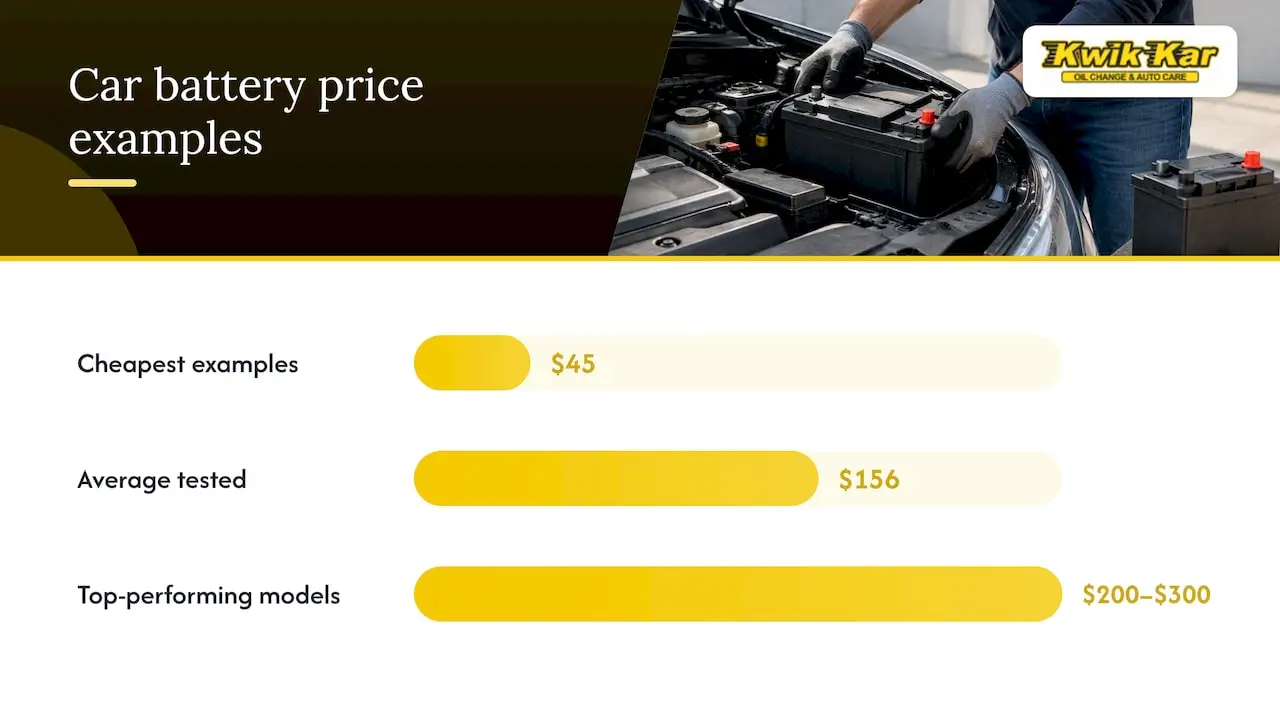
The middle of the market is where most drivers land. A mid-grade battery plus a modest installation fee, or a free install thrown in by the retailer generally puts your total in a comfortable middle range. Consumer Reports found the average tested battery price hovered around $156 in recent years, with top-performing models often landing between $200 and $300.
Costs jump at the high end for a few predictable reasons:
- AGM batteries, required by many newer vehicles with stop/start systems, cost noticeably more than flooded batteries.
- Larger truck and SUV batteries need more lead and material, raising the part price.
- Performance and luxury vehicles sometimes specify batteries built for higher electrical loads, pushing costs toward the top of the range.
- Vehicle-specific total estimates, including labor, can run into several hundred dollars for certain makes and models, per Kelley Blue Book.
Dealership pricing tends to sit above independent shops for the same battery, largely because of higher shop overhead and OEM-branded parts. An independent shop or parts retailer carrying a comparable battery often gets you the same performance for less.
What changes the price: five key cost drivers
Two batteries that look similar on a shelf can carry very different price tags. Here’s what actually moves the number on your invoice.
- Battery group size: Larger group sizes, common in trucks and SUVs, require more lead and materials, which raises the base cost.
- Battery technology: AGM batteries typically cost 40% to 100% more than conventional flooded batteries, and many vehicles with stop/start systems require AGM specifically, according to Consumer Reports.
- Cold cranking amps and reserve capacity: A battery rated for higher CCA or longer reserve capacity costs more because it uses denser plate material designed to deliver more power on demand.
- Installation difficulty: Batteries mounted under a seat, in a trunk, or buried behind engine components take longer to access, and that extra labor time shows up in the bill.
- Extra fees: Core charges, recycling fees, and regional labor rates can add a noticeable amount to the final total, even when the battery itself is reasonably priced.
AGM batteries run 40% to 100% more than flooded batteries, per Consumer Reports, and that premium reflects the more demanding job an AGM battery does in vehicles with frequent stop/start cycling.
Some vehicles also require a Battery Management System reset after replacement, which adds a diagnostic step and, at a shop, a small labor charge. Skipping that step on a car that needs it can lead to charging problems down the road.
Installation options: DIY, auto-parts stores, mobile service, and repair shops, costs and trade-offs
Where you get your battery installed matters almost as much as which battery you buy. Each path has a different mix of cost, convenience, and risk.
- DIY installation costs you nothing beyond the battery itself, but you take on the risk of incorrect terminal connections, skipped BMS resets on newer vehicles, and no professional check of the charging system. Our guide to removing a car battery safely walks through the process if you go this route.
- Auto-parts store installation is often free or low-cost with purchase, which makes it appealing for straightforward jobs. The limits show up on hard-to-reach batteries, vehicles needing a BMS reset, or cars with underlying charging issues the counter staff won’t diagnose.
- Mobile battery service brings a technician to your driveway or office, often including a diagnostic printout and on-site disposal, according to AAA. You pay for the convenience, and prices vary by provider and vehicle complexity.
- Repair shop installation costs more in labor but includes a proper charging system check, alternator test, and parasitic draw check, catching problems a simple swap would miss.
Pro Tip: Get your battery and charging system tested before you pay for a replacement. Roughly a quarter of “dead battery” complaints trace back to a failing alternator or a parasitic electrical drain, not the battery itself.
A professional diagnostic first can save you from replacing a battery that was never the actual problem, according to reporting on battery testing value.
Warranty, date codes, and buying tips that reduce total cost
The purchase price is only part of what you’ll pay over a battery’s life. A few smart checks at the counter can save you money later.
- Warranty length matters more than the sticker price. A full-replacement warranty covers the whole cost if the battery fails within the period, while a prorated warranty only credits you a shrinking percentage over time, leaving you to pay the difference.
- Check the manufacturing date code before buying. Batteries can sit in storage for months, quietly losing service life before they’re even installed, a caution echoed in reporting on battery shelf life.
- Match the original specification unless you have a reason to upgrade. Sticking with AGM if your car came with AGM, or flooded if that’s the original spec, avoids charging system mismatches.
- Confirm fitment details, including group size, terminal orientation, and mounting style, before you leave the counter or schedule an install.
- Ask for a fresh-stock battery and any available recycling credit when you turn in your old battery, since many retailers apply a core charge that’s refunded on return.
Our guide on choosing the right car battery covers group sizes and terminal layouts in more detail if you’re unsure what your vehicle needs.
Technical notes: BMS resets, vehicle compatibility, and maintenance that affect longevity
A few technical details separate a clean installation from one that causes problems weeks later.
Some newer vehicles require a Battery Management System reset after a new battery goes in, a step that tells the vehicle’s computer the battery’s parameters have changed. Skipping it can cause incorrect charging behavior and shorten the new battery’s life, according to AAA’s battery service overview.
Charging systems are tuned for a specific battery chemistry. Installing a flooded battery where the manufacturer specified AGM, or the reverse, can cause charging irregularities, since the alternator’s voltage output was calibrated for the original technology, per Consumer Reports.
Shelf life is another quiet risk. A battery is not “new” just because you’re buying it new: check the date code, since a battery that’s sat unsold for months has already lost some of its service window.
Simple habits extend battery life regardless of which one you buy: keep terminals clean of corrosion, avoid letting the battery sit fully discharged for long stretches, and have it tested annually once it passes the three-year mark, a schedule AAA recommends.
Why a professional test matters, Kwik Kar’s diagnostic value
Before you spend money on a new battery, it’s worth knowing whether the battery is actually the problem. Our ASE-certified technicians test battery health, alternator output, and parasitic draw together, since a weak alternator or a hidden electrical drain can mimic a dying battery and lead drivers to replace a part that was never at fault.
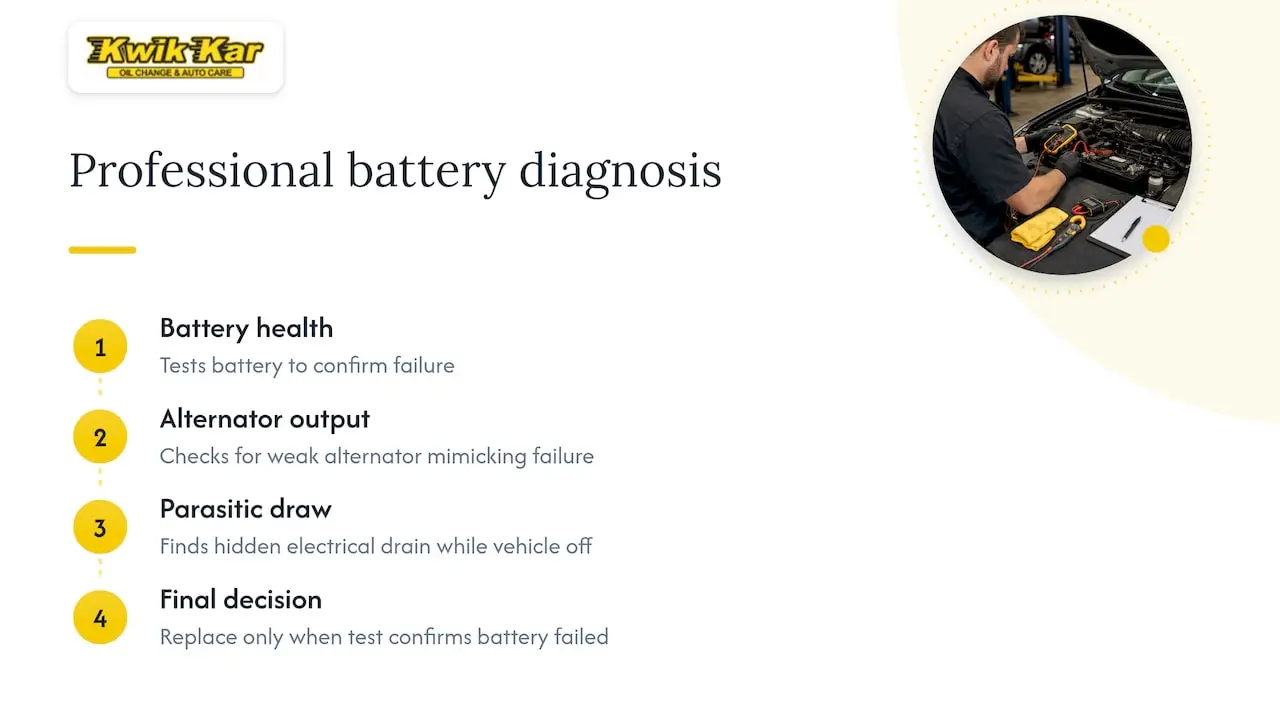
Kwik Kar Oil Change & Auto Care is recognized by CARFAX and RepairPal, and we offer discounts for military personnel and first responders. We test first, and recommend replacement only when the test confirms the battery itself has failed.
Author perspective: what we see most often and practical expectations
We see this pattern constantly: a driver buys the cheapest battery on the shelf, it fails again in eighteen months, and they end up paying for two batteries instead of one good one with a solid warranty. A quality battery backed by a full-replacement warranty almost always costs less over time than the bargain option replaced twice.
Warranty terms and honest diagnostics should guide your purchase more than the lowest number on the price tag. Test the battery and the charging system before you replace anything: it’s the one step that reliably prevents wasted money.
— Kwik Kar
Local service option: battery testing and replacement in Richardson
If you’re in Richardson and want a straight answer instead of a guess, our Battery Testing & Replacement service checks the battery, alternator, and charging system before we recommend anything. That test alone can save you from paying for a battery you didn’t need.

Every replacement comes backed by a warranty, and discounts may be available for military personnel and first responders. Ask about current coupons and discounts when you book. Schedule a battery test and replacement with our ASE-certified team, or check out our full list of services if something else is also on your mind.
Sources
Pricing and technical details in this article draw from Consumer Reports’ battery buying guide, Kelley Blue Book’s replacement cost estimates, and AAA’s guidance on battery lifespan. For a second opinion on what a diagnostic check should reveal before you buy, see this battery health check overview.
- Kelley Blue Book — Car Battery Replacement Prices & Cost Estimates
- AAA — how long do car batteries last
- Consumer Reports — why have car batteries become so expensive
- AAA — car battery replacement service quote
FAQ
How much is a car battery on average?
Most replacement batteries cost between $45 and $250 for the part, with the average tested battery landing around $156, according to Kelley Blue Book and Consumer Reports. Installation and any extra fees add to that total depending on where you go.
When should I replace my car battery?
Most batteries last between three and five years, and it’s worth having yours tested annually once it passes the three-year mark, per AAA. Slow cranking, dim headlights, or a battery warning light are signs it’s time for a test, which our guide on failing battery symptoms covers in detail.
Why do AGM batteries cost more than regular batteries?
AGM batteries typically cost 40% to 100% more than flooded batteries because they’re built to handle frequent discharge and recharge cycles, which is common in vehicles with stop/start technology, according to Consumer Reports. Many newer vehicles require AGM specifically, so swapping in a flooded battery isn’t a safe way to save money.
Is it worth paying for professional battery installation?
Professional installation costs more in labor but includes a check of your alternator and charging system, which can catch a problem a simple swap would miss. If your vehicle requires a Battery Management System reset, skipping that step during a DIY or free-install job can lead to charging issues later, per AAA.
What does Kwik Kar charge for a battery replacement?
Kwik Kar’s Battery Testing & Replacement pricing is available on request through our battery service page, where we test the battery and charging system before recommending replacement. Every replacement includes a 24-month warranty, along with discounts for military personnel and first responders.