Control Arm Bushing Symptoms: What You’ll Hear and Feel
Worn control arm bushings usually announce themselves with a clunk or thunk over bumps, steering that feels loose or wanders, a vehicle that drifts under braking, and tires that wear unevenly. The rubber has gone soft, cracked or torn, so the arm moves where it should be held firm. A technician needs to inspect the suspension to confirm it, because ball joints, tie rods and sway bar links can sound almost identical.
This guide explains each symptom, how bushings differ from other worn parts, what repair typically costs, and when to stop driving. It is written for drivers around Richardson, Plano, Garland, North Dallas and Addison, where rough pavement, construction zones and summer heat all take a toll on rubber.
TL;DR
- The classic signs are clunking over bumps, loose or wandering steering, pulling during braking and uneven tire wear.
- Bushings, ball joints and tie rods cause overlapping noises, so a hands-on inspection is the only reliable way to tell them apart.
- Replacement averages around $895 per control arm according to RepairPal figures, but the real number depends on your vehicle and what has failed.
- Stop driving and have the vehicle towed if the wheel looks off-center, you hear metal-on-metal knocking, or the car shifts direction unpredictably when you brake.
- Kwik Kar Richardson can inspect your suspension and explain what it finds. Call (972) 644-1851.
Table of Contents
- What a control arm bushing does
- Control arm bushing symptoms to watch for
- Bushing, ball joint or tie rod: how the symptoms differ
- Can you drive with bad control arm bushings?
- What control arm replacement costs
- How a suspension inspection works
- Perspective: what we see at Kwik Kar Richardson
- Steering and suspension service in Richardson
- Making bushings last
- FAQ
- Schedule a suspension inspection
- Sources
What a control arm bushing does
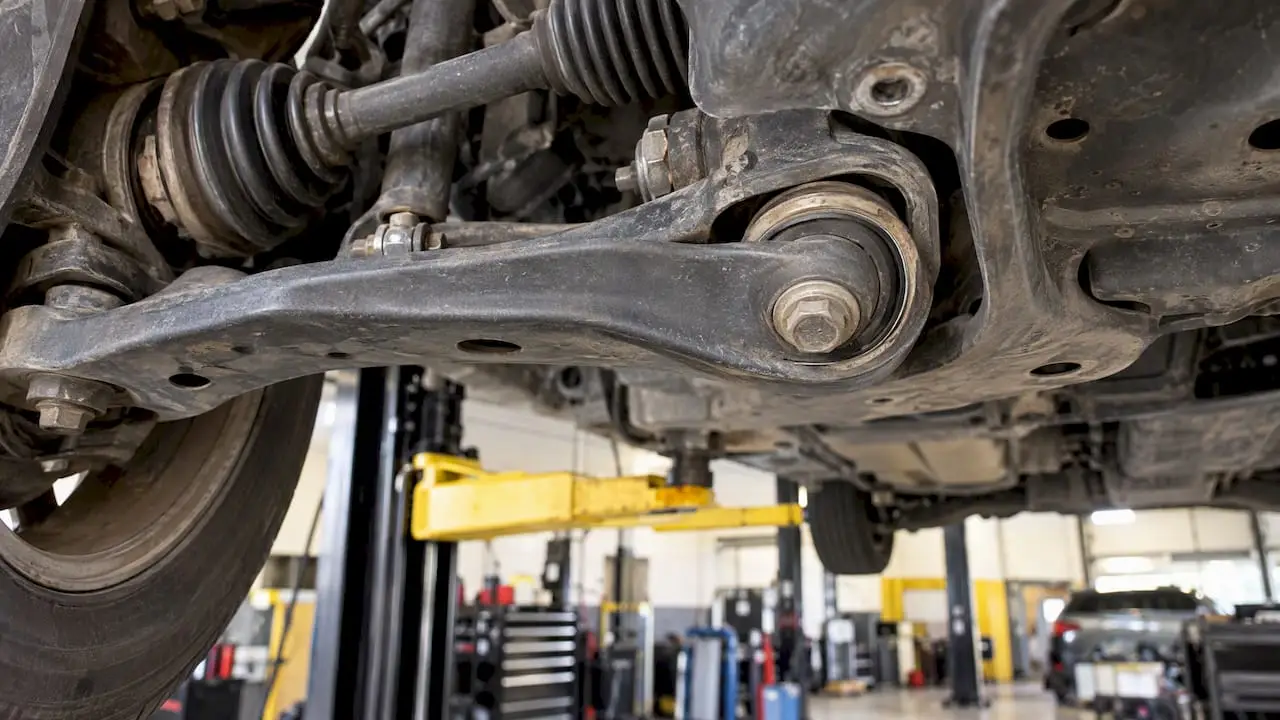
A control arm connects your wheel assembly to the vehicle’s frame or subframe. It pivots up and down as the wheel follows the road. The bushing is the rubber (or sometimes polyurethane) sleeve pressed into the end of the arm where it pivots. It absorbs vibration, quiets road noise and keeps the arm positioned precisely so your wheel stays aligned.
Think of it as the cartilage in a joint. It works silently for years, then its wear shows up as noise, looseness and odd tire wear. Because it is the part that holds geometry steady, a worn bushing lets the wheel shift slightly under load, and that shifting is what you feel.
Most vehicles have lower control arms, and many also have upper arms. The exact layout depends on the suspension design: some vehicles use a strut with only a lower arm, others use double-wishbone arrangements with both. Your owner’s manual or a technician can tell you what your vehicle has.
Control arm bushing symptoms to watch for
Bushings seldom fail overnight. The early signs are subtle, and the fluid-quiet failure of the rubber often goes unnoticed until another symptom piles on.
Clunking or thunking over bumps
The most common complaint is a dull clunk or thunk when you hit a pothole, a speed bump or a driveway apron. Worn or damaged bushings can cause clunks and thunks that mimic other suspension problems, which is why diagnosis involves checking the suspension in both loaded and unloaded positions. If you notice the sound mostly at low speeds on rough roads, our guide on what a clunk over bumps means walks through the likely causes.
The noise can also appear when you turn into a parking space or brake firmly, because those moments push the arm forward, backward or sideways against a bushing that no longer holds it.
Loose or wandering steering
When the bushing gives, the wheel can move a little on its own. You may feel the car drift within the lane, need constant small corrections on I-75 or the George Bush Turnpike, or sense a vague, delayed response when you turn the wheel. Worn control arm bushings are linked to loose or wandering steering, unstable braking and uneven tire wear as well as clunking on rough roads.
Pulling or shifting under braking
Braking pushes weight forward and loads the front control arms. If a bushing is torn, the arm can shift, changing the wheel’s angle for a moment. The result is a car that pulls to one side or feels unsettled when you brake hard. This is different from a steady pull caused by tire pressure or alignment. If your vehicle pulls consistently, see why a car pulls to the right for the broader list of causes.
Uneven tire wear
A bushing that lets the wheel tilt or toe in and out wears tires along one edge or in a feathered pattern. Camber-type wear on the inside or outside shoulder is a common clue. Rotating tires will not fix it, and a fresh alignment will not hold for long if a worn bushing is allowing the setting to drift. If your tires already show an odd pattern, our tire warning signs page shows what to look for.
Vibration, shimmy and a rough ride
A failing arm or bushing can add vibration to the steering wheel, floor or seat, most noticeably at highway speed. Vibration has many possible causes, including tire balance, brake rotors and CV joints, so treat it as a clue rather than a verdict. If it shows up mainly when braking, steering wheel shake during braking is worth reading first.
What you may see
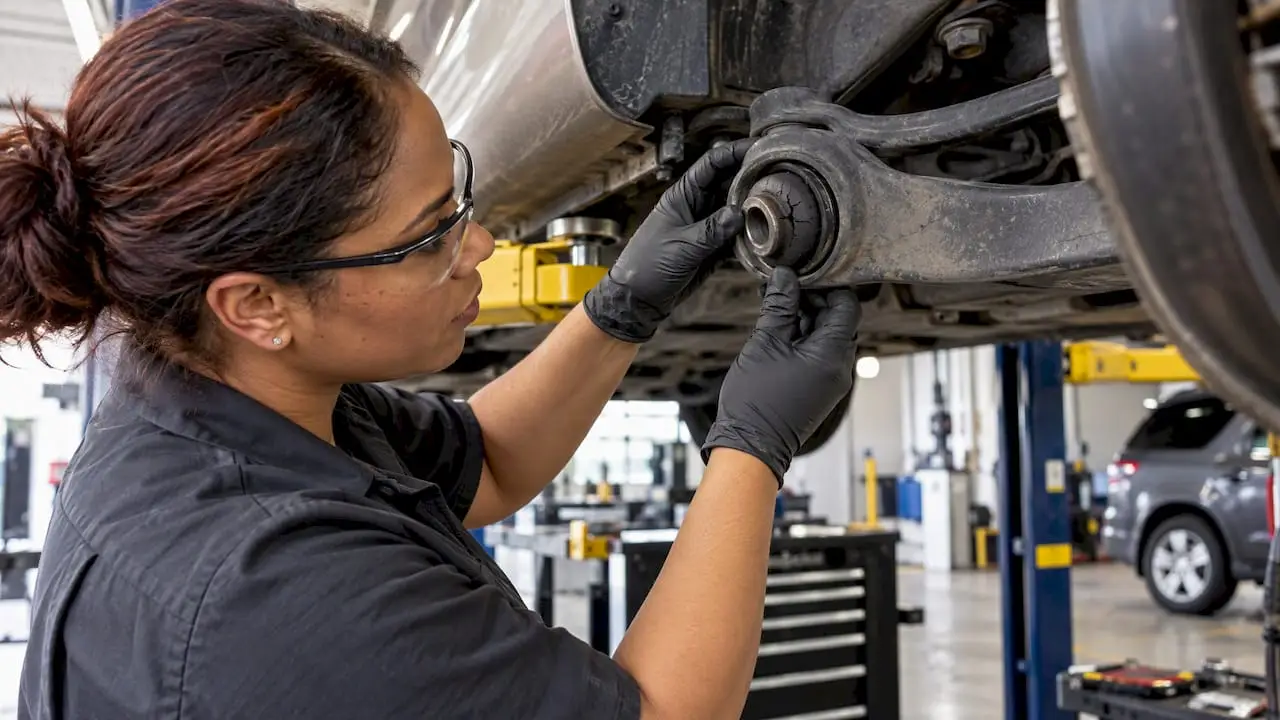
A visual check can show cracked, split or bulging rubber, fluid leaking from a hydraulic bushing, or the bushing sleeve shifted out of position. The control arm may also appear to sit closer to the rotor on one side. These are things a technician looks for with the vehicle on a lift, because most of the bushing is hidden from view.
Bushing, ball joint or tie rod: how the symptoms differ
The overlap between parts is the real challenge. A general pattern holds in diagnostic practice: ball joints tend to cause vertical looseness and loaded clunks, tie rods create steering play and toe-related wander, and control arms bring bushing-driven thumps and braking drift. It is a useful starting point, not a replacement for inspection.
| Part | What you typically notice | When it shows up most |
|---|---|---|
| Control arm bushing | Dull thunk, drift under braking, uneven tire wear, vague steering | Bumps, braking, accelerating |
| Ball joint | Clunking, steering vibration, drifting either direction, uneven tire wear | Bumps, turning, low-speed maneuvers |
| Tie rod or tie rod end | Clunking when turning, play in the steering wheel, pulling, uneven tire wear | Turning, steering input, straight-ahead driving |
| Shock or strut | Bouncing, nose dive, cupped tires | After bumps, braking |
| Sway bar link | Rattle or light clunk over small bumps | Low speed, uneven pavement |
Bad ball joint symptoms
A worn ball joint commonly causes clunking noises, excess vibration in the steering, drifting in either direction and uneven tire wear. A completely broken ball joint can cause loss of steering control, which is why a clunk that grows louder deserves prompt attention. Ball joint failure is more likely to be sudden than bushing wear, so the margin for waiting is thinner.
Bad tie rod symptoms
A worn tie rod usually shows up in the steering. Expect clunking when you turn, play in the steering wheel, uneven tire wear and pulling to one side. In extreme cases the wheel can break free from the steering assembly, and the driver can no longer steer.
Inner and outer tie rods feel somewhat different. An outer tie rod end tends to produce a knock or looseness you notice when turning at low speed. A worn inner tie rod often shows as a shimmy or play felt in the steering wheel that can be harder to pin down. Both need to be checked with the wheel off the ground.
Bad control arm symptoms (the whole arm, not only the bushing)
The arm itself can bend from a curb strike or pothole, and the ball joint built into some arms can wear out. Typical signs include knocking or clunking and veering to one side over a bump or during hard acceleration. A failing arm can also make steering feel unstable or loose.
Which control arm goes bad first?
There is no single answer. Lower arms generally carry more load and more of the road’s impact, so they tend to be a common wear point, but the order depends on the suspension design, vehicle weight, road conditions and the specific bushing. A technician checks every arm and bushing on the axle rather than assuming one.
Can you drive with bad control arm bushings?
Sometimes for a short time, but it is not a risk to carry for long. Worn bushings reduce your ability to keep steering control and allow excess movement that damages tires, steering and other suspension parts. There is no safe mileage countdown. What matters is the physical condition of the part.
Have the vehicle inspected soon if you notice an occasional clunk, mild looseness or early tire wear. Stop driving and arrange a tow if you notice any of these:
- Severe bushing separation, where the rubber has torn apart or the sleeve has shifted.
- A wheel that looks tilted or off-center.
- Metal-on-metal knocking.
- The vehicle shifts direction unpredictably when you brake.
Those are the conditions the same source describes as unsafe to continue driving. A fully broken arm can free the wheel and cause loss of control, and that is the outcome inspection exists to prevent.
Recalls are worth checking
Some control arm and ball joint problems come from manufacturing or corrosion rather than ordinary wear. NHTSA records show, for example, that certain 2024-2025 Ford Bronco and 2024 Ranger front upper control arm ball joints may have had fasteners not installed or tightened properly, which could lead to detachment and loss of steering control. A recall for 2007-2014 Mazda CX-9 vehicles addressed corrosion and possible separation of a lower-arm ball joint after exposure to salted winter roads. Enter your VIN on NHTSA’s recall lookup to see whether your vehicle has an open recall, which is repaired at no cost by the manufacturer’s dealer.
What control arm replacement costs
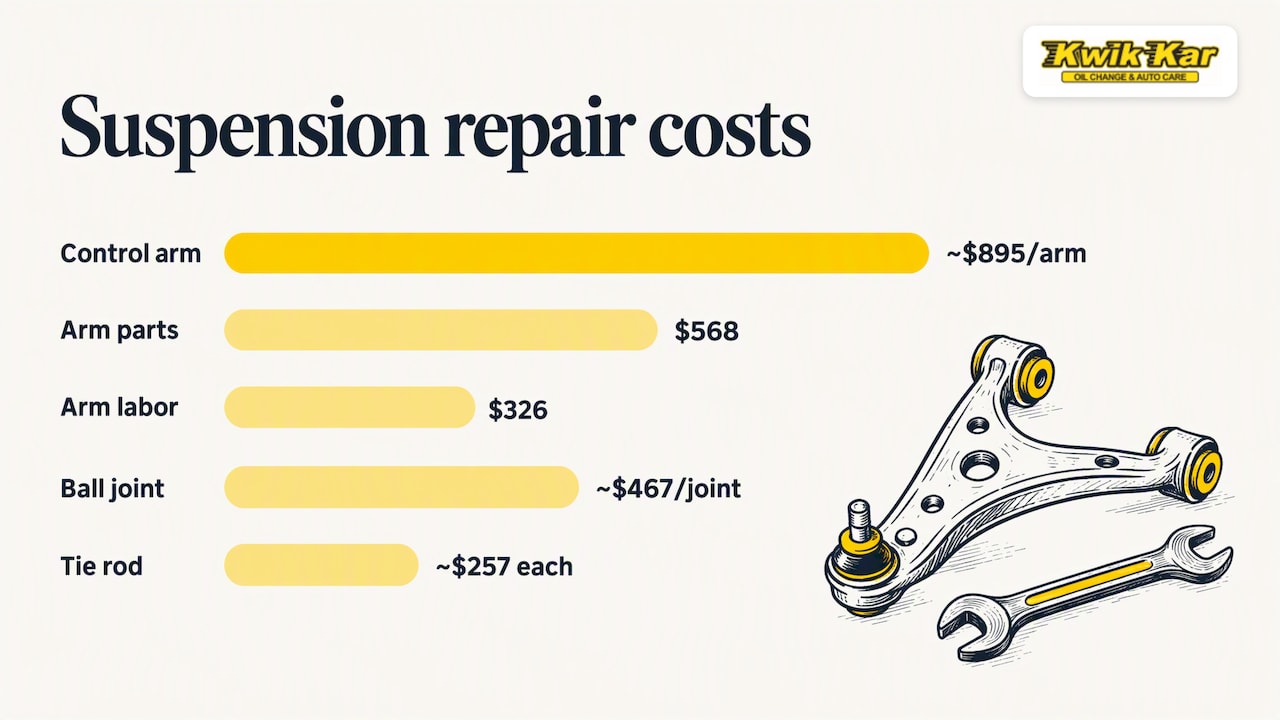
Cost is the question most drivers ask first. According to RepairPal figures reported by ConsumerAffairs, control arm replacement averages around $895 per arm, with parts averaging $568 and labor $326. The same page puts a suspension ball joint repair near $467 per joint and a tie rod at around $257 each, parts and labor.
Those are national averages, not a quote. What moves your price:
- Vehicle design. Some trucks and SUVs use arms that are easy to access; others require removing subframe parts.
- Bushing or full arm. On many vehicles the bushing is pressed into the arm and the manufacturer sells the arm as one assembly. Replacing the complete arm is often technically correct because the components work as one unit.
- Alignment. Any control arm work changes suspension geometry, so an alignment normally follows.
- Other worn parts. Ball joints, tie rods or struts found during inspection add to the total.
We do not publish set prices for suspension work, because the cost depends on what the inspection finds. We give you an estimate for your vehicle before the work begins.
How a suspension inspection works
A good diagnosis does not rely on noise alone. Here is the general sequence a technician follows.
- Listen to your description. When does it happen: cold start, braking, turning, certain roads?
- Road test. A short drive often reproduces the sound or the pull.
- Lift the vehicle. With the weight off the wheels, the technician checks for movement in the wheel, tie rods and ball joints.
- Inspect each bushing. Cracks, tears, shifted sleeves and movement under a pry bar are the signs.
- Check loaded movement. Some play only appears when the suspension carries weight, so the inspection includes loaded and unloaded views.
- Review tire wear and alignment readings. Patterns in the tread corroborate what the hands-on check found.
- Explain the findings. You should see which parts are worn, which are borderline and which are fine.
Pro tip: write down when the noise happens before your visit. “Clunk when braking into a turn at about 15 mph” gives a technician more to work with than “it sounds weird.”
Perspective: what we see at Kwik Kar Richardson
Most suspension complaints we hear start the same way: a driver mentions a faint clunk, then months later the tires are wearing on one edge and the steering has gone vague. The bushing has been quietly failing for a long time. Our advice is to treat early noise as information, not an emergency, and to get it looked at before it spreads to tires and other parts.
We also avoid assuming the control arm is the culprit. Ball joints, tie rods, sway bar links and struts can all produce the same sound, and replacing the wrong part costs you money without solving the problem. Our ASE-certified technicians inspect the front end and show you what they find, and we recommend repairs in proportion to what is actually worn, not a longer list. If a part is still serviceable, we say so.
— Kwik Kar
Steering and suspension service in Richardson
If you recognize these symptoms, we can inspect your front end and explain the options. Our steering and suspension repair service covers control arms, bushings, ball joints, tie rods and related parts, and we pair repairs with a wheel alignment when your vehicle needs one.
Qualifying repairs may be covered by our 24-month/24,000-mile limited warranty, and qualifying suspension repairs may carry our Lifetime Suspension Warranty. Not every service or inspection is covered, so ask your service advisor which warranty terms apply to your repair. We offer special discounts for military members and first responders; ask when you call.
You can also read our overview of common suspension problems, or check whether worn shock absorbers or a bad CV joint better matches what you feel.
Making bushings last
You cannot stop rubber from aging, but you can slow the damage.
- Slow down for potholes and rough railroad crossings when you can do so safely.
- Keep tires inflated to the pressure on the driver’s door placard; see our tire pressure tips.
- Get an alignment check after a hard curb or pothole strike.
- Avoid petroleum-based spray on rubber bushings, since oils can degrade them.
- Follow your manufacturer’s maintenance schedule, which may include periodic suspension inspection. Intervals vary by vehicle, so use your owner’s manual.
FAQ
Can bad control arm bushings cause a clunking noise over bumps?
Yes. A worn bushing lets the arm move more than it should, and the movement produces a dull clunk or thunk when the suspension compresses. Ball joints, sway bar links and struts can make the same sound, so the source needs to be confirmed with an inspection.
How much does it cost to fix control arm bushings?
RepairPal figures put a full control arm replacement around $895 per arm, including parts and labor, though your price depends on your vehicle and whether the bushing can be replaced separately. Call us at (972) 644-1851 for an estimate on your vehicle after inspection.
What happens if I don’t fix a bad control arm bushing?
The looseness gets worse and begins to wear tires, steering parts and other suspension components. In severe cases the wheel can shift or the vehicle can behave unpredictably under braking. Early repair is usually the less expensive path.
How do I know if it is a bushing or a ball joint?
You usually cannot tell by sound alone. Ball joints often cause clunking and vertical looseness at the wheel, while bushings tend to cause thumps and braking drift. A technician checks movement with the wheel off the ground to separate the two.
Schedule a suspension inspection
If your car clunks over bumps, drifts when you brake or is wearing tires unevenly, we are glad to take a look. Call Kwik Kar Richardson at (972) 644-1851 or schedule an appointment online, and visit Kwik Kar Oil Change & Auto Care to see our full list of services.
Sources
- Bushing Basics, MOTOR
- How To Tell If A Bushing Is Failing, Subaru Parts Plus
- Ball joint vs. tie rod vs. control arm diagnosis, Carsymp
- Driving a car with worn steering and suspension parts, Delphi
- Bad Control Arm Symptoms, AutoZone
- How Long Can You Drive With Bad Control Arm Bushings? GSW Auto Parts
- NHTSA recall 24V-770, Ford Bronco and Ranger
- NHTSA recall 15V-451, Mazda CX-9
- Car Suspension Repair Cost guide, ConsumerAffairs
- Control arms: design, wear symptoms and signs of failure, MEYLE