Drilled vs. Slotted Rotors: Which Is Right for Your Car?
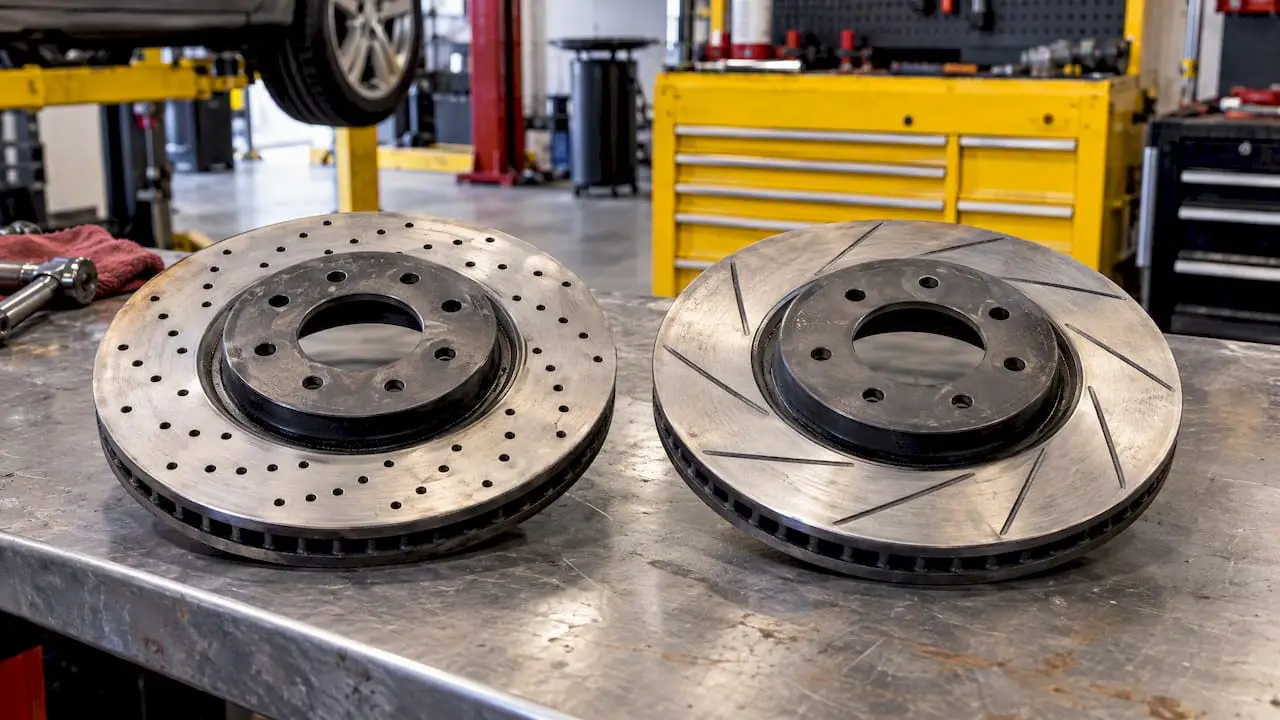
For most daily driving in Richardson, neither one. Quality solid or standard vented rotors, matched with the right pads, are the dependable and cost-effective choice. Drilled rotors have holes that vent gas and water and look aggressive. Slotted rotors have shallow grooves that sweep away dust and gas and hold up better under heavy heat, which matters for towing, hard driving and track use. Here is how they differ, where each makes sense, and what to ask before you pay for either.
TL;DR
- Drilled rotors vent gas and water through holes, but they are more prone to cracking if the holes are poorly made or the rotor is pushed hard.
- Slotted rotors use grooves to improve initial pad bite and clear gas and debris. They are generally more durable than drilled rotors in hard use.
- Street testing has not shown a significant braking gain from cross-drilled rotors over identical blank rotors, so the benefit for commuting is small.
- Pad compound, fluid condition and correct installation usually matter more to everyday braking than the rotor pattern.
- If you tow, haul or drive aggressively, a slotted rotor can be a reasonable upgrade. Have a technician confirm what fits your vehicle.
Table of Contents
- What a Brake Rotor Actually Does
- Drilled Rotors: How They Work and Where They Fall Short
- Slotted Rotors: Grooves With a Purpose
- Drilled vs. Slotted vs. Solid Rotors Side by Side
- Do Drilled or Slotted Rotors Stop Your Car Faster?
- When Each Type Makes Sense
- What Matters More Than the Rotor Pattern
- Installation Details That Trip People Up
- Symptoms That Mean It Is Time to Have Your Rotors Checked
- Our Perspective
- Brake Service at Kwik Kar Richardson
- A Note on Inspections in Richardson
- FAQ
- Sources
What a Brake Rotor Actually Does
When you press the pedal, the pads clamp onto a spinning rotor, and friction turns your car’s motion into heat. The rotor has to absorb that heat and then release it into the air. According to Brake & Front End, how well a rotor absorbs and sheds heat determines the efficiency and capacity of the brakes.
A standard rotor is a smooth disc, usually vented, meaning two friction surfaces separated by internal vanes that pull air through. Drilling and slotting are changes made to that friction surface. If you want the full picture of how rotors and pads work as a pair, our guide on the difference between brake pads and rotors covers it.
Drilled Rotors: How They Work and Where They Fall Short
Drilled (cross-drilled) rotors have holes through the friction surface. The holes give gas and water somewhere to go, and they add edges that can improve pad bite.
What drilled rotors do well
- Vent gases released by the pads during heavy braking.
- Help shed water, which is useful in a wet climate.
- Reduce the weight of the rotor slightly.
- Look sporty behind open wheels.
The trade-offs
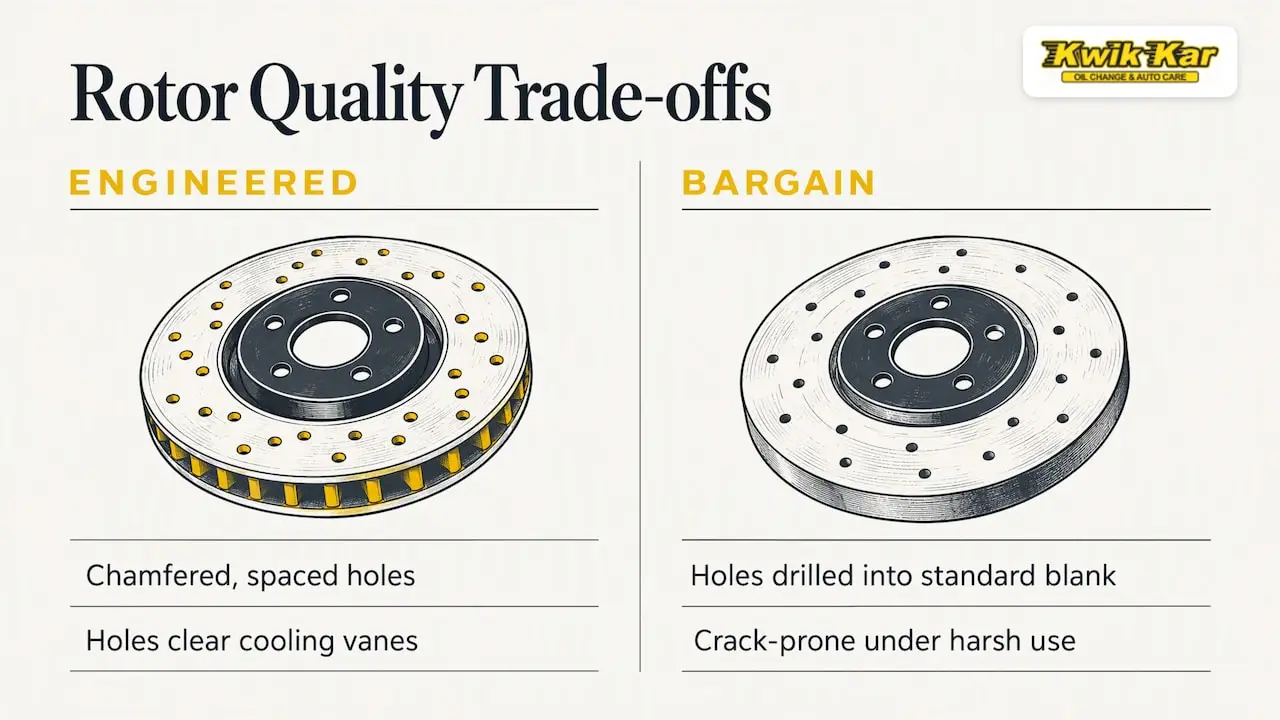
Holes remove material and create stress points. Brake & Front End reports that cross-drilled rotors are more susceptible to cracking than slotted or solid rotors when drilling creates stress risers. Good manufacturers chamfer the holes and space them so they do not intersect the internal cooling vanes. Cheaper rotors, where holes are simply drilled into a standard blank, are more likely to crack under harsh use.
That is why quality matters more with drilled rotors than with any other type. A well-engineered drilled rotor and a bargain one can look identical on a shelf.
Slotted Rotors: Grooves With a Purpose
Slotted rotors have shallow channels cut across the friction surface. Per Brake & Front End, the grooves give the pad leading edges for better initial bite and provide a path for gases released by the pads in high heat, which helps keep braking consistent. Slots are typically radiused during manufacturing to reduce stress concentrations.
What slotted rotors do well
- Keep the pad surface refreshed by clearing dust and glaze.
- Maintain consistent bite when brakes get very hot.
- Avoid the hole-related cracking risk of drilled designs.
The trade-offs
- The slots can wear pads faster, because the edges act like a light scraper.
- Some drivers notice added brake noise or a faint rhythmic sound.
- They usually cost more than standard rotors.
There is also the hybrid: rotors that are both drilled and slotted. They combine the look and the trade-offs of both, so the same quality questions apply.
Drilled vs. Slotted vs. Solid Rotors Side by Side
| Feature | Solid or standard vented | Slotted | Drilled |
|---|---|---|---|
| Gas and debris clearing | Limited | Good | Good |
| Cracking risk in hard use | Lowest | Low | Higher, depends on build quality |
| Pad wear | Typically gentlest | Can be faster | Can be faster |
| Noise | Typically quietest | Can add some | Can add some |
| Best fit | Commuting, family driving, most trucks and SUVs | Towing, heavy loads, spirited driving | Appearance, wet-weather venting, light performance use |
| Cost | Lowest | Mid to higher | Mid to higher |
The table describes general tendencies. Individual rotors vary by manufacturer, so treat it as a starting point and not a guarantee.
Do Drilled or Slotted Rotors Stop Your Car Faster?
Not meaningfully on the street. A synopsis of SAE technical paper 2006-01-0691 reports that cross-drilled rotors did not significantly increase overall braking performance versus identical blank rotors on street-driven performance sedans and sports cars with semi-metallic pads. The tested benefits showed up mainly as pedal-feel stability at very high temperatures, which is a track concern more than a commuting one.
In other words, the rotor pattern does not add stopping power. Your tires, your pads and the condition of the whole system set your stopping distance. A marketing claim that holes or slots guarantee better grip deserves skepticism.
When Each Type Makes Sense
Daily commuting on US-75, George Bush Turnpike or Central Expressway
Stop-and-go traffic produces moderate, repeated braking, not the sustained extreme heat that drilled or slotted rotors are designed for. A quality standard rotor and a good pad do the job. The AAA guidance on brake service notes that replacing worn parts on time protects the rest of the system, and that waiting can make repairs more costly.
Pad choice matters here. AAA notes that ceramic pads produce light, fine dust and are gentler on rotors, which suits quiet, low-dust commuting. Your vehicle manufacturer’s recommendation should still guide the final choice.
Towing and heavy loads
If you pull a trailer or carry heavy loads, brakes work harder and run hotter. Slotted rotors are often the sensible upgrade in that situation because they handle heat well without the cracking concerns of drilled designs. Many trucks and SUVs already ship with brakes sized for their rated towing capacity, so check your owner’s manual first.
Spirited or track driving
This is where the patterns earn their keep. Gas from the pads can form a thin layer between pad and rotor at very high temperatures, and the grooves or holes give it an exit. Even here, slotted designs generally hold up better than cheaply made drilled ones.
Wet weather and looks
Drilled rotors do shed water, and many drivers simply like how they look. That is a fair reason to choose them, as long as you buy a well-made rotor and accept the trade-offs.
What Matters More Than the Rotor Pattern
A rotor pattern is one variable out of many. These tend to have more impact on how your brakes feel and how long they last.
- Pad compound. Ceramic, semi-metallic and organic pads each trade off noise, dust, bite and rotor wear. Match the compound to how you drive.
- Brake fluid condition. Fluid absorbs moisture over time, which lowers its boiling point and can give a spongy pedal. Our guides on how often to flush brake fluid and why brake fluid DOT rating matters explain what to look for. Your manufacturer’s schedule comes first.
- Pad wear. AAA says most pads last between 25,000 and 70,000 miles, depending on driving habits, and that worn pads can damage rotors. Uneven wear is a clue to a sticking caliper or other problem. See our list of warning signs that pads need replacing.
- Correct installation and bedding. More on that below.
Installation Details That Trip People Up
Slotted and drilled rotors are often more finicky to install than plain ones.
Direction matters
Many high-performance slotted or drilled-and-slotted rotors are directional, with separate left and right versions. Baer’s installation guide explains that directionally slotted or vented rotors must spin the correct way for proper airflow and cooling. Installed backward, they can cool poorly and fatigue early, which may show up as a shaking or pulsing feel when braking. Look for an L or R marking or the vane direction before mounting.
Bed in new rotors
The same guide describes a seasoning process that burns off residual machining oils and sets up a compatible wear pattern between rotor and pad. Skipping it can cause uneven material transfer to the rotor, which hurts smoothness and causes vibration. Follow the instructions that come with your specific pads and rotors.
Quality is not optional
A rotor that cracks from poorly placed holes is a safety concern, not just a wasted purchase. Choose rotors from reputable manufacturers who engineer the pattern, and have a trained technician inspect them at service intervals.
Symptoms That Mean It Is Time to Have Your Rotors Checked
Whatever type you drive, these signs call for a professional look:
- A shake in the steering wheel or pulsing in the pedal when braking. AAA lists warped rotors among the causes of a shaking steering wheel when you press the brakes. Other causes exist, including tires and suspension, so diagnosis matters.
- Grinding or scraping noises.
- Visible grooves, deep scoring or a blue or dark discolored surface.
- A longer pedal travel or reduced stopping confidence.
- Visible cracks around holes or slots. Stop driving the vehicle if you see them and have it inspected promptly.
Not every noise means an emergency. A technician can measure rotor thickness and runout and tell you what is worn, what is borderline and what can wait. Our walkthrough on how to inspect brake rotors for safety and warping signs shows what that inspection looks at.
Our Perspective
We see plenty of brake jobs, and the pattern on the rotor is rarely what decides whether a customer is happy six months later. What matters is that the pads, rotors and fluid suit the vehicle and the way it is driven.
For a commuter or a family car, we generally steer people toward quality standard rotors and a pad compound that fits their priorities, whether that is quiet, low dust or strong bite. We do not believe in over-engineering a daily driver with racing-style parts. They can add noise, pad wear and maintenance complexity without a payoff you will feel in traffic.
If you tow, haul or want a performance feel, we will talk through options honestly, including which parts are available and appropriate for your vehicle. We would rather you spend on a correct inspection, fresh fluid and well-matched pads than on rotors that look impressive.
Our ASE-certified technicians can show you what they find, and we explain the difference between what needs attention now and what can be monitored.
— Kwik Kar
Brake Service at Kwik Kar Richardson
If your brakes are noisy, pulsing or due for inspection, Kwik Kar Oil Change & Auto Care handles brake service for drivers in Richardson, Plano, Garland, North Dallas and Addison. Our brake repair and service includes inspecting pads, rotors and fluid, and we also offer fluid exchange services. A 24-month/24,000-mile limited warranty applies to qualifying repairs only, and it does not cover every service or inspection. Ask us what applies to your repair. You can also check the current brake coupon before you book.
We offer discounts for military and first responders. Call us at (972) 644-1851 for details.
A Note on Inspections in Richardson
Brake questions sometimes come up around state inspections, so here is where the rules stand. According to the Texas Department of Motor Vehicles, House Bill 3297 ended the vehicle safety inspection requirement for non-commercial vehicles beginning January 1, 2025. Emissions inspections are still required before registration in 17 counties, including Dallas and Collin, which cover Richardson and nearby cities. Commercial vehicle safety inspections continue in Texas.
The end of the safety inspection does not change how important brakes are. With no annual check, a periodic brake inspection is the easiest way to catch wear before it becomes expensive.
FAQ
Are drilled rotors better than slotted rotors?
Not across the board. Drilled rotors vent gas and water well but carry a higher cracking risk, especially if poorly made. Slotted rotors tend to be more durable under heavy heat, so they are usually preferred for towing and aggressive driving.
What are the disadvantages of slotted rotors?
They can wear brake pads faster, may add some noise and typically cost more than standard rotors. For gentle commuting, those costs often outweigh the benefit.
Are drilled and slotted rotors okay for daily driving?
Yes, if they are well made and correctly installed, but most commuters do not need them. Tested on street cars, cross-drilled rotors did not significantly outperform blank rotors. Quality standard rotors and matched pads are usually the better value.
Do slotted rotors cool better?
Not by much on their own. Slots mainly clear gas and debris and keep pad bite consistent at high temperatures. The rotor’s vented design and size do most of the cooling.
Can I mix rotor types on the same vehicle?
Use matched rotors on both sides of an axle, and follow your manufacturer’s guidance. Directional rotors also need the correct left and right versions. A technician can confirm the right setup for your vehicle.
If your brakes feel off or you are weighing a rotor upgrade, contact Kwik Kar Richardson at (972) 644-1851 or schedule an appointment. We will inspect your brakes and explain what we find.
Sources
- Drilled and Slotted Rotors, Brake & Front End
- Synopsis of SAE paper 2006-01-0691
- Installation Procedures, Proper Rotor Direction, and Care, Baer
- Signs Your Brakes Need Service, AAA Via
- Ceramic vs. Semi-Metallic Brake Pads, AAA Automotive
- How to Know if Your Brakes Are Going Bad, AAA
- Why Your Steering Wheel Shakes, AAA Club Alliance
- Texas vehicle inspection changes, Texas DMV