
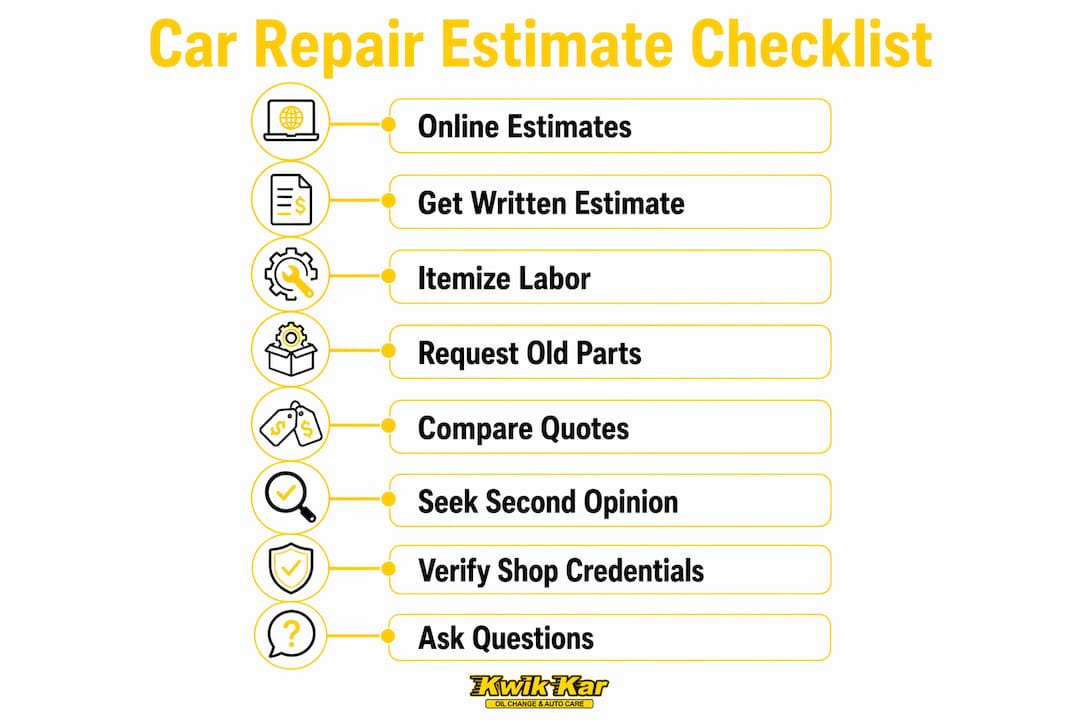
The fastest way to get an accurate car repair estimate is to demand a written, itemized estimate from the shop and cross-check it against a location-adjusted online range before you authorize a single bolt to be turned. That two-step approach protects you legally, gives you a defensible baseline, and tells you immediately whether a shop’s price is in the ballpark or a red flag.
Your three-step action checklist:
- Check an online estimator first. Enter your vehicle’s year, make, model, and ZIP code on RepairPal, Kelley Blue Book (KBB), or NAPA Auto Care to pull a location-adjusted price range. Screenshot or print the result.
- Request a written, itemized estimate from the shop. The estimate must list the complaint or diagnosis, each part with its unit price and type (new, OEM, aftermarket, or used), labor hours and hourly rate, shop fees, taxes, and warranty terms. Your VIN and odometer reading should appear on the document.
- Verify before you authorize. Ask for photos, diagnostic trouble codes (DTCs), or physical measurements as proof for any recommended replacement. Request old parts back when practical, and insist on a written supplemental-authorization policy for any work discovered after teardown.
Trust signals to look for immediately: ASE-certified technicians, a written price-honor or guarantee policy, and explicit warranty language on parts and labor.
Pro Tip: If a shop hesitates to provide a written estimate or cannot explain a line item clearly, treat that hesitation as a diagnostic code of its own.

Table of Contents
- How do online repair estimators calculate a price range?
- Which free estimator tools give you a location-adjusted range?
- What should an accurate in-person written estimate include?
- What factors drive cost differences between repair shops?
- How do you compare multiple estimates and spot red flags?
- When is a second opinion worth the effort?
- Quick answers: online estimators and shop estimates
- How Kwik Kar Oil Change & Auto Care follows this checklist
- Key Takeaways
- The estimate is a conversation, not a verdict
- Accurate estimates start with the right shop
- Useful sources
- FAQ
How do online repair estimators calculate a price range?
Online estimators do not pull a single price from thin air. They calculate a range by combining three data inputs: your vehicle’s year, make, and model (or VIN), your ZIP code, and the specific repair or maintenance item you select.
The ZIP code is the most consequential variable. Labor rates in Dallas, TX, run materially different from rates in rural Kansas, and estimators adjust for that gap by referencing localized labor-rate databases. The repair type determines which labor-time guide applies — published flat-rate manuals that specify how many hours a given job should take on a specific vehicle. Parts pricing comes from aggregated supplier catalogs, and the range widens when OEM and aftermarket options both exist for your vehicle.
That spread between the low and high figures reflects real-world variables: the parts tier you or the shop chooses, local labor-rate variance within a ZIP code, and the possibility of hidden damage that only becomes visible after teardown. Some programs go further and offer a price-honor or guarantee policy, meaning the shop commits to performing the work within the shown range. RepairPal, for example, backs its estimates with a 30-day price guarantee through its certified-shop network.
| Input variable | What it controls | Why it creates a range |
|---|---|---|
| Year / make / model or VIN | Labor-time guide selection, parts catalog match | Different trims have different labor times |
| ZIP code | Local labor-rate adjustment | Rates vary by market |
| Repair type | Flat-rate hours applied | Job complexity varies by vehicle |
| Parts category | OEM vs. aftermarket pricing | Price gap between tiers can be significant |
| Hidden damage | Not calculable online | Only visible after teardown |
Which free estimator tools give you a location-adjusted range?
Online estimators are useful baselines, not guaranteed final bills. Each of the three major free tools approaches the problem slightly differently.
RepairPal is the most granular for common mechanical repairs. Enter your ZIP, year, make, and model, select the repair, and the tool returns a low-to-high range with a breakdown of parts and labor. RepairPal’s certified-shop network adds a price-honor layer that the other tools do not offer, making its output the strongest negotiating reference for in-shop conversations.
Kelley Blue Book (KBB) integrates repair cost estimates alongside vehicle valuation data, which is useful when you are weighing whether a repair is worth more than the car’s market value. The interface is clean, and the ZIP-based adjustment is straightforward.
NAPA Auto Care ties its estimates to its network of shops, so the range reflects what NAPA-affiliated locations actually charge. That alignment can make the estimate more predictive for NAPA shops specifically, though coverage varies by region.
How to capture evidence from any estimator:
- Run the estimate on all three tools for the same repair and note where the ranges overlap.
- Screenshot each result, including the ZIP code and vehicle details visible on screen.
- Print or save the pages as PDFs to bring to the shop.
- Note the date; labor rates shift, so a screenshot from six months ago carries less weight.
What should an accurate in-person written estimate include?
A written estimate is your legal and financial protection. The FTC advises that a proper estimate identifies the condition to be repaired, the parts needed, and the anticipated labor charge — and that you should get a signed copy. Florida law goes further: under Florida Statutes 559.905, any repair expected to exceed $150 requires a written estimate with specific disclosure language. Washington State requires a written estimate for repairs over $100 and prohibits the shop from charging more than 10% above the estimate without your prior approval.
Your state may have its own threshold and rules, so check your state attorney general’s consumer protection page. Regardless of state law, demand the following on every estimate:
- Shop and customer information — shop name, address, phone number, and your contact details.
- Vehicle identification — year, make, model, VIN, odometer reading, and license plate number.
- Complaint or diagnosis — a plain-language description of the problem, not just a repair code.
- Parts list with unit prices and part type — each part listed separately, with its price and whether it is new OEM, new aftermarket, remanufactured, or used. Part numbers strengthen comparisons.
- Labor hours and hourly rate — listed separately from parts, not bundled into a single total.
- Shop fees — shop supplies and hazardous/waste disposal charges listed as separate line items, not absorbed into a vague total.
- Taxes — itemized, not hidden in the subtotal.
- Warranty terms — duration and coverage for both parts and labor, in writing.
- Diagnostic charge — stated explicitly, and whether it is refundable if you approve the repair.
- Supplemental-authorization policy — a written statement of what happens if additional damage is discovered after teardown.
A properly itemized estimate separates parts from labor so you can make true comparisons. The difference between an acceptable line item and a red flag is specificity: “Front brake pads, Wagner ThermoQuiet, aftermarket — $120” is defensible. “Miscellaneous parts — $400” is not.
Pro Tip: Ask for photographic proof or scan-tool data for any recommended replacement, and request the old part back when practical. A shop that cannot produce evidence for a failed component is asking you to take its word for a potentially expensive decision.
What factors drive cost differences between repair shops?
Two shops can quote the same repair and land $600 apart without either one being dishonest. Understanding why helps you evaluate whether a gap is reasonable or a warning sign.
Primary cost drivers:
- Labor rate and billed hours. Shops set their own hourly rates, and those rates reflect local market conditions, overhead, and technician certification levels. A shop billing 3.5 hours at $140/hr and another billing 3.0 hours at $120/hr will produce meaningfully different totals for the same job.
- OEM vs. aftermarket vs. salvage parts. OEM parts carry the manufacturer’s warranty and fit guarantee; quality aftermarket parts from brands like Bosch or Dorman cost less but vary in longevity. Salvage parts are the least expensive and carry the most uncertainty.
- Diagnostic complexity. Advanced driver-assistance systems (ADAS), EV battery diagnostics, and module programming require specialized equipment and time. A shop without the right scan tools may underquote because it cannot fully assess the job.
- Sublet work. Some repairs require machining (resurfacing rotors, for example) or specialty calibrations that a shop sends out. That sublet cost gets passed to you, and not every shop discloses it clearly upfront.
- Parts availability and shipping. A rare part for an older or imported vehicle may carry a premium or a delay that adds a rush-shipping charge.
Timeline and cost interact in ways that catch owners off guard. A parts lead time of several days can turn into a storage or rental-car cost. Teardown discovery — damage that only becomes visible once the vehicle is disassembled — can trigger a supplemental estimate that adds hours and parts to the original quote.
On estimate ranges: The spread between an estimator’s low and high figures widens with vehicle complexity, local labor variance, and the possibility of hidden damage. For a straightforward brake job on a common sedan, the range may be tight. For an ADAS-equipped crossover with a suspension issue, the range can be substantial — and the online tool cannot see what the technician will find inside.
How do you compare multiple estimates and spot red flags?
Comparing estimates line by line is the only way to know whether a lower price reflects efficiency or omission. A $200–$500 spread on a large repair is common; a $1,000+ gap almost always means the scopes differ materially, usually in part specification or omitted procedures.
Line-by-line comparison checklist:
- Match part numbers or at minimum part types across estimates.
- Compare billed labor hours for the same operation and ask whether the shop used a published labor-time guide.
- Check for labor overlap: if two repairs share disassembly steps, the total hours should be less than the sum of each job done independently.
- Verify that ADAS or safety-system recalibration appears as a line item after any sensor-related repair.
- Note warranty differences — a 12-month/12,000-mile warranty versus a 24-month/24,000-mile warranty on the same part is a real cost difference.
| Red flag | What it likely signals |
|---|---|
| “Miscellaneous” or “shop supplies” with no dollar amount | Padding or undisclosed markup |
| Single large line item with no part number or type | Vague scope, hard to dispute |
| ADAS calibration absent after sensor-related repair | Omitted safety-critical step |
| “Complete service” language without itemized tasks | Scope is undefined |
| Pressure to authorize immediately, no written proof | Shop cannot support the recommendation |
When you see a concerning item, ask directly: “Can you show me the labor-time guide entry for that operation?” or “What part number are you quoting, and is it OEM or aftermarket?” A shop that provides visual proof — photos, DTCs, or measurements — before asking for authorization is operating transparently. One that cannot answer these questions in writing is not.
When is a second opinion worth the effort?
A second written estimate is worth pursuing whenever the repair exceeds $1,000, the shop cannot produce evidence for a recommended replacement, or the estimate includes multiple unrelated expensive items appearing simultaneously. Guidance from repair experts also recommends a second opinion when the vehicle still drives normally and the shop is urging immediate, expensive action.
How to get a useful second opinion:
- Bring the original written estimate, all diagnostic trouble codes, and any photos the first shop provided.
- Ask the second shop to diagnose the original complaint from scratch, not simply react to the first shop’s recommended parts list.
- Describe your symptoms clearly and let the second shop reach its own conclusions before you show the first estimate.
When the lower quote is the right choice versus when it is not comes down to scope. A lower price that omits ADAS recalibration after a windshield replacement, or uses salvage parts on a safety-critical system, is not a bargain. A lower price that uses quality aftermarket parts with a comparable warranty on a non-safety-critical component is a legitimate saving. The difference almost always traces to part specification or omitted procedures, not to one shop being more generous.
Quick answers: online estimators and shop estimates
Why do estimators show a range instead of a single price?
Ranges reflect real variables: parts tier (OEM vs. aftermarket), local labor-rate variance within a ZIP code, and hidden damage that only appears after teardown. No online tool can see inside your vehicle.
Can you request OEM parts specifically?
Yes. California regulations require that each part on an estimate be identified as new, used, rebuilt, or reconditioned, and that non-OEM aftermarket crash parts be explicitly labeled. You have the right to specify OEM parts; expect a higher price and confirm the shop will honor that choice in writing.
When is a written estimate legally required?
It varies by state. Florida requires a written estimate for repairs expected to exceed $150. Washington State requires one for repairs over $100 and caps overages at 10% without your approval. Check your state attorney general’s consumer protection page for the rule that applies to you.
What if the final invoice exceeds the estimate?
Under Washington State rules, a shop cannot charge more than 10% above the written estimate without prior approval. Florida law requires the shop to contact you before exceeding the authorized amount. If a shop presents a bill materially above the estimate without having contacted you, you have grounds to dispute the overage.
How do price-honor or guarantee programs work?
RepairPal’s certified-shop network backs its estimates with a price-honor guarantee, meaning the shop commits to performing the work within the shown range. Always confirm the guarantee terms in writing before authorizing work.
How Kwik Kar Oil Change & Auto Care follows this checklist
Kwik Kar Oil Change & Auto Care in Richardson, TX, operates with ASE-certified technicians and carries RepairPal recognition, two of the strongest trust signals in the industry. The shop’s process maps directly to the itemized-estimate checklist: VIN and odometer capture at intake, parts listed by unit price and type, labor hours and rate broken out separately, and photos or scan-tool data available on request for recommended replacements.
What to bring when you visit:
- Your online estimator screenshots (RepairPal, KBB, or NAPA) with the ZIP code and vehicle details visible.
- A clear, plain-language description of your symptoms — not just a warning light, but when it appears, under what conditions, and how long it has been present. The car trouble diagnosis guide from Kwik Kar’s blog can help you organize that description before you arrive.
- Your original written estimate if you are seeking a second opinion.
Military personnel and first responders receive special discounts. Schedule a diagnostic or bring your estimator printout to the Richardson location and let the team walk through the numbers with you.
Key Takeaways
Getting an accurate car repair estimate requires a written, itemized document from the shop cross-checked against a location-adjusted online range before you authorize any work.
| Point | Details |
|---|---|
| Start with an online estimator | Enter your ZIP, year, make, and model on RepairPal, KBB, or NAPA and screenshot the location-adjusted range. |
| Demand a fully itemized written estimate | Every part must show its unit price and type; labor hours and rate must be listed separately from parts. |
| Verify with evidence | Ask for photos, DTCs, or measurements before authorizing any recommended replacement. |
| A $1,000+ gap signals scope differences | Large estimate spreads usually mean different part specs or omitted procedures, not simple price generosity. |
| Kwik Kar Oil Change & Auto Care | ASE-certified, RepairPal-recognized shop in Richardson, TX, that provides itemized written estimates and diagnostic proof on request. |
The estimate is a conversation, not a verdict
Most car owners treat a repair estimate the way they treat a doctor’s bill: something that arrives, gets paid, and disappears. That passivity is expensive. An estimate is the opening move in a negotiation you are fully entitled to participate in, and the checklist in this guide gives you the vocabulary to do it.
The mistake I see most often is not the failure to get a second opinion on a $3,000 repair. It is the failure to ask a single clarifying question on a $400 repair. “What part number is that?” and “Is that OEM or aftermarket?” take ten seconds and can save you from paying for a part that fails in six months with no warranty to back it up.
Safety-critical work deserves a different standard than cosmetic repairs. A vague estimate for brake caliper replacement or ADAS recalibration is not a minor inconvenience; it is a documentation gap that could matter enormously if the repair fails. Cosmetic work — a scratch, a trim piece — carries far less risk if the estimate is imprecise. Know which category your repair falls into before you decide how hard to push for specifics.
The other common mistake is misreading a diagnostic charge. A shop that charges $120 to scan and diagnose your vehicle is not padding the bill; it is paying a technician’s time to find the actual problem rather than guess. The question worth asking is whether that charge is credited toward the repair if you approve the work. Many shops say yes. Get that answer in writing.
Use the checklist. Bring your estimator screenshots. Ask for old parts back. And when something feels off, a second opinion costs you an afternoon, not a thousand dollars.
Accurate estimates start with the right shop
Chasing a fair repair price across three shops is time-consuming, and the lowest number on paper is not always the lowest total cost once omitted procedures and warranty gaps are factored in. Kwik Kar Oil Change & Auto Care in Richardson, TX, gives you a different starting point: a shop where the estimate is already built the way this guide describes it, with itemized parts and labor, scan-tool proof available on request, and ASE-certified technicians who can explain every line item.
Bring your RepairPal or KBB printout, describe your symptoms, and let the team produce a written estimate you can actually compare. Military and first-responder discounts apply at the counter. For brake work specifically, the brake repair service page outlines what a complete brake estimate should include. To schedule a diagnostic or review your existing estimate with a certified technician, visit the auto repair services page and book your appointment today.
Useful sources
- RepairPal — Free location-adjusted repair estimates with a certified-shop price-honor guarantee; the strongest online baseline for mechanical repairs.
- FTC Auto Repair Basics — Federal guidance on written estimate rights, what an estimate must include, and how to handle disputes.
- Florida Statutes 559.905 — State law requiring a written estimate for repairs over $150, with specific disclosure requirements for shop supplies and diagnostic charges.
- Washington State Attorney General — Auto Repair — State consumer protection rules requiring written estimates over $100 and capping overages at 10% without prior approval.
- California Code of Regulations, Title 16, § 3353 — Detailed state requirements for itemized estimates, part identification (new/used/aftermarket), and authorization before work begins.
- LegalClarity — Auto Repair Estimate Template — Plain-language breakdown of what a proper itemized estimate must contain for true comparison.
- CrashLab — Comparing Collision Repair Estimates — Explains why large estimate gaps reflect scope differences (part spec, omitted recalibrations) rather than price generosity.
This article is general consumer information, not legal or professional advice. Repair estimate laws vary by state; confirm the rules that apply to your situation with your state attorney general’s office or a qualified professional.
FAQ
What is the best free tool to estimate car repair costs?
RepairPal, KBB, and NAPA Auto Care all offer free, ZIP-adjusted repair cost estimates. RepairPal’s certified-shop price-honor guarantee makes it the strongest reference for in-shop negotiations.
How do I know if a shop’s estimate is accurate?
Cross-check the shop’s written estimate against a location-adjusted online range, verify that every part is listed with its unit price and type, and ask for diagnostic proof (photos or DTCs) for any recommended replacement.
Does Kwik Kar Oil Change & Auto Care provide written itemized estimates?
Yes. Kwik Kar Oil Change & Auto Care’s ASE-certified technicians in Richardson, TX, provide written estimates with parts and labor broken out separately, and diagnostic scan data is available on request.
When should I get a second opinion on a repair estimate?
Seek a second written estimate whenever the repair exceeds $1,000, the shop cannot produce evidence for a recommended replacement, or the estimate includes multiple unrelated expensive items appearing at the same time.
Can a shop legally charge more than the written estimate?
State law governs this. In Washington State, a shop cannot exceed the written estimate by more than 10% without your prior approval. Florida requires the shop to contact you before exceeding the authorized amount. Check your state attorney general’s consumer protection page for the rule in your state.