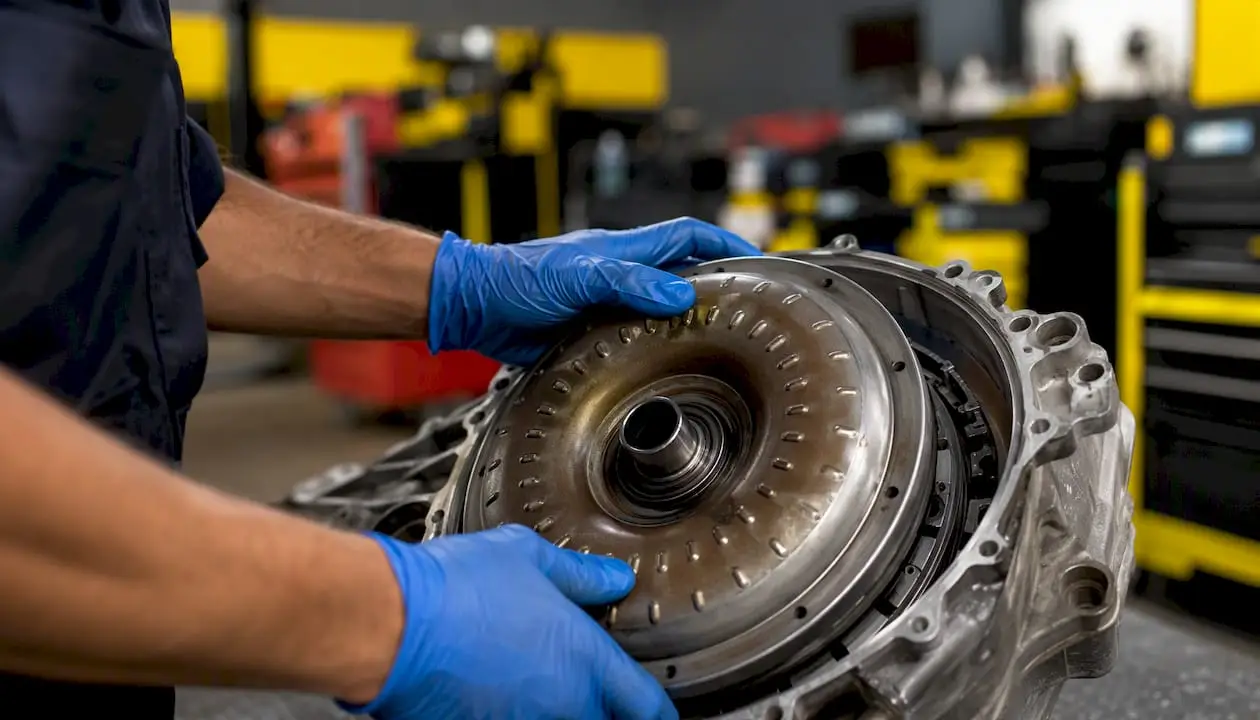
If your vehicle shudders at highway speeds, your RPMs may climb without a matching gain in speed, or you catch a burnt smell from under the hood, your torque converter is likely failing and you should stop driving it hard until a technician confirms the diagnosis. Three signs demand immediate attention: a steady vibration or shudder between moderate highway speeds under light throttle, RPM flare during acceleration without proportional speed increase, and a burnt or dark automatic transmission fluid (ATF) odor. Any one of these warrants a shop visit soon. All three together mean you should arrange a tow rather than risk further damage.
The three most urgent torque converter warning signs:
Shudder or vibration at steady highway speeds (35–55 mph) that eases when you lightly tap the brake
RPM surge or slipping where engine speed climbs but the car barely accelerates
Burnt smell or visibly dark, contaminated ATF on the dipstick
Key Takeaways
A failing torque converter almost always announces itself through a cluster of symptoms, and catching them early is the difference between a $300 ATF service and a $3,500 transmission rebuild.
Point
Details
Three urgent symptoms
Steady-speed shudder at 35–55 mph, RPM flare without speed gain, and burnt or dark ATF demand immediate shop attention.
Brake-tap triage
Lightly tapping the brake at moderate highway speed stops TCC shudder instantly; if it returns on release, the converter clutch is the likely culprit.
Fluid-first only when safe
ATF exchange can resolve early shudder if fluid is degraded but no metal flakes, stored TCC codes, or slipping are present.
Cost range
Torque converter replacement typically runs $800–$2,800 in the U.S.; delaying repair risks escalation to a full transmission rebuild.
Kwik Kar Richardson
ASE-certified technicians perform full TCC diagnostics with live scan data, ATF inspection, and written warranty coverage on all converter repairs.
What are the symptoms of a failing torque converter?
A torque converter sits between your engine and transmission, transferring power through hydraulic fluid and locking up at highway speeds via the torque converter clutch (TCC). When it starts to fail, your body feels it before your dashboard tells you. AutoZone’s symptom guide lists shuddering, slipping, overheating, unusual noises, and delayed engagement as the most commonly reported torque converter failure symptoms, and each one has a distinct feel behind the wheel.
Shudder and vibration at steady speeds
The signature symptom is a rhythmic shudder, almost like driving over rumble strips, that appears at light throttle between 35 and 55 mph. It is caused by the TCC engaging and releasing erratically instead of locking smoothly. According to TP Auto Repair’s diagnostic guide, lightly tapping the brake pedal will often stop the shudder instantly because that tap signals the TCC to disengage. If the shudder disappears with a brake tap and returns when you resume steady throttle, you have a strong indicator of a TCC problem rather than an engine misfire or worn tire. For context on how this vibration differs from brake-related shaking, the Kwik Kar guide on front-end shaking when braking is a useful comparison.
Slipping and RPM flare
Slipping feels like the engine revving freely while the car hesitates to respond. Your tachometer climbs to 3,000 or 4,000 RPM during normal acceleration, but your speedometer barely moves. This differs from a normal gear-change slip, which is brief and smooth. Torque converter slipping tends to be more sustained and often worsens as the transmission warms up.
Delayed engagement and stalling
Some drivers notice a pause of one to three seconds between shifting into Drive or Reverse and feeling the car actually move. Others experience stalling at low speeds or at stops, particularly in hot weather or after extended idling. These are signs the converter is struggling to transfer power efficiently at low RPM.
Noises that track engine RPM
Whining or humming that rises and falls with engine speed (not road speed) points to bearing wear inside the converter.
Clicking or grinding, especially during acceleration, suggests internal debris or damaged fins.
A clunking sound when shifting into gear can indicate loose converter mounting bolts or a damaged front hub.
Visual and olfactory clues
Pull the ATF dipstick after a warm drive. Healthy fluid is translucent red or pink. Fluid that is dark brown, nearly black, or smells burnt tells a story of overheating and friction material breakdown. Visible metallic flakes or a gritty texture on the dipstick cloth are serious: metal debris is circulating through your transmission. Jalopnik’s transmission warning guide notes that burnt-smelling, dark fluid with metal particles is a strong indicator of internal damage that a fluid change alone will not fix.
OBD-II codes to watchGearstar’s diagnostic overview explains that TCC-related codes are commonly misread without live scan data. The most relevant codes include:
A code alone does not confirm converter failure. It confirms a circuit or performance fault that requires further testing to isolate.
What causes a torque converter to fail?
Most converter failures trace back to a handful of root causes, and several are preventable with routine maintenance.
Worn TCC friction material: The clutch lining inside the TCC wears down over time, especially in vehicles that do a lot of highway driving or frequent towing. Once the friction surface degrades, the clutch cannot lock cleanly, producing shudder and slipping.
Contaminated or degraded ATF: Transmission fluid carries friction modifiers that allow the TCC to engage smoothly. As fluid ages, those additives break down. Contaminated fluid accelerates wear on every internal surface it touches.
Overheating: Sustained towing, heavy loads, or a failing transmission cooler raises ATF temperatures beyond safe operating range. Heat destroys seals, warps internal components, and accelerates fluid degradation faster than almost any other factor.
Bearing and internal part failures: Needle bearings inside the converter support the turbine and stator. When they fail, metal particles enter the fluid and score internal surfaces.
Seal and front-hub leaks: A leaking front seal or damaged hub allows fluid to escape, eventually starving the converter of the hydraulic pressure it needs to function.
Prevention comes down to three habits: change ATF on schedule using the fluid type your owner’s manual specifies, have your transmission cooler inspected if you tow regularly, and never ignore a transmission temperature warning light. A transmission flush guide can help you understand what a proper ATF service involves and how often it should happen.
How do mechanics diagnose a bad torque converter?
A proper diagnosis follows a logical sequence. Skipping steps is how a converter problem gets misdiagnosed as an engine misfire or a valve-body fault. Here is the workflow a qualified technician should follow, and what each step reveals:
Visual ATF inspection at operating temperature. The tech checks fluid level, color, smell, and texture. Dark or metallic fluid immediately raises the probability of internal damage and changes the repair calculus.
OBD-II scan for stored and pending codes. Pulling codes (P0740–P0744, P2769/P2770, P0715) narrows the fault to the TCC circuit, the solenoid, or the speed sensor. Codes without live data are a starting point, not a conclusion.
Live scan-tool data monitoring. With the vehicle warmed up and moving, the tech watches TCC commanded state versus actual state, turbine speed, and ATF temperature in real time. A TCC commanded “on” that shows no lockup in the data confirms a mechanical or hydraulic failure rather than a wiring fault.
Controlled road test at lockup speed. The tech drives at 40–50 mph under light throttle and observes for shudder. A light brake tap that stops the shudder and resumes it on release is the clearest field confirmation of TCC shudder, as TP Auto Repair’s diagnostic approach describes.
Stall-speed test (when warranted). With the vehicle stationary, the tech briefly holds the brake and applies full throttle to measure stall RPM. A stall speed significantly below specification suggests the converter stator is slipping; above specification points to a clutch or fluid issue. This test carries risk if the converter is already damaged, so techs use it selectively.
Hydraulic pressure checks. Line pressure testing rules out a failing pump or valve-body fault that could mimic converter symptoms.
Rule-out checks. The tech also checks for engine misfire codes, spark plug condition, and vacuum leaks, since a rough-running engine can produce vibrations that feel identical to TCC shudder. Engine diagnostics are sometimes part of the same visit when the symptom picture is ambiguous.
Estimated timeline: A thorough diagnostic typically takes 1–2 hours of shop time. If the tech needs to drop the transmission pan for an ATF inspection or perform a stall test, add another 30–60 minutes. Plan for a same-day or next-day turnaround for diagnosis; actual repair scheduling depends on parts availability.
What does torque converter repair actually cost?
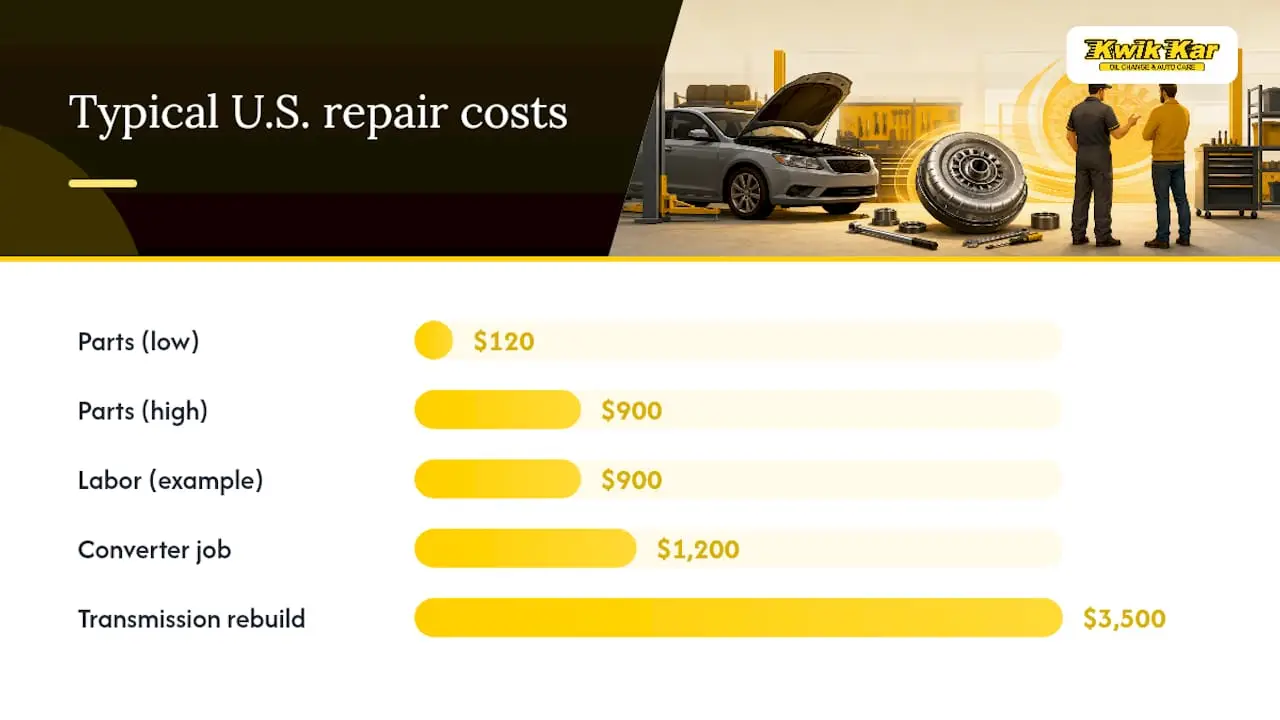
Repair costs vary widely based on vehicle type, labor rate, and how far the damage has spread. The table below reflects typical U.S. ranges drawn from published cost data.
Cost Insider’s breakdown shows that part costs alone range from roughly $120 to $900, and labor runs 3–9 hours depending on how accessible the converter is on a given platform. On a front-wheel-drive vehicle where the transmission must be fully removed, labor hours push toward the high end. On a rear-wheel-drive truck with easier access, the job is faster.
Key cost considerations:
Labor is the dominant cost driver on most vehicles. A shop charging $150/hr at 6 hours of labor adds $900 in labor alone before parts.
Remanufactured (reman) converters typically cost less than new OEM units and carry a warranty, often 12 months or 12,000 miles. New OEM units cost more but may be the right call on newer vehicles still under powertrain warranty considerations.
Delaying repair escalates cost. A failing converter that circulates metal debris through the transmission can damage solenoids, valve bodies, and clutch packs, turning a $1,200 converter job into a $3,500 transmission rebuild. Auto Repair San Antonio’s failure analysis documents exactly this contamination cascade.
Pro Tip:Ask your shop whether they offer a reman converter with a written warranty. A reputable shop will provide documentation on both the part warranty and the labor warranty separately — if they cannot produce both in writing, that is a red flag worth noting before you authorize the repair.
Can an ATF service actually fix torque converter shudder?
Sometimes, yes. Yahoo Autos’ reporting on converter failure notes that early-stage shudder caused by degraded or contaminated ATF can be resolved by a professional ATF exchange and filter service, but only when internal components show no physical damage. This is not a universal fix, and applying it to the wrong situation wastes money and delays a necessary repair.
The fluid-first approach is reasonable when: shudder is recent and mild, ATF is degraded but not dark or metallic, no TCC codes are stored, and the vehicle has simply gone past its ATF service interval. In these cases, a fresh ATF exchange restores the friction modifier chemistry the TCC needs to lock smoothly. When internal clutch surfaces are worn or debris is present, no fluid change will restore function.
Use this checklist to decide whether a fluid-first approach makes sense:
No metal flakes or grit visible on the dipstick cloth
ATF is discolored but not black or burnt-smelling
Shudder appeared gradually after high mileage or extended service intervals
No stored TCC codes (P0740–P0744) in the OBD-II system
Shudder is limited to the 35–55 mph lockup range and stops with a brake tap
When to skip straight to replacement:
ATF is dark, burnt, or contains visible metallic particles
Shudder is accompanied by slipping, stalling, or delayed engagement
Stored TCC codes are present alongside the shudder
Symptoms appeared suddenly rather than gradually
An ASE-certified technician should document ATF condition with photos before and after service and pull live scan-tool data post-service to confirm whether TCC lockup has normalized. That documentation protects you if the fluid service does not resolve the issue and a converter replacement becomes necessary. See the transmission fluid change cost guide for what a proper ATF service should include and what it typically costs.
Is it safe to drive with torque converter problems?
The honest answer: it depends on which symptoms you have, but the window for safe driving is shorter than most people assume.
Mild shudder only, no other symptoms: You can drive short distances to a shop, but avoid highway speeds and sustained cruising at lockup speed. Keep trips under 20–30 miles and monitor ATF temperature if your vehicle displays it.
Slipping or RPM flare present: Limit driving to essential trips only. Slipping generates heat, and heat accelerates damage to every component in the transmission. Do not tow anything.
Delayed engagement or stalling: Stop driving and arrange a tow. Stalling in traffic is a safety hazard, and delayed engagement in a parking lot or intersection creates real collision risk.
Burnt smell, dark ATF, or transmission temperature warning: Stop driving immediately. Continuing to operate the vehicle circulates contaminated fluid through the entire transmission, turning a converter repair into a full rebuild.
Short-term measures if you must drive before a repair:
Check ATF level and condition before each trip.
Avoid towing, hauling heavy loads, or driving in stop-and-go traffic for extended periods.
Keep highway speeds moderate to reduce time spent at TCC lockup speed.
Pull over and let the transmission cool if you notice the temperature gauge rising or smell anything burning.
The signs of transmission problems guide covers additional warning signals that indicate when a transmission issue has moved beyond the converter itself.
What to tell your mechanic and what to ask
Walking into a shop prepared saves diagnostic time and protects you from vague estimates. Here is what to bring and what to ask:
Information to bring:
Exact description of symptoms: when they occur (speed, throttle position, cold vs. warm), how long they have been present, and whether they are getting worse
Any smells you have noticed and under what conditions
A photo of the ATF on the dipstick if it looks dark or unusual
Your recent maintenance history, especially the last ATF service date and mileage
Any OBD-II codes you pulled yourself with a scan tool
Questions to ask the technician:
Will you perform a live TCC data check with a scan tool, not just pull stored codes?
Will you do a road test at lockup speed and a brake-tap check for shudder?
Will you inspect ATF condition and check for metal contamination?
Do you offer both reman and new converter options, and what warranty comes with each?
What is your labor warranty on this repair?
Red flags in an estimate:
A repair recommendation with no diagnostic data to back it up
A quote that lists only “transmission service” without specifying what was tested
No written warranty on parts or labor
Pressure to approve a full transmission rebuild before a converter-specific diagnosis is complete
Timeline to request: Ask the shop to complete the diagnostic phase within one business day and provide a written estimate before any teardown begins. Converter replacement, once parts are confirmed available, typically takes one to two days of shop time.
Why an ASE-certified local shop gets this right
Torque converter diagnosis is one of the most commonly mishandled repairs in the transmission category, and the reason is almost always the same: a shop skips live scan-tool data and goes straight from a code read to a repair recommendation. ASE certification matters here because it requires technicians to demonstrate competency in exactly the kind of systematic diagnostic process described above, including live data interpretation and hydraulic testing.
A local ASE-certified shop also offers something a dealership often cannot: a shorter feedback loop. When a technician documents ATF condition photos, pre- and post-service scan data, and stall-speed results in a single visit record, you have a paper trail that protects you if the repair needs a follow-up. Warranty handling is faster when the shop that did the work is five miles away rather than a regional service center.
That said, some situations do warrant a transmission specialty shop or dealer referral: vehicles still under powertrain warranty, dual-clutch or CVT transmissions (which use entirely different fluid and clutch architecture than a traditional torque converter), and cases where the converter failure has caused confirmed damage to the valve body or clutch packs requiring a full rebuild. In those cases, a good local shop will tell you honestly rather than attempt a repair outside their scope.
Torque converter diagnosis and repair at Kwik Kar Oil Change & Auto Care
When your transmission is shuddering, slipping, or throwing codes, you need a shop that runs the full diagnostic sequence, not just a code pull. Kwik Kar Oil Change & Auto Care in Richardson, TX offers ATF exchange and filter service, OBD-II diagnostic scans with live TCC data monitoring, stall-speed testing, and torque converter replacement and transmission repair, all performed by ASE-certified technicians recognized by both RepairPal and CARFAX.
Transparent pricing, written warranties on parts and labor, and community discounts for military personnel and first responders make Kwik Kar a straightforward choice for Richardson-area drivers who want dealership-level diagnostics without the dealership wait times or markups. To schedule your diagnostic visit, book an appointment online or call the shop directly. When you call, tell the service advisor your symptoms, the speed range where shudder occurs, and whether your ATF looks or smells unusual. That information gets your vehicle into the right diagnostic lane from the first minute.
The clearest sign is a shudder or vibration at steady highway speeds (35–55 mph) under light throttle that stops when you lightly tap the brake. Combine that with RPM flare during acceleration and dark or burnt ATF, and a failing converter is the most likely explanation.
What is the average cost of replacing a torque converter?
Torque converter replacement in the U.S. typically runs $800–$2,800 depending on the vehicle, parts choice (reman vs. new), and labor hours, which range from 3–9 hours based on accessibility.
Can I drive with a failing torque converter?
Mild shudder with no other symptoms allows short trips to a shop, but slipping, stalling, delayed engagement, or a burnt ATF smell means you should stop driving and arrange a tow to prevent escalating damage to the broader transmission.
Is it worth fixing a torque converter?
Yes, when caught early. A converter-only replacement at $800–$2,800 is far less expensive than a full transmission rebuild at $1,500–$5,000 or more. Addressing the problem before metal debris contaminates the valve body and clutch packs keeps the repair contained and cost-effective.

 If your vehicle shudders at highway speeds, your RPMs may climb without a matching gain in speed, or you catch a burnt smell from under the hood, your torque converter is likely failing and you should stop driving it hard until a technician confirms the diagnosis. Three signs demand immediate attention: a steady vibration or shudder between moderate highway speeds under light throttle, RPM flare during acceleration without proportional speed increase, and a burnt or dark automatic transmission fluid (ATF) odor. Any one of these warrants a shop visit soon. All three together mean you should arrange a tow rather than risk further damage.
The three most urgent torque converter warning signs:
If your vehicle shudders at highway speeds, your RPMs may climb without a matching gain in speed, or you catch a burnt smell from under the hood, your torque converter is likely failing and you should stop driving it hard until a technician confirms the diagnosis. Three signs demand immediate attention: a steady vibration or shudder between moderate highway speeds under light throttle, RPM flare during acceleration without proportional speed increase, and a burnt or dark automatic transmission fluid (ATF) odor. Any one of these warrants a shop visit soon. All three together mean you should arrange a tow rather than risk further damage.
The three most urgent torque converter warning signs:
 Slipping and RPM flare
Slipping feels like the engine revving freely while the car hesitates to respond. Your tachometer climbs to 3,000 or 4,000 RPM during normal acceleration, but your speedometer barely moves. This differs from a normal gear-change slip, which is brief and smooth. Torque converter slipping tends to be more sustained and often worsens as the transmission warms up.
Delayed engagement and stalling
Some drivers notice a pause of one to three seconds between shifting into Drive or Reverse and feeling the car actually move. Others experience stalling at low speeds or at stops, particularly in hot weather or after extended idling. These are signs the converter is struggling to transfer power efficiently at low RPM.
Noises that track engine RPM
Slipping and RPM flare
Slipping feels like the engine revving freely while the car hesitates to respond. Your tachometer climbs to 3,000 or 4,000 RPM during normal acceleration, but your speedometer barely moves. This differs from a normal gear-change slip, which is brief and smooth. Torque converter slipping tends to be more sustained and often worsens as the transmission warms up.
Delayed engagement and stalling
Some drivers notice a pause of one to three seconds between shifting into Drive or Reverse and feeling the car actually move. Others experience stalling at low speeds or at stops, particularly in hot weather or after extended idling. These are signs the converter is struggling to transfer power efficiently at low RPM.
Noises that track engine RPM
 Cost Insider’s breakdown shows that part costs alone range from roughly $120 to $900, and labor runs 3–9 hours depending on how accessible the converter is on a given platform. On a front-wheel-drive vehicle where the transmission must be fully removed, labor hours push toward the high end. On a rear-wheel-drive truck with easier access, the job is faster.
Key cost considerations:
Cost Insider’s breakdown shows that part costs alone range from roughly $120 to $900, and labor runs 3–9 hours depending on how accessible the converter is on a given platform. On a front-wheel-drive vehicle where the transmission must be fully removed, labor hours push toward the high end. On a rear-wheel-drive truck with easier access, the job is faster.
Key cost considerations:
 Transparent pricing, written warranties on parts and labor, and community discounts for military personnel and first responders make Kwik Kar a straightforward choice for Richardson-area drivers who want dealership-level diagnostics without the dealership wait times or markups. To schedule your diagnostic visit, book an appointment online or call the shop directly. When you call, tell the service advisor your symptoms, the speed range where shudder occurs, and whether your ATF looks or smells unusual. That information gets your vehicle into the right diagnostic lane from the first minute.