Auto Repair Warranty: What It Covers and How to Use It
An auto repair warranty is a shop’s written promise to fix, or stand behind, work it has already done if that work fails within a set time or mileage. It is different from your factory warranty and from an extended service contract. Coverage, length and exclusions come from the written terms on your invoice, so read them before you pay. At Kwik Kar Oil Change & Auto Care in Richardson, TX, qualifying repairs carry a 24-month/24,000-mile limited warranty.
TL;DR
- A repair warranty covers the specific parts and labor a shop installed. It does not cover your whole vehicle.
- There is no single standard length. The written terms on your invoice set the time, mileage, and exclusions.
- Factory warranties and extended service contracts are separate products with their own rules.
- If a repaired part fails, stop driving it if it is a safety issue, keep your paperwork, and call the shop that did the work first.
- Our 24-month/24,000-mile limited warranty applies only to qualifying repairs. Call (972) 644-1851 to ask whether yours qualifies.
Table of Contents
- Three Different Things Called a “Warranty”
- Is There a Warranty on Car Repairs?
- How Long Is the Warranty on Car Repairs?
- What an Auto Repair Warranty Usually Covers
- What Is Usually Excluded
- What to Check in the Written Terms
- Nationwide Repair Warranties: Can Any Shop Do the Work?
- Repair Warranty vs. Extended Warranty
- What to Do If a Repair Fails Under Warranty
- Why the Shop Matters as Much as the Warranty
- Our Perspective
- Repairs Where Warranty Questions Come Up Most
- A Note on Texas Inspections
- Book a Repair With Terms You Can Understand
- FAQ
- Talk to Kwik Kar Richardson
- Sources
Three Different Things Called a “Warranty”
Search results for this topic mix three different products. Knowing which one you are reading about saves a lot of confusion.
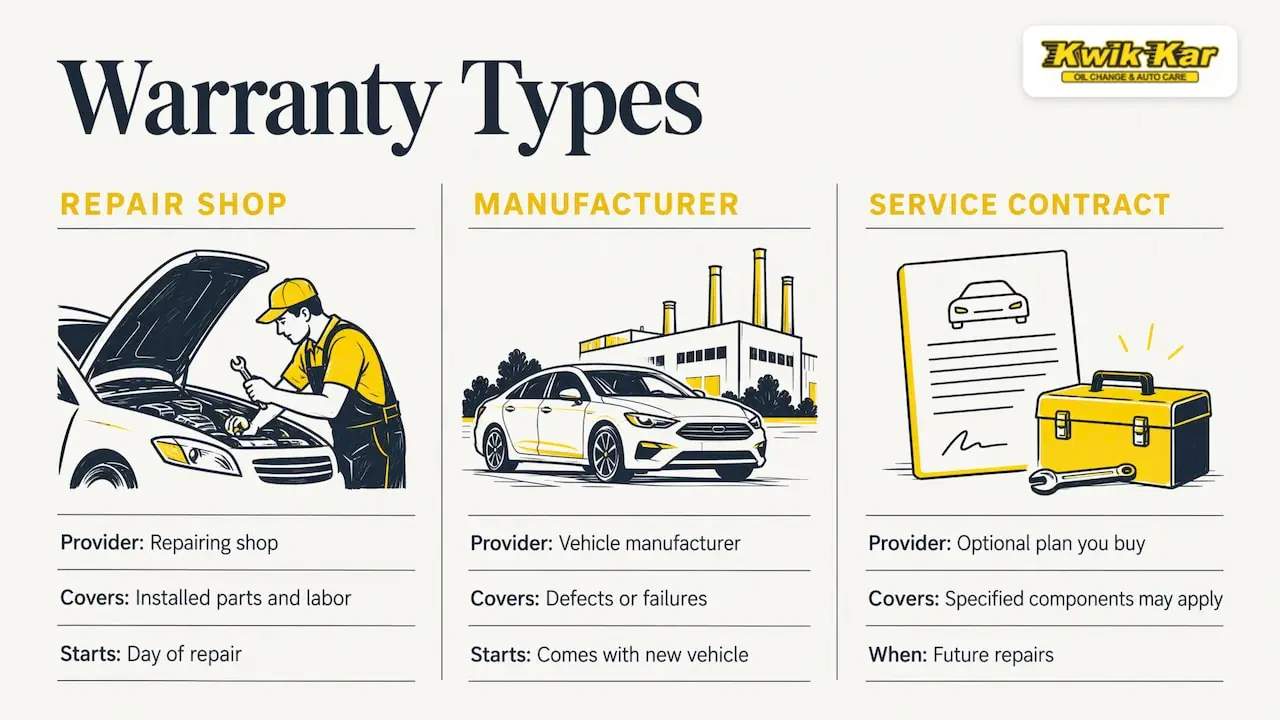
A repair shop warranty comes from the shop that fixed your car. It covers the parts it installed and the labor to install them. It begins the day of the repair, not the day you bought the vehicle.
A manufacturer (factory) warranty comes with a new vehicle. The Consumer Financial Protection Bureau explains that manufacturer warranties generally cover defects or failures, and normally exclude routine maintenance, normal-wear parts, and damage caused by abuse.
An extended warranty, or vehicle service contract, is an optional plan you buy. The same CFPB page notes that coverage varies and may apply to specified mechanical or electrical components. It is a contract for future repairs, not a promise about work already done.
This article focuses on the first type, because it is the one that protects you when a repair does not hold up. We touch on the other two where they affect your decisions.
Is There a Warranty on Car Repairs?
Not automatically. Whether a shop must warranty its work depends on the state and on what the shop offers. In New York, for example, the DMV says a repair shop is not required to warranty its work, but if it voluntarily warranties repairs, the terms and time limit must appear on the invoice. Rules in Texas differ, so the practical answer is the same everywhere: ask, and get it in writing.
Federal law adds a layer. The FTC’s guidance on the Magnuson-Moss Warranty Act says that only written warranties on consumer products fall under the Act. A verbal “we’ll take care of you” is hard to enforce. A written warranty with clear terms is not.
For drivers in Richardson, Plano, Garland, Addison and North Dallas, the habit to build is simple. Before approving any repair, ask three questions:
- Is this repair covered by a warranty?
- For how long, in months and in miles?
- Where are the terms written down?
How Long Is the Warranty on Car Repairs?
There is no single answer, and anyone who quotes one number for every shop is guessing. Warranty length varies by shop, by part, and by the type of repair. A battery, a set of brake pads, a remanufactured transmission and a spark plug set may each carry different terms.
What you can count on is how terms are usually expressed: a period of time, a mileage cap, or both, with the coverage ending at whichever limit you reach first. That is the structure of ours.
Our warranty at Kwik Kar Richardson
Qualifying repairs at our Richardson shop carry a 24-month/24,000-mile limited warranty. The word “limited” matters, and so does “qualifying.” Not every service or inspection is covered, and the terms attached to your specific repair determine what applies. We also offer a Lifetime Suspension Warranty, but only on qualifying suspension repairs.
If you want to know whether a planned repair qualifies, ask your service advisor before work begins. We will explain it in plain language, and the details are written on your paperwork. You can reach us at (972) 644-1851.
What an Auto Repair Warranty Usually Covers
A repair warranty is narrower than most people expect. In general, it covers:
- The part that was installed. If a new alternator fails early because of a defect, the warranty typically addresses that part.
- The labor to replace it. Many warranties include the cost of installing the replacement, though you should confirm this in the terms.
- The same problem returning. If the original symptom comes back because the repair did not hold, that is the core case a repair warranty exists for.
Think of it as a guarantee on a specific job. It is not coverage for everything under the hood.
What Is Usually Excluded
Exclusions are where most disappointment happens, so it is worth knowing the common ones. These are patterns drawn from how warranties generally work, not a promise about any one policy.
- Routine maintenance and wear items. Oil changes, filters, wipers and similar items are generally not warranty events. The CFPB’s description of factory coverage reflects this: routine maintenance and normal-wear parts are normally excluded.
- Damage from outside causes. Collision, flooding, overheating after a coolant leak you ignored, or misuse can void coverage on the affected part.
- Unrelated failures. A new water pump does not cover a failing power steering rack that happens to sit nearby.
- Work done elsewhere. If another shop opens up or modifies the repaired system, the original warranty may no longer apply.
- Parts you supplied. Many shops do not warranty parts the customer brings in, because they cannot verify the source or quality.
If you are weighing part choices, our guide to OEM parts versus aftermarket explains how part type can affect both cost and the warranty conversation.
What to Check in the Written Terms
Before relying on any warranty, read the paperwork with these checkpoints in mind.
| What to check | Why it matters |
|---|---|
| Time and mileage limits | Coverage usually ends at whichever limit comes first |
| Parts, labor, or both | Some terms cover only the part, leaving you to pay for installation |
| Which repairs qualify | A shop’s warranty may not apply to every service on the invoice |
| Where warranty work must be done | Some warranties require returning to the original shop, others are honored at a network of locations |
| Required maintenance | Skipping scheduled service can give a provider grounds to deny a claim |
| Claim steps | Many require approval before any work starts |
| Deductible or fees | Some plans charge per visit |
Pro tip: Take a photo of the invoice and the warranty terms the day you pick up your car. Paper fades and gets lost. A phone photo does not.
Nationwide Repair Warranties: Can Any Shop Do the Work?
Some warranties are honored at more than one location, often described as “nationwide.” That can be valuable if you travel or commute a long distance. But the phrase does not guarantee that any shop will perform covered work for free.
What to confirm in writing:
- Which shops or networks participate.
- Whether you must call a number before the work begins.
- Whether the participating shop is paid by the original provider, or you pay and are reimbursed.
- Whether the same coverage applies on the road as at home.
If your warranty is local to one shop, the simplest rule is to return there. If you regularly drive outside the Dallas area, ask about travel coverage before you need it.
Repair Warranty vs. Extended Warranty
The top search results for this topic are largely about extended service contracts, and they can be useful. But they answer a different question: how to pay for future repairs. A repair warranty answers a different one: what happens if the repair you just paid for fails.
The CFPB points to several factors that decide whether a service contract is worth its cost: the contract’s price and length, what is covered and excluded, how you use the vehicle, eligibility restrictions, and overlap with manufacturer coverage. That is a good checklist if you are considering one.
A few practical notes:
- If your factory warranty is still active, check what it already covers before buying more.
- Ask whether a service contract lets you choose your repair shop.
- Read the exclusions list first, not last.
- Ask how claims are paid and how long approvals take.
A service contract does not replace a good repair warranty from the shop you trust. They solve different problems.
What to Do If a Repair Fails Under Warranty
A failed repair is frustrating, but there is a clear order of steps that tends to resolve it.
- Make the car safe first. If the problem involves brakes, steering, or overheating, stop driving it and arrange a tow. Do not push on to “see if it clears up.”
- Find your paperwork. Locate the invoice, warranty terms, and date and mileage of the original repair.
- Call the original shop promptly. Describe the symptom and when it started. Most warranty problems get easier when the shop hears about them early.
- Do not authorize work elsewhere without checking. Having another shop repair a warranted part can end your coverage on it, as described above.
- Ask for a written diagnosis. If the shop finds the original repair failed, the warranty applies. If it finds a different cause, ask for that explained.
- Keep records of every conversation. Dates, names, and what was said.
If you cannot resolve a dispute with the shop, the FTC’s overview of federal warranty law notes that the Magnuson-Moss Act makes it easier for consumers to pursue a remedy for breach of warranty. A consumer protection office or an attorney can advise you on next steps for your specific situation.
Why the Shop Matters as Much as the Warranty
A warranty is only as good as the shop honoring it. A generous warranty from a shop that cuts corners costs you time even when it pays out. We find that the best protection is a shop that gets the diagnosis right the first time.
That is why we lean on ASE-certified technicians and digital vehicle inspections that show you what we see. Our guide on how to find a trustworthy mechanic lists what to look for, and our list of reliable auto shop qualities is a useful checklist whether you choose us or not. You can read more about our ASE and RepairPal certified technicians as well.
Our Perspective
We hear the same story from drivers around Richardson, Plano and Garland: they paid for a repair, the symptom returned, and nobody could tell them what the warranty actually covered.
Our view is that a warranty should be explained before the work, not after the problem. That is why your service advisor walks through what is being repaired, what qualifies for our 24-month/24,000-mile limited warranty, and what does not. We would rather you know the limits up front.
We also believe the best warranty claim is the one you never have to make. Careful diagnostics, ASE-certified technicians and digital inspection reports that show you the condition of your vehicle are how we aim to get the repair right the first time.
Not every service or inspection is covered, and we will tell you plainly which ones are. Our Lifetime Suspension Warranty applies only to qualifying suspension repairs.
Kwik Kar
Repairs Where Warranty Questions Come Up Most
Some repairs generate more warranty questions than others, because the parts are costly or the symptoms can return.
- Brakes. Ask which components are covered and what counts as normal wear. Our brake repair service page explains what we do.
- Suspension and steering. Worn parts here affect handling, so ask whether the Lifetime Suspension Warranty applies to your repair. See our steering and suspension repair page.
- Transmission. These repairs are among the most expensive. Our guide to signs of transmission problems helps you catch trouble early.
- Engine. Confirm which parts and labor are covered. See engine repair in Richardson.
- Air conditioning. Summers in North Texas are hard on A/C systems, so ask about coverage before the heat arrives.
Maintenance such as oil changes is typically not a warranty item, but staying on schedule can matter for factory coverage. Follow your manufacturer’s recommended intervals, which are in your owner’s manual. They differ by vehicle, and no single mileage fits every car. Our car maintenance checklist and guide to 60K, 90K and 120K mile maintenance can help you plan around your manufacturer’s schedule.
A Note on Texas Inspections
Inspection rules changed recently, and they sometimes get tangled up with warranty talk. Texas ended most non-commercial passenger vehicle safety inspections in 2025. The Texas Department of Public Safety explains that non-commercial vehicles no longer need a safety inspection before registration beginning January 1, 2025, and that commercial vehicles still must pass one.
Emissions testing remains required for qualifying vehicles in applicable counties, which include Dallas County. Commercial safety inspections continue as well. A passing inspection is not a warranty, and a repair warranty does not replace an inspection.
Book a Repair With Terms You Can Understand
If you want a repair done by ASE-certified technicians with the warranty explained before work begins, Kwik Kar Oil Change & Auto Care in Richardson is ready to help. We also offer special discounts for military members and first responders. Browse our full list of auto repair services to see what we handle, from brakes and suspension to A/C and electrical.
FAQ
Are auto repair warranties worth it?
A warranty from the shop that did your repair is generally worth having, since it covers the work you just paid for. An optional extended service contract is a separate purchase. Compare its cost, length, exclusions, and overlap with any factory coverage before deciding.
Is a repair shop required to give a warranty?
It depends on the state, and in some states shops may choose whether to offer one. Where a shop does offer one, ask for the terms in writing. Verbal promises are much harder to enforce.
Does a 24-month/24,000-mile warranty cover everything on my car?
No. Ours applies only to qualifying repairs, and it is a limited warranty. It does not cover every service or inspection. Ask your service advisor which items on your invoice qualify.
Can I take warranty work to a different shop?
Only if your terms allow it. Some warranties must be honored by the original shop, while others work through a network. Call the provider before authorizing work elsewhere, since outside repairs can end coverage on that part.
Will skipping oil changes affect my warranty?
It can, especially with factory or service-contract coverage, which may require scheduled maintenance. Follow your manufacturer’s recommended intervals and keep service records. Our oil change and preventive maintenance service can help you stay on schedule.
Talk to Kwik Kar Richardson
If you have a repair question or want to know how our warranty applies to your vehicle, call us at (972) 644-1851 or schedule an appointment online. We are happy to walk you through the terms first.
Sources
- What are the differences between a manufacturer’s warranty and an extended vehicle warranty or service contract? (CFPB)
- Know Your Rights in Auto Repair (NY DMV)
- Businessperson’s Guide to Federal Warranty Law (FTC)
- DPS Reminds Texans of Vehicle Safety Inspection Changes (Texas DPS)