Bald Tires: How to Spot Them and When to Replace
Bald tires are unsafe to drive on, period. If your tread has worn down to or below the wear bars, stop treating it as a maintenance item to schedule “sometime soon” and start treating it as a today problem.
Here’s your immediate checklist:
- Avoid highway speeds and hard braking until you address it.
- If you notice a bulge, exposed cord, or a hissing sound, pull over safely and stop driving on that tire.
- Use a properly rated spare or call for roadside service rather than risking the drive.
Safety Callout: Most states set the legal minimum tread depth at 2/32 of an inch, but that floor is a legal line, not a safety recommendation. Plan on replacing at 4/32" if you drive in rain or winter conditions.
Key Takeaways
Bald tires lose critical traction well before they hit the legal minimum, making replacement near 4/32" the safer standard than waiting for 2/32".
| Point | Details |
|---|---|
| Know the thresholds | 2/32" is the legal minimum; 4/32" is the safer replacement point for wet or winter driving. |
| Check tread properly | Use the penny test or a gauge at three or more spots per tire, and record the lowest reading. |
| Watch for uneven wear | Edge wear often signals underinflation or alignment issues; address the cause, not just the symptom. |
| Replace in pairs, or all four | AWD and traction-control vehicles need matched tread depth across all four tires. |
| Get a professional inspection | Kwik Kar Oil Change & Auto Care offers ASE-certified tread inspections with transparent digital reporting. |
Table of Contents
- What Are Bald Tires, and Why Does Tread Depth Matter?
- What Causes Tires to Wear Bald or Wear Unevenly?
- Signs a Tire Is Bald or Dangerously Worn
- How to Check Your Tread Depth the Right Way
- What Are the Real Risks of Driving on Bald Tires?
- What Should You Do If You Discover a Bald Tire?
- When Should You Replace Tires, and How Many at Once?
- How Can You Prevent Tires From Going Bald Too Soon?
- When Should You See a Professional, and What Do They Check?
- Are Bald Tires Illegal, and What Are the Penalties?
- Does Tire Type or Driving Style Change How Fast Tread Wears?
- Get Your Tires Inspected by Kwik Kar Oil Change & Auto Care
- Sources
- FAQ
What Are Bald Tires, and Why Does Tread Depth Matter?
A tire is considered bald once its tread wears down to the built-in wear bars, roughly 2/32 of an inch. A new passenger tire typically starts life with 10/32" to 12/32" of tread, so by the time you hit bald territory, you’ve lost most of the rubber that was doing the actual work.
Tread isn’t just decoration. It channels water out from under the contact patch, grips the road through thousands of small rubber blocks and sipes, and helps dissipate heat that builds up from friction. Strip that away and a tire behaves more like a smooth rubber disk on wet pavement.
The parts working together include:
- Tread blocks and ribs, which grip the road surface.
- Grooves, which channel water away to prevent hydroplaning.
- Sipes, the tiny slits that add flexibility and biting edges, especially in cold weather.
What Causes Tires to Wear Bald or Wear Unevenly?
Most bald tires don’t get that way overnight. Underinflation, overloading, misalignment, and skipped rotations are the usual suspects, and they often work together to accelerate wear you might not notice until it’s severe.
Common culprits include:
- Driving underinflated, which overworks the tire’s shoulders.
- Carrying loads beyond the vehicle’s rated capacity.
- Misaligned wheels, which chew through tread unevenly.
- Skipping rotations, so front and rear tires wear at different rates.
- Unbalanced wheels, aggressive braking, and pothole or curb impacts.
Hot summer pavement and winter road salt both speed up the process, and gravel roads add abrasive wear on top of everything else.
Pro Tip: Wear patterns tell a story. Wear concentrated on both outer edges usually points to underinflation, wear in the center suggests overinflation, and wear on just one edge often means a wheel alignment or camber issue is at play.
Signs a Tire Is Bald or Dangerously Worn
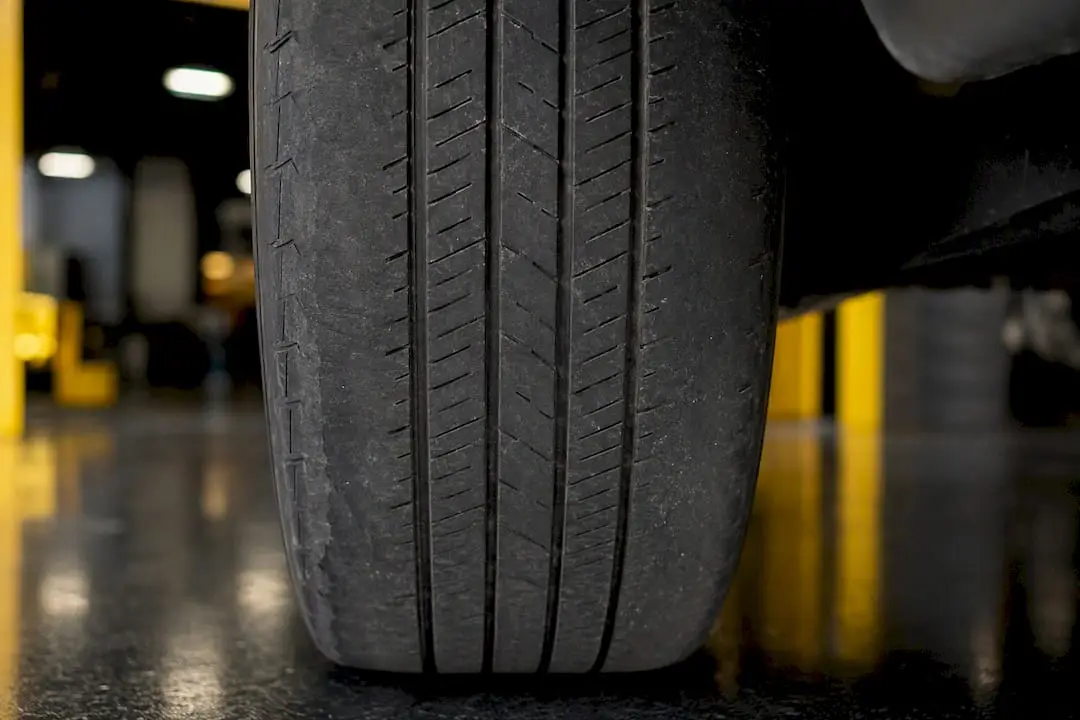
Some signs are obvious at a glance; others require a closer look at multiple spots on the tire, since wear rarely happens evenly across the whole surface.
Look for these:
- Wear bars that are visible or flush with the surrounding tread.
- A smooth, almost glassy texture where tread grooves used to be.
- Cracks running through the rubber, especially near the sidewall.
- Bulges or bubbles, which signal internal structural damage.
- Exposed cords or steel belts, which mean the tire is one pothole away from a blowout.
Check the outer shoulders, the center tread, and the inner groove separately. A tire can look fine in the middle while the outer edge is nearly bald, particularly if the alignment is off.
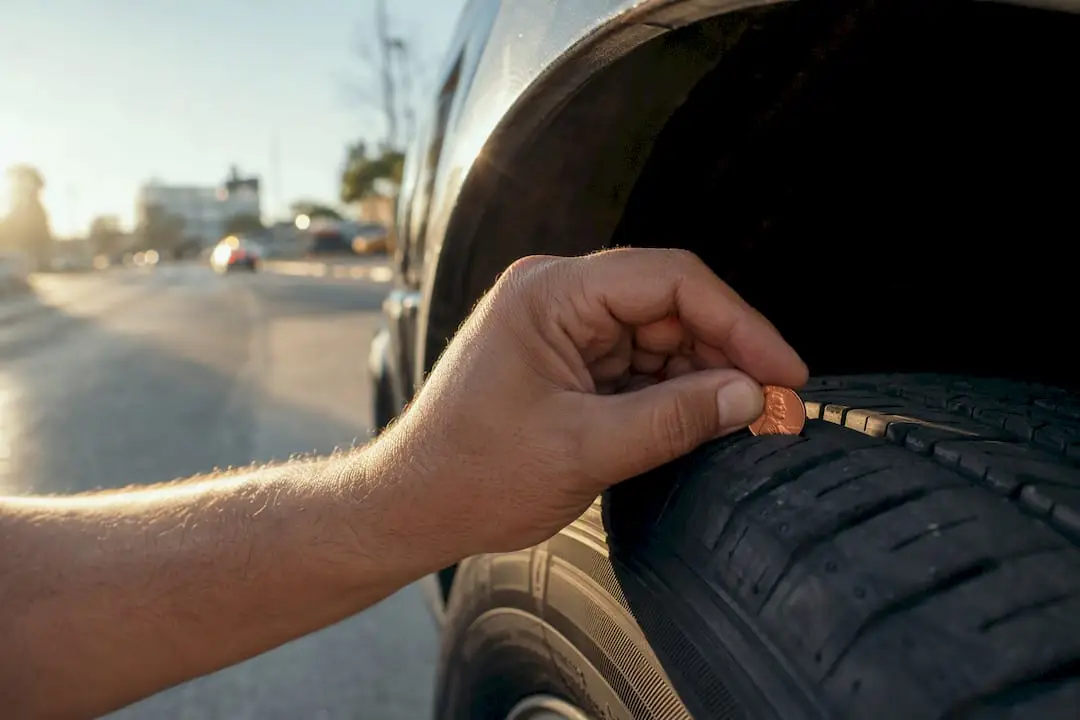
The classic penny test still works: insert a penny into the tread groove with Lincoln’s head facing down. If you can see the top of his head, you’re at or below 2/32" and it’s time to replace that tire.
How to Check Your Tread Depth the Right Way
Checking tread depth takes less time than pumping gas. Here’s how to do it properly.
- Grab a tread depth gauge (inexpensive and more precise than a penny) or use the penny method as a quick screen.
- Insert the gauge or penny into the tread groove, not on top of a tread block, and press down until it sits flat.
- Check three or more spots around each tire, including both shoulders and the center, since wear is rarely uniform.
- Record the lowest reading you find, because that’s the number that matters for safety, not the average.
- Compare your number against the thresholds: 2/32" means legal noncompliance, 4/32" is the safer target for wet or winter driving.
Pro Tip: Your tire pressure monitoring system has nothing to do with tread depth. A tire can show a perfectly normal TPMS reading while being completely bald, so don’t let a quiet dashboard light lull you into skipping a manual check.
What Are the Real Risks of Driving on Bald Tires?
Bald tires change the physics of everything your car does on the road, and not in your favor. Water can’t escape from under a smooth tire the way it can through healthy grooves, which is exactly what leads to hydroplaning at speeds that would feel perfectly controlled on a tire with proper tread.
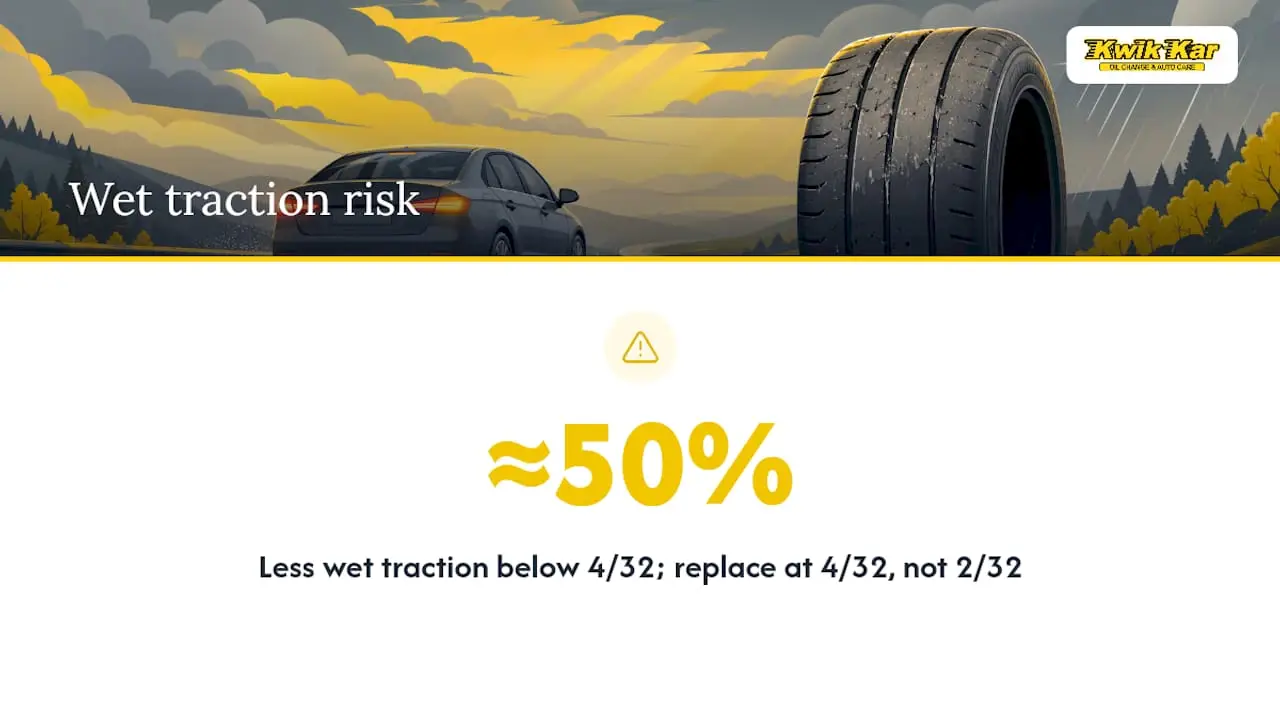
The safety math is not subtle. Research on wet-road friction shows tires under 4/32" of tread depth can lose roughly 50% of their traction on wet pavement compared with tires that have deeper tread, and that friction loss translates directly into longer stopping distances. A bald tire is also far more vulnerable to punctures and sudden blowouts, since there’s less rubber standing between the road and the steel belts underneath.
Statistic Callout: Consumer-safety coverage citing NHTSA data links a meaningful share of tire-related crashes to worn tread, reinforcing why the 4/32" threshold, not the 2/32" legal floor, is the number safety-focused drivers should track.
Beyond the physical danger, there’s financial exposure. Driving on tires below the legal minimum can result in citations and fines, and if bald tires contributed to a crash, insurers can cite negligence and deny a claim outright, leaving you to cover repair costs and liability out of pocket.
What Should You Do If You Discover a Bald Tire?
The moment you spot a bald tire, your priorities shift from “get somewhere” to “get there safely, or don’t go at all.”
- Avoid highway speeds and sudden braking maneuvers.
- Skip driving in heavy rain or snow entirely until the tire is replaced.
- Reduce vehicle load if you’re carrying passengers or cargo you don’t need for the trip.
- Use a properly inflated, rated spare, or call for roadside assistance if you’re not confident driving on it at all.
If your spare is a temporary “donut,” treat it as a bridge, not a solution. Most donuts are rated for roughly 50 miles at speeds no higher than 50 mph, and they’re not built for extended driving.
Pro Tip: Photograph the damaged tire from multiple angles and jot down your tread depth readings before you head to a shop. It speeds up the inspection and gives you a paper trail if insurance questions come up later.
When Should You Replace Tires, and How Many at Once?
Once a tire hits 2/32", replacement isn’t optional; it’s the legal minimum and the actual failure point for structural integrity. Most safety-focused technicians recommend replacing closer to 4/32" if you regularly drive in rain, snow, or on highways at higher speeds.
The “how many” question depends on your drivetrain and how evenly your tires have worn:
- Replace tires in axle pairs at minimum, so you don’t mismatch traction side to side.
- If you drive an AWD vehicle or one with active traction control, plan on replacing all four, since tread depth differences between axles can confuse the system.
- Keep tires on the same axle matched in size, construction, and profile. Mismatches can throw off ABS and stability control calibration even when tread depth looks close.
How Can You Prevent Tires From Going Bald Too Soon?
Prevention here is genuinely simple, and it’s the difference between tires that last their full rated mileage and tires that surprise you at 20,000 miles.
Build this into your routine:
- Check tread depth in at least three spots per tire, once a month.
- Set inflation to your vehicle’s placard pressure (found on the driver’s door jamb), always measured cold.
- Rotate tires every 5,000 to 8,000 miles to even out wear across all four positions.
- Have alignment checked whenever you notice uneven wear patterns, not just after you hit a pothole.
Pro Tip: Always check pressure when tires are cold, meaning the car has been parked for at least three hours. Pressure readings taken right after driving run artificially high and can mask a slow leak. If you’re storing a vehicle seasonally, keep tires slightly overinflated and out of direct sun to reduce dry rot and sidewall cracking.
When Should You See a Professional, and What Do They Check?
Bring your vehicle in if you see exposed steel belts, sidewall bulges, unusually fast or uneven wear, tires that keep losing pressure, or if you’ve just hit a pothole hard enough to worry about it.
A qualified technician will typically run through:
- Tread-depth profiling across the entire tire surface, not just one spot.
- A sidewall probe check for hidden separations or damage.
- Wheel balance and alignment verification.
- TPMS sensor function and a recommendation on replacement timing.
ASE-certified technicians bring dealership-level diagnostic training to that inspection, and a shop that hands you a digital report gives you documentation you can actually reference later, not just a verbal “you’re fine.”
Are Bald Tires Illegal, and What Are the Penalties?
Every U.S. state enforces some version of a minimum tread-depth law, and the 2/32" threshold is the standard most commonly cited during traffic stops and vehicle inspections. Driving below that line can result in a citation similar to any other equipment violation, and in states with mandatory annual inspections, a bald tire is an automatic failure.
Commercial vehicles face a stricter standard. Federal regulations for commercial trucking prohibit operating on tires with exposed ply or belt material, tread separations, or audible air leaks, regardless of the numeric tread measurement. A commercial tire can fail inspection for visible damage well before it technically hits the 2/32" mark.
The financial penalties extend past the ticket itself. As covered earlier, insurers can point to bald tires as evidence of negligence and deny a claim after an accident, which means the “fine” for driving on bald tires can turn into thousands of dollars in uncovered repair or liability costs. Fleet managers should note that inspection standards for matched tires on the same axle, covered under federal vehicle regulations, apply just as much to a two-car household as to a commercial rig.
Does Tire Type or Driving Style Change How Fast Tread Wears?
Not all tires wear at the same rate, and the differences come down to rubber compound, tread design, and how you drive.
Performance tires use softer rubber compounds for maximum grip, which means they typically wear faster than a standard all-season tire built for mileage. All-terrain and mud-terrain tires designed for off-road traction often sacrifice some tread life on pavement in exchange for grip on loose surfaces. Winter tires, meanwhile, use compounds engineered to stay flexible in the cold, but that same softness makes them wear noticeably faster if you leave them on through summer heat.
Driving conditions matter just as much as tire type. Stop-and-go city driving with frequent hard braking wears tread faster than steady highway cruising. Hot climates soften rubber and accelerate wear on the shoulders, especially if inflation is even slightly low. Gravel roads and frequent short trips (where tires never fully warm up to their designed operating temperature) both contribute to premature aging.
Your driving habits compound all of this. Aggressive acceleration, hard cornering, and heavy braking put more shear stress on tread blocks than smooth, moderate driving. Two identical vehicles with identical tires can see meaningfully different tread life depending on whether one owner drives gently and the other doesn’t. If you notice your tires wearing faster than the mileage rating suggests, matching tire type to your actual driving conditions, not just your vehicle’s stock spec, is worth a second look.
Author perspective: why it’s worth replacing earlier
Waiting until 2/32" is cutting it closer than it needs to be. I’d rather see drivers replace at 4/32", especially with wet Texas roads in the mix, and build a simple habit: check tread depth every oil change or every three months, whichever comes first. It’s a five-minute habit that beats a roadside emergency every time.
Get Your Tires Inspected by Kwik Kar Oil Change & Auto Care
Kwik Kar Oil Change & Auto Care gives Richardson drivers a faster, more transparent alternative to guessing whether a tire is safe based on a glance in the driveway. Our ASE-certified technicians run a full tread inspection, check balance and alignment, and walk you through your options with straightforward, transparent pricing, not a surprise invoice.
If your tread is close to the wear bars, or you’re just not sure, book a tire inspection and replacement consultation and we’ll measure every tire in multiple spots, explain exactly what we find, and give you a clear replacement quote on the spot. Military and first responder discounts are available, and every inspection comes with a digital report you can keep for your own records. Visit Kwik Kar Richardson to schedule your appointment today.
Sources
- Commentary: legal minimum tread depth for passenger car tires in the U.S.A.–a survey
- Bald Tires: Knowing the What, Why, Signs, and Risks
- Bald Tires: Are They Legal? (Motor1)
FAQ
Is It Okay to Drive With Bald Tires?
No. Bald tires significantly increase hydroplaning risk and stopping distance, and driving on them can violate state tread-depth laws depending on where you live.
What Should You Do If Your Tires Are Bald?
Stop driving on them at highway speeds immediately, use a properly rated spare if needed, and get the tire replaced by a qualified technician, ideally before your next long drive.
How Long Can You Drive on a Bald Tire?
There’s no safe mileage number here. Every mile on a bald tire raises your risk of a blowout, puncture, or hydroplaning incident, so the honest answer is: replace it before you drive it again.
Is It Legal to Have Bald Tires?
No, in most states driving below the 2/32" legal minimum tread depth is a citable violation, and commercial vehicles face even stricter federal standards on tire condition.