Measure Brake Pulsation, Don’t Replace Rotors Blindly in Richardson
Brake pulsation is most often caused by uneven rotor contact, either disc thickness variation or lateral runout, not true “warping” from heat. If you feel the shake only when braking, the problem is almost certainly in the brake system rather than the tires. Run a quick cruise-versus-brake check, avoid hard stops until you know more, and schedule a measured inspection if you also notice grinding, pulling, or a longer stopping distance.
TL;DR:
- Brake pulsation is primarily caused by disc thickness variation or lateral runout, not heat warping, with true warping being rare.
- A cruise-versus-brake test helps distinguish between rotor issues and tire or suspension problems, saving diagnostic time and money.
- Proper measurement of runout and disc thickness variation is essential before rotor replacement, as many pulsation causes are inaccurate guesses.
- Repeating the proper bedding, torquing lug nuts evenly, and cleaning hub faces can prevent the recurrence of brake pulsation.
- Overheating causes uneven surface hard spots, not true warping, which contributes to DTV and subsequent pedal pulse over time.
Table of Contents
- What Does Brake Pulsation Feel Like?
- What Causes Rotor Problems Behind the Pulsing Pedal?
- How Do You Tell ABS Chatter From a Mechanical Brake Pulse?
- How Do Technicians Measure and Diagnose Brake Pulsation?
- Should You Fix Brake Pulsation Yourself or See a Shop?
- What Prevents Brake Pulsation From Coming Back?
- When Is Brake Pulsation a Safety Emergency?
- What Kwik Kar Checks Before Recommending Any Brake Repair
- Can Overheated Rotors Actually Warp and Cause Pulsation?
- Does Old Brake Fluid Contribute to a Pulsing Pedal?
- How Does Uneven Pad Wear Lead to Pulsation and Noise?
- Can a Bad Wheel Bearing Feel Like Brake Pulsation?
- Do Front and Rear Brakes Pulsate Differently?
- Should You Resurface or Replace a Rotor?
- Why “Replace the Rotors and See” Is the Wrong First Move
- Get Your Brakes Measured, Not Guessed At, in Richardson
- Sources
- FAQ
What Does Brake Pulsation Feel Like?
The location of the shake tells you more than the intensity ever will. A steering wheel that shimmies side to side almost always points to the front brakes. A pulse you feel through the seat or the floorboard, without any steering wheel movement, usually means the rear brakes are involved. When the entire car shudders, both axles may be contributing.
Before you assume the rotors are at fault, run the cruise-versus-brake test. Get up to a safe cruising speed, around 50 mph on an open road, and let off the brake completely. If the car shakes at that steady speed with no braking involved, the issue is more likely tire balance, a bent wheel, or worn suspension components rather than the brakes at all. If the shake only appears when your foot touches the pedal, brake pulsation is the far more likely culprit, a distinction confirmed repeatedly in diagnostic breakdowns of brake shudder.
Before your appointment, note a few things:
- Does the pulse happen every time you brake, or only from higher speeds?
- Do you hear grinding, squealing, or a metallic scraping sound?
- Does the car pull left or right under braking?
- Has the pedal gotten softer or lower over the past few weeks?
That short list saves diagnostic time and often saves you money, since it helps a technician rule out entire systems before ever putting the car on a lift.
What Causes Rotor Problems Behind the Pulsing Pedal?
“Warped rotors” is the phrase most drivers reach for, but true heat warping is rare. What actually happens most of the time is disc thickness variation (DTV), where the rotor’s thickness differs slightly from one point around its circumference to another, or lateral runout, where the rotor wobbles side to side as it spins rather than staying perfectly flat. Both conditions make the pad contact area rise and fall thousands of times per mile, and that inconsistency is what you feel as a pulse in the pedal.
Pad deposits often start the whole cycle. Brake pads leave a thin film of friction material on the rotor surface every time you stop, and that transfer is normal. Problems begin when the deposit becomes uneven, glazed, or baked onto one section of the rotor from repeated hard stops or from sitting with your foot pressed on the pedal at a stoplight while the rotor is still hot. According to PowerStop’s technical research, a variation of only about 0.0007 inch, thinner than a human hair, is enough to start a noticeable judder.
Statistic Callout: A disc thickness variation of well under one thousandth of an inch can produce a pulse you’ll feel in your foot. That’s the kind of tolerance a caliper caliper micrometer catches and a visual inspection never will.
A sticking caliper or a seized slide pin adds another layer to the problem. When a caliper doesn’t release fully, that wheel runs hotter than the others, wearing the rotor unevenly and accelerating DTV. This is also why brand new rotors sometimes pulsate within a few hundred miles of installation:
- Hub face corrosion left uncleaned before the new rotor was mounted, which telegraphs runout into an otherwise true rotor.
- Lug nuts torqued unevenly or with an impact gun only, pulling the rotor slightly out of true against the hub.
- Existing runout in the hub assembly itself, never measured before the new parts went on.
How Do You Tell ABS Chatter From a Mechanical Brake Pulse?
Not every pedal pulsation comes from the rotors. Antilock braking systems can produce a rapid buzzing sensation in the pedal that feels similar to a mechanical pulse but behaves differently under the hood. Mechanical pulses track wheel speed. They get slower as your car slows down and disappear once you stop. ABS chatter, by contrast, tends to be higher frequency and can show up as a sharper, more electronic-feeling buzz rather than a rolling wave.
A few electronic culprits show up again and again in shop diagnostics:
- Damaged or dirty wheel speed sensors sending inconsistent signals to the ABS module.
- Cracked or chipped tone rings, the toothed rings the sensors read to calculate wheel speed.
- Corroded wiring or connectors between the sensor and the control module.
- An internal ABS module fault triggering false activation even when the road surface doesn’t call for it.
Technicians confirm which side of that line you’re on by pulling live wheel speed data with a scan tool while road testing the vehicle. If one wheel reports a speed noticeably different from the other three during a steady cruise, that’s a strong sign of a sensor or tone ring problem rather than a rotor issue. Guessing at parts here almost always wastes money, since a new set of rotors won’t fix a cracked tone ring.
How Do Technicians Measure and Diagnose Brake Pulsation?
Feel and sound get you most of the way to a diagnosis, but shops close the gap with actual measurements. Here’s the sequence a thorough inspection typically follows:
- Repeat the driver checks. A technician re-runs the cruise-versus-brake and location tests under controlled conditions to confirm which axle and which system is involved.
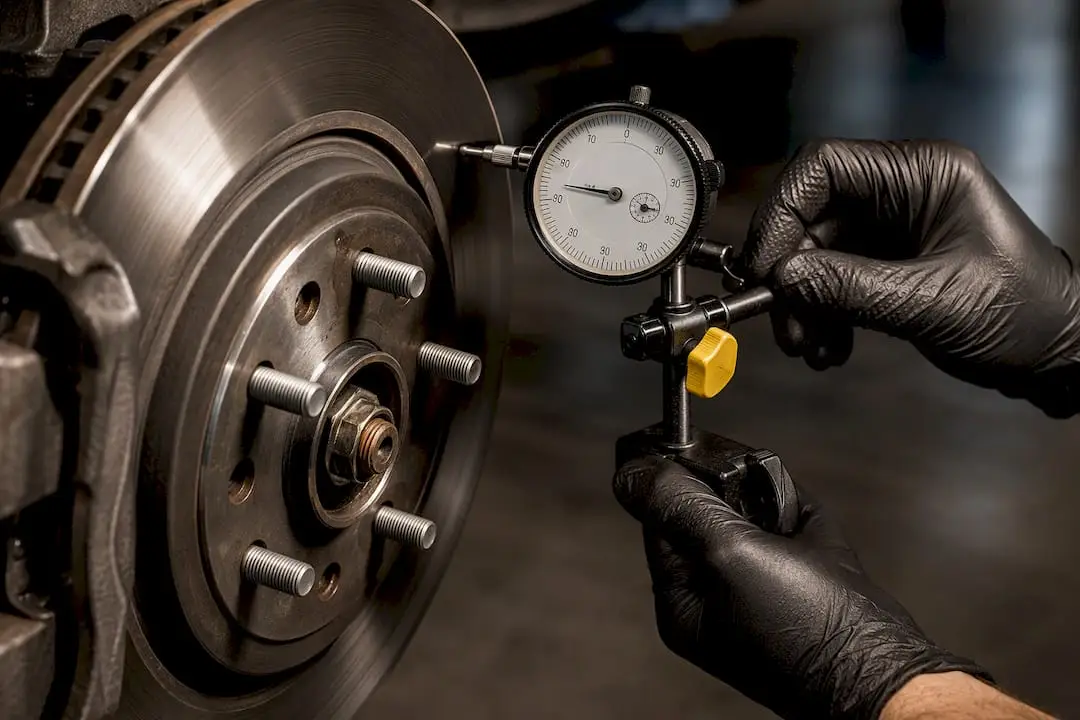
- Measure lateral runout with a dial indicator. The gauge is mounted against the rotor face while it spins, and the needle’s total swing shows how far out of true the rotor is running.
- Check disc thickness variation with a micrometer. Measurements are taken at multiple points around the rotor’s circumference to see how much the thickness changes.
- Run a hot-wheel test. After a short drive with moderate braking, an infrared thermometer or a bare hand (carefully) checks whether one wheel is noticeably hotter than the others, a telltale sign of a dragging caliper.
- Compare results against factory tolerance. Shops generally look for lateral runout at or under roughly 0.005 inch and DTV under about 0.001 inch, though exact numbers vary by manufacturer.
Pro Tip: Ask your shop to write down the runout and DTV numbers before and after any rotor work. That documentation is exactly what Technical Service Bulletins call for, and it’s your proof that the repair was measured rather than guessed at.
This measured approach matters most when a warranty or TSB claim is on the table. Manufacturers generally want to see recorded runout and thickness numbers before authorizing rotor replacement, not just a technician’s word that the pedal felt rough.
Should You Fix Brake Pulsation Yourself or See a Shop?
Some checks are safe and free to do in your own driveway. Others require tools and training that make a shop visit the smarter move.
You can reasonably handle a visual rotor inspection, checking for obvious grooves, cracks, or discoloration, and rechecking your lug nuts against the factory torque spec with a torque wrench rather than relying on whatever an impact gun left behind. The cruise-versus-brake test costs nothing and takes five minutes. If you’ve just replaced pads or rotors yourself, following a proper bedding procedure afterward matters more than almost any other single step.
A shop visit becomes necessary once the problem calls for equipment you don’t own:
- Measuring lateral runout and DTV with a dial indicator and micrometer.
- Pulling live wheel-speed data with a scan tool to rule in or out ABS faults.
- Correcting hub face corrosion, which often requires resurfacing tools.
- Performing on-car lathe work to true a rotor without removing it.
Parts for a DIY pad and rotor swap tend to run lower than a full shop job, but that gap narrows fast once you factor in a torque wrench, jack stands, and the time it takes to do it correctly. Shop pricing reflects labor, diagnostic equipment, and the guarantee that the job was measured, not eyeballed.
What Prevents Brake Pulsation From Coming Back?
Most repeat pulsation complaints trace back to skipped steps during the last repair, not a defective part. Get this sequence right and you dramatically cut the odds of feeling that shake again.
- Bed the new pads and rotors properly. A series of moderate stops from a controlled speed, without a single hard panic stop, lays down an even layer of pad material across the whole rotor face rather than one uneven hot spot.
- Torque the lug nuts to factory spec in a star pattern. Uneven clamping force pulls the rotor slightly out of true against the hub, which is one of the most common reasons new rotors pulsate within weeks of installation.
- Clean the hub face before mounting a new rotor. Rust or old brake dust between the hub and rotor telegraphs runout into the new part even when the rotor itself is perfectly flat.
- Let the brakes cool between hard stops. Avoid sitting with your foot on the pedal at a light right after aggressive braking, since that habit imprints pad material unevenly onto a hot rotor and seeds the next hot spot.
Pro Tip: Never rely on an impact wrench alone for final lug torque. A calibrated torque wrench in a star pattern is the cheapest insurance you’ll ever buy against repeat brake pulsation.
When Is Brake Pulsation a Safety Emergency?
A mild pulse at highway speed is worth scheduling an inspection for soon. Grinding metal, a pedal that sinks toward the floor, a car that pulls hard to one side, or any smoke or burning smell means stop driving and get the vehicle inspected immediately.
Urgency scales with the symptom, not just the intensity of the shake:
- Mild, occasional pulsing at highway speed with no other symptoms: schedule an inspection within the next week or two.
- Consistent pulsing on every stop, especially with noise: get it checked within a few days.
- Grinding, pulling, or a soft pedal: treat it as urgent and limit driving until inspected.
- Smoke, burning smell, or a pedal that goes to the floor: stop driving and arrange a tow if needed.
Statistic Callout: Shops typically hold lateral runout to roughly 0.005 inch or less as the pass/fail line. That single measurement, taken with a hundred-dollar dial indicator, is often the difference between a resurfacing job and a full rotor replacement.
Repair costs vary widely depending on the vehicle and the root cause. Rotor and pad replacement, sensor repairs, and ABS module work all carry different price points, and the biggest cost drivers are usually parts availability, whether resurfacing is possible instead of full replacement, and labor time tied to the specific vehicle platform. A shop can give you an accurate number once the measurements are in hand.
What Kwik Kar Checks Before Recommending Any Brake Repair
ASE-certified technicians don’t start a brake pulsation diagnosis by ordering rotors. The workflow runs through runout and DTV measurement first, then caliper function, then pad thickness, with every number written into the documented report you receive before any repair begins.
That documentation does double duty. It supports warranty or TSB claims that require recorded values, and it gives you a clear before-and-after comparison once the work is done. After machining or replacing a rotor, we re-measure, because a repair that isn’t verified isn’t finished. Kwik Kar Oil Change & Auto Care’s recognition from RepairPal and CARFAX reflects that same standard: transparent reporting, ASE-certified technicians, and a road test before the keys go back in your hand.
Can Overheated Rotors Actually Warp and Cause Pulsation?
True heat-induced warping, where a rotor physically bends out of flat, happens far less often than most drivers assume. What overheating usually produces instead is uneven hard spots on the rotor surface, tiny areas where extreme heat changes the metal’s structure, making that section harder and more resistant to normal wear than the surrounding metal.
Over time, those hard spots wear differently from the rest of the rotor, and that difference in wear is what generates thickness variation, the same DTV discussed earlier. So overheating doesn’t bend the rotor into a taco shape the way the word “warped” implies. It creates the uneven surface that eventually causes the pulse.
Repeated hard braking on mountain descents, towing without adequate cooling, or riding the brakes in stop and go traffic are the most common ways rotors reach the temperatures that trigger this. You can often catch it early with a simple visual check. Discolored, bluish, or spotty patches on the rotor face are a visible sign that a section overheated significantly more than the rest. A rotor inspection that catches those discolored zones before they turn into a full pulsation complaint can save you a rotor replacement down the road.
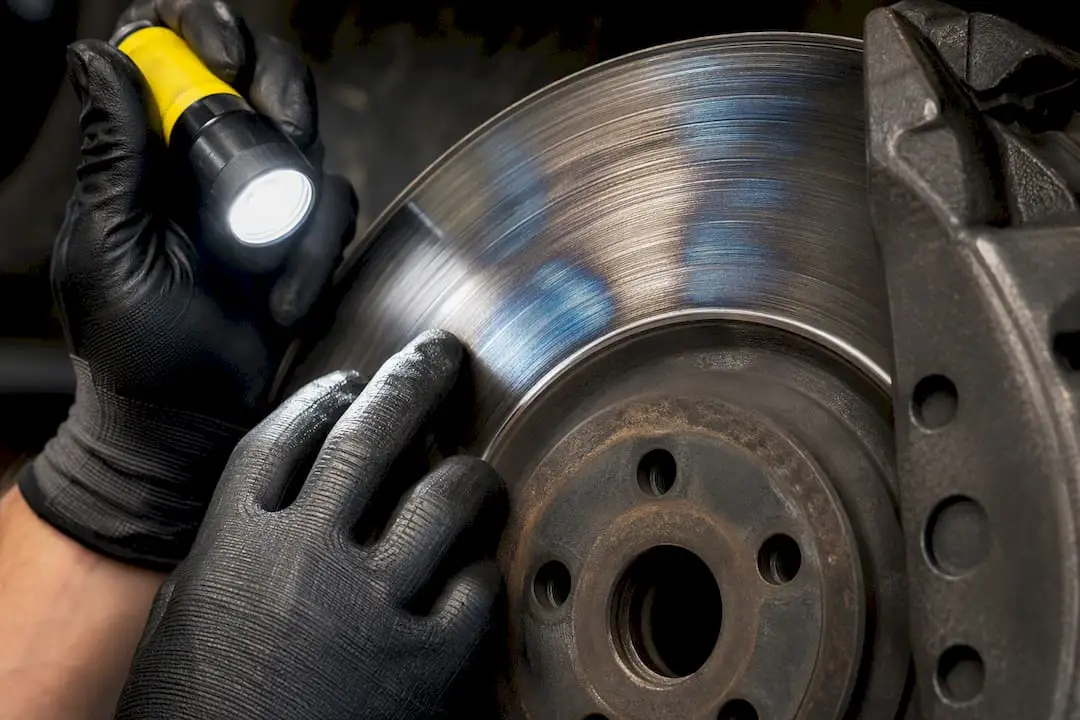
If you tow frequently or drive mountainous routes, upgrading to rotors rated for higher heat tolerance is worth discussing with a technician, since standard rotors on a heavy-duty use case are more prone to developing these hard spots in the first place.
Does Old Brake Fluid Contribute to a Pulsing Pedal?
Brake fluid condition affects pedal feel, but it produces a different sensation than true pulsation, and separating the two saves you from chasing the wrong fix. Brake fluid is hygroscopic, meaning it absorbs moisture from the air over time even in a sealed system. As water content rises, the fluid’s boiling point drops, which can lead to a spongy or soft pedal under hard, repeated braking, sometimes described as brake fade.
That spongy feeling is different from the rhythmic pulse of DTV or runout. A pulsation rises and falls in a wave tied to wheel rotation. Degraded fluid instead makes the whole pedal feel mushy or lets it sink slightly under sustained pressure, especially after several hard stops in a row, like a mountain descent.
Where fluid condition does intersect with pulsation is in diagnosis. If a technician finds both a soft pedal and a rhythmic pulse, the hydraulic system needs a look alongside the rotors, since air trapped in the lines or a failing caliper seal can compound whatever mechanical issue is already present. A full inspection typically checks fluid color and moisture content along with the mechanical measurements, since dark, contaminated fluid is often flagged for a fluid exchange as part of the same visit.
Manufacturers commonly recommend a brake fluid flush every two to three years regardless of mileage, since moisture accumulation happens on a calendar, not just on the odometer.
How Does Uneven Pad Wear Lead to Pulsation and Noise?
Brake pads are supposed to wear down evenly across their surface as they contact the rotor thousands of times per drive. When that wear becomes lopsided, thicker on one edge than the other, the pad no longer presses flat against the rotor, and that uneven contact both accelerates rotor thickness variation and often produces an audible symptom alongside the pulse.
A sticking caliper slide pin is the most frequent cause. If a pin seizes even slightly, the pad on that side rides against the rotor with uneven pressure, wearing at an angle instead of flat. That same uneven pressure explains why uneven pad wear so often shows up with squealing or scraping noises in addition to the pulse. Worn out pad wear indicators, small metal tabs designed to scrape against the rotor once the friction material gets thin, produce a high-pitched squeal specifically meant to warn you before pulsation ever becomes a complaint.
A visual pad inspection catches this early. Pads should show roughly even thickness across their face and between the inner and outer pad on the same wheel. A wedge-shaped pad, thick on one end and thin on the other, points directly at a caliper or slide pin problem rather than normal wear. Left unaddressed, that uneven wear accelerates the DTV that eventually produces the pulse you feel in the pedal, alongside a growing scraping or grinding sound as the pad material gets thinner on its worn edge.
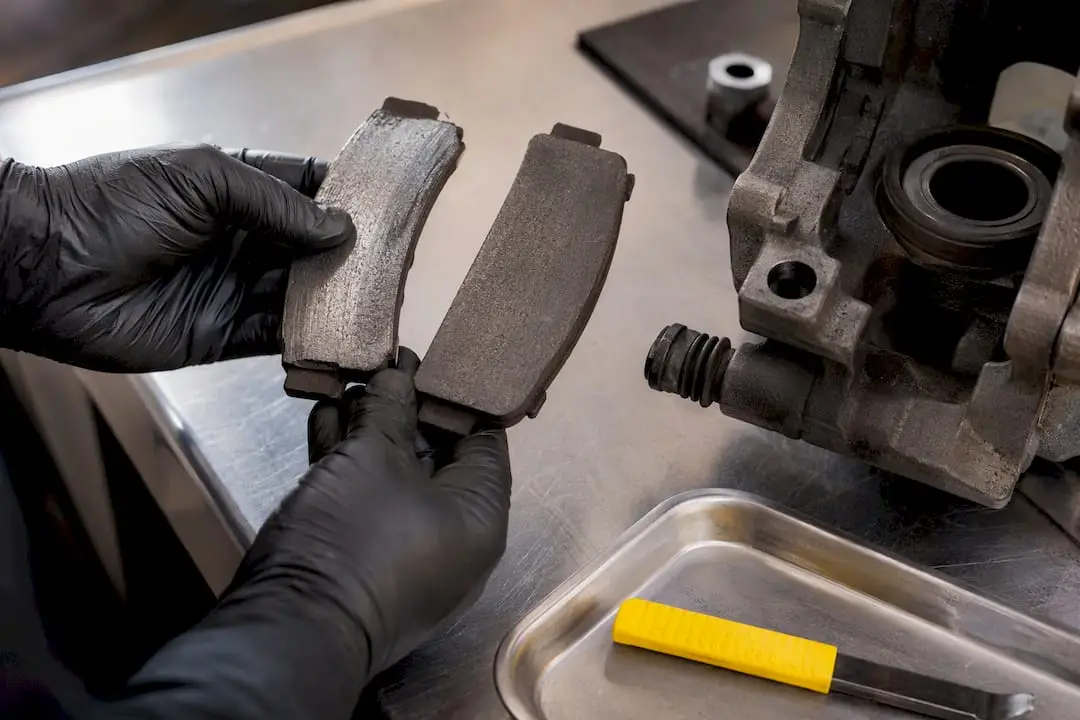
Cleaning and lubricating caliper slide pins on a regular service interval, something worth asking about at every rotation or pad inspection, is one of the simplest ways to keep pad wear even in the first place. Managing brake dust buildup on the wheels themselves is a smaller but related piece of that maintenance, since heavy dust accumulation can be a visual clue that a caliper is dragging more than it should.
Can a Bad Wheel Bearing Feel Like Brake Pulsation?
Yes, and this is one of the more common misdiagnoses drivers run into. A wheel bearing with excess play can produce a rhythmic vibration that feels remarkably similar to a pulsing brake, especially at highway speed, which is exactly why the cruise-versus-brake test matters so much before anyone reaches for new rotors.
A failing wheel bearing typically produces a droning or humming noise that changes pitch with vehicle speed, along with a vibration that’s often present whether you’re braking or not. That’s the key differentiator. Brake pulsation from DTV or runout only shows up when you apply the pedal. A bearing issue tends to be there at cruise, under acceleration, and under braking alike, sometimes getting slightly worse when you turn one direction because turning shifts load onto or away from the affected bearing.
Suspension components can muddy the picture further. Worn control arm bushings, a failing strut, or a loose tie rod end can all introduce vibration that shows up under braking simply because braking shifts weight forward and changes how the suspension loads. A front-end vibration diagnosis needs to rule these out before committing to brake-specific repairs, since replacing rotors won’t fix a worn ball joint.
The practical takeaway: if your cruise-versus-brake test shows any vibration at steady speed, even a mild one, tell your technician specifically. That detail redirects the inspection toward wheel bearings and suspension components rather than sending you straight into a rotor replacement that won’t solve the actual problem.
Do Front and Rear Brakes Pulsate Differently?
Front and rear brake pulsation feel different because of where the vibration travels through the car’s structure, and recognizing that difference helps you describe the symptom accurately before your appointment.
Front brake problems telegraph through the steering knuckle and up the steering column, which is why front DTV or runout shows up as a shimmy you feel in your hands on the steering wheel. Because front brakes typically handle a larger share of stopping force on most vehicles, front rotor issues tend to produce a more pronounced, easier to notice pulse than an equivalent amount of runout in the rear.
Rear brake problems transmit differently. Without a direct mechanical link to the steering wheel, rear pulsation usually shows up as a vibration through the seat, the floor pan, or the rear of the vehicle rather than in your hands. It can be subtler and easier to dismiss, especially on vehicles where the rear brakes do less overall work and wear more slowly.
Vehicles with rear drum brakes instead of discs experience pulsation less often, since drum brake designs are less prone to the specific thickness variation problem that causes disc pulsation, though a badly out of round drum can produce a similar shudder. If you feel vibration in both the steering wheel and the seat simultaneously, both axles may need measurement, which is exactly the kind of detail worth mentioning when you describe your symptoms to a technician ahead of an inspection.
Should You Resurface or Replace a Rotor?
Resurfacing, sometimes called turning or machining, removes a thin layer of material from the rotor face to correct minor runout or DTV without buying new parts. It’s the appropriate call when the rotor is within a manageable range of the problem and still has enough thickness remaining after machining to stay above the manufacturer’s minimum spec.
Replacement becomes the right call once measurements show the rotor doesn’t have enough material left to machine safely, or when the runout or DTV is severe enough that resurfacing wouldn’t leave a durable surface. Rotors that show deep grooves, cracking, or the discoloration associated with overheating are also generally better candidates for replacement than resurfacing, since machining won’t fully correct structural heat damage.
The decision comes down to a number, not a guess. A technician measures the rotor’s current thickness against the minimum spec stamped on the rotor itself or listed in the manufacturer’s service data. If there’s enough margin to remove material and correct the runout while staying above that minimum, resurfacing is the more cost-effective option. If not, replacement is the safer and often the only viable path. Many shops today lean toward replacement on lower-cost rotors, since new parts can sometimes cost close to what resurfacing labor runs, but the measurement should drive that decision either way, not a blanket policy in either direction.
Why “Replace the Rotors and See” Is the Wrong First Move
The instinct to swap rotors the moment a pedal pulses is understandable. It feels proactive. It’s also often the most expensive way to solve a problem that a fifteen minute driveway test could have narrowed down for free.
What the research and shop practice both point to is this: measurement should come before replacement, not after it. A dial indicator and a micrometer cost a fraction of a rotor and pad set, and they tell you definitively whether you’re looking at runout, DTV, or something else entirely, rather than leaving it to guesswork. The conventional advice to “just replace the rotors” skips that step and, worse, sometimes leads drivers to replace parts that were never the actual problem, whether that’s a wheel bearing, a suspension component, or simple tire wear masquerading as a brake issue.
What should come first, in our view, is the cheap stuff: the cruise-versus-brake test, a visual pad and rotor check, and a lug torque recheck. From there, measurement settles the rest. A shop that documents runout and DTV before recommending a repair isn’t being overly cautious. It’s doing the diagnostic work that actually prevents you from paying twice for the same problem.
— Kwik Kar
Get Your Brakes Measured, Not Guessed At, in Richardson
Most shops will quote you a rotor and pad replacement the moment you mention a shaking pedal. Kwik Kar Oil Change & Auto Care starts with a dial indicator and a micrometer instead, because a measured diagnosis in Richardson costs you nothing extra and can save you from replacing parts that were never the actual problem.

Our brake inspection checks lateral runout and disc thickness variation, tests caliper function, verifies lug torque, and includes a documented road test before we recommend anything. You get the actual numbers, not just a technician’s opinion, and that documentation is exactly what a warranty or TSB claim requires. ASE-certified technicians handle every step, with transparent digital reporting so you can see what was measured and why a repair is or isn’t needed. Military and first responder discounts are available on qualifying services. Ready to find out what’s really causing that pulse? Schedule your brake inspection with Kwik Kar Oil Change & Auto Care in Richardson and get answers backed by numbers, not guesswork.
Sources
- Brake runout TSBs on pulsation: what do they mean?
- Car shakes when braking in 2026? 7 causes diagnosed by feel | Pulscar
- Why do brake pedals vibrate? | PowerStop
- Brake pedal pulsation when stopping: warped rotors or ABS issue? | AutodataPlug
FAQ
What does brake pulsation feel like?
A rhythmic shake or vibration that rises and falls with wheel rotation, felt in the steering wheel for front brakes or through the seat and floor for rear brakes, and it appears specifically when you apply the brake pedal.
How much does it cost to fix pulsating brakes?
Cost depends on whether the rotors can be resurfaced or need full replacement, along with pad condition and any caliper or sensor issues found during inspection. A measured diagnosis at a shop like Kwik Kar Oil Change & Auto Care gives you an accurate quote based on actual runout and DTV readings rather than a blanket estimate.
How do you fix pulsating brakes?
The fix depends on the cause: resurfacing or replacing rotors for runout and DTV, replacing worn or glazed pads, freeing a sticking caliper, or repairing an ABS sensor if scan-tool data confirms an electronic fault rather than a mechanical one.
Why are my brakes pulsating after installing new rotors?
New rotor pulsation usually traces back to uncleaned hub face corrosion, lug nuts torqued unevenly or with an impact gun alone, or existing runout in the hub assembly that was never measured before the new rotors went on.
Is it safe to keep driving with pulsating brakes?
Mild, occasional pulsing is generally safe to drive on short term while you schedule an inspection, but grinding noise, a soft or sinking pedal, pulling to one side, or any burning smell means you should stop driving and have the vehicle inspected immediately.