DOT 3 vs. DOT 4 Brake Fluid: Differences, Mixing, Which to Use
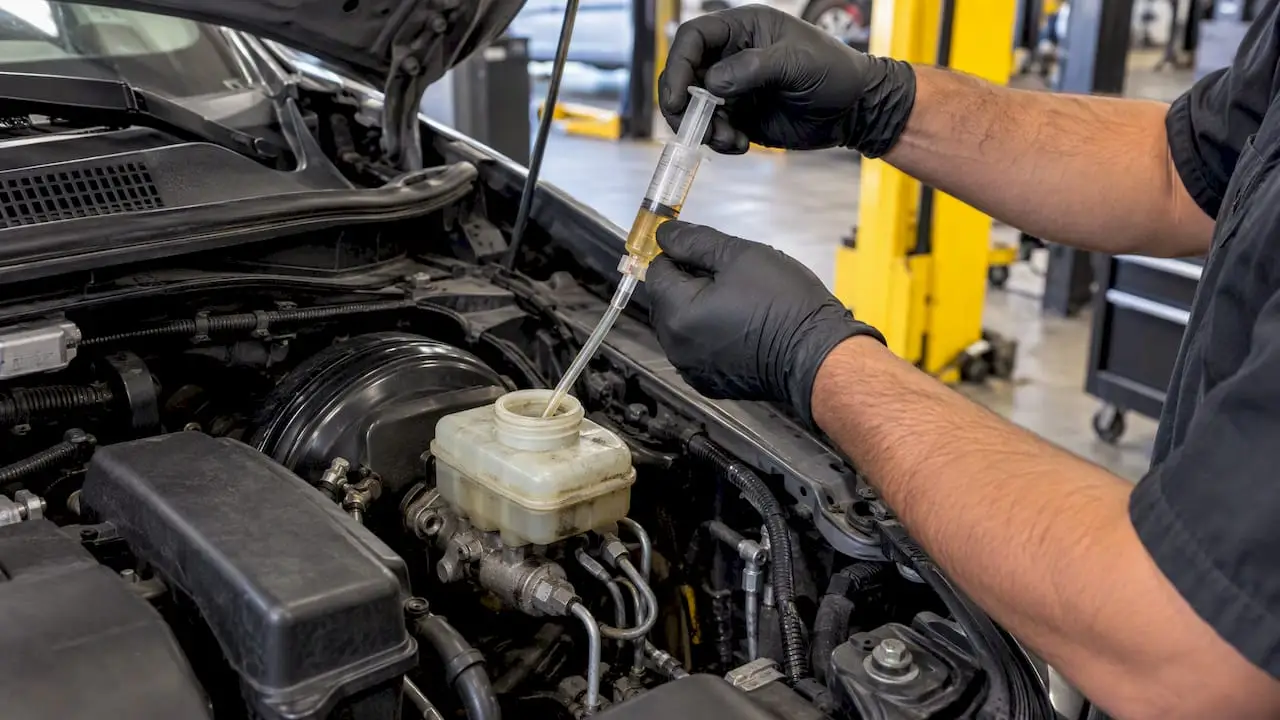
DOT 4 brake fluid has a higher minimum boiling point than DOT 3, and it is made with a different chemistry. Both are glycol-based and both absorb moisture over time. The right choice is the fluid your vehicle’s manufacturer specifies, which is printed in the owner’s manual and usually on the master-cylinder reservoir cap. At Kwik Kar Oil Change & Auto Care in Richardson, TX, we see drivers from Richardson, Plano, Garland, North Dallas and Addison ask this question often. Here is how the two fluids differ and what to do about it.
TL;DR
- DOT 4 must meet a higher boiling point than DOT 3, both dry and wet, under federal standard FMVSS 116.
- DOT 3 is glycol ether based. DOT 4 adds borate ester compounds.
- Many DOT 3 systems can accept DOT 4, but a system that calls for DOT 4 should not be topped off with DOT 3. Avoid mixing as a habit and ask a technician when in doubt.
- Your owner’s manual and reservoir cap decide which fluid goes in, not price or habit.
- Fluid age matters as much as fluid type. Both fluids absorb moisture, so follow your manufacturer’s replacement schedule.
Table of Contents
- What DOT 3 and DOT 4 Actually Mean
- How the Chemistry Differs
- Dry vs. Wet Boiling Point: The Number That Matters on the Road
- Can You Use DOT 4 Instead of DOT 3?
- Can You Mix DOT 3 and DOT 4?
- How to Find the Fluid Your Vehicle Requires
- Does Price Make DOT 3 or DOT 4 the Better Buy?
- How Often Should Brake Fluid Be Replaced?
- Our Perspective: Fluid Age Beats Fluid Label
- Brake Fluid Service at Kwik Kar Richardson
- FAQ
- Schedule Your Brake Check in Richardson
- Sources
What DOT 3 and DOT 4 Actually Mean
The DOT number is a performance class set by the U.S. Department of Transportation. Federal Motor Vehicle Safety Standard 116 defines the minimum requirements each class must meet, including boiling point. A fluid sold as DOT 3 or DOT 4 has to pass those tests.
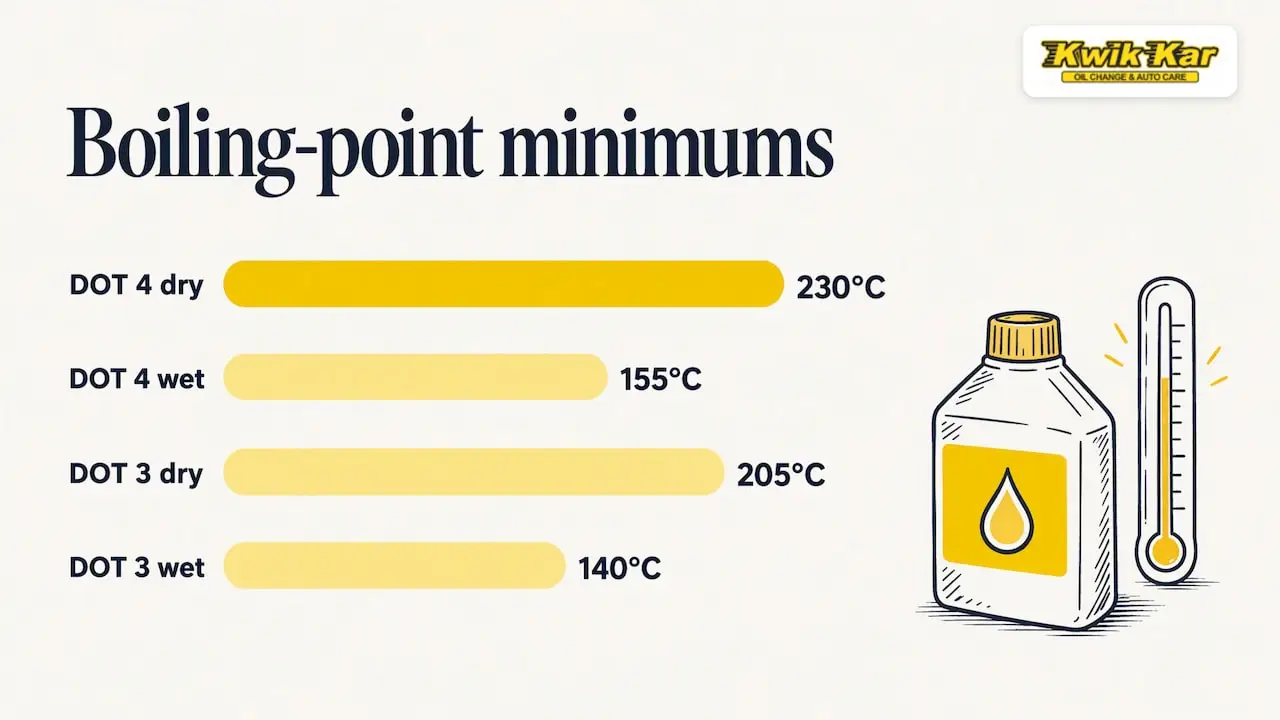
The two minimums that most readers care about are the dry and wet boiling points. According to 49 CFR 571.116, the requirements are:
| Property | DOT 3 minimum | DOT 4 minimum |
|---|---|---|
| Dry boiling point | 205°C (401°F) | 230°C (446°F) |
| Wet boiling point | 140°C (284°F) | 155°C (311°F) |
These are minimums. A specific bottle may exceed them, so the label and the manufacturer’s data sheet are worth reading. But the table shows the real separation: DOT 4 gives you more headroom before the fluid can turn to vapor under heavy braking.
How the Chemistry Differs
DOT 3 is built on glycol ether. DOT 4 uses glycol ether plus borate ester compounds, according to AMSOIL’s technical overview. That difference is what lets DOT 4 hold a higher boiling point.
Because both are glycol-based, they behave in broadly similar ways in the brake system. They are both very different from DOT 5, which is silicone-based. AAA’s guidance is that DOT 5 is not recommended for vehicles with anti-lock brakes, and that fluids should not be mixed.
There is one more practical point. The same AMSOIL source notes that DOT 4 is gaining ground because anti-lock braking and traction control systems benefit from its lower viscosity. That is one reason newer vehicles often specify DOT 4, though your manual is the final word.
Dry vs. Wet Boiling Point: The Number That Matters on the Road
The dry boiling point describes brand-new fluid straight from a sealed container. The wet boiling point describes fluid that has absorbed moisture, as in-service fluid does. Your brakes live with the wet number.
Glycol-based fluids such as DOT 3 and DOT 4 absorb moisture from their surroundings, usually by diffusion through the brake hoses or the reservoir, and that lowers the boiling point. Older National Bureau of Standards research, published by SAE, found that a significant portion of the moisture in service fluid passes through the brake hoses. In other words, a sealed-looking system still takes on water.
AMSOIL notes that DOT 3 can absorb up to 2% water every year, and that moisture can slowly corrode metal components and make the pedal feel spongy. Some sources claim DOT 4 absorbs moisture faster than DOT 3. Whatever the exact rate, the safe takeaway is the same for both: fluid ages, and aged fluid boils at a lower temperature than the number on the bottle.
Why boiling point matters
Brakes turn motion into heat. If the fluid in the calipers gets hot enough to boil, it forms vapor bubbles, and vapor compresses where liquid does not. The pedal then feels soft or sinks further than normal, and stopping power drops. This is the reason higher wet boiling points are valued, especially for towing, mountain driving, and long stop-and-go commutes.
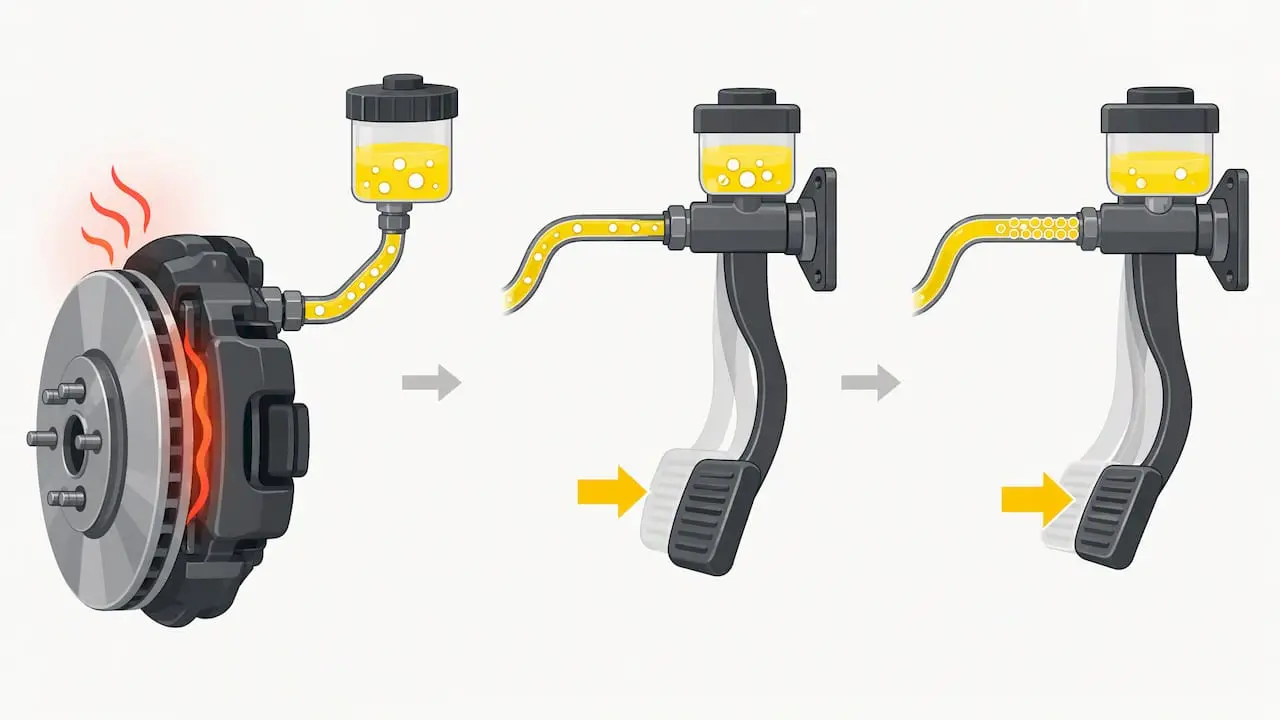
Most daily driving does not push fluid to its limit. But aged fluid narrows your safety margin without any obvious sign, which is why we treat fluid age as a maintenance item rather than a repair.
Can You Use DOT 4 Instead of DOT 3?
Often, yes, but the manual decides. A DOT 4 fluid meets or exceeds every boiling-point minimum that DOT 3 has to meet, so it does not lower the thermal margin of a system designed for DOT 3. Some manufacturers, however, specify a particular fluid or even a genuine branded one, and they have reasons.
A Mitsubishi technical service bulletin filed with NHTSA is a good example. It tells technicians to use genuine brake fluid and the DOT 3 or DOT 4 that the service manual specifies, and warns that non-genuine mineral-based fluid may swell the master-cylinder rubber cup. The lesson is that the wrong type of fluid, not just the wrong DOT number, can harm seals.
So the honest answer is this: if your vehicle lists DOT 3 or DOT 4 as acceptable, you have a choice. If it lists only one, use that one. If you are not sure, ask before you pour.
Can You Mix DOT 3 and DOT 4?
The cleanest answer is to avoid mixing and to replace the fluid completely when you change types. AAA advises not mixing brake fluids, and never putting in anything other than what the vehicle recommends, since doing so can damage brake components or cause brake failure.
That said, here is how the two glycol-based classes relate in practice:
- DOT 4 added to a DOT 3 system. The blend still sits on glycol chemistry, and the fluid you added has a higher minimum boiling point. This is generally not a concern, but a full fluid exchange is the better practice.
- DOT 3 added to a DOT 4 system. This is the one to avoid. The system was designed around the higher DOT 4 minimums of 230°C dry and 155°C wet, and DOT 3 only has to meet 205°C and 140°C. A top-off with DOT 3 can pull the blend below what the manufacturer intended.
- DOT 5 with either. Never. DOT 5 is silicone-based and should not be combined with glycol-based fluids.
If you have discovered that fluids were mixed, or you are not sure what is in the reservoir, have the system flushed and refilled with the fluid the manufacturer recommends. That is a service our technicians perform, and we explain the process in our guide to how to flush brake fluid.
How to Find the Fluid Your Vehicle Requires
You do not need to guess. Work through these checks in order:
- Read the reservoir cap. Many vehicles print the required DOT rating right on the cap or the reservoir body.
- Check the owner’s manual. Look in the fluids or specifications section. This is the document that overrides everything in this article.
- Confirm the level. The reservoir should sit between MIN and MAX. A level that keeps dropping can point to worn pads or a leak, so it deserves a professional look rather than repeated top-offs.
- Check the label on any new bottle. Make sure it lists the DOT class you need and that the seal is intact. An opened bottle absorbs moisture from the air.
- Ask us if the manual and cap disagree, or if the vehicle has been serviced elsewhere. We can check what is in the system.
Pro tip: Brake fluid damages paint. NHTSA service bulletin guidance says to wash fluid off a painted surface immediately with water. The same bulletin says to keep the reservoir from dropping below halfway between MIN and MAX during service and to keep dirt out of the fluid.
What about motorcycles?
The rule is the same: use the fluid your manufacturer specifies. Parts makers such as Cardone advise checking the shop manual or the master-cylinder lid or reservoir body, and flushing the system if different fluids have been mixed. We service cars, trucks and fleet vehicles, so for a motorcycle, follow your bike’s manual and see a motorcycle specialist.
Does Price Make DOT 3 or DOT 4 the Better Buy?
DOT 3 usually costs less per bottle, and that is the main draw. But the bottle price is a small part of the picture. For a vehicle that specifies DOT 3, using DOT 3 is correct and economical. For a vehicle that specifies DOT 4, a few dollars saved by choosing DOT 3 is not worth a lower thermal margin.
If your manual allows either, think about how you drive:
- Short local trips and light loads: Either approved fluid will do the job if it is fresh.
- Towing, heavy loads or repeated hard braking: The higher boiling points of DOT 4 give more margin, provided the manual permits it.
- Older vehicles with long gaps between services: Fresh fluid of the correct type matters more than the class on the label.
In short, the best brake fluid is the correct one, changed on time.
How Often Should Brake Fluid Be Replaced?
There is no single interval for every vehicle. HELLA notes that brake fluid is generally changed about every two years, but you should follow the intervals the vehicle manufacturer specifies. Some manufacturers use time, some use mileage, and some use both.
Start with your owner’s manual, then let a technician check the fluid’s condition at routine visits. Our articles on how often to flush brake fluid and how often to flush your car fluids go deeper on timing.
Signs the fluid may be past its best
Color tells part of the story. Fresh fluid is typically clear to light amber, and dark or murky fluid has been working hard. Color alone does not prove the fluid is bad, and clear fluid can still hold moisture, so we do not rely on it alone.
Other signs worth a professional look:
- A spongy or soft brake pedal
- A pedal that sinks slowly under steady pressure
- A brake warning light
- A reservoir level that keeps falling
- A long gap since the last fluid service
None of these automatically means an emergency. They do mean the brakes deserve a proper diagnosis soon. Our guide to dirty brake fluid risks and signs explains what each symptom can point to, and why brake fluid DOT rating matters for safety covers the rating system in more detail.
Our Perspective: Fluid Age Beats Fluid Label
We see plenty of drivers who ask whether to upgrade from DOT 3 to DOT 4, and far fewer who ask how old their fluid is. In our experience the second question is the more useful one. A vehicle with fresh fluid of the correct type will usually be in better shape than one with a premium fluid that has been in the lines for years.
Brake fluid is quiet. It does not leak noisily or smoke, and it rarely announces itself until the pedal feels different. That is why we like to look at it as part of a regular visit, alongside pads, rotors, hoses and lines. Our technicians are ASE-certified, and our digital vehicle inspections let you see what we see.
We also try to keep the advice proportionate. Not every dark reservoir is urgent, and not every car needs a fluid exchange today. We will tell you what the manufacturer calls for, what we found, and what can wait.
— Kwik Kar
Brake Fluid Service at Kwik Kar Richardson
If you want the fluid checked or replaced, our team at Kwik Kar Oil Change & Auto Care in Richardson handles brake inspections and brake repair and service, along with fluid exchange services. We will confirm which fluid your vehicle specifies before anything goes in.
If a brake repair is recommended and qualifies, our 24-month/24,000-mile limited warranty may apply to that repair. Warranty coverage applies only to qualifying repairs, not to every service or inspection, so ask us for the details on your specific job. Pricing is quoted for your vehicle, and we do not publish a flat price for brake fluid service.
If your pedal feels off, our guide on when to replace brake pads can help you tell fluid symptoms from pad wear.
FAQ
What is the main difference between DOT 3 and DOT 4?
DOT 4 has higher minimum boiling points than DOT 3, both dry and wet, under federal standard FMVSS 116. DOT 3 is glycol ether based, while DOT 4 adds borate ester compounds. Both are glycol-based and both absorb moisture over time.
Can I use DOT 4 instead of DOT 3?
In many vehicles you can, because DOT 4 meets higher boiling-point minimums. Always check the owner’s manual or reservoir cap first, since some manufacturers specify a particular fluid. If the manual allows only one type, use that one.
What happens if I mix DOT 3 and DOT 4?
AAA advises against mixing brake fluids. Adding DOT 4 to a DOT 3 system is generally less of a concern, but topping off a DOT 4 system with DOT 3 can leave the blend below what the system was designed for. If you are unsure what is in the reservoir, have the system flushed and refilled with the recommended fluid.
Is DOT 4 better than DOT 3?
On boiling point, yes, since its minimums are higher. But better on paper is not always better for your car. The correct fluid for your vehicle, in good condition, is the better choice.
Schedule Your Brake Check in Richardson
If you are unsure which fluid your vehicle needs, or how long it has been since the fluid was changed, we are glad to take a look. Call Kwik Kar Richardson at (972) 644-1851 or schedule an appointment online.
Sources
- eCFR: 49 CFR 571.116, Standard No. 116, Motor vehicle brake fluids
- AMSOIL: DOT 3 vs. DOT 4 Brake Fluid
- AAA: Car Maintenance Guide, Fluids
- HELLA: Changing the brake fluid
- SAE: Operating Performance of Motor Vehicle Braking Systems as Affected by Fluid Water Content (710253)
- NHTSA technical service bulletin, Mitsubishi, 2018
- NHTSA technical service bulletin, 2021
- Cardone: Choose the Right Brake Fluid