Why Brake Fluid Is Essential for Safe Braking
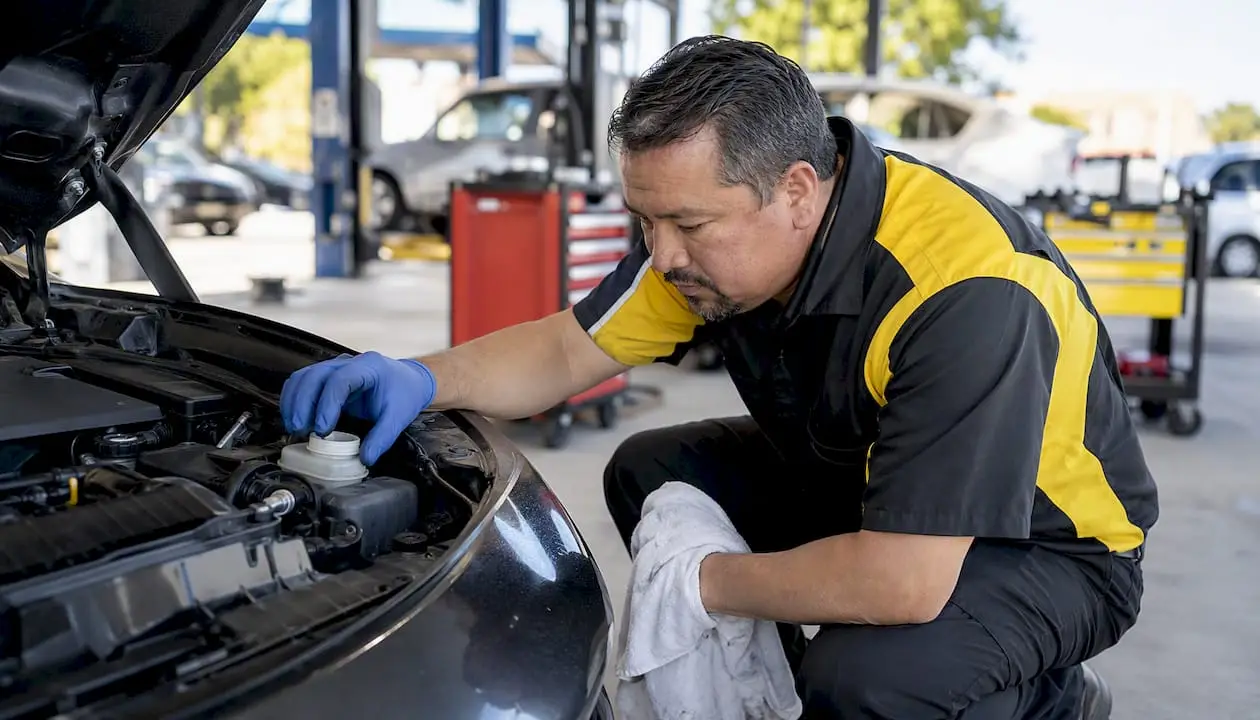
Brake fluid transmits the force from your foot on the pedal into hydraulic pressure at each wheel, stopping your car. Without it, pressing the brake pedal would accomplish nothing. This relies on one fundamental property: liquids are essentially non-compressible, meaning force applied at one end of a sealed system travels instantly and evenly to the other. DOT-rated fluids and ASE-certified technician guidance exist precisely because this system operates under extreme heat and pressure where small failures carry serious consequences.
At a glance:
- Primary function: Transfers and amplifies pedal force through a hydraulic circuit to the calipers or wheel cylinders at each wheel
- Main safety risk: Moisture absorption lowers the fluid’s boiling point, creating vapor pockets that make your pedal feel spongy and reduce stopping power
- Quick action: Check your reservoir level monthly and schedule a brake-fluid flush per your manufacturer’s interval or sooner if your pedal feels soft
Table of Contents
- What does brake fluid do in a hydraulic braking system?
- Why brake fluid condition directly affects your safety
- Which brake fluid type does your car need?
- What happens when brake fluid is low or old?
- How to check your brake fluid and when to call a pro
- How often should you replace brake fluid?
- Key Takeaways
- Why brake fluid maintenance is the safety check most drivers overlook
- Brake service at Kwik Kar Oil Change & Auto Care in Richardson, TX
- Useful sources
- FAQ
What does brake fluid do in a hydraulic braking system?
When you press the brake pedal, that force travels to the master cylinder, which pressurizes the brake fluid inside a closed network of steel and rubber lines. That pressurized fluid pushes outward to each wheel, where it forces the caliper pistons (on disc brakes) or wheel cylinders (on drum brakes) to clamp the pads or shoes against the rotor or drum. The car slows.
The reason this works so reliably is that brake fluid acts as a hydraulic medium that cannot be meaningfully compressed. A gas compresses under pressure; a liquid does not. So every pound of force you apply at the pedal becomes pressure at the wheel, amplified by the geometry of the master cylinder and caliper pistons. That amplification is why a moderate foot-press generates enough clamping force to stop a two-ton vehicle.
Heat is the complicating factor. Rotors and drums absorb enormous energy during braking, and some of that heat transfers into the fluid through the calipers and lines. Under normal driving, a quality fluid handles this easily. Under repeated hard braking, the fluid temperature can spike fast enough to matter.
Pro Tip: Picture the system as a sealed syringe connected to four smaller syringes at the wheels. Pushing the large syringe (master cylinder) forces fluid outward, and each small syringe (caliper piston) extends with equal pressure. The fluid is the messenger that never loses the signal, as long as it stays liquid.
Why brake fluid condition directly affects your safety
Bad or contaminated fluid reduces stopping performance and can cause brake fade or outright failure under heavy braking. The two mechanisms behind this are boiling and moisture absorption, and they are connected.
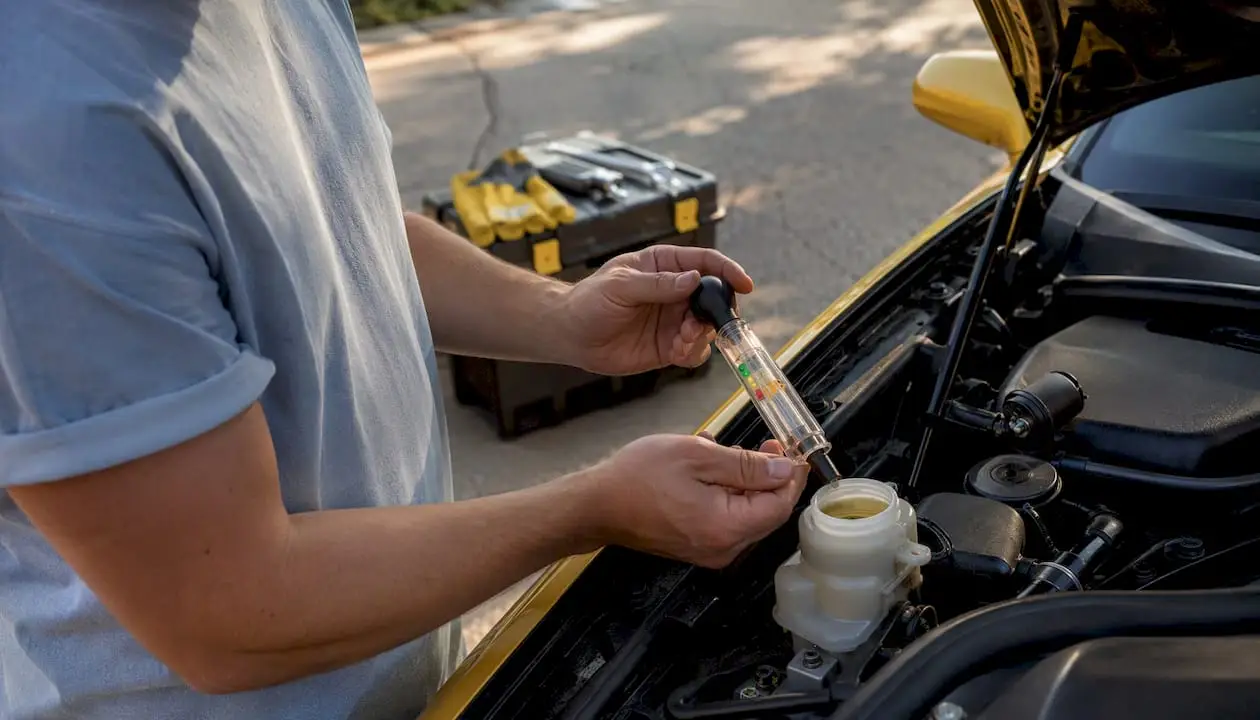
Boiling point: dry vs. wet
Every brake fluid has two boiling points. The dry boiling point applies to fresh, uncontaminated fluid. The wet boiling point reflects performance after the fluid has absorbed moisture. A DOT 4 fluid, for example, has a dry boiling point substantially higher than its wet boiling point, which drops significantly as moisture accumulates. That gap represents a significant loss of thermal headroom.
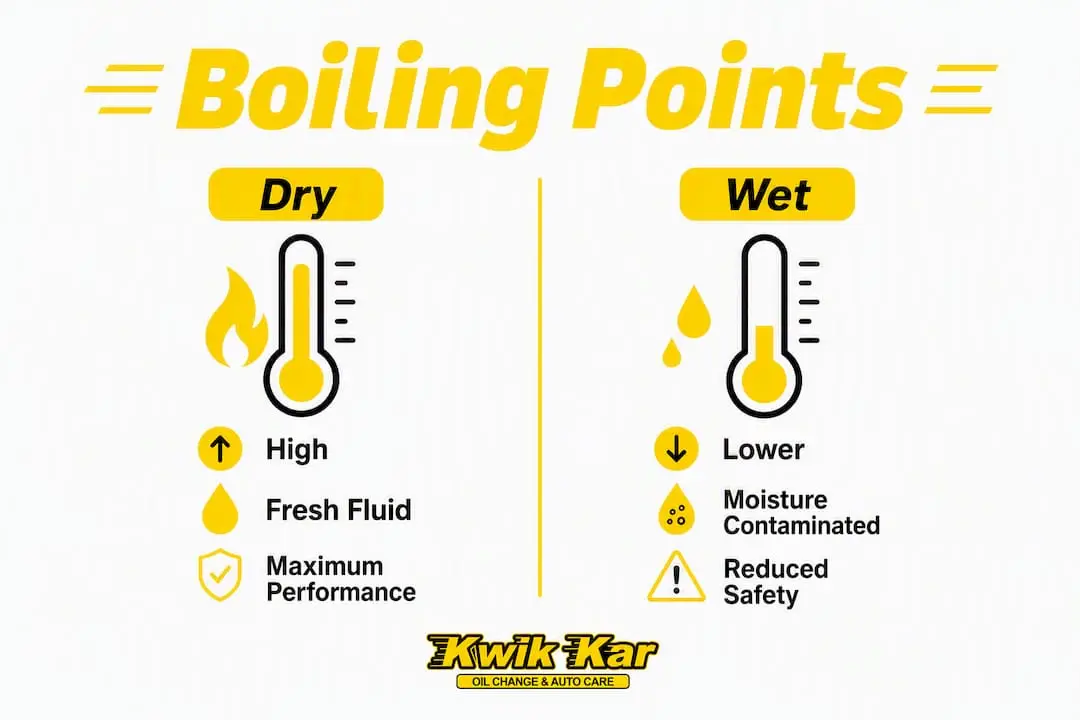
When fluid temperature exceeds its boiling point, vapor pockets form inside the lines. Gas compresses; liquid does not. Those pockets absorb pedal pressure instead of transmitting it, and the pedal travels toward the floor with little braking effect. Drivers call this brake fade. In a panic stop, it can mean the difference between stopping in time and not.
Hygroscopic behavior and internal corrosion
Glycol-based fluids (DOT 3, DOT 4, and DOT 5.1) are hygroscopic, meaning they actively absorb water vapor. Moisture enters through permeable rubber hoses and the reservoir vent cap over time. This is actually intentional by design: the fluid disperses moisture evenly throughout the system rather than allowing it to pool and corrode metal components locally. The trade-off is that the fluid’s boiling point degrades steadily, and the corrosion inhibitors inside the fluid break down as they do their job.
Once those inhibitors are depleted, internal corrosion accelerates. Calipers can seize. ABS modulator valves, which cost hundreds of dollars to replace, become vulnerable. Rubber seals degrade. None of this is visible from the outside.
Warning signs that demand immediate attention:
- Pedal feels soft, spongy, or sinks closer to the floor than usual
- Brake warning light illuminates on the dashboard
- Fluid in the reservoir looks dark brown, rusty, or cloudy
- ABS activates unexpectedly or behaves erratically
- Noticeable increase in stopping distance
Which brake fluid type does your car need?
DOT ratings are performance specifications set by the U.S. Department of Transportation, not brand names. The rating tells you the minimum boiling points a fluid must meet, not who made it.
| DOT Type | Dry Boiling Point | Wet Boiling Point | Hygroscopic? | Notes |
|---|---|---|---|---|
| DOT 3 | — | — | Yes | Glycol-based; common in older vehicles |
| DOT 4 | — | — | Yes | Glycol-based; most modern cars |
| DOT 5 | — | — | No | Silicone-based; NOT compatible with glycol systems |
| DOT 5.1 | — | — | Yes | Glycol-based; high performance, ABS-compatible |
The DOT rating your vehicle requires is printed in the owner’s manual and often stamped on the reservoir cap. Follow it.
Compatibility rules to know:
- DOT 3, DOT 4, and DOT 5.1 are glycol-based and generally compatible with each other, though mixing down (adding DOT 3 to a DOT 4 system) lowers overall performance
- DOT 5 is silicone-based and must never be mixed with glycol fluids; doing so causes the fluid to gel and can destroy seals
- When in doubt, use the exact DOT grade specified by the manufacturer
Pro Tip: Never assume that a higher DOT number is always better for your car. Some older seals and ABS systems are calibrated for DOT 3 or DOT 4. Using DOT 5.1 in a system not designed for it can cause seal swelling and leaks. Check the manual first.
What happens when brake fluid is low or old?
Low or degraded brake fluid is not a “monitor and wait” situation. A soft pedal, a rising brake warning light, or fluid that has turned dark are signals that your stopping system is already compromised. Driving on failing brakes puts you, your passengers, and everyone around you at risk. If your pedal sinks noticeably toward the floor, pull over safely and call for service — do not continue driving.
The degradation timeline tends to be quiet at first. Fresh fluid performs invisibly. As moisture accumulates over months and years, the wet boiling point drops without any dashboard warning. Brake fluid is a silent maintenance item that provides no obvious sensor alerts, so drivers often only notice problems after serious degradation has already occurred.
Early stage degradation shows up as a slightly softer pedal feel, easy to dismiss. As moisture content rises further, stopping distances increase. Under hard braking, vapor lock can cause a sudden, dramatic loss of pedal pressure. At the extreme end, seized calipers and failed ABS components become the repair bill. For a deeper look at signs of contaminated brake fluid, the pattern is consistent: the longer the fluid sits unchanged, the more expensive the eventual repair.
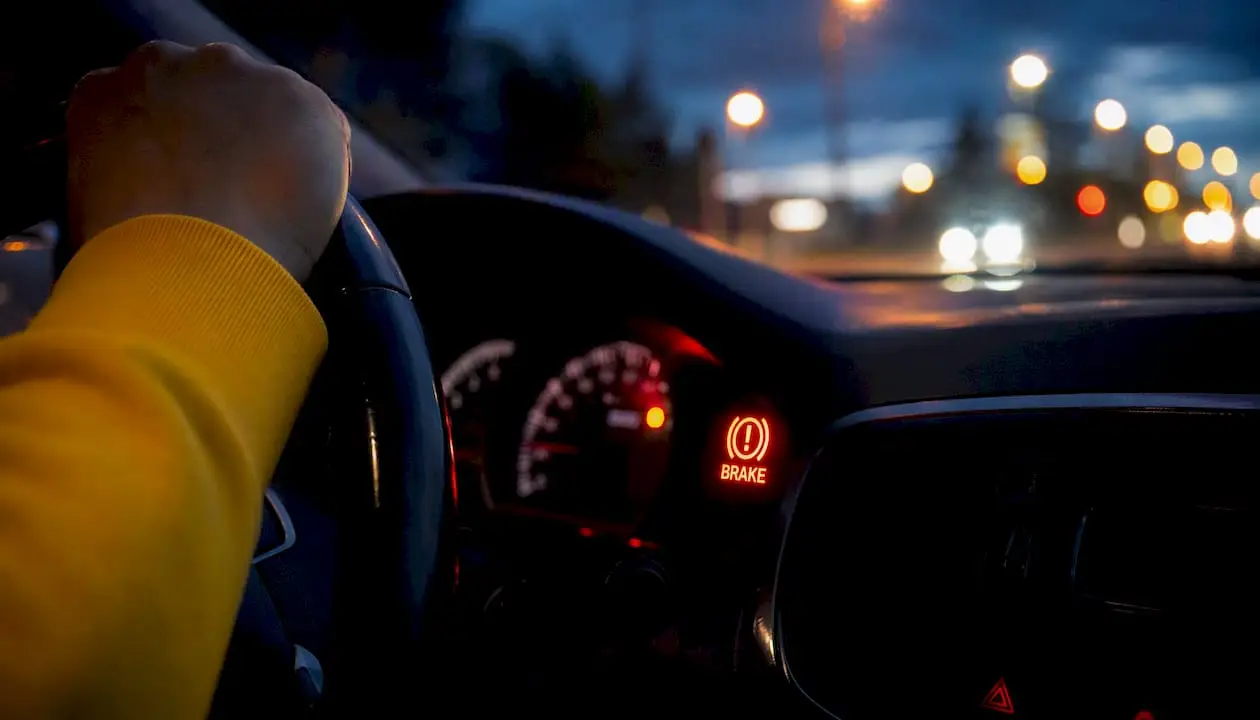
A low fluid level specifically can also indicate a leak in the system or worn brake pads (as pads wear, calipers extend further and draw more fluid from the reservoir). Either cause warrants prompt inspection.
How to check your brake fluid and when to call a pro
A quick visual check takes about two minutes and requires no tools.
- Park on level ground and let the engine cool for at least 10 minutes.
- Open the hood and locate the brake fluid reservoir, typically a small translucent plastic container near the firewall on the driver’s side.
- Check the fluid level against the MIN and MAX markings on the reservoir without removing the cap.
- If the level is between MIN and MAX, inspect the fluid color through the reservoir wall. Fresh fluid is clear to light amber. Dark brown or black fluid signals contamination.
- If topping up is needed, clean the cap and surrounding area before opening to prevent debris from entering. Add only the DOT grade specified in your owner’s manual.
- Replace the cap securely and check again in a week to confirm the level is stable.
For a more detailed walkthrough, checking your brake fluid level follows the same principles as inspecting other vehicle fluids.
Where DIY stops: Topping up is a temporary measure, not a fix. If the level keeps dropping, there is a leak. If the pedal feels spongy after topping up, air or moisture is in the lines and the system needs bleeding. Bleeding an ABS-equipped vehicle requires specific scan-tool procedures to cycle the ABS modulator valves; doing it incorrectly traps air rather than removing it. That work belongs at a shop.
Pro Tip: Color tells the story faster than anything else. Hold a white paper towel behind the reservoir. If the fluid looks darker than weak tea, it has been quietly failing you for a while. A shop with a moisture tester can confirm whether a flush is due or whether you have more time.
How often should you replace brake fluid?
Most manufacturers and shops recommend changing brake fluid every two years or around 30,000 miles, but that interval is a starting point, not a ceiling. Driving conditions matter significantly. Towing, mountainous terrain, track use, or frequent heavy braking all generate more heat and accelerate moisture absorption. In those cases, annual testing or shorter intervals make sense.
The smarter approach is objective testing. Shops equipped with moisture meters or boiling-point simulators can measure the fluid’s actual condition and recommend service only when the wet boiling point has dropped below safe limits for your DOT grade. That data-driven method avoids both unnecessary flushes and dangerous delays.
A professional brake-fluid flush is not an upsell. It drains contaminated fluid from the entire hydraulic circuit, including the ABS modulator and calipers, and replaces it with fresh fluid that meets your vehicle’s DOT specification. The cost of a flush is a fraction of what a seized caliper or failed ABS modulator costs to repair.
A professional flush at a qualified shop typically includes draining the old fluid, flushing the lines, refilling with fresh DOT-spec fluid, inspecting rubber brake lines for cracking or swelling, and checking the reservoir seal. For a full breakdown of what the service covers and how often to flush brake fluid, the interval guidance aligns with manufacturer specs and real-world driving conditions.
Pro Tip: Ask your technician to test moisture content before and after the flush. A shop that shows you the numbers is one that respects your ability to make an informed decision. ASE-certified technicians at Kwik Kar Oil Change & Auto Care use this approach as standard practice.
Key Takeaways
Brake fluid is a safety-critical hydraulic medium that degrades silently, and regular inspection or scheduled flushing is the single most effective way to protect your braking system.
| Point | Details |
|---|---|
| Core function | Brake fluid transmits pedal force as hydraulic pressure to calipers and wheel cylinders at each wheel. |
| Boiling point risk | DOT 4 wet boiling point drops significantly as moisture accumulates, creating vapor pockets and brake fade. |
| Hygroscopic degradation | Glycol-based fluids (DOT 3, 4, 5.1) absorb moisture over time, lowering boiling point and corroding internal components. |
| Service interval | Replace regularly as a baseline; shorten the interval for towing, mountain driving, or track use depending on conditions. |
| Professional service | Kwik Kar Oil Change & Auto Care’s ASE-certified technicians perform full brake-fluid flushes with moisture testing in Richardson, TX. |
Why brake fluid maintenance is the safety check most drivers overlook
There is a tendency in automotive maintenance to prioritize what is visible: oil that looks dirty, a tire that looks low, a belt that looks cracked. Brake fluid sits inside a sealed system with no color-coded dipstick and no dashboard sensor counting down to failure. That invisibility is exactly what makes it dangerous.
The conventional wisdom says “change it every two years,” and that is reasonable advice. But the more honest framing is this: most drivers have no idea what condition their brake fluid is in right now. They have never checked the color, never had it tested, and cannot remember the last time it was replaced. The fluid may be within spec or it may be well past it. Without a test, there is no way to know.
What concerns us most is the gap between when fluid starts failing and when a driver notices. That gap can be months. During that time, the system is operating with reduced thermal headroom, and one hard stop, one mountain descent, one emergency maneuver, could be the moment the fluid’s limits are reached.
Treating a brake-fluid flush as a routine safety check rather than an optional service is not overcaution. It is the same logic that drives oil changes: you do not wait for the engine to knock before changing the oil. The brake system deserves the same respect.
Brake service at Kwik Kar Oil Change & Auto Care in Richardson, TX
When your brake fluid is due for replacement, or when you are simply not sure of its condition, a professional inspection removes the guesswork. Kwik Kar Oil Change & Auto Care’s brake repair and fluid flush service in Richardson, TX includes a full hydraulic system inspection, moisture testing, complete fluid drain and refill to your vehicle’s DOT specification, and a check of brake lines and reservoir seals.
Every service is performed by ASE-certified technicians with transparent digital reporting so you see exactly what was found and what was done. Kwik Kar is recognized by CARFAX and RepairPal, and offers special pricing for military personnel and first responders. Schedule your brake-fluid inspection or flush online or by calling the Richardson location directly.
Useful sources
| Source | Description |
|---|---|
| Brake Fluid — Wikipedia | Technical overview of brake fluid chemistry, DOT classifications, and hydraulic principles |
| What Is Brake Fluid? — UTI | Accessible explanation of brake fluid function and types from a trade education institution |
| Brake Fluid Service Guide — Apex Tech Nation | DOT ratings, hygroscopic behavior, and flush procedures explained by automotive technicians |
| Brake Fluid: Do You Really Need It Every 2 Years? — High Speed Magazine | Analysis of interval recommendations and moisture-testing as an alternative to calendar-based service |
| Brake Fluid Flush Isn’t Just an Upsell — HowToGeek | Consumer-focused breakdown of why professional flushes protect ABS and caliper components |
| Brake Fluid: The Maintenance Item Everyone Forgets — TheAutowire | Safety-focused argument for proactive brake-fluid monitoring and testing |
FAQ
What happens when brake fluid is low?
Low brake fluid can cause a soft or spongy pedal, longer stopping distances, and, if a leak is the cause, eventual brake failure. A dropping fluid level also often signals worn brake pads or a hydraulic leak that requires immediate inspection.
What happens if you never change brake fluid?
Neglected fluid absorbs moisture over time, lowering its boiling point and allowing internal corrosion to damage calipers, ABS modulators, and seals. What starts as a spongy pedal can progress to seized components and repairs that cost significantly more than a routine flush.
Can you drive with low brake fluid?
Driving with noticeably low fluid is not safe. If the pedal feels soft or the brake warning light is on, pull over and arrange a tow or inspection rather than continuing to drive. A small top-up to the correct level is acceptable as a short-term measure if the level is just below the MAX mark and the pedal feels normal.
Can you just add brake fluid without flushing the system?
Topping up the reservoir restores the fluid level but does not remove contaminated or moisture-laden fluid already in the lines. If the fluid is dark or the pedal is spongy, adding fresh fluid on top of degraded fluid does not restore safe boiling-point performance. A full flush is the correct service in that situation.