0W-20 vs 5W-30: Which Oil Viscosity Fits Your Engine?

Use the viscosity your vehicle manufacturer specifies. 0W-20 is thinner than 5W-30, both when the engine is cold and when it is hot. It flows faster at start-up and creates less drag. 5W-30 holds a thicker film at operating temperature. Neither is better in general. The right one is the grade printed in your owner’s manual and on the oil filler cap.
At Kwik Kar Oil Change & Auto Care in Richardson, TX, we see both grades every day. This guide explains the difference, what happens if you pick the wrong one, and how to confirm what your engine needs. You can also call us at (972) 644-1851.
TL;DR
- 0W-20 flows more easily than 5W-30 in a cold start and is thinner at operating temperature. 5W-30 keeps a thicker film when hot.
- The manufacturer’s specification controls the choice. Engines are designed around a particular grade, so thicker is not automatically safer.
- Using a heavier or lighter grade than specified can affect fuel economy, wear and engine life.
- High mileage alone does not mean you need to switch. Check the manual first, then consider a high-mileage formula in the same grade.
- Not sure which grade your vehicle takes? A technician can confirm it at your next oil change.
Table of Contents
- What the numbers in 0W-20 and 5W-30 mean
- How they behave on a cold start
- How they behave at operating temperature
- What about 0W-20 vs 5W-20?
- Which oil viscosity should you use?
- What happens if you use the wrong viscosity?
- Can you mix 0W-20 and 5W-30?
- Does a high-mileage engine need 5W-30?
- Does viscosity affect fuel economy?
- Our perspective
- Oil changes at Kwik Kar Richardson
- A note on Texas inspections
- FAQ
- Book your oil change
- Sources
What the numbers in 0W-20 and 5W-30 mean
A viscosity grade is two readings in one label. The number before the W (for winter) describes how the oil flows in the cold. The number after the hyphen describes how the oil flows at normal operating temperature. Castrol explains that in both cases a lower number means the oil flows more easily.
Here is how that breaks down for the two oils you are comparing:
| 0W-20 | 5W-30 | |
|---|---|---|
| Cold rating (before the W) | 0W, rated for colder conditions | 5W, slightly less cold-flow ability |
| Hot grade (after the hyphen) | 20, thinner | 30, thicker |
| Typical tendency | Faster cold flow, lower internal resistance | Thicker hot film, more margin under heavy load |
The testing behind those numbers is specific. According to AMSOIL’s explanation of SAE J300, a 5W oil has to meet its cold-cranking limit at −30°C (−22°F), while 0W oils are rated for colder conditions. The hot grade is measured at 100°C (212°F), which approximates normal engine temperature.
Multigrade oils get this two-faced behavior from polymers. Mobil notes that these keep the oil fluid enough for a cold start while holding the viscosity needed at operating temperature.
For a deeper walk-through, see our guide to engine oil viscosity.
How they behave on a cold start
Most engine wear is a start-up story. When you turn the key, oil has to travel from the pan to the bearings, camshafts and valvetrain. Thinner oil gets there faster. Mobil says the W grade reflects cranking, starting and pumpability, and that lower W grades help an engine pump and start better in lower temperatures.
So 0W-20 should flow more easily than 5W-30 on a cold start, as Castrol’s grade guide describes.
What does that mean in North Texas? Our winters are mild compared with the northern states, but cold mornings still happen, and the oil spends the first minute or two well below operating temperature. The cold rating matters most when the oil is sitting in a cold pan overnight. For more on why seasonal temperatures change what your oil does, read our post on why winter oil changes matter. Cold snaps affect the body of the car too, and this guide to paintless dent repair in cold weather covers that side of it.
How they behave at operating temperature
Once the engine is warm, the second number takes over. 20 is thinner than 30. According to Castrol, 5W-30 generally forms a thicker oil film, while 0W-20 generally creates less pumping resistance.
Repsol describes the trade-off this way: 0W-20 offers faster cold flow and lower internal resistance, while 5W-30 offers a thicker hot film and a larger margin under high-load conditions. These are general tendencies. They are not guarantees for every oil or engine.
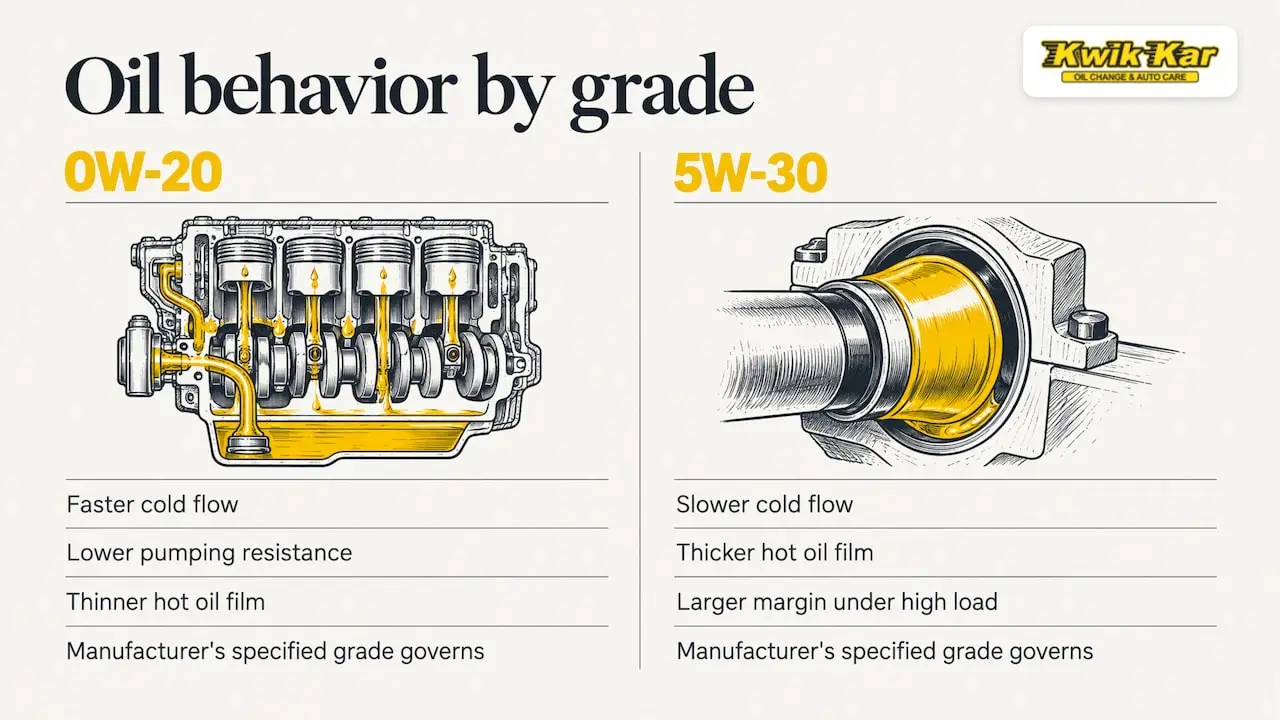
AMSOIL frames the same point as a balance between lower friction and fuel consumption on one side and a thicker lubricating film at high temperature on the other.
The key idea is that engines are built around a grade. Bearing clearances, oil pump output, variable valve timing and oil passages are designed with one viscosity in mind. A thinner oil in an engine built for it is not a compromise. It is the design.

What about 0W-20 vs 5W-20?
This is the other comparison people search for. Both oils have a hot grade of 20, so they are meant to have the same viscosity when warm. Castrol notes that 0W-20 stays slightly thinner and flows a little faster than 5W-20 during cold starts.
Castrol also points out that 5W-20 and 5W-30 have very similar cold-start viscosity because both carry the 5W rating. The difference between those two shows up when the engine is hot, where 5W-20 flows with less resistance.
In practice, the three oils line up like this:
- 0W-20: easiest cold flow, thin when hot.
- 5W-20: a little slower cold flow, same thin hot grade.
- 5W-30: a little slower cold flow, thicker hot grade.
Some manuals allow more than one of these. A 2017 Lexus RC300 manual, for example, lists 0W-20 as preferred and allows 5W-20 if 0W-20 is unavailable, with a return to 0W-20 at the next oil change. That is the manufacturer making the call, which is the point.
Which oil viscosity should you use?
Follow your manufacturer. The American Petroleum Institute’s Motor Oil Guide says to use the SAE viscosity and the API or ILSAC performance standard that the vehicle manufacturer recommends, and to consult the owner’s manual first.
Here is a simple way to confirm yours:
- Check the owner’s manual. Look under “fluids,” “capacities,” or “recommended lubricants.” Some manuals list one grade. Others list a temperature-based range.
- Look at the oil filler cap. Many engines print the grade on the cap. Treat it as a quick check, not a substitute for the manual.
- Match the performance standard too. The viscosity is only half of the label. The API or ILSAC rating on the bottle should meet what the manual calls for.
- Read the exceptions. A manual may allow a temporary alternative that should be replaced at the next oil change.
- Ask a technician if the manual is missing. Bring the year, make, model and engine size, and we can look up the specification.
Manufacturers do not all follow the same pattern, even within one brand. A Toyota technical bulletin from October 2013 shows some models requiring 0W-20 while specified exceptions continued to require 5W-20 or 5W-30. Extended 0W-20 intervals applied only to approved vehicles. Never assume your car matches the one next to it.
Two more habits help. Check the level between changes, and know how: our posts on checking oil hot or cold and engine oil level cover it. And do not apply a single mileage interval to every car. Follow the manufacturer’s schedule, and see our overview of how often to change oil.
What happens if you use the wrong viscosity?
The effects depend on the direction. Chevron Lubricants warns that the wrong viscosity can impede performance or lead to engine damage if the engine is not properly protected.
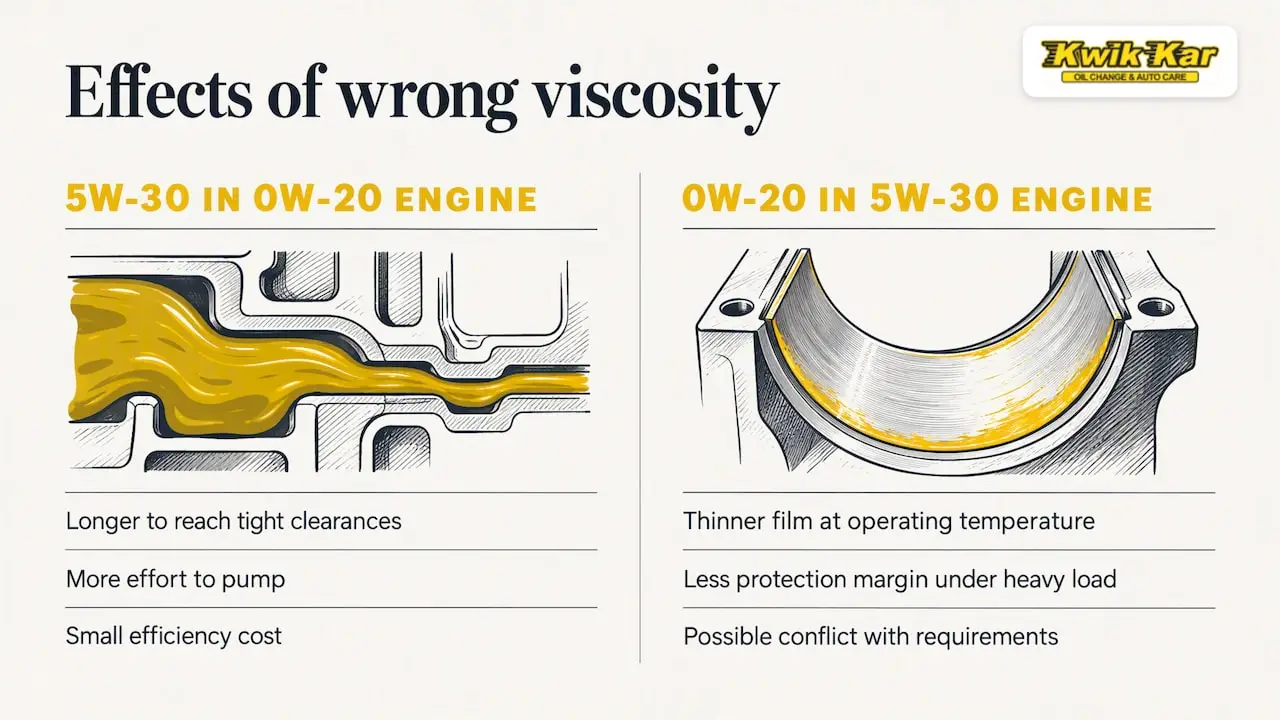
Putting 5W-30 in an engine that calls for 0W-20. The oil is thicker than the design assumed. It can take longer to reach tight clearances on a cold start, and the engine works a bit harder to pump it. Chevron notes that lower-viscosity oil generally requires less pumping effort, which can help fuel economy. The reverse suggests a small efficiency cost with thicker oil.
Putting 0W-20 in an engine that calls for 5W-30. The oil film at operating temperature is thinner than the engine was designed for. Under heavy load, towing or sustained high heat, that reduces the margin of protection the designers counted on.
Neither mistake usually causes a failure overnight. The concern is the long run: extra wear, lower efficiency and a possible conflict with the manufacturer’s requirements.
There is also a common belief that thicker oil always protects better. The research does not support a blanket rule. Protection depends on the oil reaching the right places quickly and holding the right film thickness for that engine.
Can you mix 0W-20 and 5W-30?
If you are a quart low and the only bottle on hand is the other grade, topping off will not instantly harm most engines. A small amount of a different grade blends into the oil already in the pan. It does change the overall viscosity slightly, and it does not make that grade acceptable.
Mobil explains that some multigrade oils are backward compatible, such as 0W-30 with 5W-30, but this does not replace the manufacturer’s specification.
Our practical advice:
- Top off only to get safely back to the full mark, and only as a short-term fix.
- Do not let the level stay low to avoid mixing. Low oil is the bigger risk.
- At the next change, have the oil drained and refilled with the specified grade.
Does a high-mileage engine need 5W-30?
Not automatically. Mileage does not change what the manufacturer specified. What helps older engines is often a formula designed for them in the correct grade. Mobil offers high-mileage oils for vehicles with more than 75,000 miles in 0W-20, 5W-20 and 5W-30 options.
If an older engine is burning oil or leaking, switching to a thicker grade may feel like a fix, but it is better to find the cause. We cover this in our post on high-mileage oil changes. If you are choosing between oil types as well, our guide on synthetic vs. conventional oil helps.
Does viscosity affect fuel economy?
It can, within the range the engine is designed for. Mobil says its 0W-20 product should only be used in vehicles designed for 0W-20 or 5W-20. It also says its fuel-economy claim of up to 2% for specified product comparisons depends on the vehicle, temperature, driving conditions and the oil you currently use, according to its fuel economy FAQ.
In other words, expect a small effect, not a dramatic one, and only when the grade matches the engine.
Our perspective
We get this question at the counter all the time, usually phrased as “which is better?” The honest answer is that the better oil is the one your engine was designed for.
Modern engines are built with tight tolerances, and the specified grade is part of that design. That is why we start with the manufacturer’s recommendation rather than a habit or a rule of thumb. If a vehicle calls for 0W-20, we use 0W-20. If it calls for 5W-30, we use 5W-30.
Our ASE-certified technicians look up the specification for each vehicle and use digital inspection reports so you can see what we see. Oil changes are also a chance to catch small problems, such as a seeping gasket or a low fluid, before they grow.
If you are ever unsure, ask. We would rather spend two minutes confirming a grade than have you guess.
Kwik Kar
Oil changes at Kwik Kar Richardson
We handle oil changes and preventive maintenance for drivers across Richardson, Plano, Garland, North Dallas and Addison. We confirm the manufacturer’s recommended viscosity for your vehicle, and our technicians can check fluids and note anything that needs attention. Military personnel and first responders may ask us about our discounts. You can read more about our team on our ASE and RepairPal certified technicians page.
If an oil light, a noise or a leak has you wondering about more than viscosity, our engine repair page explains what we can look at. Our 24-month/24,000-mile limited warranty applies only to qualifying repairs, and our Lifetime Suspension Warranty applies only to qualifying suspension repairs. Routine services are not all covered, so ask us what applies to your visit.
A note on Texas inspections
Oil questions often come up alongside inspection questions, so here is where things stand. Texas ended most non-commercial passenger vehicle safety inspections in 2025, and commercial safety inspections continue. Emissions testing remains required for qualifying vehicles in applicable counties. The Texas Department of Public Safety lists the affected counties, including Dallas and Collin counties, and says gasoline vehicles from 2 through 24 years old registered there receive the OBDII test. Check the DPS page for current rules for your vehicle.
FAQ
Is 0W-20 thinner than 5W-30?
Yes. Its hot grade is 20 instead of 30, so it is thinner at operating temperature. Its 0W rating also means it flows more easily in the cold. That makes it a good match for engines designed for it, and a poor substitute where 5W-30 is specified.
Can I use 5W-30 instead of 0W-20?
Only if your owner’s manual allows it. Some manuals list more than one approved grade, and others list one. If yours lists only 0W-20, stay with it. A thicker oil is not automatically more protective, and it can affect fuel economy and cold-start flow.
What happens if I use 10W-30 in an engine that calls for 0W-20?
The oil is noticeably thicker in the cold and when hot, so it is a bigger departure than 5W-30 would be. We advise against it unless the manufacturer approves it. Have a technician confirm the correct grade at your next service.
Is 5W-30 better for high mileage?
Not by default. Mileage does not override the manufacturer’s specification. A high-mileage formula in the grade your manual calls for is usually the better route. If the engine is leaking or burning oil, have it diagnosed instead of changing grade.
How do I find the right viscosity for my car?
Start with the owner’s manual and the oil filler cap. Match both the SAE grade and the API or ILSAC standard. If you cannot find it, call us with your year, make, model and engine, and we can look it up.
Book your oil change
If you would like the right oil in your engine, call Kwik Kar Richardson at (972) 644-1851 or schedule an appointment online. Bring your questions, and we will walk you through the grade your vehicle needs.
Sources
- Oil Viscosity Grades Explained, Castrol USA
- Motor oil bottle description, Mobil
- Viscosity designation, Mobil
- 5W-20 vs. 5W-30 vs. 10W-30, AMSOIL
- 0W-20 or 5W-30 oil: which one does your car use? Repsol
- API Motor Oil Guide
- Toyota technical bulletin, October 2, 2013
- 2017 Lexus RC300 owner’s manual
- Choosing the Right Viscosity, Chevron Lubricants
- Mobil 1 advanced fuel economy FAQs
- High Mileage Oil, Mobil
- Inspection Criteria for Emission Inspection, Texas DPS
- PDR in cold weather for car owners