R-1234yf vs R-134a, GWP 4 vs 1,430: What Richardson Drivers Should Ask
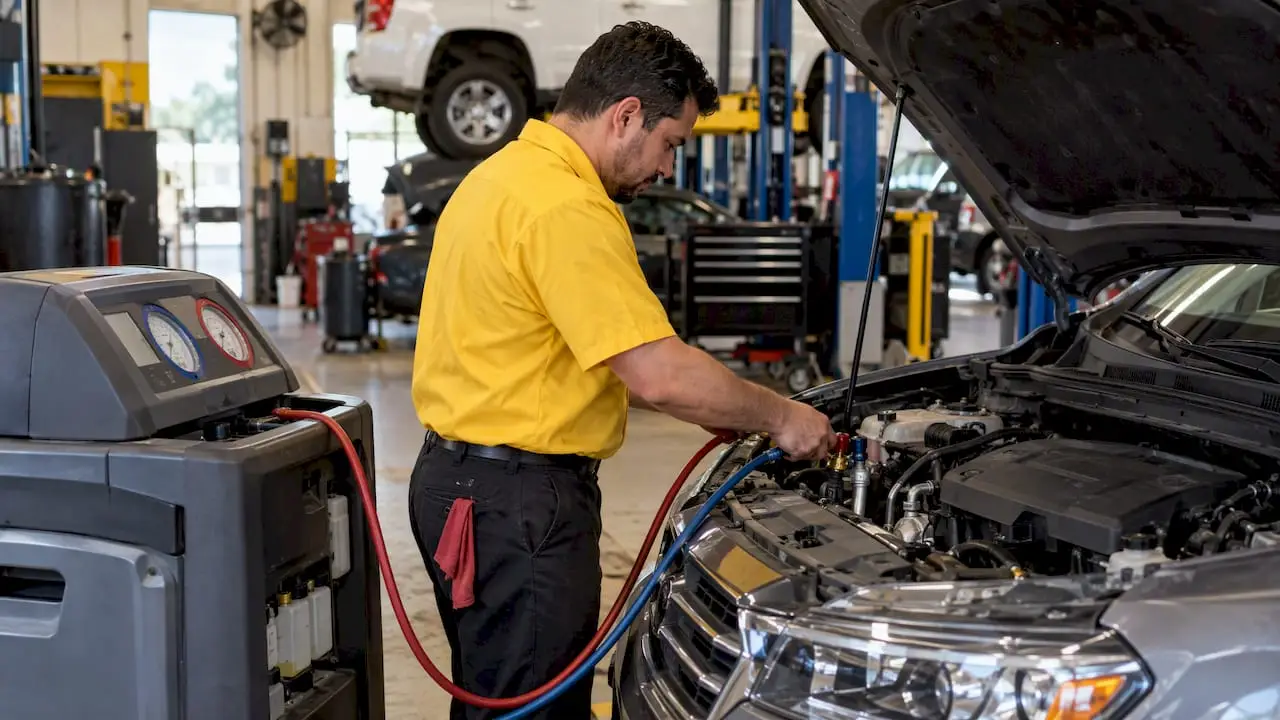
R-1234yf is the refrigerant that regulators and most automakers now favor, carrying a fraction of the climate impact of R-134a, but that environmental edge comes with real service tradeoffs. It is mildly flammable, requires different oils and recovery equipment, and costs more to buy and service. R-134a remains non-flammable and familiar to older systems, yet its much higher global warming potential is pushing it out of new vehicles. If your car needs AC work, confirm which refrigerant it uses and have a certified shop handle the job.
TL;DR:
- EPA figures put the 1234yf refrigerant’s global warming potential at about 4, compared with 1,430 for the 134a refrigerant; both have negligible ozone depletion potential.
- Before service, ask the shop to verify the underhood label, oil and charge weight specified by the manufacturer, and recovery equipment compatibility.
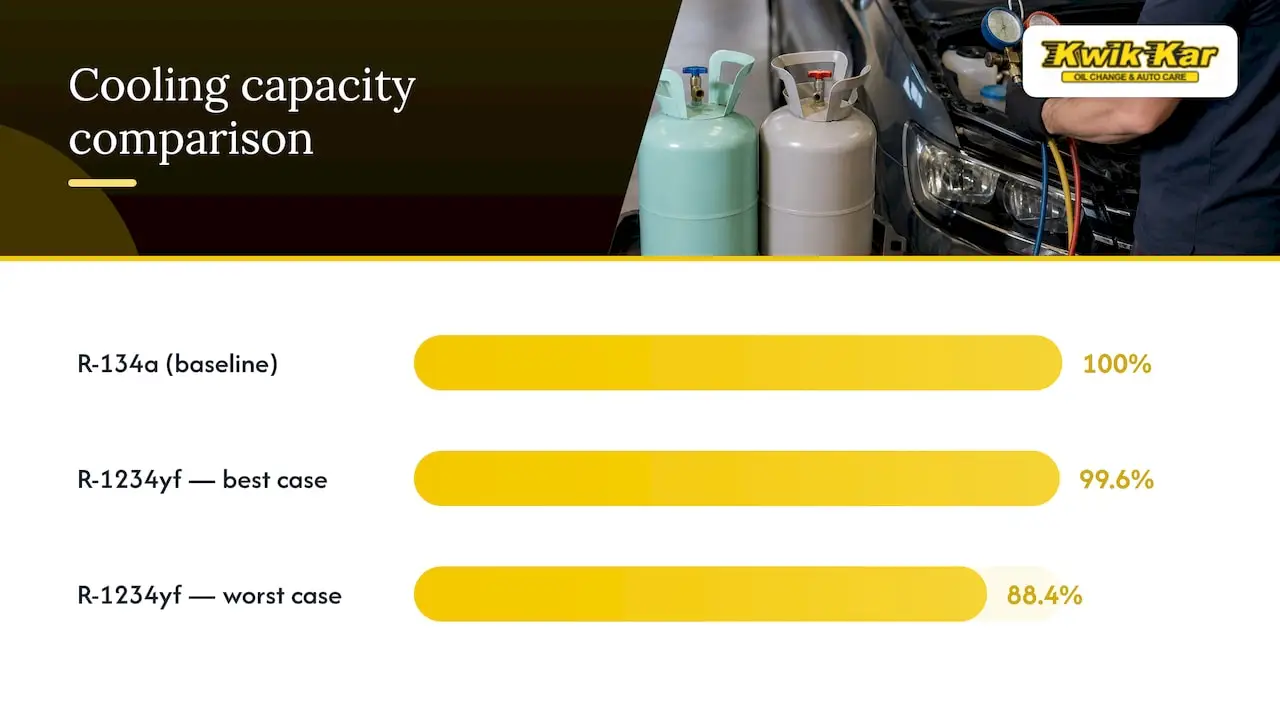
- Testing found 1234yf cooling capacity was 0.4% to 11.6% lower, depending on conditions, though everyday driving differences are often small.
- Because 1234yf is mildly flammable, choose a shop with dedicated recovery equipment, proper ventilation, and technicians trained in A2L procedures.
Table of Contents
- HFC vs HFO: Comparing the Environmental Footprint
- How Do Cooling Performance and System Compatibility Differ?
- What Does A2L Flammability Mean for Shops and Drivers?
- Why Does R1234yf Recharge Cost More Than R134a?
- A Practical Checklist Before Your Next AC Service
- How We Handle Both Refrigerants at Kwik Kar
- FAQ
- Sources
HFC vs HFO: Comparing the Environmental Footprint
R-134a belongs to the hydrofluorocarbon (HFC) family, a stable, non-flammable compound that cools effectively but lingers in the atmosphere for a long time. R-1234yf is a hydrofluoroolefin (HFO), a newer chemistry engineered to break down quickly once released. That difference shows up directly in global warming potential, a measure of how much heat a gas traps compared to carbon dioxide over a set period.
The gap is stark. R-1234yf carries a GWP of about 4, while R-134a sits at 1,430, according to the EPA’s SNAP program. That makes R-1234yf roughly 99.7% lower in climate impact, which is the main reason the EPA lists it as an acceptable substitute for mobile air conditioning systems and why most automakers adopted it starting with newer model years.
Both refrigerants have negligible ozone depletion potential, so the real story here is greenhouse gas impact, not the ozone layer. Regulatory incentives mattered as much as the chemistry itself.
- EPA SNAP approval cleared R-1234yf for use in new vehicle AC systems.
- Corporate fuel-economy and emissions credit programs rewarded automakers for switching early.
- The dramatic GWP reduction made R-1234yf the default environmental choice despite higher upfront costs.
R-1234yf’s GWP of about 4 versus R-134a’s 1,430 means a leak from an R-1234yf system does far less climate damage than the same leak from an older R-134a system, according to the EPA.
How Do Cooling Performance and System Compatibility Differ?
Lower emissions do not automatically mean identical cooling power. Compressor testing summarized in a Purdue research report found R-1234yf’s cooling capacity ran roughly 0.4% to 11.6% lower than R-134a’s depending on operating conditions, with coefficient of performance differences following a similar pattern. In everyday driving those gaps are often small, but they widen under specific test configurations or system designs.
The two refrigerants also are not interchangeable at the component level. R-134a systems typically use PAG oil, while R-1234yf systems often call for different PAG formulations or ester-based blends with distinct miscibility properties. Seals, fittings, and even the service ports differ by design to prevent accidental cross-contamination.
Before any AC service, a shop should:
- Read the underhood label to confirm which refrigerant the system was designed for.
- Verify the OEM-specified oil type and charge weight rather than assuming a standard fill.
- Confirm the recovery, recycling, and recharge (RRR) machine on hand is rated for that specific refrigerant.
Pro Tip: Always assume a salvage-title or previously repaired vehicle could have a mixed or mislabeled refrigerant system until a technician verifies it directly.
What Does A2L Flammability Mean for Shops and Drivers?
R-1234yf carries an A2L classification, meaning it has mild flammability under specific conditions, unlike the non-flammable R-134a. In practice, this risk is low when systems are serviced correctly, but it changes how a shop must handle the gas.
Properly equipped shops rely on dedicated ventilation, refrigerant-specific leak detection, and RRR machines built to SAE J2843 standards for A2L service. Spark-producing tools are kept away from recovery operations where flammable refrigerant may be present.
- Dedicated recovery equipment prevents cross-contamination between R-134a and R-1234yf systems.
- Leak detectors and ventilation reduce the chance of flammable vapor accumulation during service.
- Technicians handling R-1234yf need specific training on A2L precautions, not just general AC certification.
MACS service reports warn that contaminated RRR machines and mismatched oils or sealants can cause serious, costly damage to both the equipment and the vehicle’s AC system. Shops that verify refrigerant chemistry and use inline filters before recovery avoid the irreversible equipment damage described in those reports.
Why Does R1234yf Recharge Cost More Than R134a?
R-1234yf costs more to buy and to service, and that price difference traces back to a few straightforward factors. It is manufactured at smaller scale than long-established R-134a, and global demand from automakers switching over has kept pressure on supply. Patent licensing on the compound has also historically kept per-pound costs elevated compared to a commodity refrigerant like R-134a.
Shops factor in more than the gas itself; many also rely on quality remanufactured components like alternators and starters to keep vehicles running smoothly. Dedicated RRR machines built to A2L safety standards represent a real equipment investment, and that cost gets amortized into labor and service pricing over time.
- Manufacturing scale and patent licensing keep R-1234yf’s per-pound cost above R-134a’s.
- Regional phase-down rules, including restrictions in parts of Europe, can tighten supply and shift availability.
- Shop equipment costs for A2L-compatible RRR machines factor into what a recharge or recovery service costs.
Ask your shop whether refrigerant cost and equipment handling are included in a quoted price before authorizing AC work; our car AC recharge cost guide breaks down what typically factors into that estimate.
A Practical Checklist Before Your Next AC Service
Knowing the chemistry only helps if it changes what you do at the counter. A few simple steps protect both your wallet and your system.
- Check the underhood sticker or owner’s manual to confirm whether your vehicle uses R-134a or R-1234yf.
- Ask the technician directly whether their shop has refrigerant-specific RRR equipment for your system type.
- Confirm the oil replacement policy during service, since mismatched oil is a common cause of long-term AC trouble.
- Avoid unauthorized retrofits from R-134a to R-1234yf unless a qualified shop confirms your system’s seals, oils, and components support the switch.
Lean on a professional for anything involving the sealed system: evaporator replacement, compressor swaps, or refrigerant leak diagnosis all require recovery equipment and system knowledge most owners do not have at home. A small, correctly labeled top-off kit is a different story than opening a sealed system, but even that carries risk if you are unsure which refrigerant your car takes; our guide on common AC problems walks through which symptoms call for a shop visit versus a quick check at home.
How We Handle Both Refrigerants at Kwik Kar
We work on both R-134a and R-1234yf systems with diagnostic tools needed to verify refrigerant type before any recovery or recharge begins. We follow procedures to prevent cross-contamination between refrigerant types, including verifying oil chemistry and confirming equipment compatibility before servicing a vehicle’s AC system.
- We confirm refrigerant type from the underhood label before connecting equipment.
- We document findings through digital inspection reports you can review.
- Eligible repairs are backed with warranty coverage.
If your AC is blowing warm or you are not sure which refrigerant your system needs, schedule a visit through our AC recharge service in Richardson and we will confirm it before touching the system.
— Kwik Kar
FAQ
Why is R1234yf so expensive?
R-1234yf costs more largely because of smaller-scale manufacturing, patent licensing, and strong global demand as automakers transition away from R-134a. Shop pricing also reflects the cost of A2L-compatible recovery and recharge equipment required to service it safely.
What cars use R1234yf refrigerant?
Most vehicles built in recent model years use R-1234yf, since automakers shifted to it following EPA SNAP approval of the refrigerant for mobile air conditioning. Your specific vehicle’s underhood label will state which refrigerant it requires.
Can I use my R134a gauges on R1234yf?
No, R-134a and R-1234yf use different fittings and service port sizes specifically to prevent cross-contamination between the two systems. Attempting to force a connection risks damaging equipment or introducing the wrong refrigerant into a system never designed for it.
Are R134a and R1234yf pressures the same?
The two refrigerants have different pressure and temperature profiles, so a system designed for one is not simply rechargeable with the other. Technicians rely on refrigerant-specific gauges and OEM charge specifications rather than assuming shared pressure readings between the two.