What Role Do Oil Additives Play in Engine Protection?
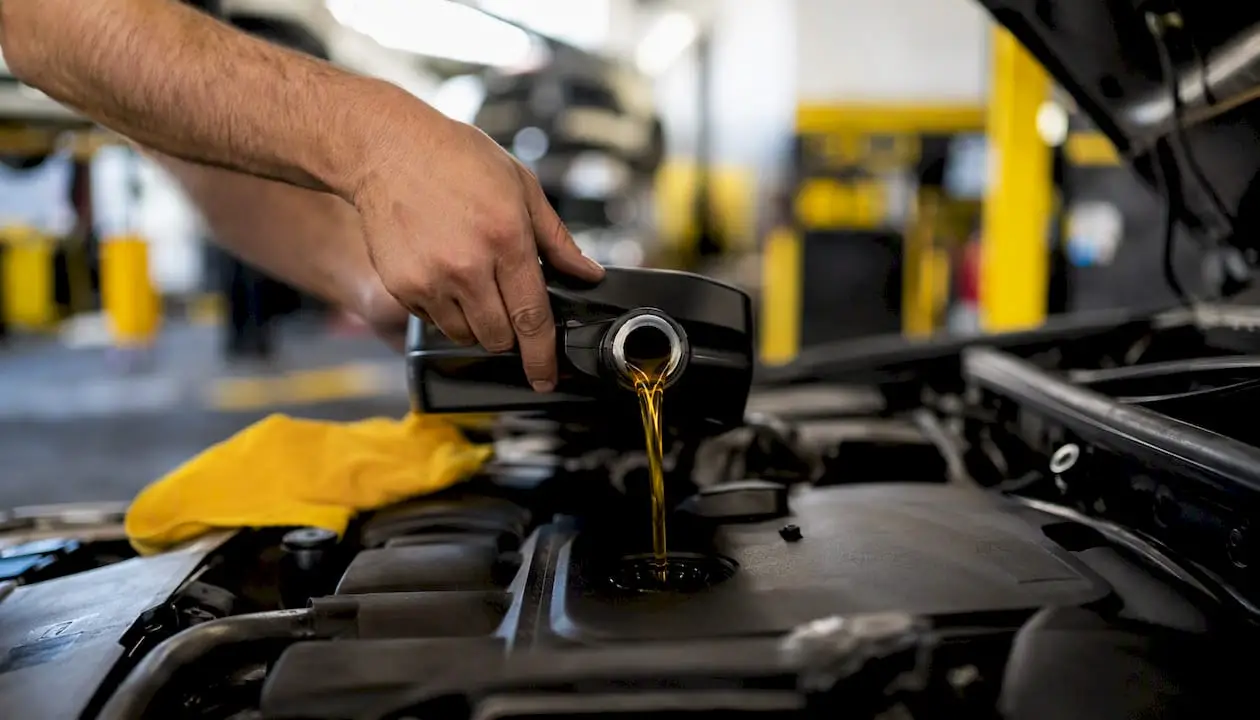
Engine oil additives are the active chemical ingredients that stop wear, block oxidation, neutralize acids, and keep contaminants suspended long enough for your next oil change to flush them out. Base oil alone, whether conventional or synthetic, cannot do this job. It lubricates, but it cannot fight the acids that form as it ages or the metal-to-metal contact that happens every time your engine starts cold.
The practical takeaway is simple: a properly formulated oil that matches your vehicle’s specifications, changed on schedule, is your best defense. Aftermarket “top-treat” additives poured in on top of that formulation are rarely necessary and can occasionally work against the balance formulators spent years dialing in. Nearly every commercial motor oil sold today already contains a complete additive package, engineered as a system, not a collection of random ingredients.
Here’s what that system actually does inside your engine:
- Anti-wear protection — ZDDP (zinc dialkyldithiophosphate) forms a sacrificial film on metal surfaces under load
- Oxidation control — antioxidants interrupt the chemical chain reactions that turn oil into sludge
- Acid neutralization — detergents with a measured Total Base Number (TBN) counteract combustion acids
- Contaminant suspension — dispersants keep soot and insolubles floating until the oil change removes them
- Viscosity stability — viscosity index improvers keep the oil flowing correctly across temperature swings
Each of those functions matters, and each one degrades at a different rate. Understanding how they work, and when they run out, is the difference between an engine that lasts 200,000 miles and one that starts burning oil at 90,000.
Key Takeaways
Properly formulated engine oil, changed on schedule, protects your engine more reliably than any aftermarket additive poured in between services.
| Point | Details |
|---|---|
| Additives work as a system | ZDDP, detergents, dispersants, and antioxidants each target a specific failure mode and are balanced together. |
| More isn’t better | Excess additive dosing can cause foaming, deposits, or seal problems instead of extra protection. |
| Oil analysis beats guesswork | Track TBN, viscosity, wear metals, and insolubles to know when protection is actually depleted. |
| OEM-spec oil is the default | Match your owner’s manual specification before considering any aftermarket product. |
| Aftermarket additives are exceptional-case tools | Reserve them for diagnosed problems confirmed by a technician, not routine use. |
If your vehicle is due for service or you want a technician to check for varnish, soot, or wear-metal buildup, schedule a full-service oil change with a certified team that checks the whole picture, not just the dipstick.
Table of Contents
- The Role of Oil Additives in Engine Protection: Core Classes
- How Do Engine Oil Additives Actually Work?
- Which Engine Parts Depend Most on Additive Protection?
- Why More Additives Isn’t Always Better Protection
- Do Aftermarket Oil Additives Actually Work?
- How Can You Tell When Additive Protection Is Running Out?
- How to Choose the Right Oil Formulation for Your Engine
- What’s the Right Approach to Additives and Engine Protection?
- A Shop’s-Eye View on Additive Questions
- Sources
- FAQ
The Role of Oil Additives in Engine Protection: Core Classes
An engine oil formulation typically runs 70% to 85% base oil, with the remainder made up of an additive package doing very specific jobs. No single additive can neutralize acid, suspend soot, and prevent metal wear at once. That’s why formulators blend distinct chemical classes, each tuned to a different failure mode.
Antioxidants slow oxidative breakdown, the process that thickens oil and creates varnish. They typically use phenolic or aminic (amine-based) chemistries and run at a variable small percentage of the formulation typically used in engine oils, according to a review of internal combustion engine lubricant additives published in Annals FIH.
Detergents, often metal-based compounds like calcium or magnesium sulfonates, neutralize acidic combustion by-products and keep piston surfaces free of lacquer.
Dispersants, commonly succinimide chemistries, keep soot, sludge, and oxidation by-products suspended in the oil rather than clumping together, at roughly 3% to 5% of formulation volume.
Anti-wear agents, dominated by ZDDP, form a protective film at metal contact points and typically account for 1% to 3% of the blend.
Viscosity index improvers (VIIs), such as olefin copolymers (OCP) or polymethacrylates (PMA), keep the oil’s flow characteristics stable from a cold start to full operating temperature.
Rounding out the package: friction modifiers (organic amphiphiles or molybdenum compounds) that reduce drag between moving parts, rust and corrosion inhibitors that guard against moisture damage during short-trip driving, anti-foam agents that prevent aeration from starving the oil pump, pour-point depressants that keep oil flowing in cold climates, seal conditioners that keep gaskets pliable, and extreme-pressure agents for heavily loaded contact points.
| Additive Class | Primary Function | Typical Share of Formulation |
|---|---|---|
| Viscosity index improvers | Maintain stable viscosity across temperatures | 5% to 10% |
| Detergents | Neutralize acids, prevent piston deposits | 2% to 5% |
| Dispersants | Keep soot and insolubles suspended | 3% to 5% |
| Anti-wear agents (ZDDP) | Form protective film at metal contact points | 1% to 3% |
| Antioxidants | Slow oxidation, prevent sludge and varnish | 1% to 3% |
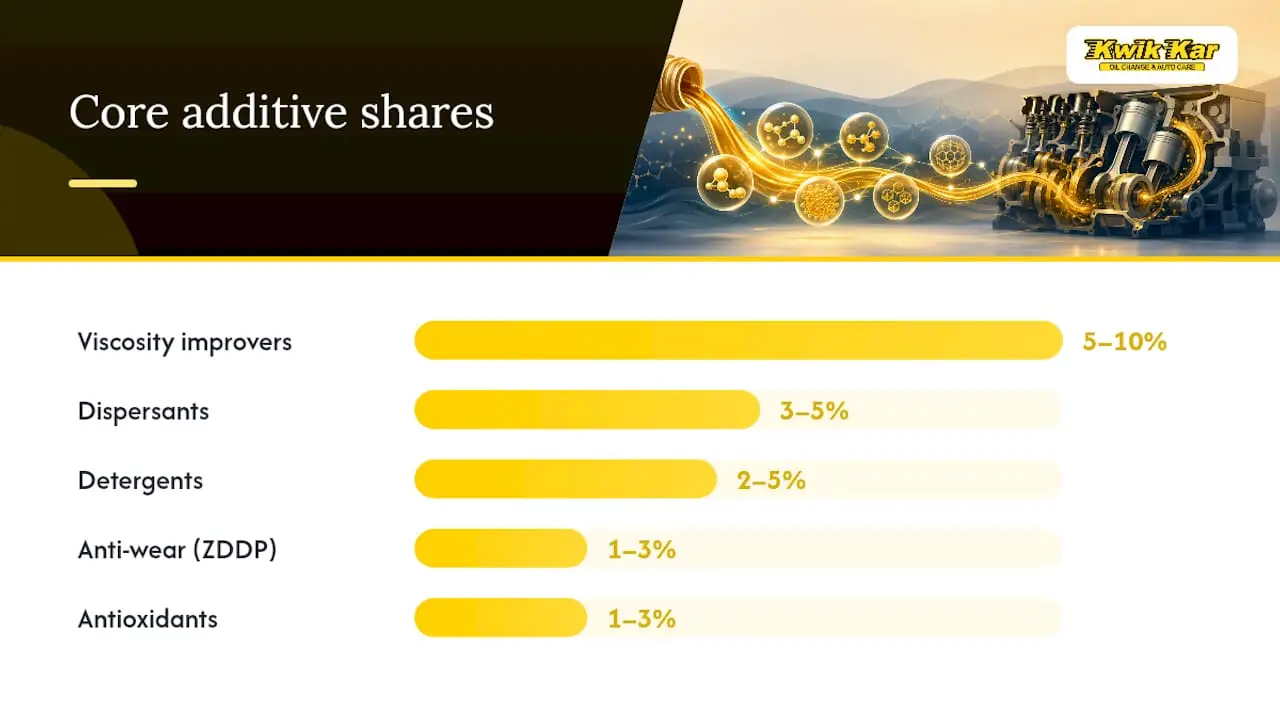
Those figures vary by oil grade and application, and diesel formulations in particular skew higher on detergent content to manage soot loading. But the pattern holds: core additive classes each target one degradation mode, and the finished product is a system where the classes are meant to complement, not compete with, one another.
How Do Engine Oil Additives Actually Work?
Anti-wear agents form tribofilms at high-temperature, high-pressure contact points, and that film is what separates metal surfaces before they can grind against each other. ZDDP is the workhorse here. Under boundary lubrication conditions, meaning the moments when oil film thickness collapses to near zero, ZDDP molecules decompose at the hot metal surface and build a glassy, load-bearing layer a few nanometers thick. The hotter and more heavily loaded the contact, the faster and stronger that film forms, which is exactly when your engine needs it most.
Friction modifiers work on a related but distinct problem: reducing drag in the mixed and hydrodynamic lubrication regimes, where a full oil film exists but friction still costs you fuel economy. Molybdenum-based compounds and organic amphiphile molecules orient themselves at the metal surface, creating a low-shear layer that lets components slide past each other with less resistance.
Antioxidants operate through a completely different chemistry. Oil oxidation is a radical chain reaction. Once it starts, one damaged molecule triggers the next, and the next, in a cascade that eventually produces the sludge and varnish that choke oil passages. Antioxidants intervene as radical scavengers, breaking that chain, and some formulations also decompose hydroperoxides before they can propagate further damage. This is the principal degradation pathway oil undergoes in service.
Detergents fight a third battle: acid neutralization. Combustion generates acidic by-products, and diesel engines in particular generate them from sulfur in fuel. Detergents carry an alkaline reserve, measured as Total Base Number, or TBN, that neutralizes those acids before they etch bearing surfaces or corrode cylinder walls. A fresh oil might carry a TBN in the range of 8 to 10 for a typical passenger car formulation, and that number falls steadily as the oil ages and the reserve gets consumed.
Dispersants handle what detergents leave behind. Soot particles, especially in diesel engines, are chemically inert; detergents can’t neutralize them. Dispersants instead surround those particles and keep them suspended in the oil rather than letting them agglomerate into sludge, and the two additive types work as a pair: detergents neutralize acids while dispersants handle particulate suspension, each covering what the other can’t.
Picture engine lubrication moving through three regimes, often called the Stribeck curve. At startup and under heavy load, you’re in boundary lubrication, where metal surfaces nearly touch and anti-wear films do the heavy lifting. As speed and oil film thickness increase, you move into mixed lubrication, a transition zone where friction modifiers earn their keep. At full operating speed and temperature, you reach hydrodynamic lubrication, where a complete oil film separates the surfaces and viscosity, not additive chemistry, controls protection.
No single additive covers all three regimes well, which is why a balanced package matters more than any individual ingredient. A formulation heavy on friction modifiers but light on anti-wear chemistry will perform beautifully on a dyno and fail during a cold start.
Which Engine Parts Depend Most on Additive Protection?
Bearings and cam lobes face the sharpest boundary-lubrication demands in the entire engine, particularly during cold starts when oil hasn’t reached full flow. This is ZDDP’s primary battleground. Without an intact anti-wear film, these surfaces experience adhesive wear within seconds of a cold start, and that damage accumulates invisibly over thousands of cycles.
Pistons and piston rings face a different threat: deposit formation. Combustion heat and blow-by gases push soot and partially oxidized fuel past the rings, and without detergents and dispersants working together, those deposits build lacquer on the piston skirt and can eventually cause ring sticking, which kills compression and lets oil consumption climb.
Valvetrain components, especially in overhead-cam designs with direct-acting followers, rely on both anti-wear film strength and friction-modifier chemistry to survive the highest contact pressures anywhere in the engine.
Turbochargers introduce a thermal dimension additives alone can’t fully solve. Oil sitting in a turbo bearing housing after shutdown can reach extreme temperatures, a phenomenon called coking, and antioxidant strength determines how well that oil resists breaking down under that heat soak before it can drain back to the pan.
Symptom-to-cause mapping is where this gets practical for you as a vehicle owner. Rising oil consumption paired with dark, varnish-like deposits on the dipstick usually points to oxidative degradation, meaning your antioxidant and dispersant capacity has run out before the oil change interval arrived. Bearing noise on a cold start that clears up after a few seconds often signals a weak or contaminated anti-wear film, sometimes from fuel dilution diluting the ZDDP concentration. Sludge visible under the oil filler cap, especially in a vehicle used mostly for short trips, points to moisture contamination overwhelming the corrosion inhibitors and dispersants together.
Why More Additives Isn’t Always Better Protection
Additive packages are optimized as a balanced system, and pouring an aftermarket product on top of that balance can cause foam, chemical antagonism, or new deposit formation instead of better protection. This is the single most misunderstood part of oil chemistry, and it’s why “more” is the wrong instinct even when the intention is good.
Some additive combinations genuinely help each other. Amine-based antioxidants paired with organo-molybdenum friction modifiers show real synergistic benefit, each reinforcing the other’s performance beyond what either delivers alone. But the reverse also happens. Certain dispersant chemistries can interfere with ZDDP’s ability to form its protective film, weakening anti-wear performance exactly when you’d expect the opposite. Formulators test these combinations extensively in bench trials precisely because higher dosages of individual additives can trigger deposit formation, seal incompatibility, or foaming rather than improved protection.
The practical risks worth knowing:
- Catalyst poisoning — excess phosphorus from ZDDP can shorten catalytic converter life over time, which is why modern low-SAPS (sulfated ash, phosphorus, sulfur) oils cap ZDDP concentration
- Aftertreatment fouling — high-ash detergents can accelerate diesel particulate filter (DPF) loading in modern diesel emissions systems
- Seal incompatibility — some aftermarket chemistries swell or shrink elastomer seals not designed for that additive
- Deposit formation — additives that break down chemically before the oil change interval can leave behind residues rather than protection
Pro Tip: Before adding any top-treat product, check your oil filter change history and, if you have access to lab testing, pull a used-oil sample first. A baseline TBN and wear-metal reading tells you whether you actually have a problem worth solving, rather than guessing based on mileage alone.
Do Aftermarket Oil Additives Actually Work?
Most modern, OEM-formulated engine oils already contain a complete and balanced additive package, and aftermarket top-treats rarely improve on that protection while introducing real risk of upsetting the balance. This isn’t a marketing opinion. It’s the practical conclusion that follows from how additive chemistry is engineered in the first place.
Industry sources are blunt about this. Analysts who cover lubricant chemistry professionally describe the “more additives equals more protection” idea as a misconception, pointing out that additives function at chemical thresholds. Once a protective concentration is reached, adding more doesn’t extend the benefit and can push the formulation past the point where it was tested for compatibility. The same source notes that following recommended oil-change intervals is frequently the more reliable route to protection than any bottle poured in between changes.
There’s also a documented history worth knowing about. Historical consumer investigations and inquiries from the Federal Trade Commission found that broad marketing claims made for some mass-market aftermarket additives lacked supporting evidence. That regulatory scrutiny is part of why a skeptical, evidence-first approach makes sense before you spend money on a product promising dramatic wear reduction or fuel economy gains.
That said, aftermarket additives aren’t universally pointless. A narrow set of legitimate use cases exists:
- Diagnosed varnish remediation, where oil analysis or visual inspection confirms existing deposit buildup and a technician recommends a targeted cleaning product before a fresh fill
- Specialty extreme-pressure needs in nonstandard duty cycles, such as heavily modified engines running loads outside what the OEM formulation anticipated
Even in those cases, the right move is consulting an ASE-certified technician first, not selecting a product off a shelf based on packaging claims. Emerging research on nanoparticle additives, including molybdenum disulfide and layered double hydroxide compounds, shows promising tribological improvements in lab settings, but those same reviews flag cost, environmental, and compatibility concerns that keep most of this chemistry out of retail products for now.
How Can You Tell When Additive Protection Is Running Out?
Oil analysis and symptom recognition are the only reliable ways to know when additive protection has been depleted. You cannot smell, see, or guess your way to that answer with any confidence, and waiting for a warning light means you’ve likely already lost a meaningful chunk of protective margin.
Several measurable indicators tell the real story:
- Falling TBN — a used-oil TBN reading dropping toward 2 or below signals the acid-neutralizing reserve is nearly exhausted
- Rising viscosity — often a sign of oxidation thickening the oil or soot loading beyond the dispersant’s suspension capacity
- Elevated insolubles — indicates dispersants are losing their ability to keep contaminants suspended
- Rising acid number — a direct measurement of acidic byproduct accumulation outpacing detergent neutralization
- Varnish potential (TEOST testing) — measures the oil’s tendency to form deposits under thermal stress, useful for high-mileage or turbocharged engines
- Wear-metal counts — iron, copper, and lead levels in a lab report reveal whether anti-wear films are holding up at bearings and cam surfaces
A practical maintenance sequence follows from those markers:
- Set a sampling frequency appropriate to duty cycle: fleet vehicles and heavy-duty diesels typically benefit from oil analysis every service interval, while passenger vehicles under normal use can sample less frequently or rely on manufacturer intervals.
- Shorten drain intervals for severe service: towing, short-trip city driving, extreme heat, or dusty conditions all accelerate additive depletion faster than the standard interval assumes.
- Replace the filter every time you change oil. A degraded filter recirculates the same insolubles the dispersants are working to suspend.
- Watch for early warning symptoms between changes: a rising oil level on the dipstick can mean fuel dilution; a falling level with dark deposits at the filler cap suggests oxidative stress.
- Consult a lab or service center if wear-metal counts trend upward across two consecutive samples, rather than waiting for a third data point to confirm the trend.
Pro Tip: If you’re pulling your own sample for lab analysis, draw it while the oil is warm, ideally right after a drive, not immediately after a cold start or after the vehicle has sat overnight. Sampling cold or after long idle periods biases the results and can mask a wear-metal trend that’s actually building.
Following proper oil-change intervals is what actually resets this whole system. Detergents and dispersants get consumed doing their job, and no amount of driving gentleness restores that reserve. Only fresh oil brings the additive package back to full strength.
How to Choose the Right Oil Formulation for Your Engine
Select oils that match your vehicle manufacturer’s specification and your actual service conditions, because finished oils are optimized packages tuned for specific applications, not generic lubricants. This is the single highest-leverage decision you can make for long-term engine protection, more impactful than any bottle you could add afterward.
Labels carry real information once you know how to read them. API service categories (like SP for current gasoline engines) tell you the oil meets minimum wear-protection and deposit-control standards for that engine generation. ACEA classifications, common on European vehicles, specify additional criteria around emissions-system compatibility and high-temperature stability. OEM approvals, stamped directly on the bottle for many European and some Asian manufacturers, indicate the oil passed that specific automaker’s in-house testing, which often exceeds the baseline API or ACEA requirement.
A simple decision tree covers most situations:
Normal daily driving calls for an OEM-spec multigrade oil at the viscosity your owner’s manual specifies. Don’t upsize viscosity “for extra protection” unless the manufacturer or a diagnosed condition calls for it. Heavy towing or high-soot diesel operation benefits from heavy-duty diesel oils formulated with higher TBN reserves to handle the acidic combustion byproducts that come with sustained load. High-mileage engines, generally past 75,000 miles, often do better with a formulation that includes seal conditioners to keep aging gaskets pliable, paired with the viscosity grade appropriate to any measured oil consumption.
Quick checks worth making before you buy: look for the TBN rating on diesel-rated oils, since diesel formulations should run noticeably higher than gasoline equivalents; check whether the product data sheet lists phosphorus content, which matters if you’re running a catalytic converter sensitive to ZDDP levels; and confirm the API or OEM approval symbol matches what your owner’s manual specifies, not just a general “for gasoline engines” claim on the front label. High-mileage formulations exist specifically to address the seal and consumption issues that show up as engines age.
What’s the Right Approach to Additives and Engine Protection?
The evidence points to one clear approach: rely on a properly formulated, OEM-spec oil changed on a disciplined schedule, and treat aftermarket additives as an exceptional-case tool rather than routine practice. That’s not a cautious hedge. It’s what the chemistry and the industry data both support.
Five specific actions put that approach into practice:
- Pick OEM-spec oils that match your owner’s manual specification, not the cheapest bottle carrying a compatible viscosity number
- Follow manufacturer drain intervals, and shorten them for severe service like towing, short trips, or extreme climates
- Use oil analysis for fleet or high-load vehicles where the cost of a lab report is trivial compared to the cost of an unplanned engine failure
- Consult an ASE-certified shop before adding any top-treat product, especially if marketing claims sound too dramatic to be backed by real bench testing
- Replace the filter at every oil change, since a clogged or degraded filter undermines everything the dispersant package is trying to accomplish
Certain situations genuinely warrant professional evaluation rather than a DIY decision. Vintage engines built before modern ZDDP-reduced formulations sometimes need a specialty oil with higher zinc and phosphorus content to protect flat-tappet camshafts. Diagnosed varnish or sludge conditions call for a technician-guided remediation plan, not a random bottle from the auto parts aisle. And engines running unusual duty cycles after modification, whether that’s a turbo upgrade or a fleet vehicle repurposed for heavier loads than it was speced for, deserve a formulation review against the new demands rather than an assumption that the factory-recommended oil still applies.
A Shop’s-Eye View on Additive Questions
Kwik Kar Oil Change & Auto Care fields additive questions from customers constantly, usually framed as “should I add something to make my oil last longer?” The honest answer, almost every time, is that a full-service oil change already does that job better than anything poured in from a bottle. Our ASE-certified technicians check for varnish buildup and abnormal soot levels during every service, and when a vehicle’s history or symptoms call for it, we recommend oil analysis rather than guessing.
What restores the additive package isn’t a supplement. It’s a complete drain, a fresh filter, and new oil matched to the manufacturer’s specification, backed by an inspection that catches problems the additive chemistry alone can’t fix, like a failing PCV valve dumping extra blow-by into the crankcase or a coolant leak diluting the oil. That combination, done consistently on schedule, is what keeps an engine’s protective chemistry at full strength between visits.
Sources
- Oil additive
- The Chemistry and Function of Lubricant Additives (STLE reference chapter)
- Lubricant Additives – 12 Critical Mechanisms Enhancing Tribological Performance – About Tribology
FAQ
Are oil additives good for your engine?
The additives already built into a properly formulated engine oil are essential and protect your engine effectively. Aftermarket additives poured in on top of that formulation are usually unnecessary and can occasionally disrupt the balance formulators engineered into the oil.
What is the best oil additive for engine protection?
The most effective “additive” strategy is choosing an oil that meets your vehicle manufacturer’s specification, since that oil already contains a balanced package of anti-wear, antioxidant, and detergent chemistry tuned for your engine. No standalone bottled product outperforms a correctly matched, full-service oil change.
What are the main functions of oil additives?
Oil additives neutralize acids, form protective wear films, keep soot and sludge suspended, resist oxidation, and stabilize viscosity across temperature swings. Each function comes from a distinct chemical class working alongside the others.
What are the five main types of oil additives?
The core classes most commonly discussed are antioxidants, detergents, dispersants, anti-wear agents like ZDDP, and viscosity index improvers, though full formulations also include friction modifiers and corrosion inhibitors. Each class targets a different degradation mode inside the engine.