Slipping Transmission Symptoms: What They Mean and What to Do

A slipping transmission happens when the engine revs up but the vehicle does not gain speed to match, or a gear fails to engage at all. Three signs give you the clearest read on whether that is what’s happening under your hood right now:
- RPM spike or gear flare: the tachometer jumps but your speed lags behind
- Delayed engagement: you shift into Drive or Reverse and the car hesitates before it moves
- Loss of drive: the transmission feels like it’s slipped into neutral, especially under acceleration or on a hill
If any of these sound familiar, pull over when it’s safe, avoid towing or hauling anything heavy, and check the fluid level only if you can do it without risk. That single check often tells you more than the symptom itself.
Key Takeaways
Slipping transmission symptoms almost always trace back to one of four causes: low or burnt fluid, worn clutch packs, a failed solenoid or TCM, or torque converter damage, and only a fluid check plus an OBD scan can tell you which.
| Point | Details |
|---|---|
| Watch the tachometer | An RPM spike without matching speed is the clearest sign of a true slip, not an engine issue. |
| Check fluid color first | Bright red is healthy; dark brown or black with a burnt smell signals internal clutch damage. |
| Solenoid faults mimic slipping | A failed solenoid often costs far less to fix than an internal rebuild, so scan for codes before assuming the worst. |
| Cost ranges vary widely | Repairs run from about $100 for fluid or solenoid service to $8,000 or more for a full rebuild. |
| Get a professional diagnostic | Kwik Kar Oil Change & Auto Care runs OBD scans, fluid analysis, and stall tests before quoting any repair. |
Table of Contents
- What Slipping Transmission Symptoms Actually Feel Like
- What Causes Slipping Transmission Problems?
- How Do You Diagnose a Slipping Transmission?
- How Much Does It Cost to Fix a Slipping Transmission?
- Preventing Transmission Slipping Before It Starts
- Sources
- FAQ
What Slipping Transmission Symptoms Actually Feel Like
Recognizing slipping transmission symptoms is one thing. Describing them accurately to a technician is another, and it’s the difference between a fast diagnosis and a guessing game. Here’s how each symptom actually presents itself behind the wheel.
- RPM spikes and gear flares. Watch your tachometer during acceleration. If it jumps unexpectedly, hovers high, then drops as the transmission catches back up, that’s a flare. It’s the transmission equivalent of a wheel spinning on ice. One detail worth remembering: drivers often mistake an engine misfire for a transmission slip, but a true slip shows an unprompted RPM spike with no matching increase in speed, not a stumble or shake from the engine bay.
- Delayed or rough engagement. You shift into Drive, and there’s a pause, a clunk, or a lurch before the car actually moves. Some vehicles lose that familiar creep forward at idle entirely.
- Hard or jerky shifts. Gear changes that used to be smooth now feel abrupt, or the transmission seems to hunt between gears on a hill or under load.
- Smells and sounds. A burnt, slightly sweet odor from under the hood usually means the fluid has cooked past its usable life. Whining or grinding noises, especially in reverse, point toward internal wear.
- Visible leaks. A reddish puddle under the front-center of the vehicle is one of the earliest, cheapest-to-catch warning signs there is.
Higher-than-normal engine revs without matching acceleration, along with rough shifting and burning odors, are the textbook combination AutoZone points to when identifying a slip. If you’re noticing two or more of these together, you’re not imagining it.
What Causes Slipping Transmission Problems?
Every slip has a mechanical or electrical root, and figuring out which one you’re dealing with changes the entire repair conversation.
- Low or contaminated fluid reduces hydraulic pressure inside the transmission, which prevents clutch packs from clamping down properly. This is the most common and cheapest cause to fix, provided you catch it early.
- Worn friction material or torn piston seals inside the clutch packs cause a persistent mechanical slip that no fluid top-up will solve. A torn seal can let hydraulic force bypass the clutch pack entirely, which explains why some vehicles slip even when the fluid level checks out fine.
- Failed solenoids or a faulty transmission control module (TCM) create symptoms that look identical to internal slipping, but they’re often a fraction of the cost to repair since no internal teardown is required.
- Overheating accelerates all of the above. Heat breaks down fluid faster, degraded fluid slips more, and slipping generates more heat. It’s a cycle that gets worse the longer it runs.
Overheated fluid is frequently the tipping point that turns a manageable issue into a rapid failure, which is exactly why the diagnostic order matters as much as the diagnosis itself.
How Do You Diagnose a Slipping Transmission?
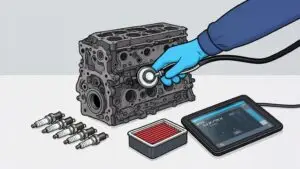
Start with what you can safely check yourself, then let a shop confirm it with tools you don’t have at home.
Step 1: Visual and dipstick check. Look under the vehicle for fresh leaks, then check the transmission fluid level and condition if your vehicle has an accessible dipstick (many modern automatics don’t). Note the color and smell before you do anything else.
Step 2: Stationary engagement test. With the vehicle safely parked and the brake firmly applied, shift from Park to Drive, then to Reverse, and note the delay. A hesitation longer than roughly two seconds often points to a hydraulic pressure deficit that a simple top-up won’t fix.
Step 3: Road observation. Watch the tachometer against your speedometer during acceleration. CVT-equipped vehicles can feel like a “rubber band” stretching before power catches up, which is normal for that transmission type but worth distinguishing from an actual flare.
Step 4: Professional diagnostic tools. A shop will run an OBD/TCM scan for codes like P0730 (incorrect gear ratio), P0750 through P0770 (solenoid circuit faults), or P0218 (transmission overheating), then verify solenoid resistance and perform a stall test to isolate the cause.
Fluid color tells its own story, and it’s often the fastest triage tool available:
| Fluid Appearance | Smell | Likely Condition |
|---|---|---|
| Bright red, clear | Neutral, faintly oily | Healthy, no immediate concern |
| Light brown | Mild, slightly acrid | Aging, due for a fluid exchange soon |
| Dark brown or black | Burnt, sharp | Clutch burnout or internal damage likely |
Pro Tip: Bring a photo of your dipstick fluid to the shop if you can. Techs can often narrow down the likely cause before the car even hits the lift.
Checking fluid level, condition, stored codes, and solenoid resistance together lets you isolate whether you’re facing a $150 fix or a five-figure repair, according to Expert Auto Guide’s diagnostic breakdown.
How Much Does It Cost to Fix a Slipping Transmission?
Cost depends entirely on which cause you’re dealing with, and that’s why skipping the diagnostic step is the most expensive mistake you can make.
- Fluid service, solenoid replacement, or minor electrical repair: roughly $100 to $800
- Torque converter repair or partial rebuild: roughly $800 to $2,500
- Full transmission rebuild or replacement: roughly $1,500 to $8,000 or more
Repair costs genuinely do range from a $150 fluid service up to an $8,000-plus replacement, and the gap between those two numbers is exactly why early action pays off.
Stop driving and arrange a tow rather than limping to a shop if you notice complete loss of drive, a burnt smell combined with visible slipping, or grinding noises under load. Those combinations suggest the clutch packs are already sustaining damage every mile you continue. On the other hand, catching a brief RPM flare early and getting a fluid check and diagnostic scan done promptly is often what separates a $150 fix from a rebuild.

Preventing Transmission Slipping Before It Starts
Most slipping issues are preventable, and the maintenance involved is simpler than most owners expect.
- Follow your manufacturer’s specified fluid type and exchange interval rather than a generic mileage rule, since the wrong fluid type can cause slipping on its own.
- Fix small leaks the moment you spot them. A drip today is a fluid-starved clutch pack in six months.
- Avoid towing heavy loads without an auxiliary cooler, and give the vehicle a break if you notice the temperature gauge climbing during hard driving.
- Schedule periodic OBD scans and fluid inspections even when nothing feels wrong. Solenoid faults often show up in stored codes before you ever feel a flare.
A proper transmission flush on the manufacturer’s schedule, paired with routine fluid checks, catches most of this before it becomes a repair bill.
What Happens During a Professional Transmission Diagnostic
At Kwik Kar Oil Change & Auto Care, ASE-certified technicians run the full diagnostic sequence before recommending anything.
- OBD/TCM code scan and solenoid resistance testing
- Fluid color, smell, and level inspection
- Stationary engagement and stall tests, followed by a lift inspection when warranted
You get a written estimate, straightforward answers, and transparent pricing, plus discounts available for military members and first responders.
A Note on Getting an Honest Diagnosis
Too many drivers assume a slip automatically means a rebuild, and that assumption alone probably costs owners more than the actual mechanical problem does. A solenoid fault and a burnt clutch pack can feel almost identical from the driver’s seat, but the repair bill between them is night and day. The only way to know which one you’re facing is to have someone actually run the codes, check the resistance, and inspect the fluid before quoting a number. Anyone who prices a transmission job over the phone without that information is guessing, and you deserve better than a guess when the number on the invoice could run into the thousands.
— Kwik Kar
Book a Transmission Diagnostic With a Written Estimate
There’s a real cost to guessing at a transmission problem, and it’s not just money. It’s the risk of driving on a clutch pack that’s already failing while you wait to find out for sure. Kwik Kar Oil Change & Auto Care runs a complete diagnostic on every vehicle that comes in with slipping symptoms: an OBD scan, fluid inspection, a test drive to confirm the pattern, and a written estimate before any work begins.

ASE-certified technicians handle the diagnosis, so you’re getting dealership-level accuracy without dealership pricing, backed by warranty coverage on the repair itself. Military members and first responders receive dedicated discounts on service. If your car is showing any combination of RPM flares, delayed engagement, or a burnt smell, schedule a transmission diagnostic at Kwik Kar Oil Change & Auto Care and get a clear answer, and a clear price, before you decide on next steps.
Sources
- How to Diagnose a Slipping Transmission: A DIY Guide — Expert Auto Guide
- Signs your transmission is about to fail — USA Today
- What is transmission slipping? — AutoZone DIY
FAQ
What Can Be Mistaken for a Slipping Transmission?
An engine misfire is the most common mix-up, since both can feel like a loss of power. The key difference is that a true slip shows an RPM spike with no matching speed increase, while a misfire usually comes with shaking or stumbling from the engine itself.
How Do You Fix a Slipping Transmission?
The fix depends on the cause: a fluid service or solenoid replacement handles the cheaper, more common cases, while worn clutch packs or torque converter damage require a partial or full rebuild. An OBD scan and fluid inspection determine which repair path applies before any work starts.
Can You Drive a Car If the Transmission Is Slipping?
Short trips at low speed may be possible, but continued driving risks turning a fluid or solenoid issue into clutch pack damage that requires a full rebuild. Stop driving and arrange a tow if you notice complete loss of drive, a burnt smell, or grinding under load.
How Expensive Is It to Fix a Slipping Transmission?
Costs range from about $100 to $800 for fluid service or solenoid repair, $800 to $2,500 for torque converter work, and $1,500 to $8,000 or more for a full rebuild or replacement. The final number depends entirely on what the diagnostic scan and fluid inspection reveal.