Drain and Fill vs Flush: Safe Transmission Fluid Service in Richardson
Most automatic transmissions should be checked by 100,000 miles, and many benefit from a fluid change well before that if you tow, drive stop-and-go traffic, or live somewhere hot. Manual and CVT transmissions run on shorter clocks, often 30,000 to 60,000 miles. Automakers market some fluids as “lifetime,” but that term usually means the life of the warranty, not the life of your transmission. If you plan to keep your vehicle for the long haul, an expert service center can check your fluid condition and tell you exactly where you stand.
TL;DR:
- Transmission fluid should be checked by 100,000 miles for automatics, with more frequent service advised if towing, Stop-and-go driving, or high temperatures are common.
- Manual and CVT transmissions require fluid changes sooner, typically between 25,000 and 60,000 miles, with CVTs needing proprietary fluids to prevent damage.
- Signs of degraded transmission fluid include burnt smell, dark color, delayed engagement, slipping gears, and unusual noises, which demand prompt attention.
- Flushing systems can dislodge deposits and cause damage in high-mileage units, so staged drain-and-fill is the safer choice for vehicles with uncertain service history.
- Regular inspections and conservative servicing are critical for long-term transmission health, especially beyond 150,000 miles, to avoid costly repairs and ensure safety.
Table of Contents
- How Often Should You Change Transmission Fluid?
- What Are the Warning Signs of Bad Transmission Fluid?
- Drain-And-Fill Vs. Flush: Which Service Method Is Safer?
- Should You Shorten Your Fluid Change Interval?
- Why Does Driving Style Affect Transmission Fluid Life?
- What Happens if You Never Change Your Transmission Fluid?
- How Do You Avoid Unnecessary Transmission Services?
- Kwik Kar’s Approach to Transmission Fluid Service
- Schedule Your Transmission Fluid Check in Richardson
- Sources
- FAQ
How Often Should You Change Transmission Fluid?
The honest answer depends on what kind of transmission you’re driving and how you drive it. There’s no single number that applies to every vehicle on the road, but there are ranges you can trust.
Manual transmissions tend to need attention sooner because the gear-to-gear contact generates more metal shavings and heat than an automatic’s hydraulic system. Many manufacturers recommend a change within a moderate mileage range often between 30,000 and 60,000 miles, though some heavier-duty manual gearboxes stretch that window further.
Automatic transmissions cover a much wider historic range, from roughly 30,000 miles on older designs up to a high mileage point on modern units built with better seals and synthetic fluids. Cars, even on vehicles the manufacturer labels as “lifetime fill.” That label almost always refers to the fluid lasting the length of the factory warranty, not the life of the vehicle.
CVT transmissions are pickier than either of the above. They rely on a belt-and-pulley system that’s sensitive to fluid viscosity and friction properties, so most manufacturers set moderate service intervals often in a lower mileage range and specify a proprietary fluid. Using the wrong fluid type in a CVT isn’t a minor mismatch. It can cause slipping, shuddering, or premature belt wear.
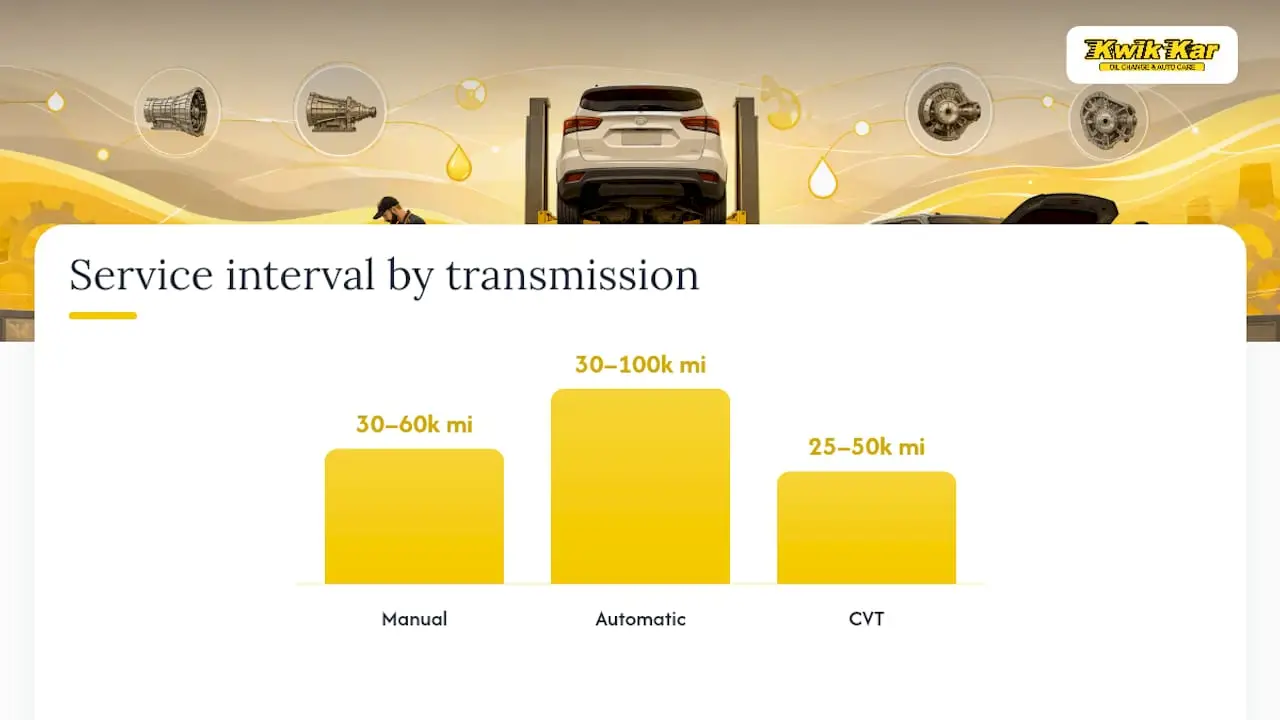
Here’s a quick reference for planning purposes:
- Manual transmissions: 30,000 to 60,000 miles, sooner if you drive aggressively or tow.
- Automatic transmissions: 30,000 to 100,000 miles depending on make, model, and fluid type.
- CVT transmissions: 25,000 to 50,000 miles, always with the manufacturer-specified fluid.
- Heavy-duty and commercial transmissions (like those found in fleet trucks): governed by duty-cycle schedules rather than flat mileage, often measured in hours or months as much as miles.
Commercial operators running Allison-equipped trucks or vans should know their maintenance schedules aren’t one-size-fits-all either. Allison’s own service literature ties fluid and filter intervals to duty cycle, meaning a delivery van idling in traffic all day needs different attention than a highway hauler covering long, steady routes. Fleet managers get more precision by pairing that schedule with fluid analysis rather than guessing from an odometer reading alone.
Your owner’s manual is still the right starting point for any passenger vehicle. If you plan to keep your car past the 100,000-mile mark, the safer play is to treat that manual’s interval as the outer limit, not the ideal one, and get the fluid inspected sooner rather than later.
What Are the Warning Signs of Bad Transmission Fluid?
Your transmission fluid tells its own story, mostly through color and smell, and your car tells the rest through how it shifts. Catching these signs early is the difference between a routine service and a rebuilt transmission.
- Check the color first. Fresh fluid runs bright red and slightly translucent. As it ages, it shifts to light brown, then dark brown, and finally black when it’s badly burnt.
- Smell it. A sharp, burnt odor means the fluid has broken down under heat and lost its ability to lubricate and cool properly.
- Watch for delayed engagement. If there’s a pause between shifting into drive and the car actually moving, degraded fluid is a common culprit.
- Feel for slipping or harsh shifts. The transmission slipping between gears, shifting too hard, or hesitating unpredictably usually points to fluid that’s lost its friction properties.
- Listen for whining or grinding. Unusual noises during acceleration or gear changes often mean internal components are running without adequate lubrication.
- Check for a milky or pink tint. Milky fluid signals coolant has leaked into the transmission, and that calls for immediate professional attention, not a wait-and-see approach.
If your vehicle has a dipstick, checking color and level takes a few minutes in your driveway. Most newer vehicles use sealed transmission systems with no dipstick at all, which means a proper check requires lifting the vehicle and reading a sensor or fill plug. For a closer look at what these symptoms mean for your specific vehicle, our guide on signs of transmission problems walks through each one in more depth.
Drain-And-Fill Vs. Flush: Which Service Method Is Safer?
Not all transmission services accomplish the same thing, and picking the wrong one on the wrong vehicle can cause real damage.
A standard drain-and-fill removes the fluid sitting in the pan, typically replacing 30% to 50% of the total fluid volume, since the rest stays trapped in the torque converter and cooler lines. Done regularly, on a schedule that matches your transmission type, this is one of the most reliable ways to keep fluid fresh without disturbing anything inside the system.
A staged drain-and-fill, repeated three or four times over a short mileage window, gradually cycles out most of the old fluid. This staged approach can approach the fluid renewal of a full flush without the pressure-driven risk of dislodging deposits, which makes it the preferred method for vehicles with unknown maintenance history or higher mileage.
A machine flush pushes new fluid through the entire system under pressure, replacing nearly all of the old fluid in one service. That thoroughness is exactly what makes it risky on older transmissions. Flushing a high-mileage unit can dislodge sludge and metal particles that have settled in the pan, sending them into narrow valve body passages where they cause clogs.
- Drain-and-fill: lower risk, partial fluid replacement, best for routine maintenance.
- Staged drain-and-fill: moderate effort, near-complete replacement, best for older or unknown-history vehicles.
- Machine flush: fastest, most thorough, but carries real risk on high-mileage or long-neglected transmissions.
CVT owners face an added wrinkle. The proprietary fluids these systems use aren’t interchangeable with generic automatic transmission fluid, and using the wrong type can cause the belt to slip. Our CVT fluid change guide covers what to ask for by name when scheduling service.
Pro Tip: If you don’t know your transmission’s full service history and it’s north of 100,000 miles, ask for a staged drain-and-fill instead of a one-time flush. It’s the more conservative move, and conservative wins when you’re dealing with fluid that’s been sitting for years.
Should You Shorten Your Fluid Change Interval?
Manufacturer intervals assume average driving. Plenty of drivers don’t fit that profile, and if you’re one of them, the calendar or odometer on your dashboard isn’t telling the whole story.
“Severe service” is the industry term for conditions that stress a transmission harder than normal commuting. It covers regular towing, frequent stop-and-go traffic, extended idling, and consistent exposure to extreme heat or cold. Any one of these accelerates how fast fluid breaks down, and stacking two or three of them together means you should plan on the shorter end of your transmission’s recommended range, sometimes well short of it.
- Towing a trailer regularly generates more heat in the fluid than normal driving.
- Stop-and-go city traffic keeps the transmission cycling through gears constantly.
- Extreme heat speeds up fluid oxidation; extreme cold thickens fluid before it warms up.
- High-mileage vehicles (100,000 to 150,000-plus miles) benefit more from staged drain-and-fills and regular inspections than from a single aggressive service.
Fleet and commercial operators have an advantage here: fluid analysis and prognostic monitoring, the same tools referenced in Allison’s transmission fluid and filter change recommendations, let you set intervals based on actual fluid condition rather than a generic mileage guess. Passenger vehicle owners don’t usually have access to that kind of monitoring, but the principle still applies: when in doubt, check sooner.
Why Does Driving Style Affect Transmission Fluid Life?
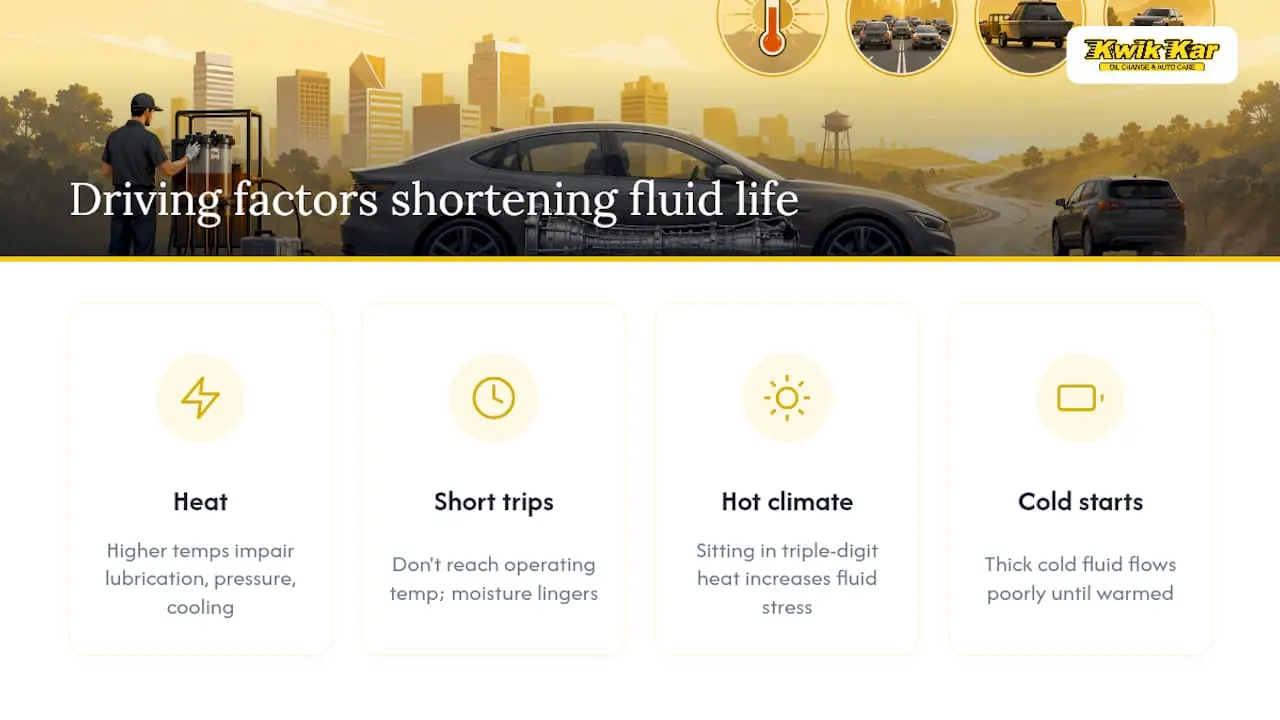
Heat is the single biggest enemy of transmission fluid, and how you drive determines how much heat your transmission generates. A transmission fluid’s job is to lubricate moving parts, transfer hydraulic pressure, and carry heat away from the torque converter and clutch packs. Every one of those jobs gets harder as temperatures climb.
Short trips are surprisingly hard on fluid because the transmission never fully reaches its optimal operating temperature, which means moisture and combustion byproducts don’t burn off the way they would on a longer drive. Fluid is also hygroscopic to a degree, meaning it absorbs small amounts of moisture over time, and that moisture lowers its effective boiling point and accelerates internal corrosion.
Climate plays its own role. A vehicle that regularly sits in triple-digit Texas heat during summer traffic works its transmission fluid harder than one driven in milder conditions, even with identical mileage. Cold starts add stress too, since thick, cold fluid doesn’t flow or lubricate as effectively until it warms up. A shift map tuning guide from TuningBot breaks down how transmission control units respond to these stress factors, which is useful background if you’re curious about what’s happening electronically while your fluid degrades mechanically.
None of this means you need to baby your vehicle. It means two drivers with identical mileage can need service at very different points, and mileage alone is an incomplete way to judge fluid health.
What Happens if You Never Change Your Transmission Fluid?
Skipping transmission fluid service doesn’t cause a sudden failure most of the time. It causes a slow decline that eventually turns into an expensive one.
Degraded fluid loses its friction properties first, which shows up as slipping between gears or delayed shifts. Keep driving on that fluid, and heat builds faster than it should, accelerating wear on clutch packs and seals that were designed to last the life of the transmission under normal fluid conditions. Eventually, metal-on-metal contact increases inside the unit, and what started as a fluid problem becomes a mechanical one.
The financial gap here is significant, even without pinning down an exact number: routine drain-and-fill service costs a fraction of what a transmission rebuild or replacement runs. Consistent, conservative fluid maintenance is one of the more reliable ways to avoid that bill entirely, since most transmission failures trace back to heat damage and fluid breakdown rather than a sudden defect.
There’s also a safety dimension that’s easy to overlook. A transmission that hesitates or slips unpredictably in traffic, especially when merging or accelerating onto a highway, creates a real hazard for you and the drivers around you. If you’ve noticed any of the shifting symptoms described earlier in this guide, that’s your signal to get it looked at rather than waiting for the next scheduled service.
How Do You Avoid Unnecessary Transmission Services?
Transmission service is one of the more commonly upsold repairs in the industry, largely because most drivers can’t verify fluid condition themselves. A little knowledge goes a long way toward protecting your wallet.
Be cautious of any shop that recommends a full flush without first inspecting your fluid’s actual color, smell, and condition. A flush pushed as a blanket recommendation for every vehicle over a certain mileage, regardless of symptoms or service history, is a red flag rather than a standard practice. Ask to see the fluid before and after service. A reputable technician will show you, not just tell you.
Watch for pressure to add “transmission conditioners” or aftermarket additives as a substitute for an actual fluid change. These products rarely replace what a proper drain-and-fill accomplishes, and stacking them onto old, degraded fluid doesn’t reverse existing wear.
Get a second opinion before authorizing a flush on a high-mileage vehicle with unknown service history, since that’s exactly the scenario where a flush carries the most risk and a staged drain-and-fill is the safer path. And always confirm the shop is using the fluid type specified for your transmission, particularly on CVTs, where the wrong fluid causes damage a flush won’t fix.
The clearest sign of a trustworthy shop isn’t the price. It’s whether they explain what they found in your fluid before recommending what to do about it.
Kwik Kar’s Approach to Transmission Fluid Service
Our ASE-certified technicians start every transmission service with an inspection, not a recommendation. That means checking fluid color, smell, and level before deciding whether your vehicle needs a routine drain-and-fill, a staged service, or simply a follow-up check down the road. Kwik Kar Oil Change & Auto Care is recognized by both CARFAX and RepairPal, and that recognition reflects the same transparency we bring to every transmission appointment.
When you bring your vehicle in, expect a straightforward conversation about what the technicians found and why they recommend a specific service, backed by a written inspection report you can keep for your records. Bring your maintenance history if you have it. It helps us judge whether a conservative approach or a more thorough service makes sense for your mileage.
— Kwik Kar
Schedule Your Transmission Fluid Check in Richardson
If your dashboard warning light is off but your gut says something’s not right with your shifts, that instinct is worth acting on before it turns into a bigger repair. This service center gives drivers a real inspection first, not a guess, so you only pay for the service your fluid actually needs.
Technicians check fluid color, smell, and level before recommending a drain-and-fill, a staged service for higher-mileage vehicles, or CVT-specific fluid replacement; each visit includes clear explanations of the findings. Whether you’re due for a routine check or you’ve noticed slipping, delayed shifts, or a burnt smell, our auto repair services team can get you answers the same day in most cases. Military members and first responders can inquire about available discounts when booking. Schedule your transmission fluid inspection at Kwik Kar Oil Change & Auto Care in Richardson today, and drive with confidence instead of guesswork about what’s happening inside your transmission.
Sources
- Cars
- Allison — Transmission Fluid and Filter Change Recommendations (off-highway)
- Transmission Flush Vs. Drain And Fill: Which Method Actually Protects Your Car’s Transmission? | Carsymp
- Transmission flushes: When they help and when they hurt your car | HowToGeek
FAQ
How Often Do I Really Need to Change Transmission Fluid?
Most automatics should be checked and likely serviced by around 100,000 miles, while manual and CVT transmissions typically need attention between 25,000 and 60,000 miles depending on type and driving conditions.
Can Transmission Fluid Last 10 Years?
Some manufacturers market fluid as “lifetime,” but that label usually refers to the factory warranty period, not a literal decade-plus without service, especially if you drive in severe conditions like frequent towing or stop-and-go traffic.
Why Do Some Mechanics Say Not to Change Transmission Fluid?
The concern usually applies to older, high-mileage vehicles with unknown service history, where a single aggressive flush can dislodge built-up deposits and clog narrow valve body passages; a staged drain-and-fill avoids that risk.
Is 150,000 Miles Too Late to Change Transmission Fluid?
It’s not too late, but it does change the recommended method. At that mileage, a staged drain-and-fill or professional inspection is safer than a one-time machine flush, and a qualified service center can assess your fluid’s actual condition before recommending a service.