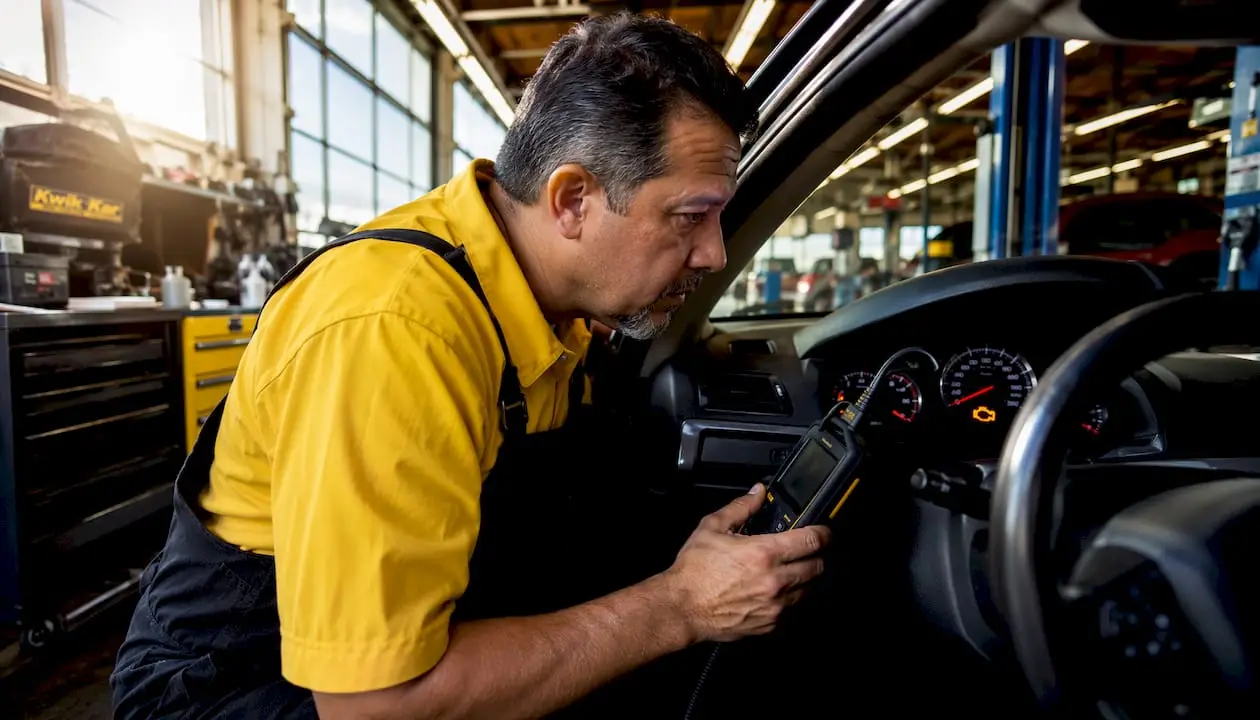
Yes — in any U.S. jurisdiction that requires OBD-II emissions testing, an illuminated check engine light automatically fails inspection. The inspector doesn’t eyeball the dashboard; they plug a scanner into your vehicle’s OBD-II port and read the computer directly. If the Malfunction Indicator Lamp (MIL) is commanded on, stored diagnostic trouble codes (DTCs) are present, or readiness monitors show “Not Ready,” the vehicle fails on the spot.
Here’s what that means for you right now:
- You’ll need a repair, not just a reset. Clearing codes without fixing the underlying fault only delays the inevitable.
- Don’t show up with incomplete monitors. Even a freshly repaired car can fail if the monitors haven’t finished their self-tests.
- Verify your state or county requires emissions testing. Safety-only inspection states won’t fail you for a lit MIL, but you should confirm before assuming.
Pro Tip: If your check engine light is flashing rather than steady, stop driving immediately. A flashing MIL signals a severe misfire that can destroy your catalytic converter within minutes. Have the vehicle towed to a shop.
Table of Contents
- Why a check engine light causes an automatic inspection failure
- Common problems that trigger the CEL and cause inspection failures
- Does your state require emissions testing? It depends
- Why clearing codes before inspection usually backfires
- What to do when the check engine light comes on before your inspection
- How Kwik Kar helps with diagnostics, repairs, and pre-inspection checks
- Key Takeaways
- Ready for a pre-inspection scan? Kwik Kar has you covered
- Useful sources and where to check state rules
- FAQ
Why a check engine light causes an automatic inspection failure
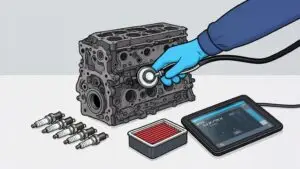
The technical reason comes down to how modern emissions inspections actually work. Every gasoline-powered passenger vehicle built since 1996 uses the OBD-II standard, a federally mandated onboard diagnostic system that continuously monitors emissions-related components. When the inspector connects to your OBD-II port, they’re reading three things:
- MIL command status: Is the light commanded on by the computer? (Not just whether the bulb is lit.)
- Stored DTCs: Are there active or pending emissions fault codes?
- Readiness monitors: Have the self-test routines for systems like the catalytic converter, oxygen sensors, and EVAP completed successfully?
An active MIL means automatic failure in every jurisdiction that runs OBD-II testing. Inspectors are legally prohibited from passing a vehicle with an active fault indicator. There’s no override, no judgment call.
One thing worth knowing: removing the dashboard bulb or covering the light does nothing. The California BAR confirms that inspectors query the MIL command bit electronically. If the computer says the light is on, the car fails regardless of what you see on the dash.
Common problems that trigger the CEL and cause inspection failures
The check engine light covers a wide range of faults, but a handful of issues account for the majority of inspection failures. Knowing which ones are likely, and what they cost to fix, helps you plan before your appointment.
- Loose or faulty gas cap (EVAP leak): The most common and cheapest fix. A loose cap triggers an evaporative emissions code. Tighten or replace it for under $25. Urgency: low.
- Oxygen sensor failure: O2 sensors degrade over time and throw codes that directly affect emissions readings. Replacement typically runs $200–$350 depending on location and vehicle. Learn more about O2 sensor symptoms before your visit. Urgency: medium.
- Spark plugs or ignition coils (misfire): Misfires waste fuel, spike emissions, and can damage the catalytic converter if left unaddressed. Spark plug and coil jobs generally run $200–$600. Urgency: medium to high.
- Catalytic converter failure: The most expensive fix on this list, typically $1,500–$2,500. A failed cat usually follows prolonged misfires or O2 sensor neglect. Urgency: high.
- Mass airflow (MAF) sensor: A dirty or failed MAF sensor throws off the air-fuel mixture and triggers emissions codes. Cleaning or replacement costs vary but often fall in the $150–$400 range. Urgency: medium.
- EVAP system leaks: Beyond the gas cap, small leaks in the evaporative emissions system can be harder to trace. Diagnosis and repair can range from $100 to $600 depending on the leak location. Urgency: low to medium.
Free OBD-II code reads at auto parts stores give you a starting point, but a generic code like P0420 (catalyst efficiency) doesn’t tell you why the cat is failing. For best practices on inspection logistics and protecting your vehicle fleet, see this rental vehicle inspection guide. An ASE-certified technician can trace the root cause and prevent you from replacing expensive parts that aren’t actually the problem.
Does your state require emissions testing? It depends
Not every state will fail you for a lit check engine light. The U.S. splits into two broad inspection regimes, and approximately 22 states have no statewide emissions program at all. Some states run safety-only inspections that check brakes, lights, and tires but never touch the OBD port. Others require emissions testing statewide or allow individual counties to add that requirement.
| Inspection Type | What It Checks | CEL Causes Failure? |
|---|---|---|
| OBD-II emissions (statewide) | MIL status, DTCs, readiness monitors | Yes, automatic |
| County-level emissions | Same as above, county-mandated | Yes, where required |
| Safety-only inspection | Brakes, lights, tires, wipers | No |
Texas, for example, combines safety and emissions into a single annual inspection for most counties. If you’re in Richardson or the Dallas-Fort Worth area, your vehicle faces both checks. States like Florida and Iowa have no statewide emissions program, so a lit MIL won’t cause an inspection failure there.
The only authoritative source for your specific situation is your state or county DMV. Rules change, county exemptions exist, and vehicle age or type can shift which test applies to you. Check before you assume.
Even in emissions states, the rules around incomplete monitors vary. Most programs allow a limited number of incomplete monitors depending on model year, and newer vehicles are held to stricter standards. Showing up with three or four monitors still cycling through after a code clear will fail you just as surely as an active MIL.
Why clearing codes before inspection usually backfires
This is one of the most common mistakes vehicle owners make, and it almost always results in a second failed inspection. Here’s the mechanics of why.
- Codes are cleared (or battery is disconnected). The MIL goes off. The car looks fine from the driver’s seat.
- Readiness monitors reset to “Not Ready.” Every emissions-related self-test routine is wiped. The computer has no record of completed checks.
- The inspector scans the OBD port. Even with no active codes, the scanner sees multiple monitors in a “Not Ready” state.
- The vehicle fails. The NY DMV is explicit: a “Not Ready” condition is detectable and treated as a failure.
- Monitors need time to reset. Most require a driving distance over multiple drive cycles, generally taking several days over several days, mixing highway and city conditions.
- Some monitors are especially slow. The EVAP monitor, for instance, requires a specific fuel level range, a cold soak period, and particular temperature conditions. It can take a week of normal driving to complete.
- The catalytic converter monitor is similarly demanding. It needs multiple warm-up and cool-down cycles under load before it registers Ready.
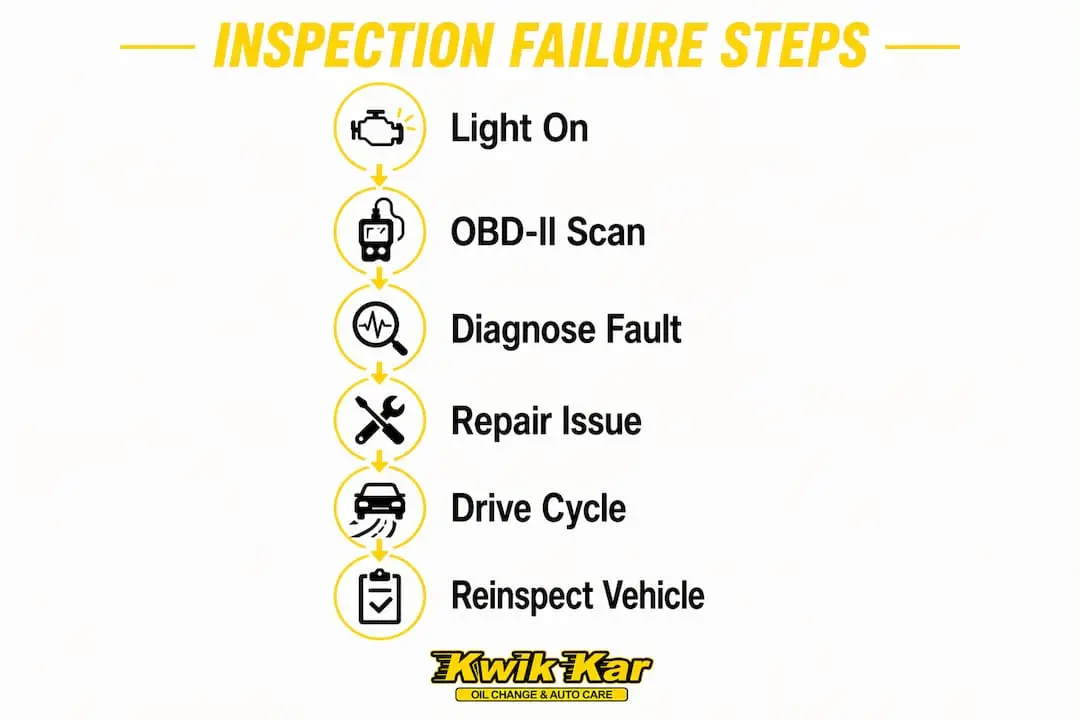
The right sequence is: diagnose the fault, repair it, complete the necessary drive cycles, confirm all monitors show Ready, then schedule the inspection. Skipping any step sends you back to the end of the line.
Pro Tip: A quality OBD-II reset guide walks you through safe approaches. But the short version is this: resetting without repairing just delays the failure.
What to do when the check engine light comes on before your inspection
Follow these steps in order. Skipping ahead wastes time and money.
- Confirm whether the MIL is steady or flashing. Steady means you likely have time to diagnose and repair. Flashing means stop driving now and arrange a tow. A flashing light signals a severe misfire that can destroy the catalytic converter within minutes of continued driving.
- Check the gas cap first. Remove it, inspect the seal, and retighten firmly. If an EVAP code was the only issue, the light may clear on its own after a few drive cycles. This costs nothing.
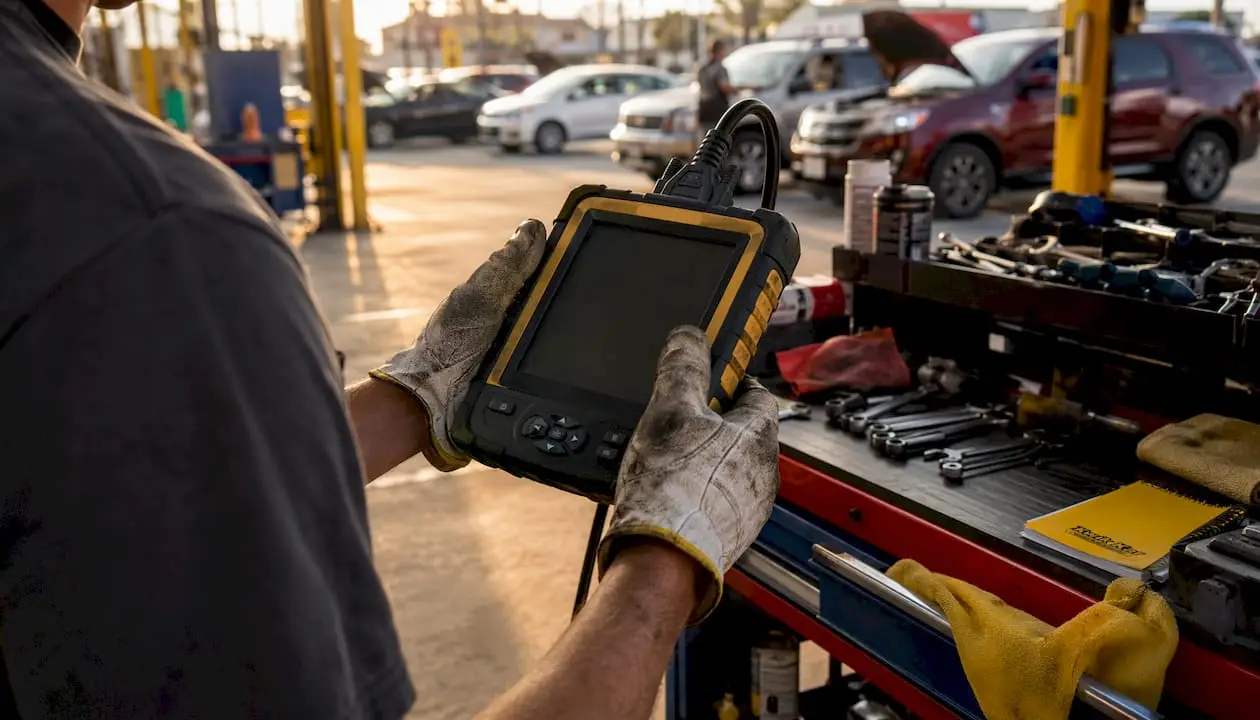
- Get a code read. Auto parts stores offer free scans. This gives you the DTC, which narrows the likely cause. For a more complete picture, including monitor status and freeze-frame data, a shop scan is more useful.
- Decide whether to drive or tow. A steady light with a minor code (loose gas cap, minor O2 sensor fault) is generally safe to drive to a shop. A flashing light, rough running, or overheating means tow it.
- Get the repair done by an ASE-certified technician. Confirm the root cause before replacing parts. A P0420 code, for example, can stem from a bad O2 sensor rather than a failed catalytic converter.
- Complete the drive cycles. After repair, your technician should advise on the mileage and conditions needed to bring monitors back to Ready. Plan on 50–100 miles of mixed driving over several days for most monitors.
- Verify monitor status before scheduling the inspection. An inexpensive Bluetooth OBD-II reader paired with a phone app (Torque Pro, OBD Fusion, or similar) shows live monitor status. Or ask your shop for a pre-inspection scan.
A pre-test checklist should include a 15–20 minute warm-up drive, a gas cap check, a scan confirming no active codes, and a monitor readiness confirmation. Most monitors require 50–100 miles of mixed driving over several days to show Ready after codes are cleared or repairs are performed. Showing up with all monitors green is the only reliable path to a pass.
Pro Tip: Many states offer a retest window after a repair, sometimes 30–60 days, where you pay a reduced fee or no fee for the second test. Ask your shop about the retest process in your county so you’re not caught off guard.
How Kwik Kar helps with diagnostics, repairs, and pre-inspection checks
Kwik Kar Oil Change & Auto Care in Richardson, TX handles every stage of the inspection-readiness process, from the first scan to the final pre-test confirmation.
- Full OBD-II diagnostics: ASE-certified technicians read MIL status, stored DTCs, freeze-frame data, and monitor readiness in one visit, giving you a complete picture rather than a single code number.
- Pre-inspection readiness scans: Before you schedule your state inspection, Kwik Kar can confirm whether your monitors are Ready and flag any active codes that would cause a failure.
- EVAP and O2 sensor repairs: Two of the most common inspection-failure causes are handled in-house, with transparent estimates before any work begins.
- Catalytic converter diagnostics: Rather than defaulting to a replacement, technicians trace whether the cat failure stems from an upstream sensor or ignition issue, which can save significant money.
- Certified repair work with warranty coverage: Repairs are backed by warranty, and the shop is recognized by both RepairPal and CARFAX for quality and reliability.
- Transparent digital reporting: You see the codes, the diagnosis, and the repair estimate before anything is touched.
- Military and first responder discounts: Available at the Richardson location as a standing offer.
The typical flow at Kwik Kar looks like this: scan and diagnosis, written estimate, approved repair, monitored drive cycles if needed, pre-test scan to confirm readiness, then you schedule your state inspection with confidence. For Texas inspection requirements specific to your vehicle, the Texas state inspection guide covers what to expect.
Key Takeaways
An illuminated MIL is an automatic emissions inspection failure in every U.S. state that requires OBD-II testing, and clearing codes without repairing the fault creates a “Not Ready” condition that fails just as reliably.
| Point | Details |
|---|---|
| MIL = automatic fail | An illuminated check engine light fails OBD-II emissions inspections in every jurisdiction that requires them. |
| Don’t just clear codes | Clearing codes resets monitors to “Not Ready,” which inspectors detect and treat as a failure. |
| Drive cycles take time | Most monitors need several days of mixed driving over multiple drive cycles to return to Ready after a reset. |
| Verify your state’s rules | A significant number of states have no statewide emissions program; check your state or county DMV before assuming. |
| Kwik Kar handles the full process | Kwik Kar Oil Change & Auto Care offers OBD-II diagnostics, pre-inspection readiness scans, and certified repairs in Richardson, TX. |
The check engine light is telling you something worth hearing
Most drivers treat the check engine light as a nuisance, something to deal with after the inspection. That instinct costs real money. The MIL is an early warning system, and the codes it stores are the vehicle’s way of flagging a problem before it compounds. An oxygen sensor that costs $250 to replace today can, if ignored, push unburned fuel into the catalytic converter and turn a manageable repair into a $2,000 job.
What we see consistently at the shop is that vehicles arriving for inspection with an active MIL almost always have a history of the light being cleared rather than repaired. The code comes back because the fault never went away. The right approach is straightforward: read the code, find the root cause, fix it properly, let the monitors complete, and then test. That sequence works every time.
Transparency matters in this process. A good shop shows you the codes, explains what they mean in plain language, and gives you a written estimate before touching anything. You should never walk out of a diagnostic appointment wondering what was found or why a repair is necessary.
Ready for a pre-inspection scan? Kwik Kar has you covered
A failed inspection wastes your time and delays your registration. Kwik Kar Oil Change & Auto Care gives you a clear advantage: ASE-certified technicians who read your vehicle’s full OBD-II data, identify the exact fault, and get your monitors to Ready before you ever walk into an inspection lane.
The engine diagnostics service at Kwik Kar covers the complete scan, a written diagnosis, and a repair estimate with no guesswork. Military personnel and first responders receive special discounts at the Richardson location. If you already have an inspection appointment scheduled, bring the date and Kwik Kar can prioritize your pre-test scan to fit the timeline.
Book your diagnostic appointment at Kwik Kar Richardson and show up to your state inspection knowing your vehicle is ready to pass.
Useful sources and where to check state rules
Confirming your specific inspection requirements takes five minutes and saves you a failed test. These are the most reliable places to look.
- DC DMV: Common Causes of Inspection Failure: Clear breakdown of OBD test failure causes for personal vehicles, including MIL status and “Not Ready” conditions.
- NJDEP Stop the Soot: OBD-II Information: Explains how DTCs trigger inspection failures and how to address them before a retest.
- NC DEQ: Emissions Inspection Results: Detailed guidance on readiness monitors, drive cycles, and what “Not Ready” means for your retest.
- NY DMV: What Do You Mean My Car’s Not Ready?: Plain-language explanation of the “Not Ready” condition and how to resolve it.
- Your state or county DMV website: The authoritative source for whether your jurisdiction requires OBD-II emissions testing, which vehicles are exempt, and retest window rules. Search “[your state] DMV vehicle inspection requirements.”
- Kwik Kar Richardson engine diagnostics: Local shop resource for pre-inspection scans, OBD-II diagnostics, and repair services in Richardson, TX.
FAQ
Will I fail inspection if my check engine light is on?
Yes, in any state or county that requires OBD-II emissions testing. Inspectors are prohibited from passing a vehicle with an active MIL, regardless of the underlying cause.
Why is my check engine light on but the car seems fine?
Many fault codes, particularly EVAP leaks or minor O2 sensor degradation, don’t produce noticeable drivability symptoms. The computer detected an emissions-related fault that falls outside acceptable parameters, even if the car drives normally.
How much does a diagnostic scan cost?
A basic code read is often free at auto parts stores. A full diagnostic at a shop, which includes monitor status, freeze-frame data, and root-cause analysis, typically costs $50–$200 depending on complexity.
Can I drive with the check engine light on to get to the shop?
A steady check engine light is generally safe for short-distance driving to a repair facility. A flashing check engine light is not. Pull over safely and arrange a tow to avoid catalytic converter damage.
Can I clear the codes right before my inspection to pass?
No. Clearing codes resets readiness monitors to “Not Ready,” a condition inspectors detect immediately. Most monitors need 50–100 miles of mixed driving over several days before they return to Ready, and the underlying fault will trigger the MIL again before that happens.