Richardson Drivers: Technician Checklist When a Window Won’t Roll Up
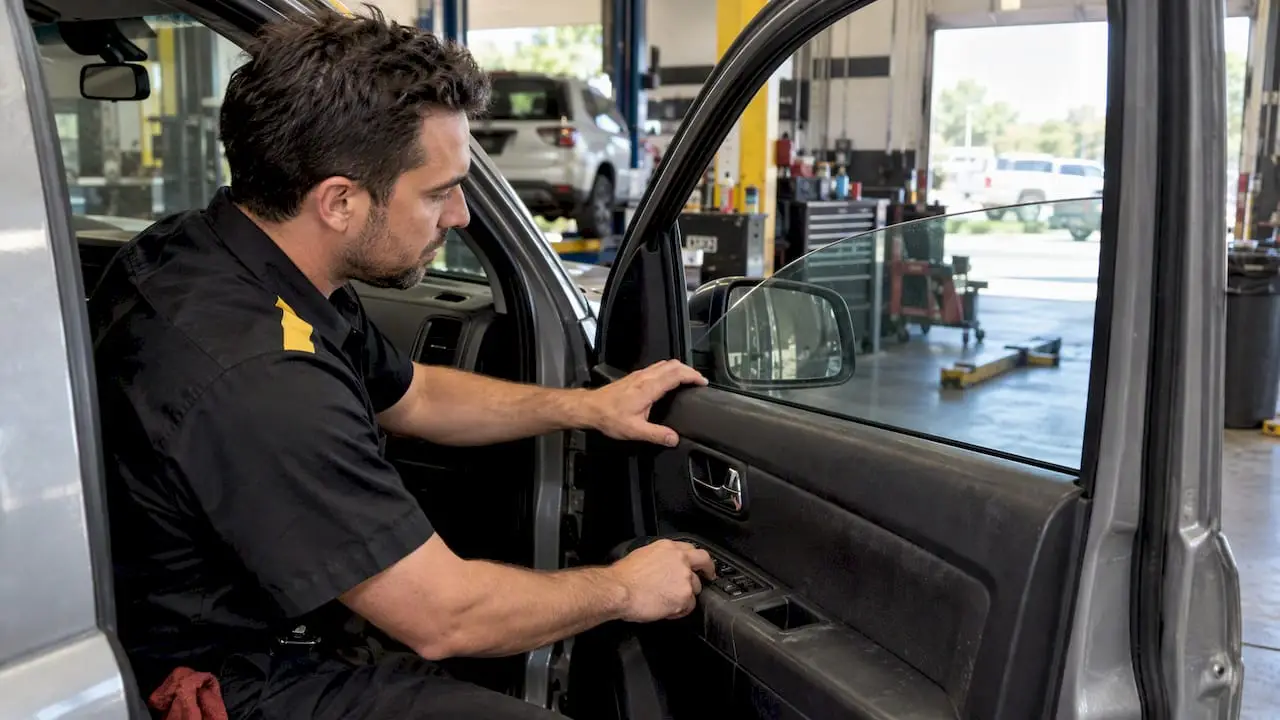
If your window goes down but won’t come back up, the most likely culprits are the switch, the motor, the regulator, or the anti-pinch system, and several of these are safe to check yourself. Start with the simple steps before anyone touches the door panel. If you notice smoke, melted plastic, water intrusion, or power that cuts in and out, stop testing and book a diagnostic instead.
TL;DR:
- A blown fuse or failed relay is often the cause if the window shows no movement and no sound when operated.
- Water damage, debris, or misaligned tracks can cause windows to stop moving or behave erratically, requiring inspection of the mechanical channel.
- Replacing a manual window handle or regulator is straightforward, usually involving a few basic tools, with full regulator replacements being more reliable for failure.
- Persistent electrical issues, such as recurring switch failures or software glitches, may require professional diagnostics and module testing.
- Recall checks are essential, as water intrusion or switch failures have led to large-scale Honda recalls, emphasizing the importance of VIN-based recall verification.
Table of Contents
- How Power and Manual Windows Actually Work
- What Your Symptoms Usually Mean
- Step-by-Step Troubleshooting You Can Try Safely
- Fixing a Manual Crank Window
- When to Call a Professional Instead
- Safety Rules and Recall Checks You Shouldn’t Skip
- Keeping Windows Working Smoothly
- How We Diagnose Window Problems at Kwik Kar
- Get Your Window Fixed Right in Richardson
- FAQ
- Sources
How Power and Manual Windows Actually Work
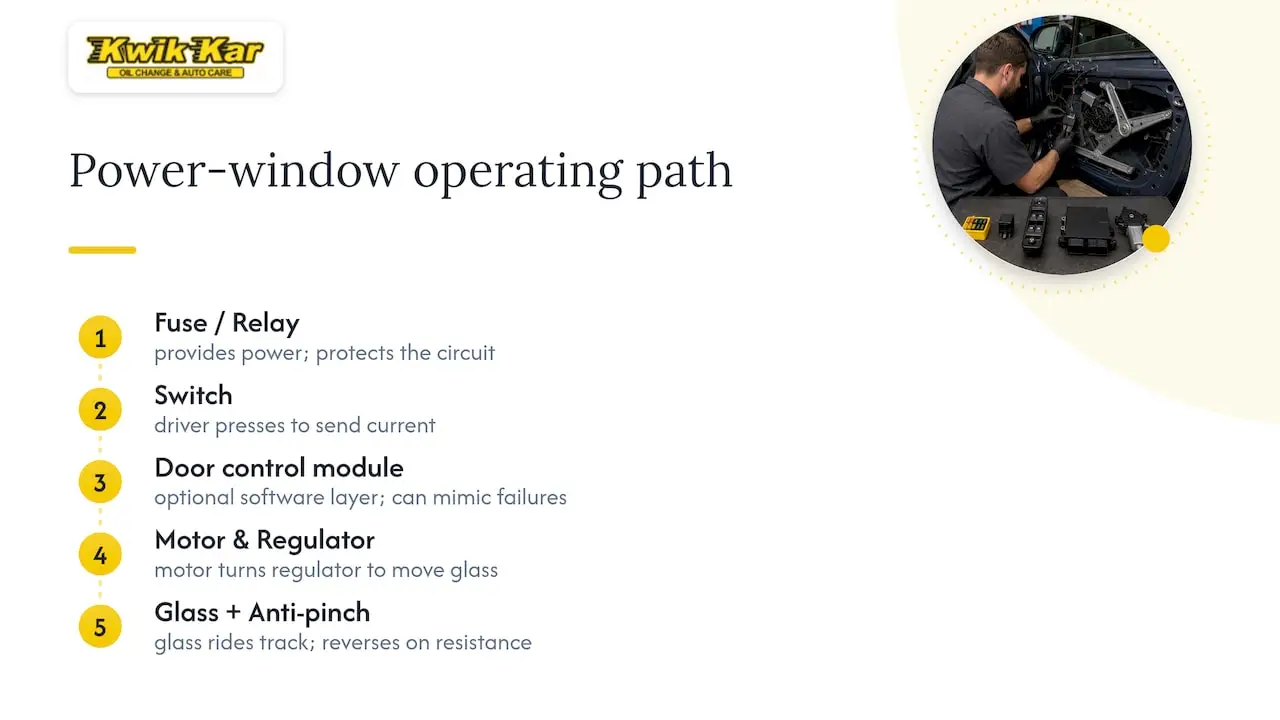
A power window runs on a motor, a regulator (the scissor or cable mechanism that moves the glass), a switch, and a fuse or relay that feeds the whole circuit. Press the switch and current flows to the motor, which turns the regulator and raises the glass along its track. Most vehicles built in the last few decades also include an anti-pinch, or automatic reversal, feature that stops and reverses the glass when it senses resistance, such as a hand or a stuck object, during an unsupervised close. Newer vehicles add door control modules and software layers to this system, which means a glitch in programming can sometimes mimic a mechanical failure.
What Your Symptoms Usually Mean
Matching what you see to a likely cause saves time before you start pulling trim panels.
- No movement and no sound: points to a blown fuse, a failed relay, or a dead master switch.
- Window goes down but not up, with a faint hum: often a weak or failing motor, or a regulator with worn gears or a snapped cable.
- Window moves partway and stops or reverses: suggests binding, a misaligned track, or debris frozen in the channel.
- Works sometimes, then quits: a classic sign of a loose or corroded connector, especially in a door that sees frequent window use.
- Switch feels sticky or the window behaves oddly after a spill: water-damaged switches can short and, in rare cases, overheat, which is why this is one symptom you should not ignore.
- Everything is sluggish, including interior lights: a weak battery or poor ground connection can starve the motor of the voltage it needs.
Step-by-Step Troubleshooting You Can Try Safely
Work through these in order, and keep fingers clear of the glass edge at every step. Never test an anti-pinch system with your hand, since the point is to see if the window senses resistance, not to find out the hard way.
- Check the ignition and battery first. Many vehicles disable window motors unless the ignition is on or in accessory mode, and some require a reset after a dead battery. Check your owner’s manual for a window reset or calibration sequence before assuming a part has failed.
- Inspect the fuse and relay. Locate the window fuse using your owner’s manual diagram, pull it, and check for a broken filament; swap in a known-good relay of the same rating if you have one.
- Isolate the switch. If your vehicle has separate window switches, swap the suspect door’s switch with a working one (where panels allow) to see if the problem follows the switch or stays with the door.
- Listen at the motor. A hum with no glass movement usually means the motor is struggling or the regulator has failed mechanically; silence with no hum points back to the switch, fuse, or wiring.
- Check the mechanical track. Remove the interior door seal carefully, look for debris or ice in the channel, and apply a silicone-based lubricant rather than oil, which attracts grit.
- Protect the opening. If the window is stuck down, cover the gap with plastic sheeting and tape to keep out rain and dust until you can get it fixed.
Pro Tip: Write down exactly when the failure started, whether it happened after rain, a jump-start, or other door work. That detail often points a technician straight to the cause.
Fixing a Manual Crank Window
Manual windows have fewer parts to fail, but the common complaints are still predictable.
- Handle spins without moving the glass: usually a stripped spline on the handle or regulator shaft.
- Handle feels loose or wobbly: often just a worn retaining clip, an easy fix once the door panel is off.
- Window drops suddenly inside the door: typically a broken regulator arm or a snapped lift cable.
A screwdriver, trim removal tool, and a replacement clip or regulator are usually all you need for the simpler fixes. If the regulator itself has failed, replacing the full assembly is usually more reliable than patching individual parts.
When to Call a Professional Instead
Some signs mean it’s time to stop troubleshooting and book a shop visit: any smell of burning plastic, visible heat damage near the switch, water sitting inside the door, or a fault that comes and goes without a clear pattern. Module or software related glitches also fall outside typical DIY range.
A technician’s process usually looks like this:
- Check the VIN for open recalls before replacing anything.
- Test wiring and connectors for continuity and voltage drop.
- Bench-test the motor and regulator to separate electrical faults from mechanical ones.
- Scan the door control module for stored fault codes.
As AAA explains, diagnostic time can sometimes cost more than the repair itself because locating an intermittent electrical fault takes specialized testing, not guesswork. Before authorizing work, ask about the diagnostic fee cap, whether the shop uses OEM or aftermarket parts, what warranty applies, and the expected turnaround.
Safety Rules and Recall Checks You Shouldn’t Skip
Automatic reversal exists for a real reason. Under 49 CFR § 571.118, power windows must limit the squeezing force to 100 newtons on each closing attempt when closing without someone watching, which is why you should never disable or bypass an anti-pinch feature even if it seems to be causing delays.
- Ice, misalignment, or a dirty channel can trigger repeated reversal attempts that look like a malfunction but are the system working as designed.
- Check your VIN through NHTSA’s recall lookup before paying for parts, since eligibility is specific to your vehicle, not your model year in general.
- Recall history is a useful reminder here: water intrusion into power window switches led Honda to recall roughly 1.8 million vehicles for free switch replacement and wiring inspection, proof that a sticky switch is sometimes a documented defect, not just bad luck.
Keeping Windows Working Smoothly
A few habits go a long way toward avoiding a repeat visit.
- Clean door channels regularly and lubricate with a silicone-based spray, never a petroleum product that attracts dust and grime.
- Keep liquids away from window switches, and if one does get wet, disconnect the battery and let it dry fully before using it again.
- Ask your shop to glance at switch housings during routine maintenance visits, since early corrosion is easy to miss until it fails completely.
Pro Tip: A quick wipe-down of door jambs and channels takes only 10 to 20 minutes and helps prevent the grit buildup that causes binding later.
How We Diagnose Window Problems at Kwik Kar
In our bays, water-damaged switches, corroded connectors, and calibration glitches show up more often than outright motor failure. Our process starts with a VIN and recall check, followed by a digital inspection and a written diagnostic authorization before any further work begins. Before your visit, jot down when the issue started, whether one-touch or key fob operation is affected, and any recent door work.
— Kwik Kar
Get Your Window Fixed Right in Richardson
A stuck window rarely fixes itself, and driving around with one taped shut gets old fast. Our ASE-certified technicians handle electrical diagnostics, motor and regulator replacement, and switch repair with transparent pricing and a written diagnostic cap before we start, so there are no surprises on the invoice.

- We check your battery and charging system if low voltage is part of the problem.
- Every repair carries warranty coverage, and special discounts are available for certain groups.
- Our engine diagnostic service covers module-level scans when a software fault is suspected.
Ready to get it sorted? Visit our service and repair page to schedule a diagnostic appointment in Richardson today.
FAQ
Why would my car window go down but not up?
This usually means the motor, regulator, or anti-pinch sensor is struggling to push the glass upward, since gravity helps it go down but the motor has to do all the work going up. A weak motor, worn regulator gears, or a track obstruction are the most common reasons.
My window button is broken. What can I do to fix it?
Try the other door’s switch first to see if the problem follows the switch or stays with that door, since many vehicles let you swap switches to isolate the fault. If swapping doesn’t help, the regulator or wiring behind the panel likely needs inspection by a technician.
How much does it cost to fix a car window that won’t go up or down?
There’s no single published price since the fix depends on whether the problem is a fuse, a switch, a motor, or a full regulator assembly, and parts and labor costs vary. AAA notes that diagnostic time for electrical issues can be a significant part of the total bill, which is why asking for a diagnostic cap upfront matters.
How do I open a car window with a dead battery?
Most power windows won’t operate at all without battery voltage, so a jump-start or a fresh battery is usually the first step. If the window was already stuck down before the battery died, a mechanical hold like tape and plastic sheeting will protect the interior until you can get power restored.
Sources
- 49 CFR § 571.118 – Standard No. 118 — Power-operated window, partition, and roof panel systems.
- Check for Recalls: Vehicle, Car Seat, Tire, Equipment | NHTSA
- Honda recalls nearly 1.8 million cars over flaming window switch and corroding driveshafts
- Car repair labor rates explained | AAA Automotive