Your car feels fine on the first part of the drive. Then you stop at a light, the idle turns uneven, and the engine starts shaking just enough to make you look at the dash. Maybe it hesitates getting onto US-75. Maybe the check engine light starts flashing for a moment, then stays on. A lot of drivers in Richardson show up with that exact story.
One of the most common causes is a bad ignition coil. On modern coil-on-plug engines, each coil has one job: send high voltage to its spark plug at the right moment so the air-fuel mixture burns cleanly. When one coil starts breaking down, one cylinder can stop pulling its weight. That’s when you get the stumble, rough idle, and lack of power that seem to come and go.
The tricky part is that ignition coil problems can imitate other faults. A worn spark plug, oil in a plug well, a weak battery, wiring trouble, an injector problem, or even a compression issue can look similar at first. That’s why guessing gets expensive fast. The right move is to follow a clean diagnostic process, rule out what it isn’t, and confirm what it is before replacing parts.
Is Your Car Trying to Tell You Something?
A bad ignition coil rarely announces itself with one clean, obvious symptom. Most of the time, the car starts dropping hints. It may crank normally but feel rough at idle. It may pull away from a stop sign, then hesitate as load increases. Some drivers notice it most with the A/C on, when the engine has to work a little harder.
That pattern matters. A failing coil can work when conditions are easy and struggle when the spark demand rises. Heat under the hood often makes it worse, which is why a vehicle can act normal on one trip and rough on the next.
What the drive usually feels like
The complaint often sounds like this:
- At idle: the engine shakes, the RPM needle isn’t perfectly steady, and the exhaust note sounds uneven.
- Under acceleration: the car hesitates, bucks slightly, or feels flat when you press the pedal.
- At low speed in traffic: the engine may smooth out for a moment, then stumble again.
- When restarting: it might seem better briefly, which makes the fault feel random even when it isn’t.
That inconsistency is one reason drivers wait too long. They hope it was bad fuel or a temporary glitch. Sometimes it is. But when the same stumble keeps returning, ignition should move high on the suspect list.
Why ignition coils create confusing symptoms
Modern ignition systems are more precise than older distributor setups, but they’re also less forgiving when one part starts failing. A single weak coil can affect one cylinder only. That’s enough to create a rough-running engine without making the whole vehicle instantly undrivable.
A car with one weak coil can still run. It just won’t run correctly, and that’s when secondary damage starts becoming the real concern.
At the shop, discipline matters. The fastest repair is often the one that begins with a slower diagnosis. If a driver replaces a coil because a code looked coil-related, but the actual fault is a spark plug, oil contamination, or low voltage supply, the symptom comes right back. Then the owner has spent money and lost time without fixing the actual cause.
A solid diagnosis starts with what the car is doing, when it does it, and whether the fault stays tied to one cylinder or follows a part. That decision-making process is what separates a clean repair from repeat visits.
Decoding the Signs of a Failing Ignition Coil
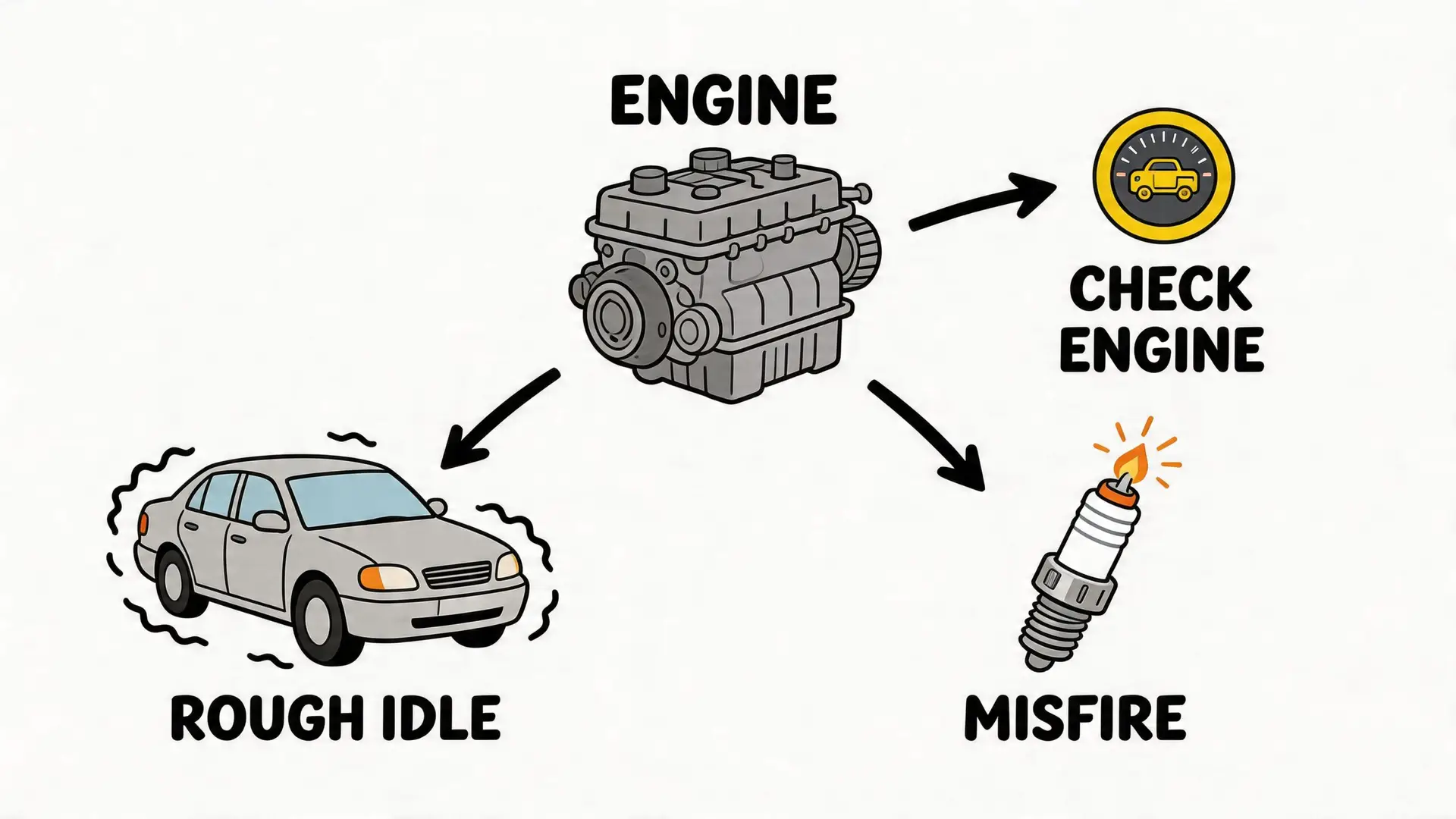
A bad ignition coil usually shows up through misfire-related symptoms. That makes sense, because the coil is responsible for delivering the spark that starts combustion in the cylinder. If the spark is weak, delayed, or absent, the cylinder doesn’t contribute the way it should.
Bad ignition coils are a primary reason for engine misfires, and misfires account for approximately 20-30% of all check engine light activations in modern vehicles according to NGK ignition coil failure guidance. That same source notes a failing coil can cause incomplete combustion, which may drop fuel economy by 15-25% and speed up catalytic converter damage.
Engine misfire
This is the symptom most tied to a bad ignition coil. Drivers describe it as a stumble, shudder, or skip. Under load, it can feel like the engine misses a beat.
Why it happens is simple. One cylinder isn’t getting a strong enough spark to ignite the mixture correctly, so that cylinder contributes less or not at all for that firing event. If the misfire happens often enough, the engine loses smoothness and power.
Rough idle
A rough idle is often the first symptom people notice because it’s easy to feel at a stoplight. The steering wheel may vibrate. The seat may buzz. The engine note can sound uneven instead of steady.
At idle, the engine is turning slowly and every cylinder’s contribution is easier to notice. A weak coil that causes a small miss at cruise can feel much more obvious when the car is sitting still in gear.
Sluggish acceleration and power loss
A failing coil often shows up when the engine is asked to do more work. Merging, climbing, or accelerating from a stop increases spark demand. That’s when a weak coil may stop keeping up.
The result isn’t always dramatic. Sometimes the car feels dull and delayed. Drivers say it no longer responds crisply, even though the engine still runs.
Fuel economy changes
When combustion is incomplete, the engine doesn’t use fuel efficiently. Some drivers notice they’re stopping at the pump sooner without changing driving habits. That isn’t a perfect diagnostic clue by itself, but when poor mileage appears with a rough idle or hesitation, ignition becomes a stronger suspect.
If you’re also trying to sort out whether plugs might be involved, our guide to bad spark plug symptoms can help you separate the two patterns.
Check engine light and flashing light
A steady check engine light means the computer has detected a fault. A flashing check engine light is more urgent. It often means the misfire is active enough to risk damage to the catalytic converter.
Shop-floor rule: If the engine is running rough and the check engine light is flashing, don’t keep pushing it down the road to “see if it clears up.”
Stalling or hard running in traffic
As coil failure gets worse, the engine may struggle badly enough to stall, especially at idle or low speed. That’s a safety issue more than an inconvenience. If your car cuts out while turning across traffic or creeps unpredictably in a parking lot, the repair can’t wait.
A bad ignition coil doesn’t always create every symptom at once. What matters is the pattern. Rough idle, stumble under load, and a check engine light together point to an ignition problem far more clearly than any one symptom by itself.
How to Test for a Bad Ignition Coil Yourself
You pull away from a light in Richardson, the engine stumbles, and the check engine light comes on. At that point, guessing gets expensive. A bad coil can cause a misfire, but so can a worn plug, a wiring problem, an injector fault, or low compression. Good testing is about narrowing the problem without creating a bigger one.
Start with safety. Let the engine cool if the coils sit on a hot valve cover, and keep your hands off live ignition components while the engine is running. Modern coil systems produce enough voltage to hurt you, and careless testing can damage connectors that were fine to begin with.
Start with a visual inspection
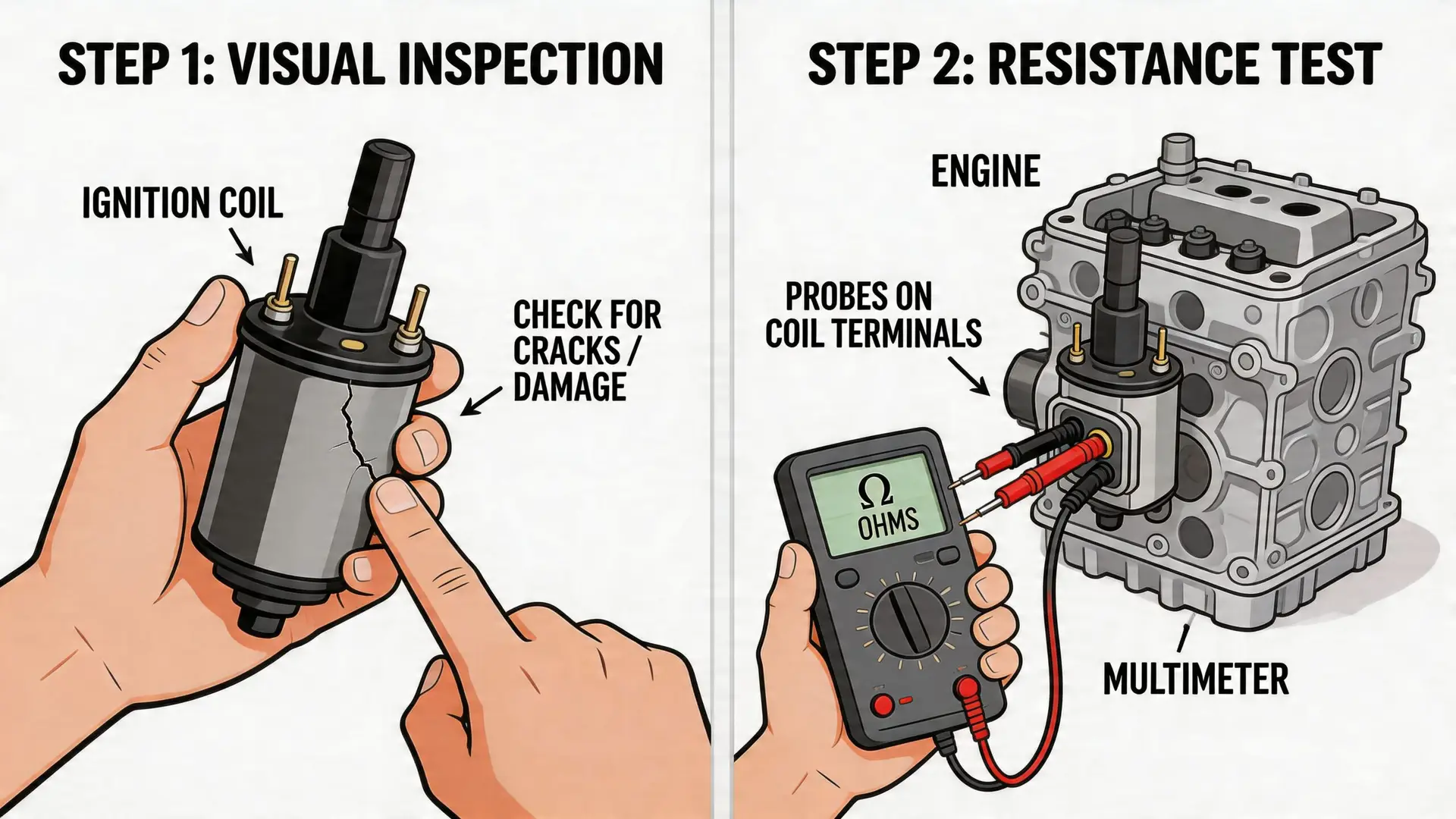
Begin with what you can see before you start swapping parts. Remove the engine cover if needed and inspect the suspect cylinder area closely.
Look for:
- Cracks in the coil housing: small cracks let moisture in and allow spark to leak before it reaches the plug.
- Oil in the spark plug well: this often points to a valve cover gasket leak. Oil damages boots and insulation over time.
- Burn marks or carbon tracking: these marks show voltage has been escaping outside the normal path.
- Loose connectors or damaged wiring: a coil with poor power, ground, or signal will act bad even if the coil itself is still usable.
If the plug well is wet or oil-soaked, stop there and deal with that condition too. Installing a new coil into contamination is one of the fastest ways to waste money on a comeback repair.
Read the trouble codes
An OBD-II scan should come next. Codes help aim the diagnosis, but they do not convict the coil by themselves.
A cylinder-specific misfire code tells you where the engine computer noticed the problem. A coil circuit code points you toward the ignition side of that cylinder. Either way, you still need to verify the cause. If you want a better handle on what the warning light is telling you, our guide on how to check engine light issues explains how scan data fits into the process.
| What you find | What it suggests | What it does not prove |
|---|---|---|
| Cylinder-specific misfire code | That cylinder needs closer inspection | That the coil alone is bad |
| Coil circuit code | A problem in the ignition circuit for that coil | That replacing the coil will fix it |
| No code but obvious rough running | An intermittent fault may still be present | That ignition is ruled out |
DIY diagnosis often goes off track. Drivers read one code, buy one part, and hope. On newer cars, that shortcut often costs more than one proper diagnostic session.
Why multimeter testing has limits
A multimeter still has a place, but it is not the final word on a modern coil-on-plug system.
On older ignition systems, resistance checks were more useful. On many newer vehicles, a coil can pass a basic resistance check and still fail under heat, load, or higher RPM. I see that in the shop regularly. The car misfires on the road, the meter says the coil is fine in the bay, and the owner has already replaced parts that were never the problem.
Use a meter to check for obvious power supply issues, connector problems, damaged grounds, or wiring faults. Do not treat a passing resistance reading as proof that the coil is healthy.
If the misfire shows up under load but your meter test looks normal, the coil is still on the suspect list.
That trade-off matters. DIY checks can save money when they clearly isolate the fault. They waste money when they give false confidence and the vehicle keeps being driven with an active misfire.
The coil-swap test is the definitive confirmation step
When the engine has individual coils and you can access them without tearing half the intake apart, the coil-swap test is one of the best practical checks you can do. AutoZone’s ignition coil diagnostic guide also points to coil swapping as a strong way to confirm whether the problem follows the coil.
The order matters:
- Clear the stored codes so old information does not mislead you.
- Move the suspect coil to another cylinder.
- Keep the comparison fair. On some vehicles, it also makes sense to move the boot and spark plug with it if you are trying to isolate variables.
- Drive the car long enough for the fault to return.
- Scan it again and see whether the misfire moved.
If the misfire follows the coil to the new cylinder, you have strong evidence the coil is bad. If the misfire stays on the original cylinder, look harder at the plug, injector, wiring, compression, or oil contamination in that well.
When DIY makes sense and when it doesn’t
DIY testing makes sense when access is easy, the problem is limited to one cylinder, and you have enough tools to verify what changed. It makes less sense when the misfire is intermittent, multiple cylinders are involved, or the engine design makes access difficult enough that one broken connector creates a second repair.
A practical cutoff looks like this:
- Reasonable DIY case: one cylinder misfire, easy coil access, no visible wiring damage, no oil in the plug well.
- Professional diagnosis case: repeat misfire after swapping parts, no pattern that stays consistent, multiple related codes, or a newer engine where ignition, fuel, and mechanical faults overlap.
At Kwik Kar Richardson, I usually tell drivers the same thing. Spend a little on diagnosis before you spend a lot on guesses. That approach helps prevent the bigger bill, especially when a continuing misfire starts overheating the catalytic converter or washes fuel into a cylinder and creates more damage.
Replacing a Bad Ignition Coil The Right Way
Once you know the coil is the problem, the replacement itself is usually the easy part. The comeback repairs happen because the part got changed, but the conditions around it did not. I see that a lot on late-model cars. Someone installs a new coil, the misfire goes away for a week, then the same cylinder starts acting up again because the plug was worn out, the well had oil in it, or the connector was loose.
Modern ignition systems also punish shortcuts. On older vehicles, a quick resistance check could sometimes point you in the right direction. On many newer cars, that kind of simple test can miss a coil that only fails under heat and load. A replacement should follow a confirmed diagnosis, not guesswork, because repeated misfires can overheat the catalytic converter and turn a moderate repair into an expensive one.
Ignition coils fail for reasons beyond age. DENSO’s explanation of ignition coil failure causes points to moisture intrusion, spark plug wear, and voltage-related issues as common contributors. That matters because a new coil will not last if the same stress stays in place.
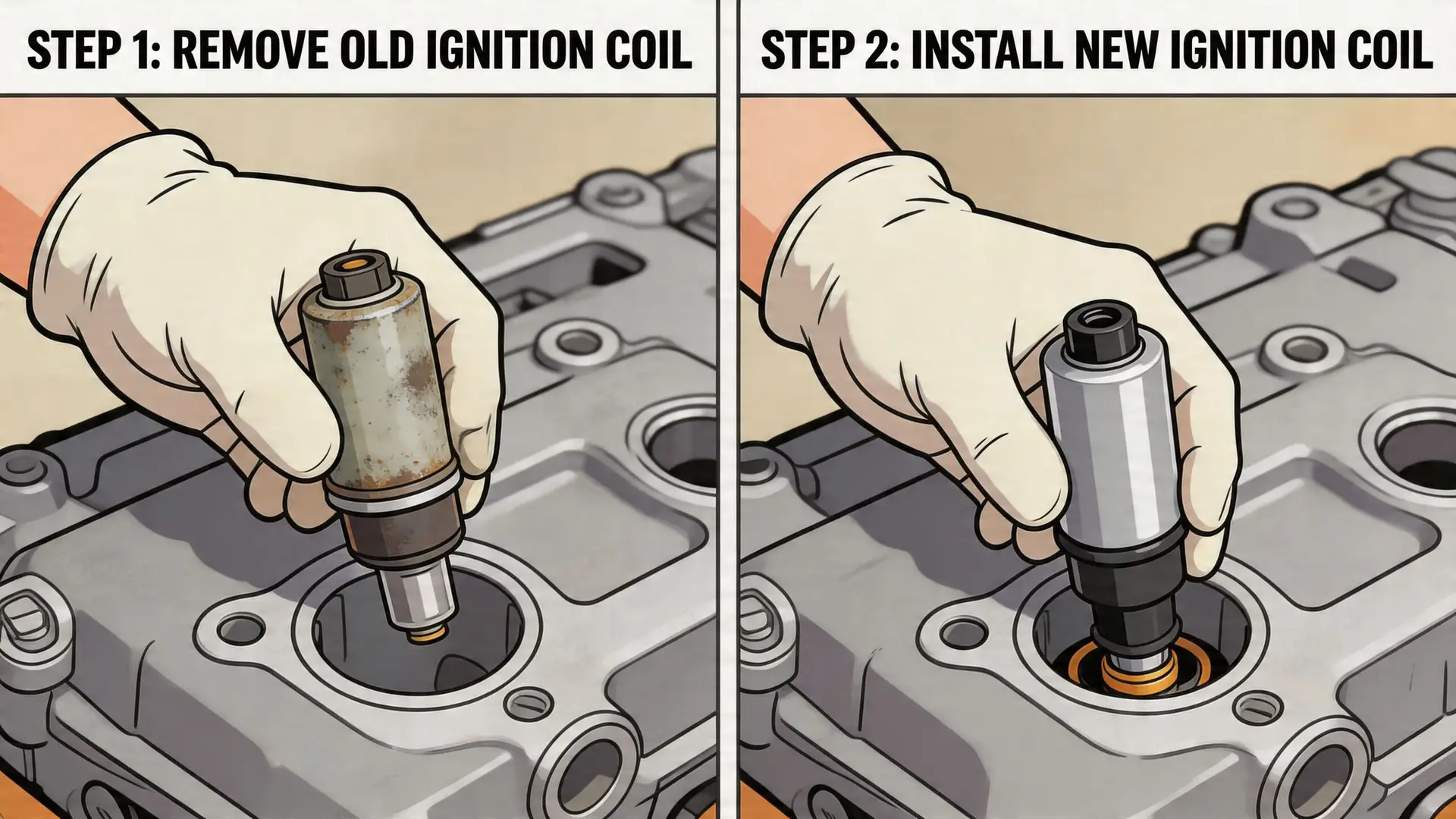
Gather the right tools and parts
For most coil-on-plug setups, start with the basics:
- Basic hand tools: usually a ratchet, extension, and the correct socket for the coil bolt
- A torque wrench: helpful on low-torque fasteners and coil hold-down bolts
- Dielectric grease: only where the service information or part design calls for it
- The correct replacement coil: match by engine and VIN application, not appearance alone
- A spark plug plan: if the plug is worn, fouled, oil-soaked, or overdue, deal with it now
Part choice matters too. The cheapest coil on the shelf can cost more if it creates an intermittent problem that sends you back into diagnosis. On some vehicles, an OE or high-quality aftermarket coil is worth the extra cost because labor and repeat testing are the expensive part.
Follow the replacement sequence
The process is simple on paper, but details matter:
- Disconnect the negative battery terminal if service information calls for it or if you are working near exposed electrical connections.
- Remove any engine cover or intake ducting needed for safe access.
- Release the electrical connector carefully and avoid prying on old lock tabs.
- Remove the retaining bolt and pull the coil straight up without twisting the boot apart.
- Inspect the plug well and boot for oil, water, rust staining, carbon tracking, or torn insulation.
- Check the spark plug condition before installing the new coil.
- Clean and dry the area if contamination is present.
- Install the new coil and torque fasteners properly.
- Reconnect everything, clear codes, and verify the repair with a road test.
If the plug tube has oil or water in it, stop there and address that cause first. Otherwise the new coil goes back into the same failure environment.
Don’t ignore the spark plug
A coil and spark plug work as a set. When the plug gap grows too wide, coil demand goes up. When a coil gets weak, the plug can foul. Replacing one and ignoring the other is one reason a misfire returns even though the “bad part” was changed.
That is also where the economics shift. Replacing one coil in your driveway can be a smart repair when access is easy and the diagnosis is strong. Replacing coils and plugs by trial and error on a newer engine gets expensive fast, especially if the fault is an injector problem, a valve cover leak filling the well with oil, or wiring damage that only shows up under vibration.
A short visual can help if you want to see the basic service flow on a coil-on-plug setup:
What holds up over time
Repairs last when the whole cylinder gets checked, not just the failed coil. That includes plug condition, contamination in the well, connector fit, charging voltage, and confirmation that the misfire is gone under real driving conditions.
The repairs that fail early usually involve one of these mistakes:
- Replacing a coil without a well-supported diagnosis
- Reusing a worn or fouled spark plug
- Ignoring oil or moisture in the plug well
- Damaging the connector while removing it
- Skipping the final scan and road test
At the service counter, a coil replacement can look like a quick line-item repair. In the bay, the real decision is whether the coil failed by itself or whether something else pushed it there. Professional shops typically verify those related conditions before closing the hood, because that extra diagnostic time is often cheaper than repeated parts replacement and the collateral damage a continuing misfire can cause.
DIY vs Professional Replacement Weighing Your Options
Your check engine light comes on Monday, the car shakes at idle, and an online parts search makes a coil look like a quick Saturday fix. Sometimes it is. Sometimes that same decision turns a simple repair into two or three parts bills because the coil was never the actual problem.
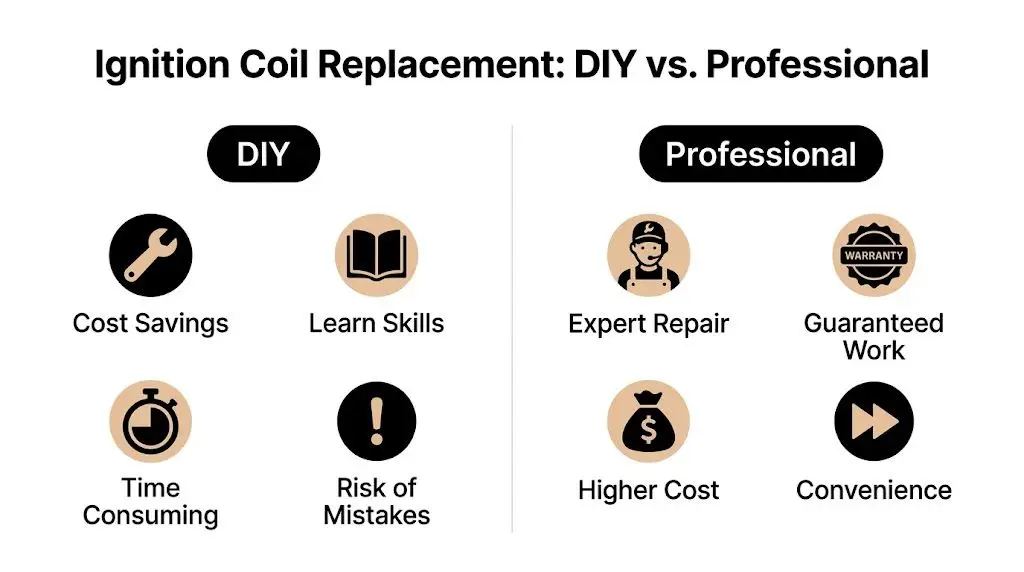
When DIY makes sense
DIY replacement is a reasonable choice when access is straightforward, the misfire has been pinned to one coil with solid testing, and the plug well is dry and clean. On an older or simpler coil-on-plug setup, that can be a fair driveway repair if you use quality parts and handle the connector carefully.
The advantages are real:
- Lower immediate cost: you save the labor charge.
- Control over the repair: you choose the brand, plug, and related service parts.
- Useful experience: for owners who already maintain their vehicles, this is a practical job to know.
It also helps if the maintenance history is known. If the plugs are overdue, replacing only the coil is rarely the smartest move. A good starting point is understanding how often spark plugs should be changed, because plug condition affects how hard the coil has to work.
Why DIY guesses get expensive
The hard part usually is not removing the coil. The hard part is deciding whether the coil failed.
Modern ignition systems do not always cooperate with simple driveway tests. A multimeter can catch an obvious open circuit on some older designs, but many newer coils fail only under heat, load, or vibration. I see vehicles come into Kwik Kar Richardson with a fresh coil already installed, yet the misfire is still there because the actual fault is a worn plug, oil contamination, a weak connector, an injector issue, or low compression.
That is the economic trade-off. The DIY route can save money when the diagnosis is already clear. It gets expensive fast when parts are used as test equipment.
Paying for diagnosis once is often cheaper than buying one good coil, then another plug, then another coil, while the original fault keeps damaging the cylinder.
Side-by-side trade-offs
| Factor | DIY | Professional |
|---|---|---|
| Upfront spend | Lower if you already have tools and the right part | Higher because labor and diagnostic time are included |
| Time | Unpredictable if the cause is not confirmed | Usually shorter once testing starts with a scan tool and scope |
| Tools needed | Basic hand tools, scan tool, service info, and enough access to work safely | Shop equipment is already in place |
| Risk of misdiagnosis | Higher, especially on intermittent faults and newer systems | Lower when wiring, plugs, injector contribution, and coil output are checked together |
| Best fit | Clear fault, easy access, and downtime you can afford | Newer vehicles, repeat misfires, poor access, or any case where a wrong call gets costly |
When professional replacement is the better call
Professional service makes more sense when the symptom pattern does not stay consistent, the code history points in more than one direction, or the engine bay is packed tight enough that a simple coil swap is no longer simple. That applies to many late-model direct-injection engines.
It also matters for drivers who cannot afford a comeback. Fleet vehicles, work trucks, commuter cars, and family vehicles usually benefit from a confirmed diagnosis first. A flashing check engine light means the misfire is active enough to risk catalyst damage, so guessing is a bad bet.
A coil replacement is only a good repair if it fixes the reason the cylinder stopped firing. That is why professional diagnosis often wins on total cost, even when the labor line looks higher at first glance.
Preventing Future Ignition Coil Failures
Ignition coils don’t usually fail in total isolation. In the bay, the repeat failures often trace back to something that kept stressing the coil after the original symptom appeared. Prevention is mostly about reducing that stress and catching related problems before they turn one bad ignition coil into a bigger repair.
Keep the spark plugs on schedule
This is the first place to focus. Worn plugs increase the effort required to fire the mixture, which forces the coil to work harder than it should. If your plugs are overdue, the coil pays for it.
If you need help planning that service, our guide on how often you should change spark plugs is a good place to start.
Fix leaks and voltage issues early
Oil in a plug well, moisture around the coil boot, and low battery voltage all create conditions that shorten coil life. If a valve cover gasket is leaking, that isn’t just a leak anymore. It becomes an ignition problem too. The same goes for a battery or charging system that isn’t keeping voltage where the ignition system needs it.
A quick routine inspection can catch those issues before they become a misfire complaint.
Preventive repair often feels optional until the alternative is a tow, a flashing check engine light, and a second damaged component.
Why prevention pays
The economics are straightforward. A proactive ignition coil replacement may cost $150-$300, while letting a failed coil persist can cause cascading damage to the engine computer or ignition control module, leading to repairs that can exceed $2,000, according to Aftermarket News coverage of ignition coil failure prevention.
That doesn’t mean every older coil needs immediate replacement. It means known ignition problems shouldn’t be left to “see if they get worse.” They usually do, and they rarely damage only themselves.
The smartest prevention plan is simple: keep plugs current, address leaks promptly, pay attention to battery health, and don’t ignore early misfire symptoms. That approach costs less than reactive repairs and keeps the vehicle safer to drive in traffic.
Frequently Asked Questions About Ignition Coils
Can you drive with a bad ignition coil?
You can sometimes drive with one, but that doesn’t make it a good idea. The engine may still run on the remaining cylinders, which is why people keep going to work or home first. The risk is that the misfire continues under load and causes further damage, especially to the catalytic converter.
If the check engine light is flashing or the engine is stumbling badly, driving it further is a poor bet.
Should you replace all ignition coils at once?
Not always. If one coil fails on a lower-mileage vehicle and the rest test well, replacing the failed coil may be perfectly reasonable. On an older or high-mileage engine, the decision gets more nuanced because the other coils have seen the same heat cycles and vibration.
What matters is the whole picture: mileage, access, the condition of the plugs, and whether the remaining coils show signs of age or contamination.
What’s the difference between an ignition coil and a spark plug?
The ignition coil creates the high voltage needed for ignition. The spark plug uses that voltage to create the spark inside the cylinder. They work together, but they’re not interchangeable and they don’t fail in the same way.
A weak coil can keep a good plug from firing correctly. A worn plug can overwork a good coil. That’s why both need to be considered during diagnosis.
Why did the new coil not fix the misfire?
Because the code may have pointed to a cylinder, not to a guaranteed failed coil. If the misfire stays after replacement, the cause may be the spark plug, connector, wiring, fuel injector, or a mechanical condition inside that cylinder.
That’s the reason experienced techs don’t stop at code reading. They confirm the fault path before calling for parts.
If your vehicle is idling rough, hesitating in traffic, or showing misfire-related warning lights, Kwik Kar Oil Change and Auto Care in Richardson can inspect the ignition system, verify whether the problem is the coil or another cylinder issue, and help you make a practical repair decision before the fault turns into a more expensive one.