That little red battery light on your dashboard is one of those warnings that immediately grabs your attention—and for good reason. It’s easy to assume it just means you have a dead battery, but let's clear that up right away: this light signals a problem with your car's entire charging system.
When you see it, your car is running solely on battery power, and you don’t have much time before it shuts down completely.
What That Battery Light Is Really Telling You
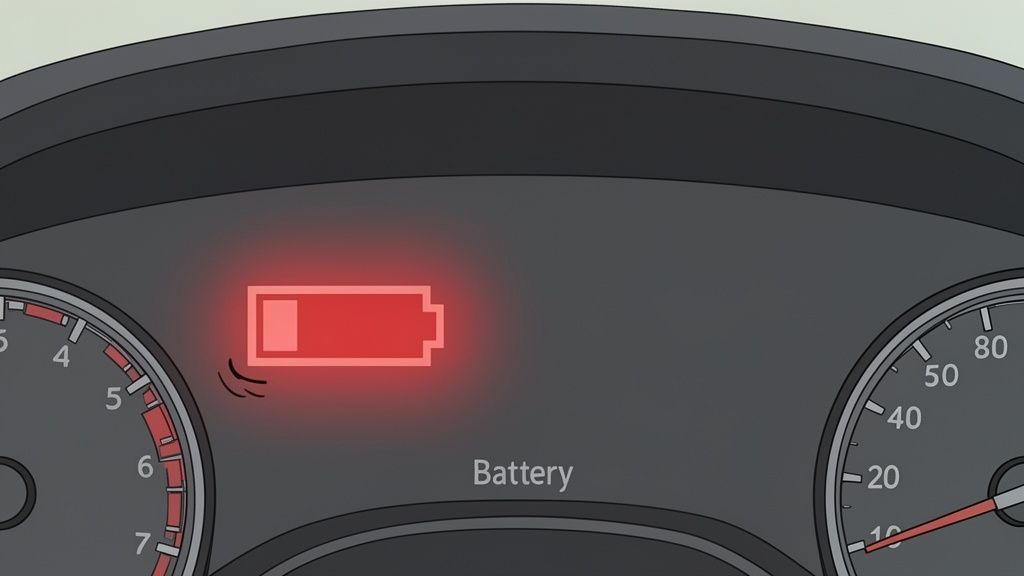
Think of that light as your car’s distress signal. It pops on when the electrical system’s voltage drops below a safe level. A healthy system keeps things humming along between 13.5 and 14.5 volts while the engine is on. If that light is glowing, the voltage has dipped, meaning the battery isn't getting the juice it needs from the alternator to stay charged.
Now, every electronic component—from your engine's ignition and fuel pump to the headlights and radio—is draining the battery’s limited reserves. This is a critical warning. Ignoring it is the fastest way to find yourself stranded, usually at the worst possible moment. The problem could be the battery, but it could also be a number of other parts that work together to keep your car powered up.
Common Causes and Urgency
So, what’s the most likely culprit behind that glowing red icon? Understanding the possibilities helps you gauge how serious the problem is and figure out your next move. Too often, drivers see the battery light on a dashboard and keep going, only to end up with a car that won't restart.
A car battery's lifespan is typically 3–5 years, but that can shrink dramatically in our Texas heat. A battery that might last 58 months up north could fail in under 41 months here in Richardson, TX. The heat accelerates the chemical reactions inside, causing them to wear out faster. You can learn more about how climate impacts battery life in this car battery buying guide from Consumer Reports.
Key Takeaway: The battery light signals a charging system failure, not just a battery problem. Your car has a limited amount of time before it will shut down completely.
Quick Guide to the Battery Warning Light
To help you get a better idea of what might be wrong, here’s a quick rundown of the most common issues, the symptoms that usually accompany them, and how quickly you need to act.
| Potential Cause | Common Symptoms | Urgency Level |
|---|---|---|
| Failing Alternator | Dimming headlights, slow accessories, whining noise from engine | High – Immediate attention needed |
| Old/Weak Battery | Difficulty starting the car, corroded terminals, dim interior lights | Medium – Get tested soon |
| Worn Drive Belt | Squealing sound at startup, visible cracks or fraying on the belt | High – Risk of overheating and power loss |
| Faulty Wiring | Flickering battery light, intermittent electrical issues | Medium – Can be hard to diagnose; see a pro |
This table should give you a starting point, but diagnosing electrical issues can be tricky. If you’re not comfortable checking these things yourself, it’s always best to let a professional take a look.
The Four Main Reasons Your Battery Light Is On
When that little red battery icon lights up your dashboard, it’s your car’s way of saying something is wrong with the electrical system. It's a common misconception that this light only points to a bad battery. In reality, it's a general alert, and the battery is just one of several potential culprits.
Think of it this way: your car's charging system is a team. If one player isn't doing its job, the whole system suffers. Let's walk through the four most common reasons you'll see that light, starting with the most obvious and moving to the less apparent issues.
A Tired or Failing Battery
This is usually the first thing that comes to mind, and for good reason. A car battery doesn't last forever, especially here in Richardson where the intense Texas heat can bake the life out of it. An old battery simply can't hold a charge the way it used to, just like an old phone that needs to be plugged in constantly.
When the battery's voltage drops too low, it triggers the warning light. You might have already noticed other clues, like your engine struggling to turn over in the morning or your headlights seeming a bit dimmer than usual. A quick look under the hood can sometimes tell the story—if you see a crusty, blueish-white buildup on the terminals, that corrosion is blocking the electrical connection.
Pro Tip: If your car battery is over three years old, have it tested during your next oil change at Kwik Kar. It's a simple, proactive check that can save you from being stranded later.
The Alternator Is Not Charging
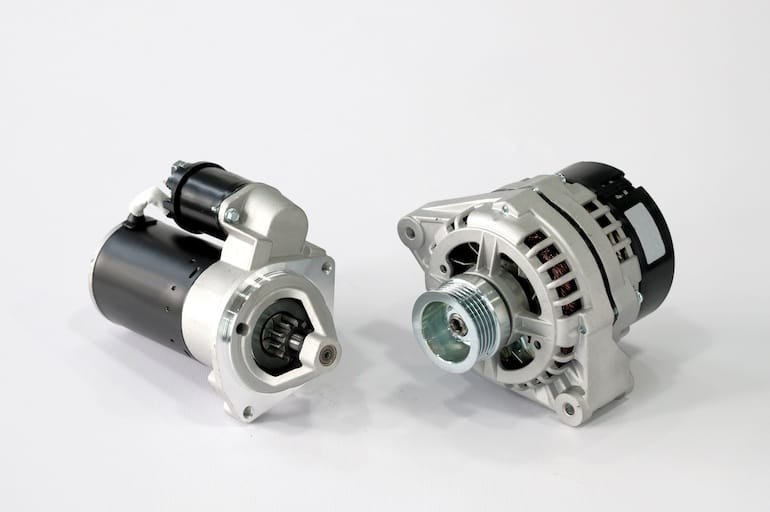
If the battery provides the initial spark, the alternator is the workhorse that keeps everything running. It’s a mini generator driven by your engine that powers all your electronics—from the radio to the A/C—while also recharging the battery. When the alternator starts to fail, the battery light on dashboard is your primary warning.
A dying alternator won't produce enough voltage to meet the car's demands. To compensate, your vehicle will start draining the battery directly, which can leave it completely dead in a surprisingly short amount of time.
You'll often notice other signs that point to the alternator:
- Dimming or Flickering Lights: Your headlights or interior lights might pulse or fade, especially when you turn on another accessory.
- Strange Noises: A whining or grinding sound from under the hood can be a sign of worn-out bearings inside the alternator.
- Electrical Gremlins: Power windows might move slower than normal, or your sound system could cut out unexpectedly.
Catching these issues early is key. For a more detailed breakdown, check out our guide on common bad alternator symptoms.
A Loose or Worn Drive Belt
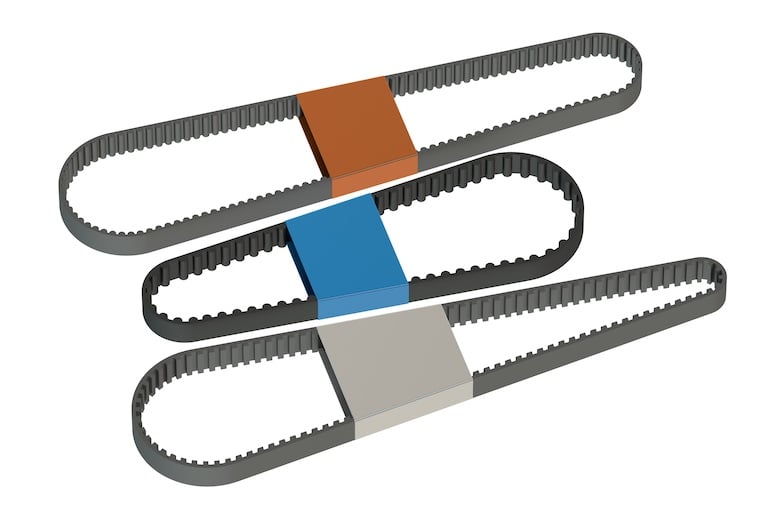
The alternator can’t do its job alone. It's spun by a long rubber belt, often called the serpentine belt, that's connected to the engine. For the alternator to generate power, that belt needs to be tight and in good condition.
If the belt is old, cracked, or stretched out, it will slip on the alternator's pulley. This means the alternator isn't spinning fast enough to produce a proper charge, causing the battery light to appear, sometimes intermittently. A tell-tale sign of a slipping belt is a high-pitched squeal when you start the engine or run the A/C. This is a critical part, as it usually also runs the power steering and water pump, so a complete failure can cause much bigger problems.
Faulty Wiring or Blown Fuses
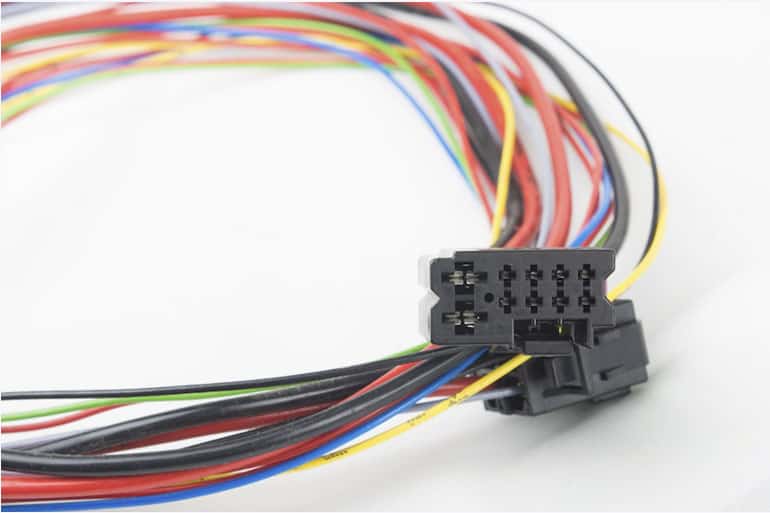
Finally, the problem might just be a bad connection. Your car is full of wires, and any corrosion, loose terminal, or frayed cable between the battery, alternator, and computer can disrupt the electrical flow.
This can be the trickiest problem to diagnose. A loose ground wire might cause the battery light to flicker only when you hit a bump. A corroded battery cable can prevent a good connection, or a simple blown fuse in the charging circuit can stop the alternator from charging the battery altogether. While it's less common than a bad battery or alternator, faulty wiring is always something a good technician will check if the main components test out fine.
What To Do Immediately When The Light Comes On
That sudden glow of the battery light on your dashboard can definitely get your heart pumping, but what you do in the next few minutes is critical. It can mean the difference between rolling into a safe spot and getting stranded on the side of the road.
Your car has just fired off a major warning flare: it's no longer making its own electricity and is running purely on the battery's reserve power. That power is finite. The mission now is to conserve every last drop and figure out your next move.
Think of it like your phone hitting 5% battery—you immediately dim the screen and close apps. You need to do the same for your car. The first thing to do is cut the electrical load, right now. Every accessory you shut off buys you more precious time and distance.
Go down this mental checklist and turn off these power hogs:
- Climate Control: Your AC and heater are massive energy drains. Turn the whole system off, not just down.
- Radio/Stereo System: Your playlist can wait. Power down the audio system completely.
- Phone Chargers & Accessories: Unplug everything. Cords for your phone, dash cam, or any other gadget are all pulling power.
- Heated Seats/Steering Wheel: These comfort features use a surprising amount of electricity. Switch them off.
By shedding all this extra weight from the electrical system, you're allowing the battery to dedicate its limited energy to the essentials: the engine, the ignition, and the fuel pump. Whatever you do, try to avoid turning the engine off and on again. Restarting a car takes a massive jolt of power that you just don't have to spare.
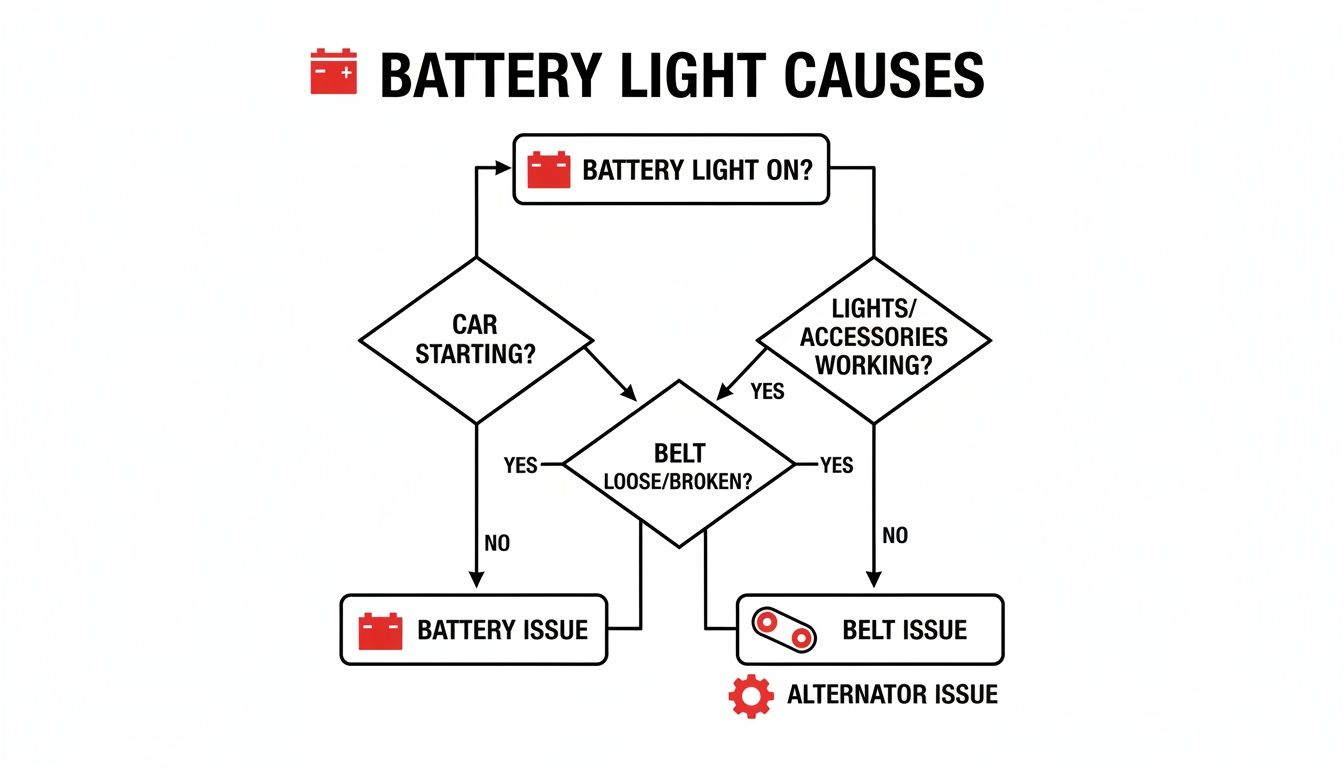
This chart gives you a good visual of the process. The battery light is just the beginning of the story; a little investigation is needed to find the real culprit, which is often the alternator or a belt, not just the battery itself.
Pulling Over for a Safe Visual Check
Your next goal is to find a safe place to pull over—a well-lit parking lot is perfect, but a wide shoulder or quiet side street will do. Once you're safely parked and the engine is off, you can play detective for a minute. You don't need to be a mechanic; you're just looking for clues.
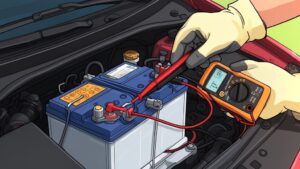
Pop the hood and lay eyes on the battery. See any fuzzy, blue-green, or whitish crust built up around the metal terminals? That's corrosion, and it acts like a roadblock for electricity. A bad connection here is a very common cause and, thankfully, often a simple fix.
Next, check the battery cables themselves. Carefully try to wiggle the connectors on the battery terminals. If one is loose, it can’t maintain a solid connection, causing the charging system to fail intermittently.
Safety First: The engine bay can be a dangerous place. Never touch both battery terminals at the same time, and be careful around a recently running engine—many parts will be extremely hot.
Inspecting the Drive Belt
After you've checked the battery, try to locate the drive belt (you might know it as the serpentine belt). It's a long, ribbed rubber belt that winds its way around several pulleys at the front of your engine. Crucially, it's what spins the alternator to generate power.
Give it a good look. Are you seeing any obvious red flags?
- Cracks, frays, or chunks of rubber missing?
- Does the surface look overly shiny or glazed?
- Is it loose on the pulleys, or has it slipped off entirely?
You might even remember hearing a high-pitched squeal when you started the car or when you accelerated—a classic sign of a belt that's slipping. A broken or failing belt is a showstopper. It doesn't just kill the alternator; it often runs the power steering and water pump, too. If that belt is snapped, do not drive the car any further.
Just doing these quick checks gives you a huge advantage. Knowing if the belt is shredded or the terminals are caked in corrosion helps a technician diagnose the problem way faster, which means getting you back on your way sooner.
How A Professional Technician Diagnoses The Issue
When your own DIY checks hit a dead end, it's time to let a professional take over. At Kwik Kar in Richardson, our ASE-certified technicians don't guess—we diagnose. We move beyond a simple visual inspection and use a systematic process with advanced tools to find the exact reason that battery light is on your dashboard.
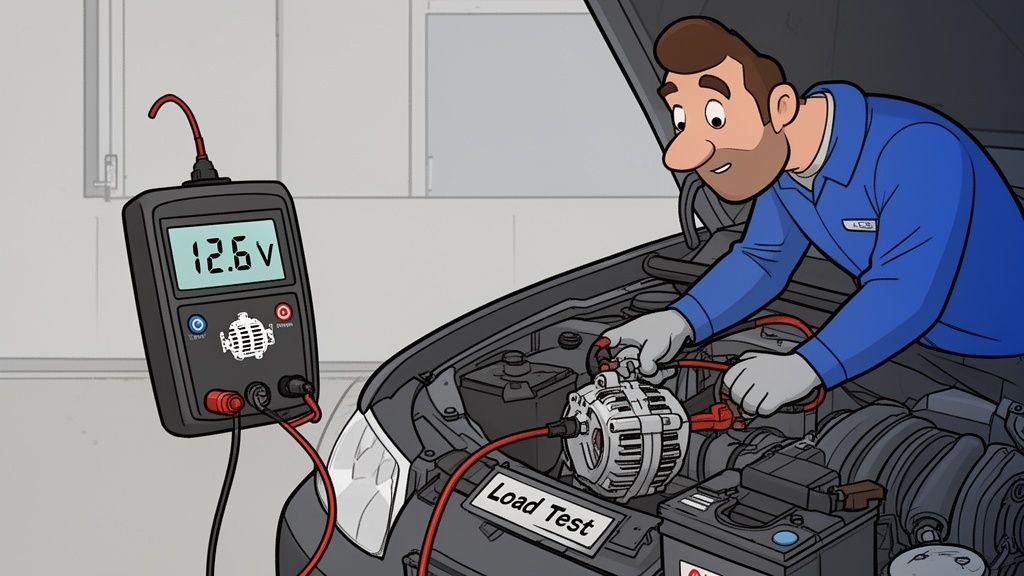
The very first thing we do is a comprehensive charging system analysis. This is way more than just checking the voltage. We hook up professional-grade testers to get a complete picture of your vehicle's electrical health, which involves a few key tests.
Professional Battery and System Testing
Our technicians kick things off with a battery load test. This isn't about what the battery voltage is at rest; it's about how it performs under pressure, simulating the heavy demand of starting your engine. A battery might show a perfect 12.6 volts sitting there, but crumble under a load test, revealing it’s on its last legs. We're specifically checking the Cold Cranking Amps (CCA) to see if it has the muscle to do its job.
Next, with the engine running, we conduct a charging system test. This is a direct measure of the alternator's output. A healthy alternator should be putting out a steady voltage, usually between 13.5 and 14.5 volts. If the reading is too low, we know the alternator isn't recharging the battery. If it's too high, the voltage regulator is probably fried, which can literally "cook" your battery over time. You can learn more about the vital role your charging system plays in our guide to alternators and starters.
This professional approach is crucial. According to ASE data, a staggering 20% of all roadside assistance calls are due to dead or failing batteries. A proper diagnosis prevents you from becoming a part of that statistic.
Hunting for Parasitic Drains
What happens if the battery and alternator both test fine? This is where a technician's real skill comes into play. The next likely culprit is a parasitic drain—a sneaky electrical leak that slowly bleeds your battery dry while the car is turned off. Think of it as a tiny, invisible faucet left dripping overnight.
It could be a glove box light that won't turn off, a faulty alarm, or a bad relay in a computer module. These small draws won't kill your battery in an hour, but they can easily drain it over a weekend, leaving you with a no-start situation and that pesky battery light.
To hunt down a parasitic drain, a technician will:
- Connect a specialized meter called an ammeter in series with the battery.
- Measure the electrical draw after the car is off and all its systems have gone to "sleep."
- Systematically pull one fuse at a time, watching the meter until the excessive draw suddenly drops. This isolates the faulty circuit.
It's a methodical process, but it's the only surefire way to pinpoint the source of the electrical leak.
Expert Insight: A normal parasitic draw on a modern car should be under 50 milliamps. Anything significantly higher than that points to a problem that will cause chronic battery failure if it isn't fixed.
Advanced Diagnostic Tools and Techniques
Sometimes, the issue is even more subtle. It could be a loose ground wire, a partially frayed cable, or even a computer communication error causing intermittent problems that are tough to replicate.
In these tricky cases, we pull out the advanced tools. We might use an oscilloscope to visualize the alternator's electrical signal in real-time or a digital scanner to check for hidden fault codes stored in your vehicle's computer.
For those curious about the complexities of vehicle electronics, there are great resources that explain how to diagnose car electrical problems from a professional's perspective. It really shows why having the right equipment is non-negotiable for finding the true root cause and ensuring we fix the problem right the first time.
What To Expect: Repair Costs And Options
Once a technician has figured out exactly why your battery light on your dashboard came on, the next logical question is always, "How much is this going to cost?" Let's be honest, car repairs are never fun, but knowing what to expect financially can take a lot of the stress out of the situation. Here at Kwik Kar, we believe in complete transparency, so we'll lay out the potential costs before any work begins.
The final bill really hinges on the root cause and your specific car, truck, or SUV. A simple fix might be surprisingly affordable, whereas replacing a major component will be a more significant investment. We’ll walk through the most common culprits to give you a clearer picture.
Breaking Down Common Repair Costs
The price to get that pesky battery light turned off can range from under a hundred dollars to several hundred, all depending on what needs to be fixed or replaced. For example, the alternator on a luxury SUV is going to be a pricier part and often harder to access than one on a compact sedan, which affects the labor time and total cost.
Here’s a general breakdown of what you can expect for the most frequent repairs. These estimates are all-in, covering both the part and the labor to get it installed.
Our Promise to You: You will always get a detailed, written estimate from us before we pick up a single wrench. No hidden fees, no surprises—just honest, quality work backed by our NAPA AutoCare warranty.
Estimated Repair Costs for Common Battery System Issues
To help you budget, we've put together this table outlining the realistic cost ranges for the most common services related to a battery warning light. Remember, these are general estimates, and the final cost will depend on your vehicle's make and model.
| Service / Repair | Estimated Cost Range (Parts & Labor) | Typical Time Required |
|---|---|---|
| New Car Battery | $150 – $350 | 20-45 Minutes |
| Alternator Replacement | $400 – $900+ | 1-3 Hours |
| Drive/Serpentine Belt | $100 – $250 | 30-60 Minutes |
| Battery Terminal Cleaning | $30 – $60 | 15-20 Minutes |
As you can see, a quick battery terminal cleaning is a very minor expense. On the other hand, a full alternator replacement is a more substantial repair. It's crucial to understand that putting off a necessary fix, like a failing alternator, often leads to bigger headaches—like being forced to replace a perfectly good battery that died because it wasn't getting charged. If you want to dive deeper into battery lifespans, check out our guide on how long a car battery should last.
Why Choose Kwik Kar for Your Repair?
Choosing a repair shop isn't just about finding the cheapest hourly rate; it’s about getting real, long-term value and the peace of mind that comes with it. A cheap, poorly installed part can fail in a few months, leaving you stranded all over again. At Kwik Kar in Richardson, we focus on delivering quality that you can count on.
Here’s what makes our service different:
- ASE-Certified Technicians: Our mechanics have the training and hands-on experience to diagnose the problem correctly the first time. That saves you from paying for parts you didn't need.
- Quality NAPA Parts: We use top-tier NAPA parts that meet or exceed what your car's manufacturer recommends, ensuring your vehicle runs reliably.
- Nationwide Warranty: Most of our work is covered by the NAPA AutoCare 24-Month/24,000-Mile Peace of Mind® Warranty, which is honored at over 17,000 locations across the country.
We are also proud to offer discounts for military personnel, first responders, and healthcare providers as a small way of saying thank you. Our goal is to be the auto shop you trust, building a relationship based on expertise, fair pricing, and genuine care for our customers and their vehicles.
Answering Your Top Questions About the Battery Light
Even after you know the potential causes, seeing that little red battery icon pop up can still leave you with some nagging questions. It’s one thing to understand why the battery light on a dashboard might be on, but it's another thing entirely to know exactly what to do in a real-world situation.
We hear the same follow-up questions from drivers all the time here in Richardson. Let's clear up that lingering confusion so you can act with confidence the next time you're faced with this particular warning.
Can I Keep Driving My Car If The Battery Light Is On?
Technically, you can drive for a very short distance, but it's a huge gamble that we strongly advise against. When that light is on, your car is running entirely on the battery's stored power. Sooner or later—and probably sooner—that power will run out, and your car will stall completely. This could happen anywhere, from the middle of a busy intersection to the fast lane on the highway.
Your immediate goal should be to get to the nearest trusted auto shop, like Kwik Kar, as safely and quickly as you can.
To stretch your battery's remaining life on the way, here's what to do:
- Turn off every single electrical accessory. That means the radio, air conditioning, heater, and any phone chargers. Unplug everything.
- Avoid stopping and restarting the engine. Starting the car draws a massive amount of power you simply can't spare.
- If you see other warning lights appear (like the temperature gauge creeping up) or your headlights start to dim, find a safe place to pull over immediately and call for roadside assistance.
My Battery Light Comes On And Off—What Does That Mean?
An intermittent battery light is a classic sign of a problem that's just starting to get serious. Think of it as your car's final warning before a complete failure. Don't make the mistake of ignoring it just because the light goes away for a bit.
This flickering or on-again-off-again warning usually points to a few specific culprits:
- A Slipping Drive Belt: The belt that spins the alternator might be gripping the pulley just fine at certain engine speeds but slipping at others, causing a temporary drop in charging.
- A Failing Alternator: The alternator itself might be on its last legs, working inconsistently. It might produce enough voltage one minute and then fail the next.
- Loose or Corroded Connections: A battery cable that isn't tight or has built-up corrosion can make and break its connection as the car vibrates, triggering the light sporadically.
An intermittent light is your car telling you a key component is on the verge of giving out. Getting it checked by a Kwik Kar technician now can save you from being stranded later.
I Just Replaced My Battery, So Why Is The Light Back On?
This is an incredibly frustrating situation, but it almost always means the battery wasn't the root cause of the problem—it was just a symptom. The new battery you just paid for is now suffering the same fate as the old one. The light is your warning that this brand-new part is being drained because it isn't receiving a proper charge.
The most likely suspect here is a faulty alternator. The old battery probably died because the alternator wasn’t recharging it correctly in the first place.
Other possibilities, though less common, include:
- The wrong type of battery was installed for your vehicle's needs.
- A poor connection was made at the new battery terminals during installation.
- A fuse or link in the charging circuit has blown, which stops power from reaching the battery.
This scenario is the perfect example of why a complete charging system diagnostic is so important. We don't just swap parts; we find and fix the underlying issue so it doesn't happen again.
How Can I Prevent Battery And Alternator Problems?
While you can't prevent every single issue, a little proactive maintenance is your best defense against unexpected electrical failures. A few simple habits can dramatically extend the life of your entire charging system.
First, get your battery and charging system tested at least once a year, especially after your battery is a couple of years old. The intense Texas heat is notoriously hard on these components. We can run a quick test for you during any routine oil change.
Second, keep an eye on your battery terminals. Corrosion is a common enemy that blocks the flow of electricity. We can clean them and apply a protective coating to prevent future buildup.
Finally, just listen to your car. If you hear squealing noises or see visible cracks on the serpentine belt, get it replaced before it breaks and leaves you stranded. Simple preventive checks by a trained eye can catch these small issues long before they're big enough to trigger a warning light.
Don't let a battery light leave you guessing on the side of the road. If you're in the Richardson area, bring your vehicle to Kwik Kar Oil Change and Auto Care. Our ASE-certified technicians will perform a comprehensive diagnostic to find the real problem and get you back on your way safely. Schedule your visit today at https://www.kkrichardson.com.