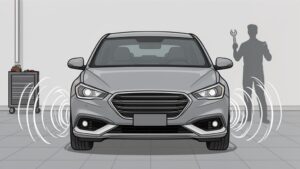
If you see black smoke billowing out of your exhaust, it’s a sure sign your engine is burning too much fuel. This condition, known as running "rich," means the delicate balance of fuel and air your engine needs has been thrown off. It's a clear signal that needs prompt attention to head off poor fuel economy and potential engine damage.
Unpacking the Meaning of Black Exhaust Smoke
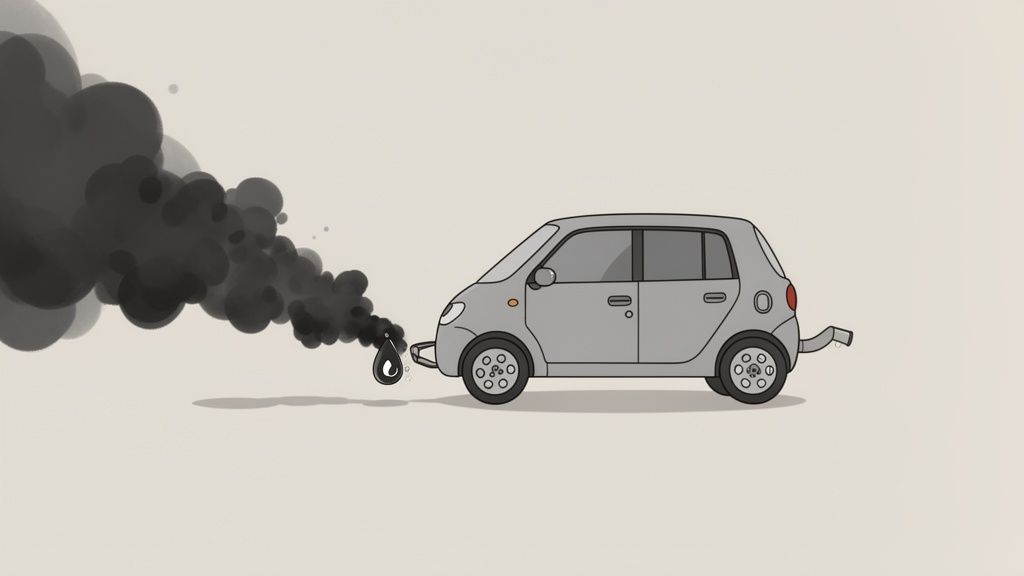
When you notice a dark plume trailing your vehicle, it's an unmistakable cry for help from your engine. Those dark, sooty particles making up the smoke are really just unburned fuel.
Think of it like trying to light a campfire with damp wood—instead of a clean, hot flame, you get a ton of thick, black soot. Your engine is essentially doing the same thing, struggling to ignite the excessive amount of fuel it’s being fed.
This imbalance can be triggered by a handful of different mechanical or sensor-related issues. While it definitely looks alarming, the good news is that black smoke often points to problems that are a bit more straightforward to diagnose than the issues that cause blue or white smoke.
What Your Car Is Trying to Tell You
The appearance of black smoke is a direct symptom of incomplete combustion. Your car's computer, the Electronic Control Unit (ECU), works constantly to maintain that perfect air-to-fuel ratio for peak efficiency. When a component in that system fails, the whole balance gets thrown out of whack.
A few common signals often show up alongside black smoke:
- A noticeable drop in fuel mileage: Because your engine is literally wasting gas, you'll find yourself at the pump more often.
- Reduced engine power or sluggish acceleration: An improper fuel mixture robs your engine of the power it needs to perform like it should.
- A rough or shaky idle: The engine might struggle to run smoothly when you're stopped due to the inconsistent combustion.
- The smell of gasoline: You might even catch the distinct odor of raw fuel, which is a dead giveaway of an overly rich mixture.
Black smoke is more than just an ugly emission; it's a direct indicator of inefficiency. Ignoring it means you are actively wasting money on fuel and putting unnecessary strain on critical engine and exhaust components like your catalytic converter.
Often, the problem causing the smoke will also trigger your car’s dashboard warning lights. If you're seeing black smoke, keep an eye out for the check engine light, too. The two issues are frequently connected, and you can learn more about what your check engine light means in our detailed guide. Understanding these symptoms is the first step toward getting a correct diagnosis and a lasting repair.
Decoding The Color Of Your Exhaust Smoke
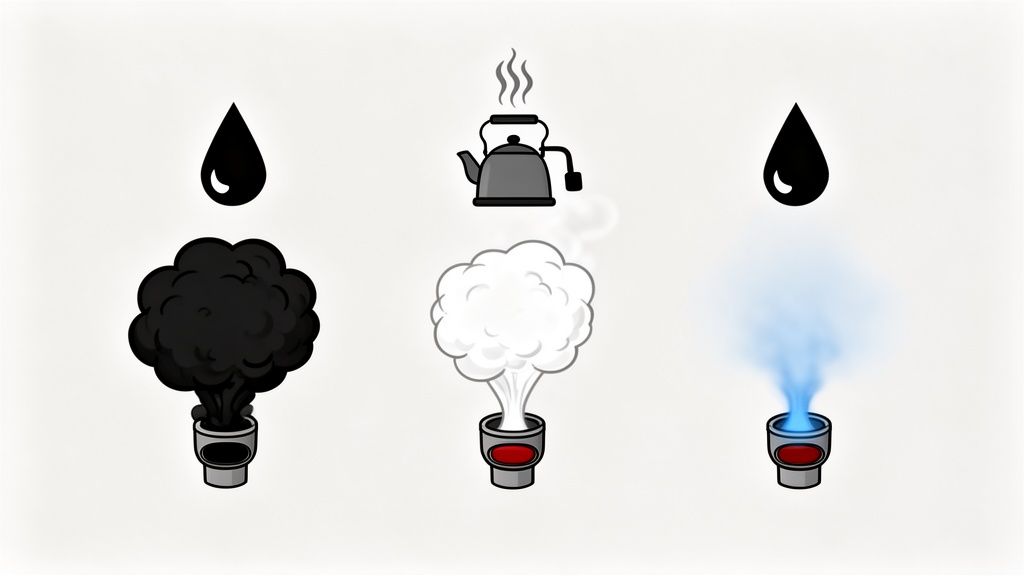
Not all exhaust smoke is created equal. The color puffing out of your tailpipe is your car’s way of sending you a very specific message about its health. Think of it as a smoke signal telling you what’s happening deep inside the engine.
Learning to tell the difference between these colors helps you understand the problem's severity and gives you a head start when you talk to your mechanic. It’s the first step to a fast, accurate diagnosis.
Black Smoke: The Fuel Problem
As we've covered, black smoke coming from the exhaust is a dead giveaway that the engine is burning too much fuel. This is what mechanics call a "rich" fuel mixture—there's simply not enough air to burn all the gasoline or diesel getting pumped into the cylinders. What you see is a cloud of soot, which is just wasted, unburned fuel.
This isn’t just an ugly sight; it's a clear sign of incomplete combustion. The health risks are also serious, especially with diesel engines. Studies on vehicle exhaust have shown that on-road diesel vehicles were responsible for nearly half of all vehicle-related particulate pollution deaths in 2015, totaling around 181,000 lives lost.
White Smoke: The Coolant Intruder
Thick, persistent white smoke points to a totally different problem: coolant is getting inside your engine. This isn't the same thin, vapor-like steam you see on a cold Texas morning—that’s just normal condensation burning off.
We’re talking about a dense, sweet-smelling cloud that hangs in the air, almost like steam from a kettle. This means antifreeze is leaking into the combustion chambers and turning into steam. It’s a major issue that can quickly lead to overheating and catastrophic engine failure if you ignore it.
The usual suspects are:
- A blown head gasket, which is the seal between the engine block and cylinder head.
- A cracked cylinder head or engine block, which is less common but much more severe.
If you see thick white smoke, pull over and turn off the engine as soon as it's safe. Driving a car that's burning coolant is one of the fastest ways to destroy your engine, turning a repair into a full replacement.
Blue or Gray Smoke: The Oil Burner
If the smoke has a distinct blue or grayish tint, your engine is burning oil. Motor oil has one job: lubricating moving parts while staying out of the combustion chamber. When it manages to sneak in, it burns with the fuel and creates that signature blue-tinged smoke.
This usually signals internal engine wear. A small puff of blue smoke right when you start the car often points to worn valve seals. But if the smoke is constant while you're driving, it’s likely a more serious problem like worn-out piston rings. Burning oil leads to low oil levels, fouled spark plugs, and can even ruin your catalytic converter over time.
Quick Guide to Exhaust Smoke Colors
To make it easier, here's a quick reference table to help you identify what that smoke is trying to tell you.
| Smoke Color | What It Looks Like | Likely Cause | Urgency Level |
|---|---|---|---|
| Black | Thick, dark, and sooty | Too much fuel, not enough air | High – Address soon to avoid engine and converter damage |
| White | Dense, sweet-smelling clouds | Burning coolant from an internal leak | Critical – Stop driving immediately to prevent overheating |
| Blue/Gray | Bluish tint, oily smell | Burning engine oil | High – Needs prompt attention to prevent oil loss and engine wear |
Paying attention to these visual clues can save you from a much bigger headache down the road. If you see any of these smoke signals, it's a clear sign your car needs a professional look.
The Five Most Common Causes Of Black Smoke
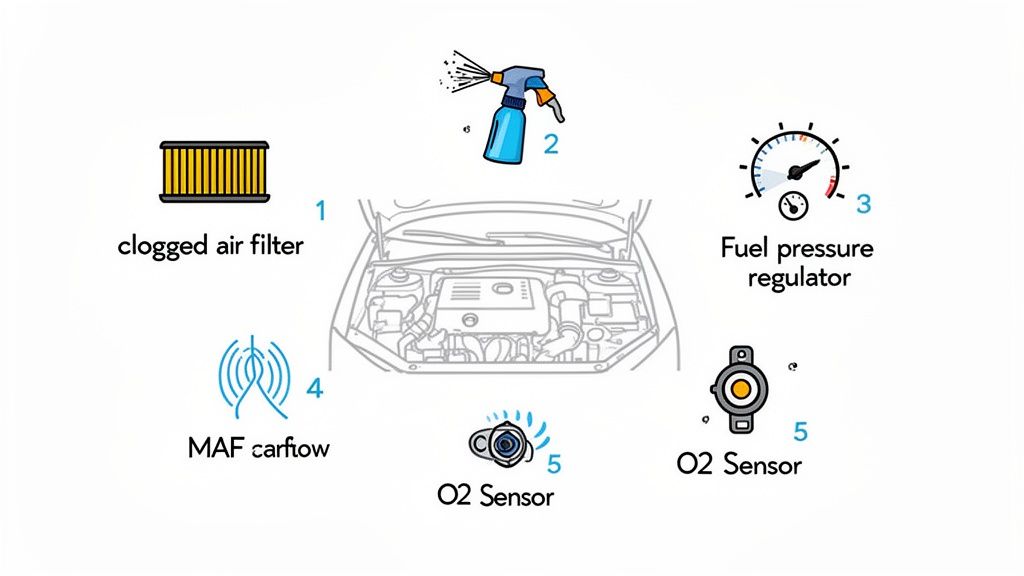
When you see that puff of black smoke, your engine is sending a clear distress signal. It’s running too "rich," which is just a mechanic's way of saying the delicate air-to-fuel ratio is off. Far too much fuel is getting into the combustion chamber, or there isn't nearly enough air to burn it all cleanly.
Let's break down the five most common culprits that throw this critical balance out of whack.
1. A Clogged Air Filter
The simplest and most frequent cause of black smoke coming from exhaust is a plain old dirty engine air filter. Think of the air filter as your engine's lungs. To work efficiently, it needs to breathe in a precise volume of clean air to mix perfectly with fuel.
When that filter gets choked with dust, leaves, and road grime, it's like forcing your engine to breathe through a dirty mask. It struggles to pull in enough oxygen, but the fuel system doesn't know that—it just keeps injecting the normal amount of gasoline. The result is a fuel-heavy mixture that can't burn completely, producing that sooty black smoke you see billowing out the tailpipe.
A clogged filter isn’t just an emissions problem; it kills your performance and fuel economy. Your engine will feel sluggish, and you'll see your MPG drop because you're literally just wasting gas with every incomplete combustion cycle.
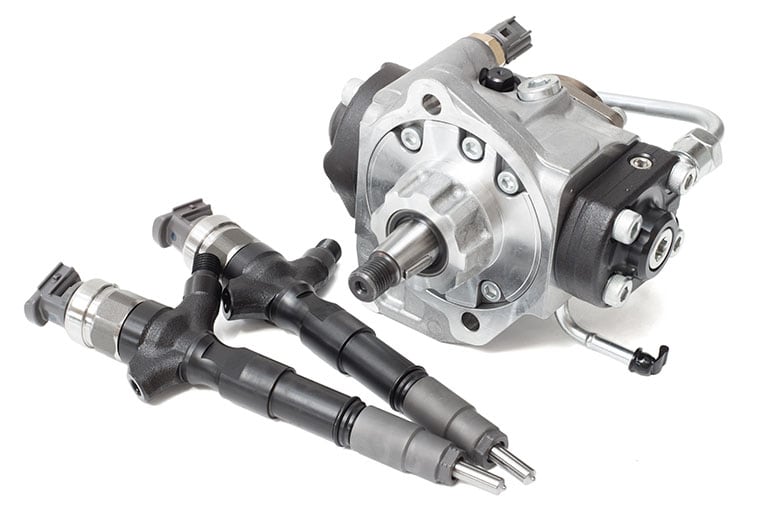
2. Failing Fuel Injectors
If the air filter looks good, the next logical stop is the fuel injectors. These are highly sophisticated nozzles responsible for spraying a fine, atomized mist of fuel into the engine's cylinders at exactly the right millisecond.
A fuel injector can go bad in a couple of ways that lead straight to black smoke:
- Leaking or Dripping: An injector can get stuck partially open or develop a bad seal, causing it to drip raw fuel into the cylinder. This isn't the fine mist the engine needs; it's a messy puddle that overwhelms the combustion process.
- Bad Spray Pattern: When injectors get dirty or clogged, their carefully engineered spray pattern gets ruined. Instead of a perfect cone of mist, they might squirt a solid stream of fuel, which doesn't mix well with air and fails to burn properly.
A faulty injector is like a garden hose nozzle stuck on "jet" instead of "mist." It dumps way too much liquid in one spot. If you're dealing with injector issues, you'll probably also notice a rough idle, engine misfires, or a strong smell of gas. To see how these parts work in more detail, check out our guide on how to test fuel injectors.
The link between maintenance and emissions is undeniable. Research from the World Bank often connects black smoke directly to lax vehicle upkeep, identifying dirty air filters and faulty injectors as primary sources of the fine carbonaceous particles that harm both public health and the environment. You can explore the data behind these findings in this detailed analysis of vehicle smoke measurement.
3. A Faulty Fuel Pressure Regulator
Your car's fuel system is designed to run under a very specific, consistent pressure. The fuel pressure regulator is the gatekeeper that makes sure the pressure never gets too high or too low.
If this regulator fails, it can let the fuel pressure skyrocket. This forces the injectors to spray way more fuel than your engine's computer is asking for. Even if the injectors are working perfectly, the extreme pressure shoves too much gasoline into the cylinders every single time they open.
Imagine trying to fill a small drinking glass with a firehose—you're going to make a mess and waste a ton of water. That's pretty much what a bad fuel pressure regulator does to your engine, creating a severely rich condition and clouds of black smoke.
4. A Malfunctioning Mass Airflow Sensor
Modern engines are run by a network of sensors that feed real-time information to the main computer, or ECU. The Mass Airflow (MAF) sensor is one of the most important ones. It sits right after the air filter and measures the exact amount and density of air flowing into the engine.
The ECU takes this data and calculates precisely how much fuel to add for a perfect burn. But if the MAF sensor gets dirty or fails, it starts sending bad information. It might tell the ECU that less air is coming in than there actually is.
Based on that faulty data, the computer miscalculates and injects too much fuel. It’s like a chef using a broken scale to measure flour for a cake—the recipe is doomed from the start. A failing MAF sensor will almost always cause black smoke, poor acceleration, and sometimes stalling.
5. A Bad Oxygen Sensor
Finally, we have the Oxygen (O2) sensor. Located in your exhaust pipe, its job is to analyze the gases after combustion has already happened. It's the final quality-control check for the air-fuel mixture.
It tells the ECU if the mixture was too rich (not enough oxygen left) or too lean (too much oxygen left). The computer uses this feedback to make constant, tiny adjustments to the fuel delivery, keeping everything in perfect balance.
But when an O2 sensor goes bad, it can get stuck sending a "lean" signal. This tricks the computer into thinking the engine is starved for fuel. In response, the ECU overcompensates by dumping in more and more gasoline, creating a feedback loop that results in constant over-fueling and, you guessed it, black smoke.
Why You Should Never Ignore Black Smoke
Seeing black smoke puffing out of your exhaust is more than just a bad look—it’s a serious warning sign from your engine. Think of it like a smoke alarm for your car. Ignoring it won't make the problem go away; it just gives a small, often inexpensive issue the chance to grow into a massive, wallet-draining repair.
That excess fuel causing the smoke is surprisingly destructive. It acts like a solvent, slowly eating away at critical engine components from the inside out. Putting off a trip to the shop lets these problems snowball. What might start as a faulty sensor can quickly cascade into serious mechanical failure if you let it go.
The High Cost of Long-Term Engine Damage
When your engine is running "rich" (the technical term for burning too much fuel), it’s not just wasting gas. It’s actively harming itself. The unburned gasoline washes away the ultra-thin film of oil that’s supposed to lubricate your cylinder walls. Without that crucial protection, the friction between your piston rings and the cylinder walls skyrockets.
This direct metal-on-metal grinding causes accelerated wear and tear, leading to a loss of engine compression and, eventually, a noticeable drop in power. Worse yet, some of that raw fuel will inevitably slip past the pistons and into your crankcase, mixing with your engine oil.
Once fuel contaminates your oil, it breaks down its viscosity and ruins its ability to protect moving parts. This thinned-out, fuel-laced oil gets pumped all through your engine, failing to properly lubricate bearings, camshafts, and other critical components. This is how a small problem sets the stage for catastrophic engine failure.
Guaranteed Failed Emissions Tests
If you live in Texas or any other state with mandatory vehicle inspections, black smoke is an automatic fail. No questions asked. Emissions testing equipment is specifically designed to sniff out high levels of hydrocarbons—which is exactly what unburned fuel is made of. A failed test means you can't renew your vehicle's registration until you get the problem fixed.
This isn't just about passing a local test; it’s part of a much bigger push for cleaner air. The global market for remote automotive exhaust sensing is expected to more than double, from $76 million in 2022 to $147 million by 2027, all driven by stricter emissions standards. With transportation making up 29% of U.S. greenhouse gas emissions, spotting and fixing high-polluting vehicles is a top priority. You can learn more about the growth of emissions sensing technology and see why this isn't going away.
Plummeting Fuel Economy and Wasted Money
The most immediate and painful consequence of running rich is the hit to your wallet. Every time you see that black cloud behind you, you're literally watching your money go up in smoke and soot. An engine burning too much fuel can easily lose 25% or more of its efficiency.
Let's say your truck normally gets 24 miles per gallon. That could suddenly tank to 18 MPG or even less. The math is simple: you’ll be making more frequent, more expensive trips to the gas station. By ignoring the black smoke, you're paying a premium for terrible performance and a polluted environment every single time you drive.
Let’s quickly recap the three biggest reasons to act fast:
- Accelerated Engine Wear: Unburned fuel strips vital oil from cylinder walls and contaminates your motor oil, fast-tracking expensive component failure.
- Failed State Inspections: Your car will flunk its mandatory emissions test, making it illegal to renew your registration until it's repaired.
- Significant Financial Loss: You’ll spend way more on gas due to a massive drop in fuel economy, essentially throwing money out the tailpipe with every mile.
What To Do When You See Black Smoke
Seeing a plume of black smoke trailing your car can be pretty alarming, but don't panic. It's your car's way of telling you something is off, and your response doesn't have to be complicated.
The first step is a quick visual check you can do right in your driveway. From there, the path to a diagnosis gets a bit more technical, requiring some specialized tools. Knowing what you can check yourself versus when to call in a pro will save you a ton of time, money, and stress.
Start With One Simple DIY Check
Before you start imagining the worst-case scenario, pop the hood and check one simple part: the engine air filter. A clogged air filter is a surprisingly common cause of black smoke coming from exhaust, and thankfully, it's the easiest to inspect.
Think of it like your engine's lungs—if it can't get enough air, it can't function properly.
Just find the big black plastic box in your engine bay, unclip the cover, and slide the filter out. If it’s white or a light off-white, it’s clean. But if you pull out a filter that's dark gray, caked in black grime, or full of debris, you've probably found your culprit. Swapping it for a new one is cheap, takes just a couple of minutes, and often fixes the black smoke issue right away.
When to Trust a Professional Technician
If that air filter looks clean, the problem is deeper inside the fuel or sensor systems. This is where things get tricky. We're talking about components like fuel injectors, the fuel pressure regulator, or the Mass Airflow (MAF) sensor—none of which are simple DIY fixes. These parts are all wired into a complex electronic network, and guessing which one has gone bad is a surefire way to waste money and get frustrated.
This is exactly when you need a professional. A certified technician doesn't guess; they use advanced scan tools to talk directly to your vehicle's computer.
A professional diagnostic scan isn't just about reading a code. It pulls specific trouble codes that act like a roadmap, pointing the technician straight to the failing sensor or system. This data-driven approach takes the guesswork out of the equation, ensuring you only replace the parts that are actually broken.
This process is infinitely more reliable than just swapping parts until the smoke goes away. It guarantees an accurate diagnosis the first time around.
The Professional Diagnostic Process
When you bring your car to a certified shop like Kwik Kar, our ASE-certified technicians don't just start replacing parts. They follow a precise, systematic process to find the root cause of that black smoke.
- Code Reading: First, we plug a professional-grade OBD-II scanner into your car's diagnostic port. This tool reads the specific Diagnostic Trouble Codes (DTCs) your car's computer has logged. A code like P0172 – System Too Rich immediately confirms there's a fuel imbalance.
- Live Data Analysis: Next, our techs dive into the live data streams from your engine's sensors. They can watch the O2 sensor readings, MAF sensor data, and fuel injector behavior in real-time. This helps them spot which component is sending bad information or just not working right.
- Component Testing: With the data pointing them in the right direction, they test specific parts. This might mean checking the fuel pressure to see if the regulator has failed or running an electronic test on an injector to confirm it's leaking. For more complex issues, a deeper inspection might be needed, which is where services like an induction service come in to help clean those vital pathways.
This methodical approach ensures the repair is targeted and effective, giving you a lasting solution that gets your car running efficiently again.
The flowchart below shows just how quickly ignoring black smoke can spiral into much bigger problems, from serious engine damage to failing your state emissions test.
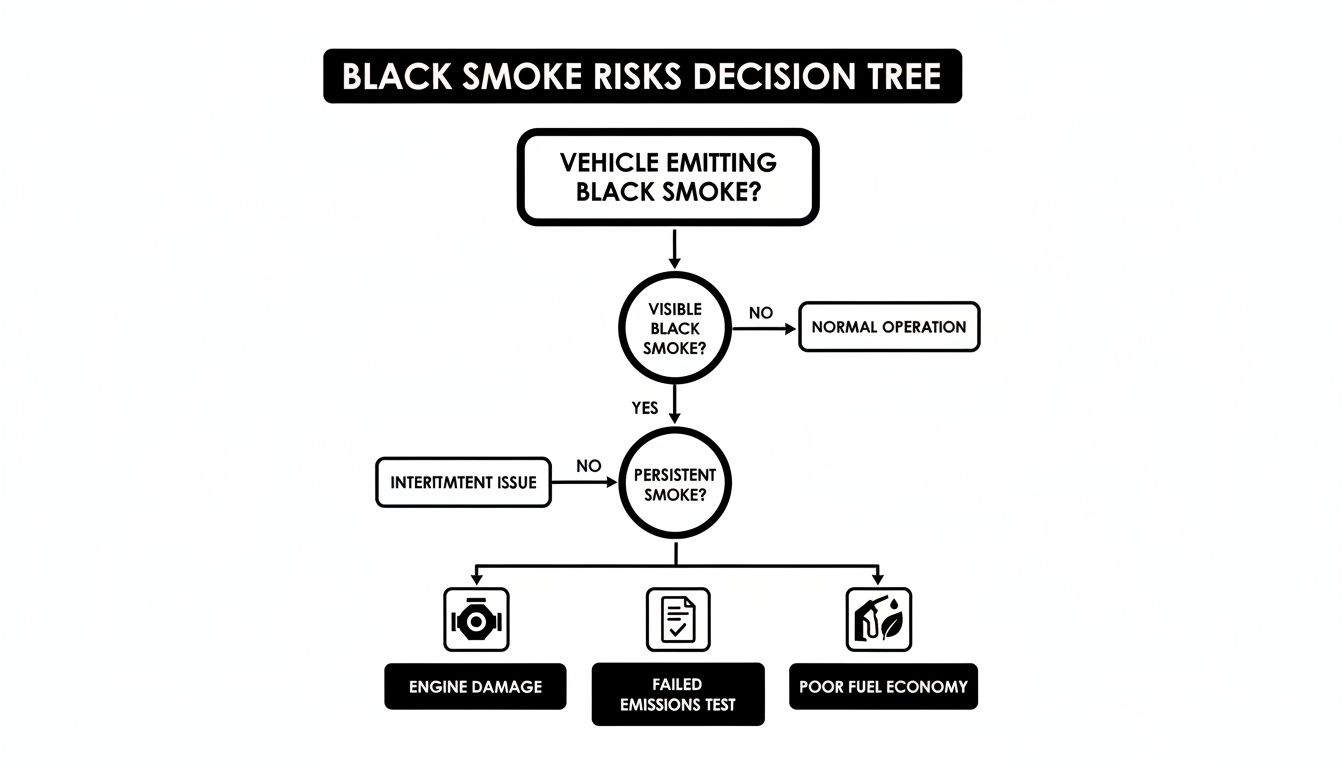
As you can see, a lingering fuel issue has a direct impact on your engine's health, your wallet, and even your ability to legally be on the road. Getting it checked out sooner rather than later is always the smart move.
Frequently Asked Questions About Exhaust Smoke
After digging into the causes and risks of black smoke, it’s completely normal to have a few more questions pop up. We put this section together to give you quick, straightforward answers to the things we hear most often from drivers. The goal is to help you feel more confident about what’s going on with your car and what to do next.
Let's clear up everything from how tiny parts can cause big smoke clouds to what a potential repair bill might look like.
Can a Bad Spark Plug Cause Black Smoke?
Yes, a faulty spark plug can absolutely be the culprit behind black smoke coming from your exhaust. Think of the spark plug as the lighter for the fuel in your engine. For a clean, efficient burn, that spark has to be strong and timed just right.
If a spark plug is old, covered in gunk, or damaged, it can't create a good spark. When that ignition fails, raw, unburned fuel gets shoved out of the cylinder and into the exhaust system. You see this leftover fuel as a puff of black, sooty smoke.
A bad spark plug usually doesn't travel alone. You’ll likely notice other symptoms, too:
- Engine Misfires: The car might feel like it's stuttering or hesitating when you press the gas.
- Rough Idle: When you're stopped, the engine might shake or run unevenly.
- Trouble Starting: A weak spark makes it much harder for the engine to fire up.
The good news? While a single bad plug can cause these annoying issues, it's a relatively simple and inexpensive fix that can get your engine running smoothly and clear up that smoke.
How Much Does It Cost to Fix Black Smoke?
The cost to get rid of black smoke is all over the map because it completely depends on what’s causing it. The repair could be a quick, cheap fix or a much more involved and pricey component replacement. It’s like asking how much it costs to fix a leak—it depends if you just need to tighten a fitting or replace the entire water heater.
Here’s a realistic breakdown of what you might expect to pay, from the simplest fix to the most complex:
- Engine Air Filter: This is the best-case scenario. A new filter usually runs between $25 and $75 for the part and labor, and it’s a very quick job.
- Spark Plugs: If worn-out plugs are the problem, you can expect to pay anywhere from $100 to $300, depending on your vehicle and how many cylinders it has.
- Sensors (MAF or O2): Replacing a bad Mass Airflow or Oxygen sensor is a bit more involved. With parts and diagnostic time, the total can land between $200 and $500.
- Fuel Injectors: Now we're getting to the higher end. A single bad fuel injector can cost $300 to $600+ to replace. If several have failed, that cost will climb.
The most important takeaway here is that a proper diagnosis is everything. Throwing parts at the problem by guessing is almost always more expensive than paying for a professional diagnostic service to find the exact issue from the start.
Is It Dangerous to Drive with Black Smoke?
While black smoke doesn't signal the immediate, catastrophic engine failure that thick white smoke (a coolant leak) does, it's still dangerous to ignore. When you keep driving with your engine running too rich, you're putting a ton of stress on critical and expensive parts. That unburned fuel acts like a solvent, slowly causing damage that can snowball into much bigger, more expensive problems.
Here are the main risks you're running:
- Catalytic Converter Damage: When raw fuel gets into your exhaust, it can overheat and literally melt the inside of your catalytic converter. That’s a component that can easily cost $1,000 or more to replace.
- Poor Engine Performance: Your car will feel sluggish and won't respond like it should. This can be a real safety hazard when you need to accelerate to merge onto the highway or get out of a tricky situation.
- Accelerated Engine Wear: The excess fuel washes away the lubricating oil from the cylinder walls. This leads to increased friction, causing premature wear on your pistons and rings.
It’s not just about cars, either. Homeowners often need to consider other types of exhaust safety—for example, knowing if is dryer exhaust dangerous is key to keeping a home safe. In the same way, dealing with your vehicle's black smoke protects both your engine and your wallet.
Don't let black smoke turn a small fix into a major repair bill. The ASE-certified technicians at Kwik Kar Oil Change and Auto Care have the advanced diagnostic tools to pinpoint the problem quickly and accurately. Schedule your appointment today and drive away with confidence, knowing your vehicle is running cleanly and efficiently. Book your service at https://www.kkrichardson.com.