Your brake fluid’s DOT rating isn’t just a random number on the bottle—it’s a critical safety standard set by the Department of Transportation. This rating tells you everything about the fluid's boiling point and chemical properties. Think of it as the lifeblood of your car’s hydraulic brake system. When you hit the pedal, this fluid is what carries the force to your wheels, and using the right one is key to preventing brake failure.
Why Brake Fluid Is Your Car's Most Critical Safety Feature
Imagine your braking system is having a high-stakes conversation. When your foot presses the brake pedal, you're the one talking. The brake calipers at the wheels are listening intently. The brake fluid is the message itself, carrying your command instantly. For this to work flawlessly, the fluid has to be incompressible—it can't be squished down.
This is where the science gets really important. Fresh brake fluid is a powerful hydraulic fluid, perfectly transmitting pressure from your foot to the brakes. The catch? Most common types are "hygroscopic," which is just a fancy way of saying they naturally absorb moisture from the air over time.
As brake fluid absorbs water, its boiling point drops significantly. When the fluid boils under the intense heat of braking, it creates compressible vapor bubbles in the lines. This is the root cause of a "spongy" or soft brake pedal and can lead to a dangerous loss of stopping power.
Even a tiny amount of water—as little as 3.7% by volume—is enough to make your brake fluid unsafe. This is exactly why simply topping off your fluid isn't a real fix. A complete fluid flush is the only way to purge the old, water-contaminated fluid and replace it with fresh, effective fluid. The entire system's integrity, from the fluid itself to physical parts like hoses and high-pressure brake hose ferrules, has to be perfect for your brakes to work when you need them most.
Picking the right brake fluid DOT type and keeping it properly maintained is an absolute non-negotiable for vehicle safety, every bit as crucial as the condition of your tires or brake pads. If you want to expand your knowledge of brake health, you can also learn more about how to inspect brake rotors in our detailed guide. Neglecting this vital fluid is like gambling with your ability to stop, and that’s a bet you never want to lose.
Decoding the DOT Numbers: What They Mean for Your Brakes
When you grab a bottle of brake fluid, you’ll notice “DOT” followed by a number right on the label. That’s not just a product code—it’s a performance standard set by the Department of Transportation. Think of it as a grade that tells you exactly how that fluid will perform under the intense heat and pressure of your braking system.
These grades are all about two things: the fluid’s chemical base and, most importantly, its boiling point. The real enemy of your brake system is moisture. Most common brake fluids are hygroscopic, which is a technical way of saying they naturally absorb water from the air over time.
Why does a little water matter so much? Because it dramatically lowers the fluid's boiling point. This is why every bottle has two key temperature ratings:
- Dry Boiling Point: This is the boiling point of brand-new, perfectly sealed fluid straight from the factory.
- Wet Boiling Point: This is the boiling point after the fluid has absorbed around 3.7% water, something that can easily happen within two years of normal driving.
The Dangers of Boiling Fluid
When brake fluid boils, it turns from a non-compressible liquid into a gas, creating vapor bubbles in your brake lines. Liquid can’t be squished, but gas can. The result? Your brake pedal suddenly feels soft and "spongy," or even sinks straight to the floor with little effect. This is a terrifying situation known as brake fade, and it means you’ve lost a significant amount of your stopping power.
A higher brake fluid DOT number almost always means a higher boiling point. This gives you a bigger safety margin, which is especially critical for modern cars with ABS and traction control systems that generate extra heat.
The diagram below shows how your brake system relies on this fluid to keep you safe. That simple press of the pedal is a powerful hydraulic action.
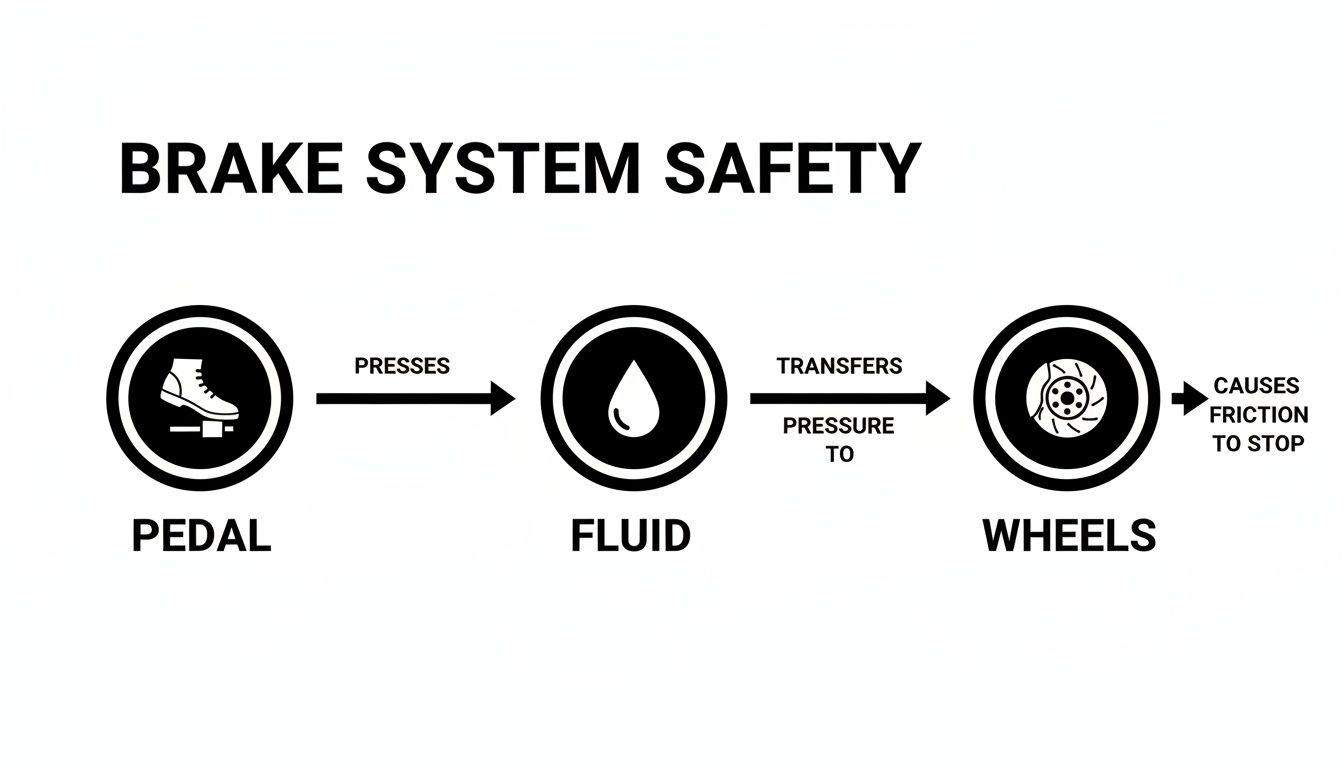
As you can see, the fluid is the essential messenger that carries the force from your foot to the wheels. Keeping that fluid in good shape isn’t just a suggestion—it’s fundamental to your safety. Understanding the difference between dry and wet boiling points is the first step to seeing why regular brake fluid flushes are so important.
DOT 3 and DOT 4: The Workhorses for Everyday Driving
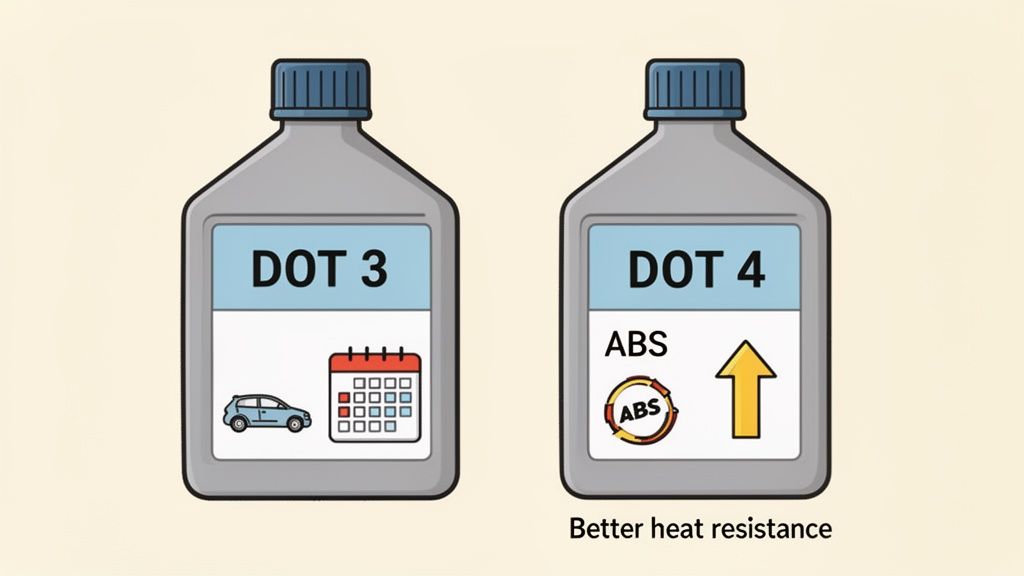
When you look at the brake fluid aisle, you’ll see a few different numbers, but for the vast majority of cars, trucks, and SUVs on the road, it almost always comes down to two: DOT 3 and DOT 4. These are the dependable, glycol-based workhorses of the automotive world.
While they both do the same fundamental job, there are key differences that really matter for your car's performance and safety.
Think of DOT 3 as the long-standing industry standard. It’s been around for decades, and for good reason—it’s a reliable, cost-effective choice that gets the job done in countless daily drivers with conventional braking systems.
The main trade-off, however, is that it’s more hygroscopic, meaning it absorbs water from the air more readily. This moisture lowers its boiling point over time, which is why sticking to a regular flush schedule is so important for preventing that dreaded spongy brake pedal.
Understanding DOT 4 as an Upgrade
DOT 4 is the natural evolution of DOT 3, engineered to handle the demands of more modern vehicles. It has a higher minimum boiling point, both when it's fresh out of the bottle (dry boiling point) and after it's been in your car absorbing moisture (wet boiling point).
This extra heat resistance isn't just a nice bonus; it's a necessity for today's cars.
Vehicles with Anti-lock Braking Systems (ABS) and traction control generate a lot of extra heat when those systems kick in, firing off rapid, high-pressure pulses. DOT 4 is built to take that stress without boiling, making sure your safety systems perform exactly as they should when you need them most. Its formula contains special additives called borate esters that help it resist moisture absorption better than DOT 3.
The most important rule to remember is compatibility. You can almost always put DOT 4 fluid in a system that calls for DOT 3. It's a common and safe upgrade that gives you a bigger safety margin. However, you should never put DOT 3 in a system designed for DOT 4, because it simply can't handle the heat.
Making this simple switch can give you more confidence on the road, knowing your brakes have extra protection against heat-related brake fade.
Which Is Right for Your Daily Driver?
For an older vehicle with a basic braking system, DOT 3 is usually perfectly fine as long as you’re diligent about maintenance. It’s a testament to its reliability that DOT 3 fluid still commands a massive 43.14% share of the global market, making it the go-to for millions of cars worldwide. You can dive deeper into these trends with the market analysis on fortunebusinessinsights.com.
But for any car built in the last 15-20 years—especially one with ABS, traction control, or if you just want that extra peace of mind—upgrading to DOT 4 is the smarter move. The small difference in cost is well worth it for the superior performance and added safety.
DOT 5 and DOT 5.1 For High-Performance and Special Uses
Once you get past the common brake fluids you see every day, you enter the more specialized territory of DOT 5 and DOT 5.1. Their names are almost identical, which is a recipe for confusion, but they are completely different chemicals. Grabbing the wrong one can cause some serious, expensive damage to your brake system.
First up is the real outlier of the group: DOT 5. Unlike every other brake fluid we’ve talked about, DOT 5 is silicone-based. This gives it a very unique quality—it’s hydrophobic, which is a fancy way of saying it repels water instead of absorbing it.
This property makes DOT 5 a fantastic choice for vehicles that sit for long stretches, like classic cars, museum pieces, or military vehicles. Since it doesn’t pull moisture out of the air, it helps prevent the internal rust and corrosion that can wreck a brake system that’s left idle. But that same quality makes it a terrible fit for most modern cars.
- Incompatibility: Silicone fluid absolutely does not mix with glycol-based fluids like DOT 3, 4, or 5.1. If you mix them, you’ll create a thick, gel-like sludge that will clog your entire brake system and cause immediate brake failure.
- ABS Issues: DOT 5 fluid has a tendency to get foamy under the fast, pulsing pressure of an Anti-lock Braking System (ABS). This introduces air and compressibility into the lines, leading to a spongy, unsafe brake pedal.
DOT 5.1: The Peak of Glycol Performance
Now, let's clear up the confusion and talk about DOT 5.1. Despite the name, it's a high-performance glycol-based fluid. Chemically, it’s a direct relative of DOT 3 and DOT 4, not DOT 5. You can think of it as the ultimate evolution of the standard brake fluid you already know.
DOT 5.1 boasts the highest boiling points—both dry and wet—of any glycol-based fluid on the market. This incredible resistance to heat makes it the clear winner for the most demanding vehicles on the road today.
DOT 5.1 is engineered for extreme heat and pressure, making it the standard for high-performance track cars, electric vehicles (EVs) with regenerative braking systems, and vehicles equipped with advanced driver-assistance systems (ADAS) that rely on flawless brake response.
The auto industry is definitely moving in this direction. High-performance fluids like DOT 4 and DOT 5.1 are being adopted more quickly in Europe and North America. In fact, U.S. automakers are now making DOT 5.1 the standard for new models equipped with ADAS. This shift is all about ensuring thermal stability for advanced safety tech and regenerative braking. You can dive deeper into these market trends on the brake fluids market at mordorintelligence.com.
Since DOT 5.1 is glycol-based, it’s perfectly safe to mix with DOT 3 and DOT 4 systems, making it a great premium upgrade. To get the full performance benefit of its higher boiling points, however, we always recommend a complete system flush. For the ultimate stopping power in a modern, high-tech vehicle, DOT 5.1 is the undisputed champion.
How to Spot the Warning Signs of Bad Brake Fluid
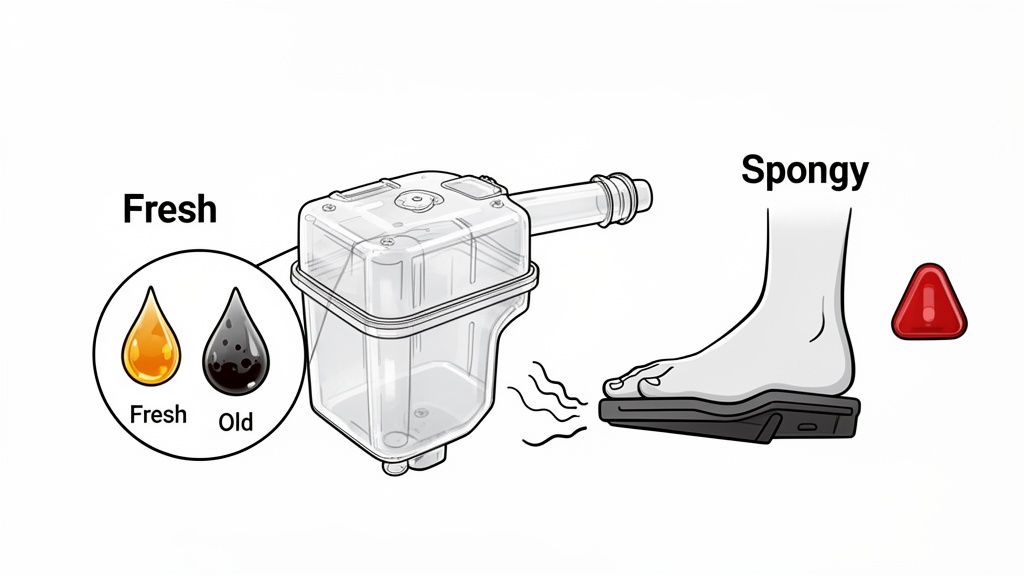
Your car has ways of letting you know when something’s off, and your brake system is no different. Learning to spot the warning signs of bad brake fluid is one of the best things you can do to turn a potential hazard into simple, manageable maintenance. The most telling sign is a change in how your brake pedal feels under your foot.
If your pedal suddenly feels “spongy,” soft, or sinks further toward the floor than it used to, that’s a big red flag. This mushiness usually means moisture has gotten into the brake fluid, lowering its boiling point and creating tiny air bubbles in the lines that compress when you push the pedal. Instead of a firm, confident stop, you get a weak response that seriously compromises your stopping power. While a spongy pedal is a common problem, other issues can cause your brake pedal feels hard.
Other Key Warning Signs
Beyond a spongy pedal, your vehicle might give you a few other hints that its brake fluid needs to be replaced. Keep an eye—and an ear—out for these other indicators:
- Brake Warning Light Comes On: Your dashboard is ground zero for important alerts. If the ABS or brake warning light pops on, it could be signaling low fluid levels or a different fault in the system that needs an immediate professional look.
- Reduced Stopping Performance: Do you find yourself pushing the pedal harder or noticing your car takes longer to come to a stop? Degraded, waterlogged brake fluid is a very common culprit behind this loss of performance.
- Strange Noises: Squealing and grinding often point to worn-out brake pads, but these sounds can also be related to a hydraulic system that’s struggling to do its job.
Perform a Quick Visual Check
You don’t have to be a mechanic to get a rough idea of your brake fluid's health. A quick look at the brake fluid reservoir under the hood can tell you a lot.
Fresh, healthy brake fluid should be nearly transparent with a light honey or amber color. Over time, as it absorbs moisture and collects debris, it will darken, eventually turning into a murky, dark brown or even black sludge.
This drastic color change is a dead giveaway that the fluid has lost its ability to perform and protect your brake components. If you peek into the reservoir and see dark, dirty fluid, it’s time to schedule a professional brake fluid flush before a minor maintenance issue becomes a major safety risk.
Trusting the Experts for Your Brake Fluid Service
So now you know the difference between each **brake fluid DOT** rating. That’s great, but knowing the theory is one thing—making sure it’s applied correctly to your car is what really counts for your safety on the road. Proper maintenance isn’t just about picking the right bottle off the shelf; it’s about making sure the service is done right by people who know what they’re doing.
A brake fluid service is much more than a simple top-off. It's a complete brake fluid flush, a process where technicians purge the entire system of old, moisture-soaked fluid and refill it with fresh, high-performance fluid. This is absolutely essential because old, contaminated fluid can cause dangerous brake fade and corrode expensive brake components from the inside out.
Why Professional Service Matters
Trying to flush your brake fluid at home is one of those jobs that seems straightforward but is incredibly risky. It’s dangerously easy to introduce air bubbles into the brake lines without the right equipment. Since air compresses (unlike fluid), even a tiny amount can leave you with a soft, spongy brake pedal that goes straight to the floor.
That’s why bringing your car to a professional shop like Kwik Kar Richardson is so important. Our ASE-certified technicians have the state-of-the-art equipment needed to perform a full system purge, ensuring every last drop of old fluid is gone and—critically—that no air gets into your lines.
Using the right brake fluid DOT type is also a non-negotiable part of the job. Our technicians will confirm the exact fluid your vehicle’s manufacturer specifies, which is vital for protecting sensitive parts like your ABS module and keeping your warranty valid. This isn't just about following rules; it's about your safety. To learn more, check out our guide on the recommended frequency of a brake fluid flush.
Keeping a Critical System in Peak Condition
There's a reason the auto service industry is so massive—modern cars are complex machines that demand expert care. Your brakes are, without a doubt, the single most important safety system on your vehicle. Their performance is not something you want to leave to chance.
Don’t wait for a problem to show up. Schedule a professional brake check at Kwik Kar Richardson today. Our experts will assess the condition of your brake fluid and give you the peace of mind that comes from knowing your car is ready for anything the road throws at you.
Frequently Asked Questions About Brake Fluid
After diving into the world of DOT ratings and boiling points, it's natural to still have a few questions floating around. Let's clear up some of the most common things we hear from drivers about their brake fluid with some simple, straight-to-the-point answers.
Can I Mix Different Brake Fluid DOT Types?
This is a big one we get a lot. The short answer is no, you really shouldn't mix different brake fluids if you can help it.
In a real pinch, you can mix glycol-based fluids like DOT 3, DOT 4, and DOT 5.1. But be warned: doing this will immediately lower the performance of your entire brake system to match whichever fluid has the lowest boiling point.
However, there's one combination you must absolutely, positively never try.
Never mix silicone-based DOT 5 fluid with any of the glycol-based fluids (DOT 3, DOT 4, or DOT 5.1). Their chemistries are totally incompatible. The fluid will turn into a thick gel, clog your brake lines, and could lead to total, catastrophic brake failure.
If you’re ever unsure, the only truly safe move is a complete brake fluid flush and refill.
How Often Should I Change My Brake Fluid?
Most vehicle manufacturers recommend flushing and replacing your brake fluid every two to three years, or around every 30,000 miles. This isn't just an upsell—it's critical preventative maintenance.
Because the most common brake fluids are hygroscopic, they're constantly pulling moisture out of the air. Over time, that water builds up, causing corrosion inside your brake system and dramatically lowering the fluid's boiling point and your car's stopping power.
Professional drivers make a detailed pre-trip inspection a non-negotiable part of their routine to catch issues before they become dangerous. Sticking to your car's service schedule for things like brake fluid is just as important for that same safety-first mindset.
Can I Use DOT 4 Fluid If My Car Takes DOT 3?
Yes, in nearly every case, putting DOT 4 fluid into a system that calls for DOT 3 is a perfectly safe and common upgrade. DOT 4 has higher boiling points, which gives you an extra buffer of safety, especially in newer cars with advanced braking systems.
Just remember you can’t go the other way. Never put DOT 3 in a car designed for DOT 4, as it simply can't handle the higher temperatures the system expects.
For any questions about your vehicle's specific needs or to schedule a professional brake service, the ASE-certified technicians at Kwik Kar Oil Change and Auto Care are here to help. Schedule your appointment online and drive with confidence.