A brake noise usually starts small. You hear a squeal pulling up to a light in Richardson, or you feel a light shudder in the pedal during the morning commute, and your first thought is often the same: can this wait?
Sometimes it can wait a short while. Sometimes it should not wait at all. The hard part is knowing the difference.
Brakes are one of the few systems on your vehicle that talk to you in sound, feel, and behavior. A chirp, a grind, a pull to one side, a soft pedal. Those are not random quirks. They are clues. If you understand what brake pads and shoes do, how they wear, and what happens when you delay service, you can make better decisions for your safety and your budget.
Your Brakes Are Talking Are You Listening
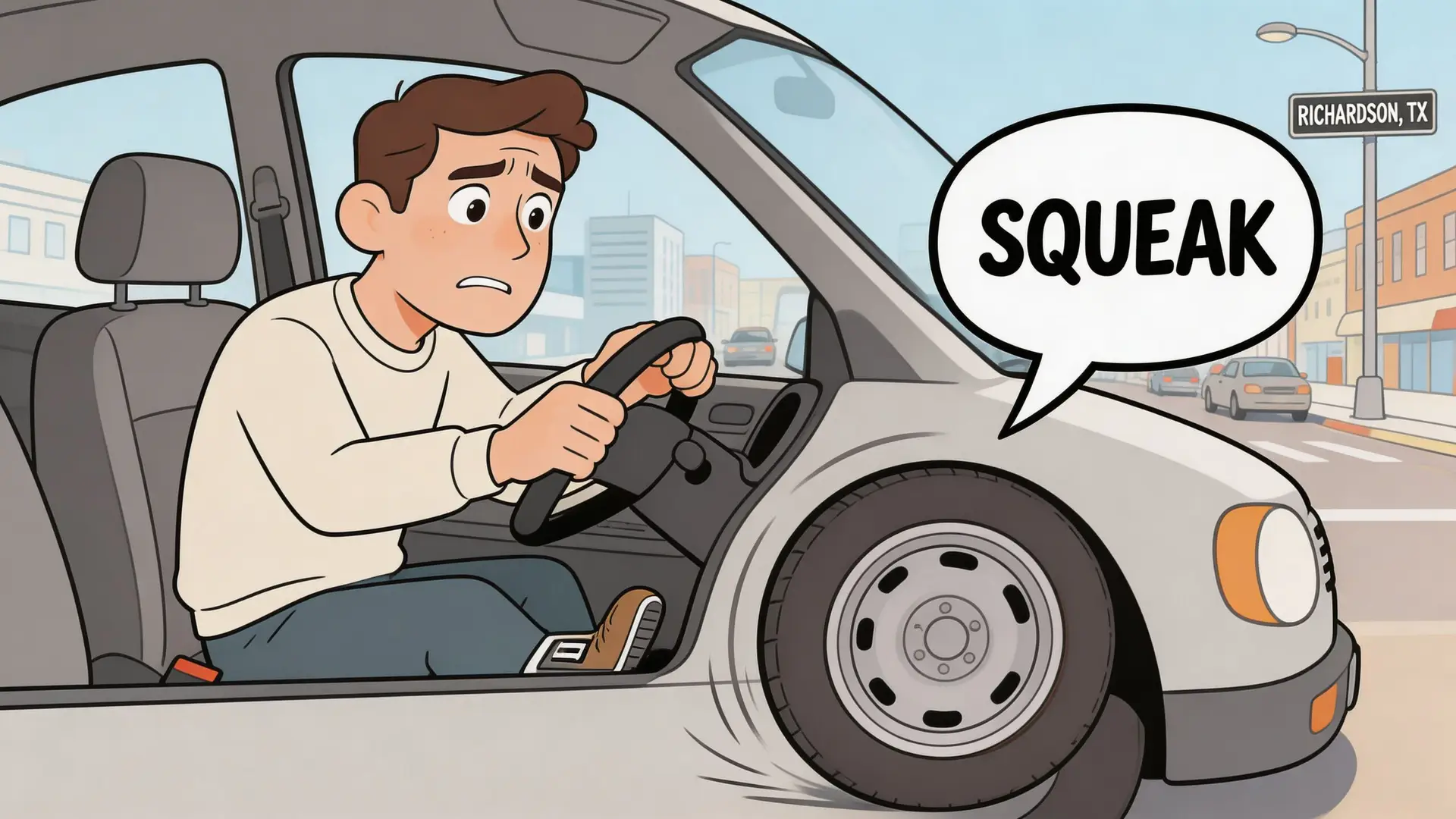
The most common brake conversation starts with a squeak.
That sound often shows up before a driver notices any drop in stopping power. The car still stops, so it is easy to assume the problem is minor. But your brake system is built from parts that wear together, heat together, and fail together if one part gets ignored too long.
Modern brakes feel normal because generations of engineers solved a lot of ugly problems for us. In 1901, Herbert Frood patented the first commercial brake blocks, and in 1902, Louis Renault invented the mechanical drum brake. Hydraulic brakes became standard by the late 1920s, which dramatically improved safety and control (vehicle brake pad history).
That history matters for one reason. Your current brake system is precise. It is not just a pedal and some friction material. It is a balanced system designed around heat, pressure, hydraulic force, and part compatibility.
What drivers usually notice first
Most customers mention one of these before anything else:
- A squeal at low speed when approaching a stop sign
- A scraping or grinding sound that was not there last week
- A pulsing pedal during harder stops
- A vehicle that feels different under braking, even if they cannot describe it yet
Any of those changes deserves attention. Not panic. Attention.
If your brakes feel or sound different, trust the change. You do not need to diagnose it yourself. You just need to stop ignoring it.
Why basic brake knowledge saves money
Drivers often think brake service becomes expensive because shops “find more stuff.” The underlying reason is usually simpler. Brake parts wear in stages. Catch the issue early and you may only replace friction material. Wait too long and the surrounding hardware starts taking damage too.
That is the pattern behind most expensive brake repairs. Not bad luck. Delay.
Disc Brakes vs Drum Brakes How Your Car Stops
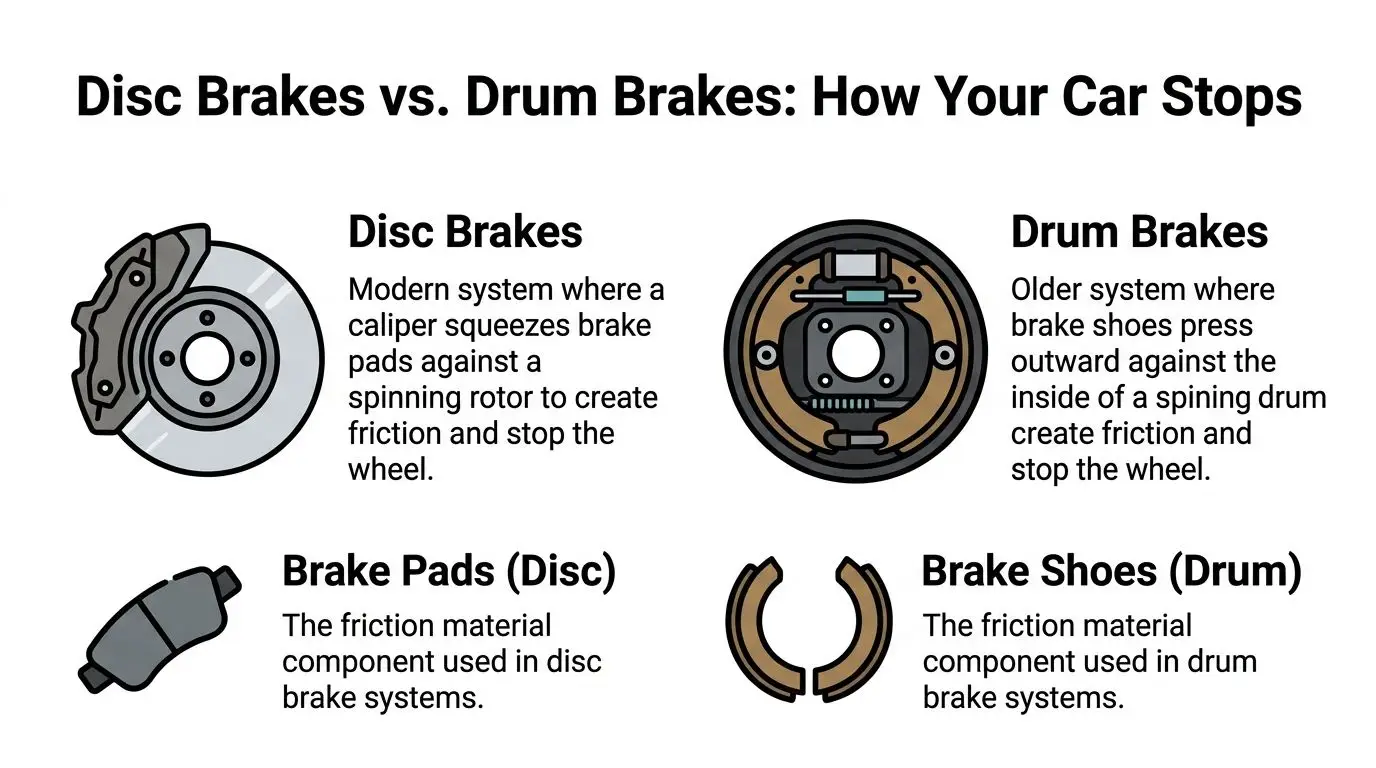
If you have ever wondered why people say “pads” on one car and “shoes” on another, the answer is simple. They belong to different brake designs.
Disc brakes use brake pads. Drum brakes use brake shoes.
How disc brakes work
Think of a bicycle hand brake squeezing the rim. A disc brake works on a similar idea, just with stronger parts and hydraulic force.
A rotor spins with the wheel. A caliper sits around that rotor. When you press the brake pedal, hydraulic pressure pushes the brake pads against both sides of the rotor. The friction slows the rotor, and that slows the wheel.
Disc brakes are common on front wheels because they handle heat well and are easier to inspect. You can usually see the basic setup through the wheel.
How drum brakes work
A drum brake hides its working parts inside a metal drum.
Instead of squeezing inward like pads on a rotor, brake shoes push outward against the inside surface of the spinning drum. That friction slows the wheel. It is a clever design, and it remains common on many rear axles because it is cost-effective and durable in normal driving.
The key difference is heat. Drum brakes hold more of it inside. Disc brakes shed more of it into the air.
Why many vehicles use both
A lot of everyday vehicles use disc brakes in front and drum brakes in back. That setup balances braking performance and cost.
Front brakes usually do more of the stopping work, so manufacturers often put the better heat-managing system there. Rear brakes can often use drums without creating a problem for routine driving.
Here is the simple side-by-side view:
| System | Friction part | How it stops the wheel | Common placement |
|---|---|---|---|
| Disc brake | Brake pads | Pads clamp onto a rotor | Often front, sometimes all four |
| Drum brake | Brake shoes | Shoes press outward inside a drum | Often rear |
Where people get confused
Drivers often assume pads and shoes are interchangeable names. They are not.
They also assume newer means every car has four-wheel discs. Not always. Many vehicles still use rear drums for practical reasons.
Hybrids and EVs add another layer. They still have friction brakes, but they may use them less aggressively because the vehicle also slows itself through energy recovery. If you want a plain-English overview, this guide on how regenerative braking works helps explain why brake wear patterns can feel different on electrified vehicles.
If you also want a simple breakdown of how pads relate to another major part in the disc system, this page on brake pads and rotors is useful:
Pads and shoes do the same job. They just do it in different housings, with different heat behavior and different service needs.
Material Matters Choosing The Right Brake Pads
Not all brake pads are built from the same material. That matters because the material affects noise, dust, lifespan, and braking feel.
Two of the most common choices drivers hear about are semi-metallic and ceramic.
Ceramic vs semi-metallic
Ceramic brake pads, developed in the 1970s, can often last 50,000 to 70,000 miles, while semi-metallic pads typically last around 30,000 miles (automotive brake pad market). Ceramic pads are also known for reduced noise and less visible brake dust.
Semi-metallic pads still have their place. They are often a solid fit for drivers who put more demand on the brake system, such as heavier vehicles or repeated harder stops. The trade-off is that they can be noisier and may not stay as clean-looking around the wheels.
How to think about the choice
Ask yourself three questions.
What kind of driving do you do
If your vehicle mainly sees school runs, grocery trips, office commuting, and highway driving, ceramic pads are often attractive because they tend to be quieter and longer-lasting.
If your driving is harder on the brakes, such as frequent heavy loads, more aggressive stopping, or repeated stop-and-go use, your technician may discuss semi-metallic options.
What bothers you more, noise or shorter life
Some drivers hate brake dust on the wheels. Others do not care, but they want stronger bite and do not mind more sound.
Neither reaction is wrong. It is a preference question tied to how the vehicle is used.
Are you matching the vehicle, not just shopping the cheapest part
A brake pad is not just a rectangle of friction material. It is a tuned component in a system that was designed for a certain feel and friction range.
That is why a good parts decision starts with vehicle fitment, not shelf price alone.
A practical rule
If you are unsure, tell the technician how the vehicle is driven, who usually drives it, and what you disliked about the last brake job. That gives more useful guidance than asking for the “best pad.”
Recognizing the Warning Signs of Worn Brakes
Brakes rarely fail without warning. Most systems give clues early. The problem is that drivers often hear one clue, feel another, and do not realize they point to the same issue.
What you hear
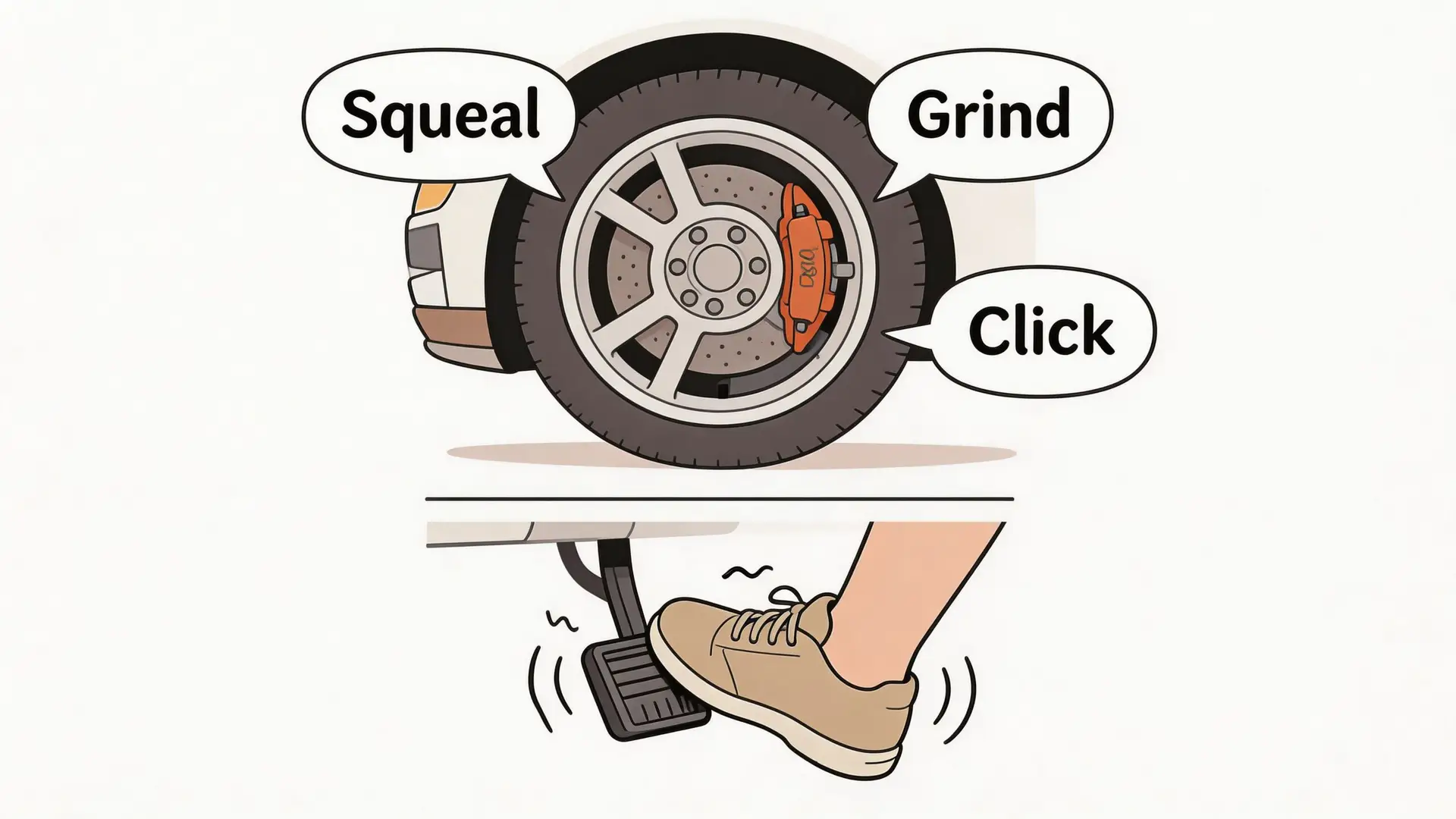
A high-pitched squeal is one of the most familiar signs. It can mean the pads are worn, the friction surface is glazed, or the hardware needs inspection.
A grinding noise is more urgent. That often suggests the friction material is gone or nearly gone, and metal parts may be contacting the rotor or drum surface.
A click or clunk can point to loose hardware or movement where there should not be movement.
What you feel
A pulsing pedal usually means something in the braking surface is uneven. On disc brakes, drivers often describe this as a vibration or shudder during stops.
A soft pedal can suggest hydraulic trouble, air in the system, overheated fluid, or another issue that needs immediate diagnosis.
If the car pulls to one side, one side may be grabbing harder than the other. That can come from uneven wear, sticking components, or contamination.
What you see
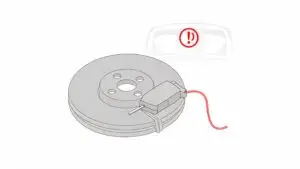
A warning light should never be treated as background decoration.
It may indicate a parking brake issue, low fluid, or another system problem. The meaning depends on the vehicle, but the right response is the same. Get it checked.
Here is a quick checklist you can keep in mind:
| Symptom Type | What to Look For | What It Could Mean |
|---|---|---|
| Sound | Squealing at stops | Pad or shoe wear, glazing, hardware issue |
| Sound | Grinding | Severe wear, possible metal-to-metal contact |
| Feel | Pulsation in pedal | Uneven braking surface or heat-related issues |
| Feel | Soft pedal | Hydraulic problem or fluid-related issue |
| Feel | Pulling left or right | Uneven braking force or sticking parts |
| Visual | Brake warning light | System fault or fluid issue |
When noise becomes an emergency
There is a big difference between “schedule service soon” and “do not keep driving.”
Use this simple rule:
- Squeal only usually means schedule an inspection promptly
- Grinding, major pull, or very soft pedal means stop treating it like routine maintenance
- Sudden loss of braking power means focus on safety first
If you ever face a true loss-of-brakes situation, this guide on what to do when brakes fail is worth reading before you need it.
A lot of drivers first notice brake wear through noise. If that is what brought you here, this page on common causes of squeaky brakes may also help:
Here is a short visual walkthrough of common brake symptoms and what they can feel like on the road.
Grinding is expensive noise. Once metal starts cutting into a rotor or drum, the repair usually grows beyond simple friction replacement.
The Smart Money Why Proactive Replacement Saves You More
Most brake articles stop at safety. Safety matters most, but budget matters too. Families, commuters, and fleet owners all ask the same practical question: when does waiting stop saving money and start costing more?
The answer is earlier than many people think.
The critical tipping point
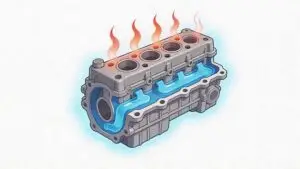
Brake pads must be replaced at the manufacturer’s minimum thickness, typically 2 to 3 mm. Running below that point can increase caliper temperatures by 20 to 30 percent, and that extra heat can boil brake fluid and damage seals, turning a routine brake job into a much larger repair (minimum brake pad thickness and heat effects).
That is the financial turning point.
At healthy thickness, the pad still does its job as a friction surface and a heat buffer. Once it gets too thin, the rest of the brake assembly starts absorbing heat it was never meant to carry.
What “waiting a little longer” can really mean
Drivers often picture brake wear as a straight line. Pads get thinner, then eventually you replace them. In the shop, it is usually more like this:
- Early wear stage
The pad or shoe is worn but still protecting the rest of the system. - Late wear stage
Heat management gets worse. Braking surfaces may start wearing unevenly. - Damage stage
Rotors, drums, calipers, seals, and fluid may all be affected.
A simple friction replacement is one category of repair. A brake job that now needs rotor or caliper work is a different category.
Why preventive service has better ROI
You do not need a spreadsheet to understand the logic.
- You protect higher-cost parts by replacing lower-cost friction material first
- You avoid downtime and the stress of a last-minute brake problem
- You preserve braking smoothness before vibration and pull issues show up
- You reduce the chance of stacked repairs where one delay creates several parts needs
The verified data supports this in practical terms. Ignoring the wear limit can escalate a straightforward pad replacement into caliper and rotor repair costing hundreds more, based on the same source above.
That is why proactive brake service is not “doing it early” in the wasteful sense. It is replacing a sacrificial part before it damages the hard parts around it.
A better question to ask your technician
Instead of asking, “Can I get a few more miles out of these?” ask this:
“Are they still thick enough to protect the rest of the system?”
That question gets you closer to the underlying financial issue.
If you want more guidance on timing, this related page can help you think about replacement windows:
The cheapest brake job is usually the one done before heat and metal contact start damaging the parts around the pads or shoes.
The Kwik Kar Difference for Richardson Drivers
A brake inspection should do more than confirm that the friction material looks thin. A proper inspection checks the whole system that supports that friction material.
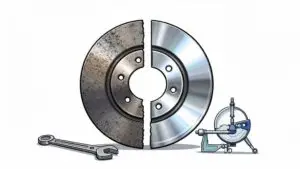
That means measuring pad or shoe thickness, inspecting rotor or drum condition, checking hardware, looking for leaks, watching for uneven wear patterns, and making sure the replacement part matches what the vehicle was designed to use.
Why exact part matching matters
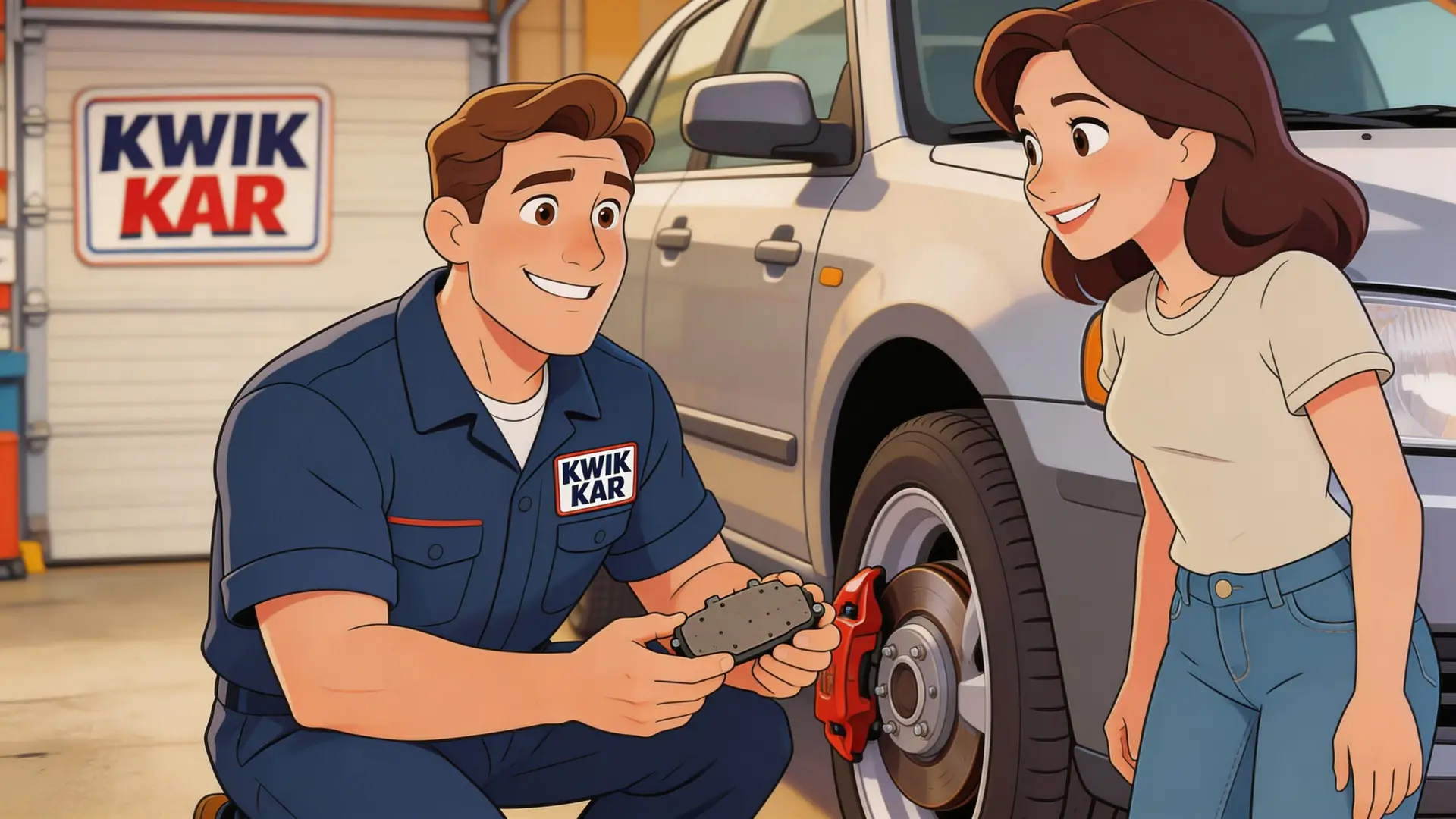
Brake pad edge codes contain important technical information. The two letters at the end identify the coefficient of friction when the pad is cold and when it is hot. A mismatched code can upset braking balance, increase wear, and create safety risks, which is why ASE-certified technicians decode that information to match the correct part (decrypting brake pad edge codes).
That detail is easy to miss if someone treats every aftermarket pad as “close enough.”
A vehicle designed around one friction range may not behave properly with another. The driver might notice the difference as noise, touchy braking, uneven response, or faster wear.
What a careful shop looks for
A thorough brake service visit usually includes:
- Measured wear, not guesswork so the decision is based on actual thickness
- Rotor or drum inspection for grooves, heat damage, or uneven surfaces
- Hardware review because clips, slides, springs, and contact points affect wear
- Fluid and hydraulic checks when pedal feel or heat history raises concern
Kwik Kar Oil Change and Auto Care in Richardson is one local option for this kind of brake inspection and replacement work, with ASE-certified technicians and service standards backed by NAPA AutoCare, RepairPal, and CARFAX information from the business profile.
Why that matters locally
Richardson drivers put different kinds of demand on brakes. Some spend more time in stop-and-go traffic. Some drive aging vehicles and want to avoid bigger repair bills. Some manage work vehicles and care about predictable maintenance scheduling.
Those groups all benefit from the same thing. Good measurement, correct part matching, and clear explanation before the repair grows.
If you qualify, the shop also offers discounts for military personnel, first responders, and healthcare workers.
Frequently Asked Brake Service Questions
Do front and rear brakes wear at the same rate
Usually no.
On many vehicles, the front brakes handle more of the stopping load, so they often wear faster. That is one reason inspection matters more than guessing by mileage alone.
Can brake pads and shoes be replaced before they are fully worn out
Yes. In many cases, that is the smarter move.
Friction material is supposed to wear first so the harder, more expensive parts do not. Replacing it before damage spreads is often the lower-cost choice over the life of the vehicle.
If my brakes only squeak sometimes, should I still have them checked
Yes.
Intermittent noise still counts as brake feedback. Heat, humidity, dust, and driving conditions can change when the sound appears, but occasional squeaking can still point to wear or hardware problems.
Are drum brakes bad compared to disc brakes
No.
They are different, not automatically bad. Drum brakes remain common for practical reasons, especially on rear axles. The important thing is that the system is in good condition and serviced with the correct parts.
Do hybrid and electric vehicles still need brake inspections
Absolutely.
They may use friction brakes differently because of regenerative braking, but they still rely on pads, rotors, calipers, and hydraulic components. Less frequent use can even make some issues easier to miss without inspection.
Should I wait until I hear grinding
No.
Grinding often means the repair has moved beyond normal wear. At that point, the chance of added rotor or drum damage goes up, and the bill usually follows.
If your vehicle is making noise, pulling during stops, or due for a brake inspection, Kwik Kar Oil Change and Auto Care can help you get a clear answer before a small wear issue turns into a larger repair. A measured inspection and the right replacement parts can protect both your safety and your budget.