When your brake pedal suddenly feels like you're pushing against a brick wall, it's more than just an inconvenience—it's a serious safety warning from your vehicle. This isn't a problem you can ignore. A hard brake pedal is a clear sign that the power-assist system in your brakes has likely failed.
This system is designed to multiply the force from your foot, making it easy to stop a two-ton vehicle with minimal effort. When it's not working, you're left with the raw, unassisted hydraulic system, which requires significantly more physical effort to slow down or stop. You might still be able to brake, but your stopping distance will be dangerously longer.
What It Means When Your Brake Pedal Is Hard to Press
That stiff, stubborn resistance is your car's way of telling you something critical has gone wrong. Braking should feel smooth and responsive. It's thanks to your power brake system, a brilliant bit of engineering that acts as an amplifier for the force you apply to the pedal.
Think of it like power steering, but for your brakes. When everything is in order, a light touch does the trick. When the system fails, however, you're the one doing all the heavy lifting. A brake pedal that's hard to press is the number one symptom of this failure.
The Role of the Brake Booster
The hero of your power brake system is the brake booster. It's that black, circular canister you'll find in the engine bay, mounted on the firewall right behind your brake pedal. It uses vacuum from the engine to make braking feel almost effortless.
When the booster fails or the vacuum supply gets cut off, the pedal instantly becomes firm and incredibly difficult to push down.
A hard brake pedal is almost never a minor issue. It directly compromises your ability to stop the vehicle safely, especially in an emergency. Ignoring this symptom dramatically increases the risk of an accident.
Why Immediate Action Is Critical
Your car might still move, but driving it is extremely unsafe. The sheer amount of leg strength needed for a sudden stop could be more than you can physically manage, turning a routine situation into a potential collision. The takeaway is simple:
- It's a power-assist failure: You are now manually pushing fluid through the brake lines with no help.
- Stopping distances increase dramatically: Your reaction time doesn't change, but the time and distance it takes for the car to actually stop are dangerously longer.
- It requires professional diagnosis: This is not a "wait and see" problem. It's a clear signal to pull over, stop driving, and get your vehicle to a certified technician immediately.
Before we dive into the common causes, it's helpful to understand exactly what you might be feeling. The specific symptoms can sometimes point our technicians in the right direction even before they open the hood.
Understanding Hard Brake Pedal Symptoms
Here's a quick look at symptoms you might experience with a hard brake pedal and their likely implications.
| Symptom | What It Likely Means | Action Required |
|---|---|---|
| Pedal is hard from the start | This often points to a complete failure in the brake booster or a major vacuum leak. | Stop driving immediately. The vehicle is unsafe. Have it towed to a repair shop. |
| Pedal becomes hard while driving | Could be an intermittent vacuum issue or a failing check valve. You may have also heard a hissing sound. | Pull over safely as soon as possible. Do not continue driving. |
| Hard pedal plus a high, hissing idle | This is a classic sign of a vacuum leak from a ruptured booster diaphragm or a cracked vacuum hose. | Immediate professional diagnosis is needed. The engine and brakes are both affected. |
| Brakes work, but require huge effort | This is the textbook symptom of a failed power-assist system. You are pushing against the hydraulic system alone. | The vehicle is unsafe for emergency braking. Get it serviced right away. |
Recognizing these signs is the first step. The next is understanding what's causing them, which helps you know what to expect when you bring your car in for service.
How Your Power Brake System Works
To get why your brake pedal suddenly feels like you're pushing against a brick wall, you have to appreciate why it's normally so easy. Your car has a power brake system that does all the heavy lifting, turning a light tap of your foot into serious stopping power. Without it, stopping in a hurry would require the leg strength of a pro athlete.
The star of this whole operation is the brake booster. Think of it like this: you're trying to push a heavy box across the floor. It's a struggle. But then a friend comes along and pushes with you, making it almost effortless. The brake booster is that helpful friend for your braking system.
The Role of the Brake Booster and Vacuum
This big, round, black canister sits right on the firewall behind your brake pedal, and it uses a surprisingly simple force: engine vacuum. While your engine is running, it creates suction—much like a household vacuum cleaner. The brake booster cleverly harnesses this suction to multiply the force from your foot by as much as ten times.
This power assist is what gives you that smooth, controlled, and easy braking feel you're used to. A small diaphragm inside the booster separates it into two chambers. When you hit the brakes, a valve lets air into one side, and the pressure difference created by the engine's vacuum does the hard work, providing the "boost."
This diagram shows how your foot on the pedal kicks off this whole power-assisted process, engaging the booster which then activates the brakes.
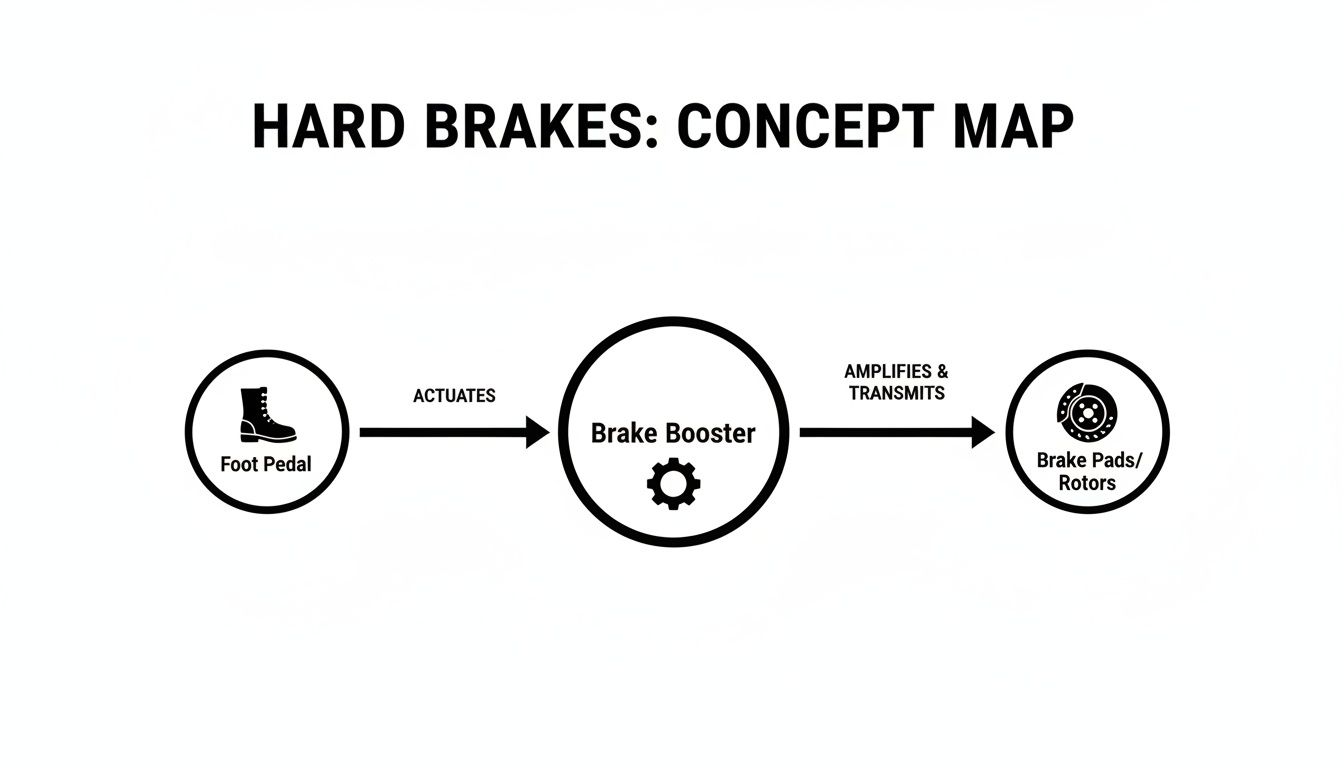
As you can see, the flow from your foot to the brake booster and finally to the brakes themselves shows just how vital that booster is as the middleman.
Key Supporting Components
Of course, the booster doesn't work alone. A couple of other parts are absolutely essential for the system to do its job:
- The Master Cylinder: Bolted to the front of the brake booster, this component takes that amplified force and turns it into hydraulic pressure, sending brake fluid out to the wheels to squeeze the brake pads.
- The Check Valve: This is a small but mighty valve on the vacuum hose. It makes sure the booster holds onto its vacuum supply even when the engine isn't creating much, like when you're accelerating. If this little valve fails, the booster loses its power assist in a heartbeat.
You really can't overstate the importance of a properly working brake system. Major recalls pop up all the time, showing how even tiny defects can create huge safety risks. For instance, Honda and Acura recently had to recall over 259,000 vehicles for a brake pedal problem that could affect a driver's ability to stop. You can read more about this widespread recall and see why routine checks are so important.
When this system fails and you get a hard brake pedal, you're left fighting all that hydraulic pressure entirely on your own.
Diagnosing the Common Causes of a Hard Brake Pedal
When your brake pedal suddenly feels like you're pushing against a brick wall, it’s a clear signal from your car's power-assist system that something is wrong. Figuring out the root cause is really a process of elimination, starting with the most common failures and moving on to the less likely ones.
The overwhelming majority of the time, a rock-hard pedal points directly to an issue with the brake booster or the vacuum it needs to operate. Since this part is what multiplies your foot's pressure into serious stopping power, any problem with it leaves you to do all the work yourself.
The Prime Suspect: A Faulty Brake Booster
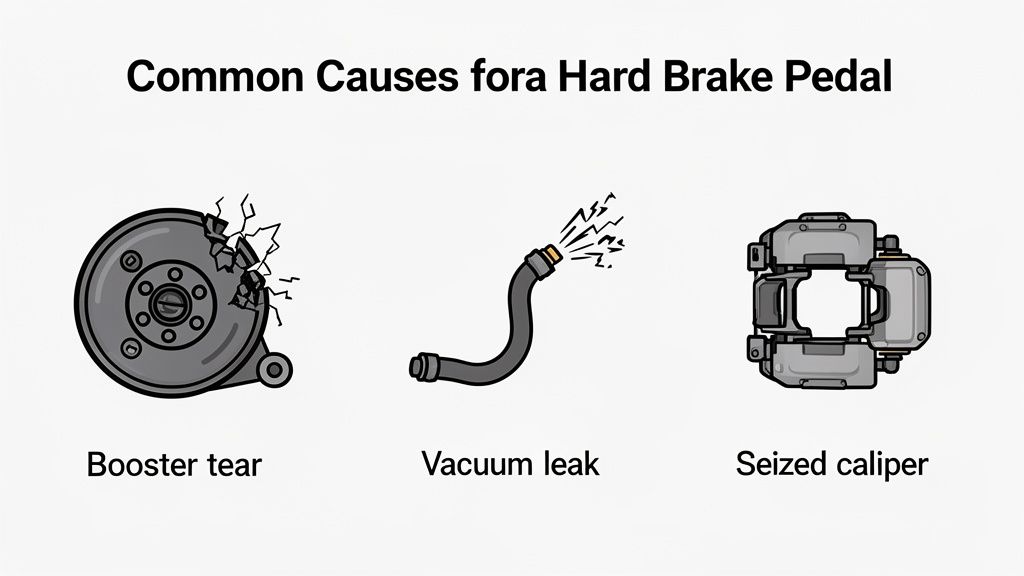
More often than not, the brake booster itself is the source of the problem. Picture a large, black canister under your hood. Inside is a flexible rubber diaphragm that creates two separate chambers. If that diaphragm gets a tear or even a small crack, it can't hold a vacuum anymore, and your power assist is gone in an instant.
It's not just the internal diaphragm, either. The seals around the booster can wear out and fail with age. A bad seal where it connects to the master cylinder or where the pushrod from your pedal enters can also cause a complete loss of vacuum. The result is always the same: a brake pedal that takes an incredible amount of leg strength to press down.
A failed brake booster does more than just make braking a workout; it fundamentally changes how your vehicle stops. You're basically driving a car with a fully manual, unassisted brake system from decades ago—something modern vehicles are absolutely not designed for.
The Common Accomplice: A Vacuum Leak
Of course, even a brand-new brake booster is completely useless if it doesn't have a steady supply of engine vacuum. That thick rubber hose running from your engine to the booster is its lifeline. If that hose cracks, splits, or simply pops off, the booster is starved of the vacuum it needs to function.
Think of it like trying to drink through a straw with a big hole in it—you can suck as hard as you want, but you won't get anything. A vacuum leak like this often creates a very noticeable hissing sound from the engine bay, which might get even louder when you press the brake pedal. This is one of the first things our technicians listen for.
Another potential culprit is the check valve, a small plastic piece usually inserted into the hose or the booster itself. Its only job is to trap vacuum inside the booster so you have power assist even if the engine stalls. If it fails, that vacuum escapes, and your power assist vanishes right along with it.
Other Less Common Causes
While booster and vacuum problems make up the vast majority of hard pedal cases, a few other mechanical issues can sometimes mimic the same symptoms. They aren't as common, but they're important to rule out during a professional diagnosis.
- Seized Brake Caliper: A caliper piston can get stuck in its bore due to rust or corrosion. This locks the brake pads in place, creating a ton of resistance that you'll feel all the way back at the pedal.
- Contaminated Brake Fluid: Old brake fluid that has absorbed too much moisture can cause corrosion and sludge to build up inside the system. This gunk can clog up brake lines or jam components like the master cylinder.
- Mechanical Obstruction: This one is pretty rare, but we've seen it. Sometimes an object, like a fallen water bottle or a thick floor mat, can get lodged behind the brake pedal and physically stop it from moving.
Ultimately, while these symptoms provide excellent clues, only a thorough inspection from a certified technician can nail down the exact cause. Using specialized tools like vacuum gauges and smoke machines, they can pinpoint the failure with 100% accuracy. This ensures we perform the right repair the first time, getting you back on the road safely and without wasting money on guesswork.
Safe Diagnostic Checks You Can Perform at Home
Before you start dialing a tow truck or booking a shop visit, there are a couple of simple, safe checks you can do right in your driveway. These steps won't replace a professional diagnosis, but they can give you valuable clues about what's going on with your hard brake pedal. The information you gather can even help a technician track down the problem a lot faster.
Just remember, safety first. Only do these checks if your vehicle is parked on a level surface with the emergency brake set.
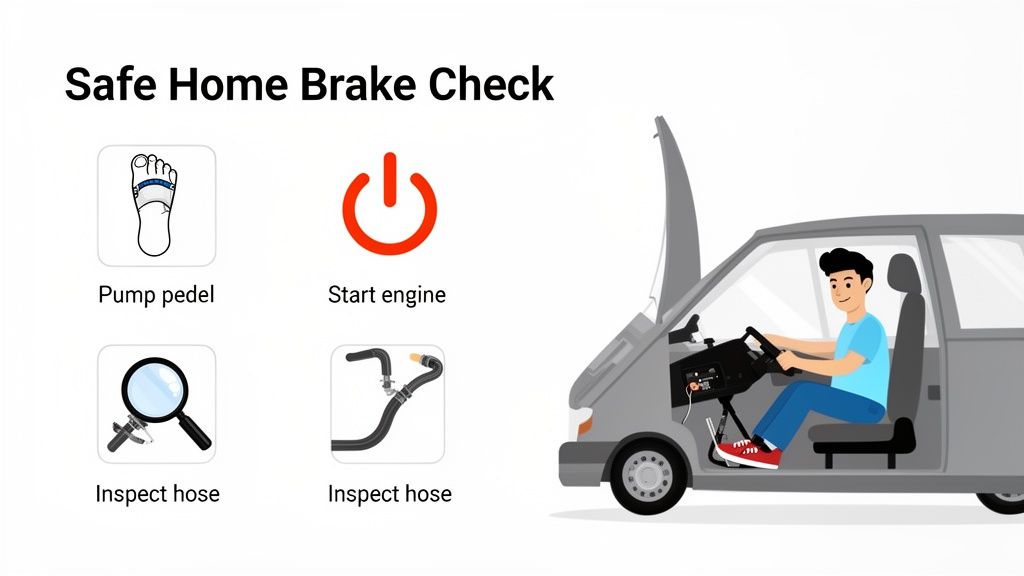
Performing the Brake Booster Test
This classic test is the best way to get a quick read on your brake booster's health. It’s a straightforward, two-step process that doesn't require any tools and gives you an immediate feel for what’s happening.
- With the engine off, pump your brake pedal four or five times. You should feel the pedal getting firmer with each pump. This is normal; you're just using up the stored vacuum inside the booster.
- Now, hold firm pressure on the pedal and start the engine. If the booster is doing its job, you should feel the pedal drop slightly—about an inch or so—and become much easier to hold down.
What the Results Mean
If the pedal drops a bit when the engine starts, your brake booster is likely working correctly. On the other hand, if the pedal stays high and hard with no change at all, it's a strong sign the booster has failed or isn't getting the vacuum it needs to operate.
Conducting a Visual Inspection
Next, pop the hood and take a quick look around. You're looking for the brake booster, which is the big, round, black canister mounted to the firewall on the driver's side of the engine bay.
You’ll see a thick rubber hose connected to it—that’s the vacuum line. Carefully trace this hose along its entire length, checking for any obvious signs of damage:
- Cracks or splits in the rubber
- Loose or disconnected fittings at either end
- Obvious brittleness or deterioration from age
Think of this hose as the booster's lifeline. Even a tiny leak is enough to starve it of vacuum and cause a hard brake pedal. While you're under the hood, it's also a good time to check your other automotive fluids. If you need a refresher, take a look at our guide on how to check car fluids.
A brake system you can count on is non-negotiable for road safety. Problems that make braking difficult or unpredictable increase the risk of pedal error, a factor in roughly 16,000 preventable crashes in the U.S. each year. You can discover more insights on how proper vehicle maintenance helps prevent accidents by visiting NHTSA's pedal error advisory page.
The Professional Repair Process for Your Brakes
When you bring your car to us with a brake pedal that's hard to press, our ASE-certified technicians don't just start guessing. We kick off a systematic process designed to find the exact failure point. This isn't about throwing parts at a problem; it's a methodical diagnosis to uncover the root cause, ensuring you only pay for the repairs your vehicle actually needs.
The first step is always to verify what you're feeling. A technician will carefully test the brake pedal with the engine off and then on, confirming that lack of power assist you've been dealing with. This simple check, combined with listening for any tell-tale hissing sounds, often gives us the first clues we need to head down the right diagnostic path.
Advanced Diagnostic Tools
To get from a hunch to a certainty, we rely on specialized equipment. A quick visual inspection just isn't enough when we're dealing with a component as critical as a brake booster.
Vacuum Gauges: We connect a professional vacuum gauge right to the booster's supply hose. This tool gives us a precise measurement of the engine vacuum reaching the booster, telling us instantly if the issue is a weak supply or a failure inside the booster itself. A low or jumpy reading points us toward a leak somewhere in the line.
Smoke Machines: For those sneaky, hard-to-find vacuum leaks, a smoke machine is our secret weapon. This device gently fills the vacuum system with a harmless, visible vapor. Wherever that smoke seeps out is exactly where the vacuum is escaping—whether it's from a hairline crack in a hose or a bad seal.
This level of detailed inspection ensures we nail the diagnosis the first time. The last thing any driver wants is a return trip for the same problem, especially when it involves their brakes.
Transparent Estimates and Clear Communication
Once we've confirmed the exact cause of your hard brake pedal, our service advisor will sit down with you and walk you through everything we found. We believe in total transparency from start to finish.
You will receive a detailed, written estimate that clearly outlines the necessary repairs, the parts required, and the labor involved. We explain the "why" behind the recommendation and will never proceed with any work until you fully understand and approve the plan.
Our goal is to take the mystery out of auto repair, giving you the confidence that your vehicle is in expert hands. Whether it's a simple vacuum hose replacement or a full brake booster installation, we make sure the job is done to the highest industry standards. You can learn more about our commitment to quality in our complete guide to professional brake services.
Your Next Steps for a Safe and Reliable Vehicle
When it comes to your vehicle's brakes, there's absolutely no room for error. A brake pedal that’s hard to push isn't some minor inconvenience you can put off—it's a critical safety failure that demands immediate, professional attention.
Ignoring a warning sign like this puts you, your passengers, and everyone else on the road in serious danger. Your ability to stop reliably is massively compromised, turning even a quick trip to the store into a risky gamble.
The only smart move is to get your vehicle to a team with proven expertise. You'll want to find an auto shop with ASE-certified technicians who have the proper training and diagnostic tools to figure out exactly what’s wrong. Shops that are part of trusted networks, like NAPA AutoCare, show a real commitment to high standards and quality work.
Schedule Your Professional Brake Inspection
Don't wait and hope the problem goes away on its own. Getting ahead of issues is the key to keeping your car healthy for the long haul. For example, staying on top of services like a brake fluid flush can prevent bigger problems down the line. You can learn more in our guide on how often to get a brake fluid flush.
It's also worth noting that after any major brake repair, especially with new pads or rotors, there's a new auto part break-in period that's essential for getting the best performance and ensuring your safety.
Your safety is our number one priority. Schedule a comprehensive brake inspection with our certified technicians today so you can get back on the road with confidence.
Common Questions About a Hard Brake Pedal
Even after getting a handle on the likely causes, it’s completely normal to have a few practical questions. Let's walk through some of the most common things drivers ask when they’re facing a hard brake pedal, so you know exactly what to expect.
We'll cover everything from potential costs to whether it’s even safe to drive your car to the shop.
How Much Does It Cost to Fix a Hard Brake Pedal?
The final bill really depends on what’s causing the problem. Sometimes, it’s a simple and relatively cheap fix. If a vacuum hose has cracked or just popped off, you might only be looking at a bill between $100 and $200. This is a common culprit and thankfully, a quick repair.
On the other hand, if the brake booster itself has failed, the repair is more involved. The part is more expensive, and it takes more labor to replace. For a full brake booster replacement, you can expect the cost to be anywhere from $400 to over $800, depending on your car’s make and model. The only way to know for sure is to have a professional diagnose it first.
Can I Drive My Car If the Brake Pedal Is Hard?
Driving with a hard brake pedal is extremely dangerous, and we strongly advise against it. Your ability to stop the car is severely limited, which is a massive risk, especially if you need to brake suddenly in an emergency.
The amount of physical force you’ll need to apply just to slow down is huge. Your normal stopping distances will be much, much longer than you’re used to. For your safety and everyone else’s, the best thing to do is pull over safely and have your vehicle towed to a certified repair shop.
Can Cold Weather Make My Brake Pedal Hard?
While extreme cold can make fluids thicker and rubber parts less flexible, it’s not a typical cause for a brake pedal that stays hard. That feeling of stepping on a rock is almost always a sign of a mechanical or vacuum failure in the power-assist system.
If the pedal is still stiff after your car has had a chance to warm up, that’s a clear signal that something has failed. It needs to be inspected right away, no matter what the thermometer says. Don't just write off a hard pedal as a symptom of cold weather.
Don't guess when it comes to your brakes. The ASE-certified team at Kwik Kar Oil Change and Auto Care has the expertise and diagnostic tools to accurately pinpoint the problem and get you back on the road safely. Schedule your professional brake inspection today at https://www.kkrichardson.com.