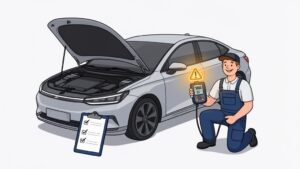
If your car pulls to the right, your first thought might be wheel alignment, and you're often right. But uneven tire pressure is another prime suspect. These two issues are the most common culprits, creating an imbalance that forces your car to drift. This isn't just annoying—it's your car sending a clear signal that it needs attention.
Why Your Car Pulls to the Right
That frustrating feeling of constantly correcting the steering wheel just to drive straight means something is out of whack in your steering, suspension, or tire setup. It's a lot like trying to walk in a pair of shoes with mismatched soles; your body has to work overtime just to stay balanced. For your car, this constant fight not only wears you out, but it also puts extra strain on its components, causing them to wear down faster.
Ignoring a persistent pull is a bad idea, especially on busy Richardson roads. It's a fight for control you shouldn't have to have, and it can even mess with your braking in an emergency.
Diagnosing the Pulling Sensation
The first step in figuring out what’s wrong is to notice when the pull happens. Different symptoms point to different problems. A pull that only happens when you hit the brakes, for instance, is a classic sign of a brake issue, like a stuck caliper.
On the other hand, a car that consistently drifts right at different speeds is almost always pointing to a problem with the tires or wheel alignment. Think about your daily drive down US-75; if you're constantly fighting the wheel to keep from drifting into the next lane, you're experiencing a red flag for bad alignment. In fact, it's the number one symptom drivers report before an alignment service, affecting up to 80% of vehicles that have hit a pothole or curb. You can learn more about why vehicle alignment is so important at commercialtire.com.
To help you get a better idea of what might be going on, here's a quick guide to what your car's pulling could mean.
Quick Guide to What Your Car's Pull Means
| Symptom | Most Likely Cause | Next Step |
|---|---|---|
| Pulls only when you brake | Stuck brake caliper or worn brake hose | Schedule a brake inspection |
| Pulls constantly at all speeds | Bad wheel alignment or uneven tire pressure | Check tire pressure; if normal, schedule an alignment |
| Pulls only during acceleration | "Torque steer" (common in FWD cars) or worn suspension part | If severe, have the suspension and engine mounts checked |
This table gives you a starting point, but a professional diagnosis is the only way to be certain.
The flowchart below shows how a technician might approach the problem, starting with the same simple questions to narrow down the possibilities.
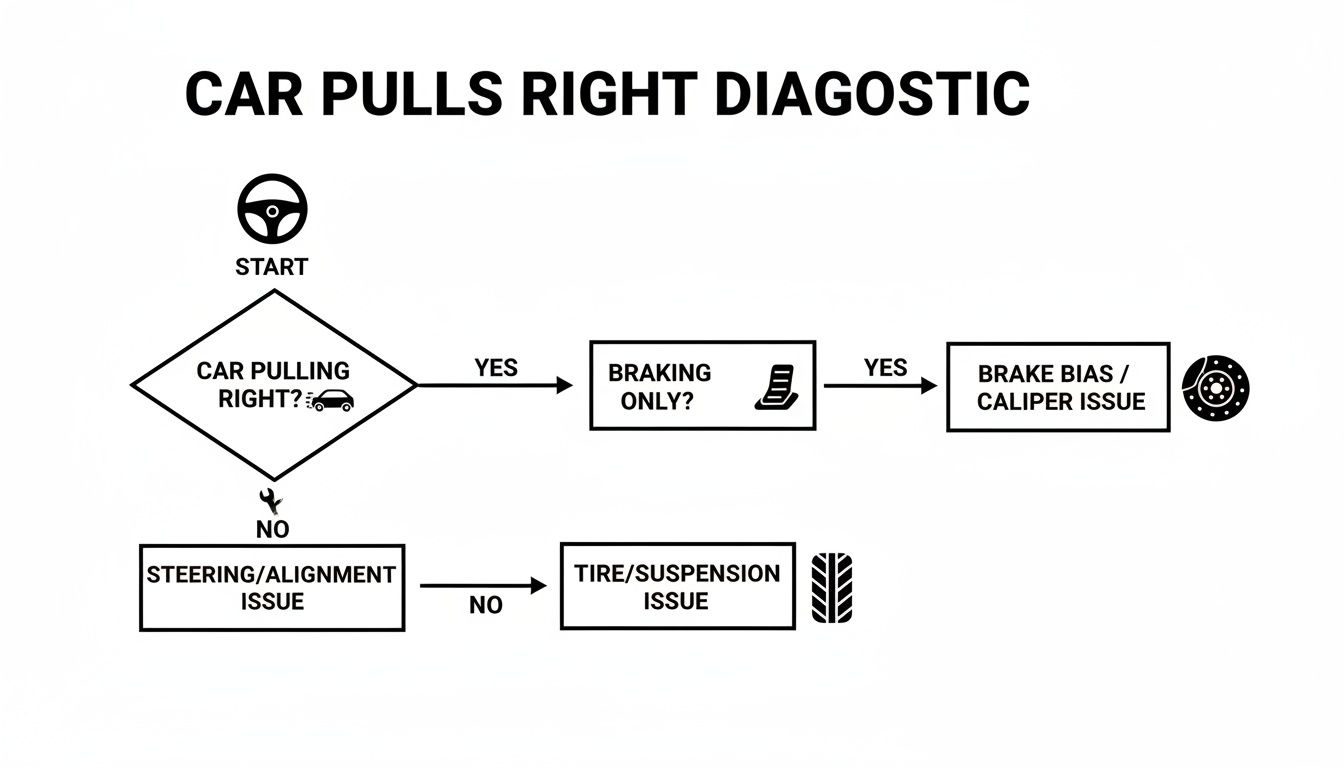
As you can see, figuring out if the pull is constant or only happens during braking is the key first step. From there, we can get to the root of the problem and recommend the right fix.
The Role of Wheel Alignment in Straight Driving
So, you've checked your tire pressure, but your car is still determined to drift to the right. In this case, the most likely culprit is your wheel alignment. It’s far and away the #1 reason for a vehicle to persistently pull to one side.
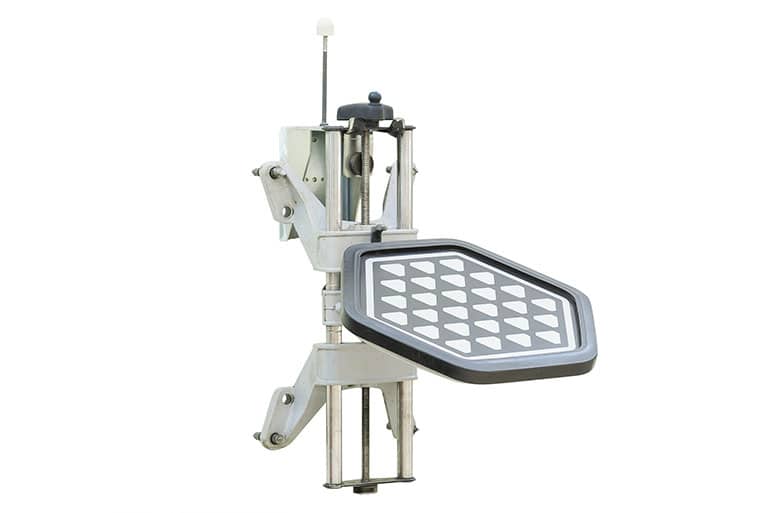
Think of your car's alignment like a finely tuned machine where every part has to be perfectly positioned. Hitting a single deep pothole on a Richardson street, bumping a curb at the grocery store, or even just the slow, steady wear from thousands of miles can knock your car's sensitive alignment angles out of spec. Once that happens, the car loses its balance.
Key Takeaway: A vehicle’s wheel alignment involves tiny, precise adjustments that control how your tires meet the road. When these angles are off, the car will naturally follow the path of least resistance, which feels like a constant pull to the left or right.
Understanding Camber, Caster, and Toe
While wheel alignment sounds complicated, it really just comes down to three main angles. Getting a handle on these terms makes it much easier to picture what’s going on when your car starts pulling.
Imagine looking at your wheels from different points of view:
- Camber: This is the inward or outward tilt of your tires when you look at the car from the front. If the tops of the tires lean out, that’s positive camber. If they lean in, it's negative camber. When the camber is different between your two front wheels, it’s a classic recipe for a steering pull.
- Caster: Now, look at your wheel from the side. Caster is the angle of your steering axis. A proper caster angle is what helps your steering wheel return to the center on its own after a turn and keeps the car stable at high speeds. If the caster is uneven, your car will pull toward the side with less positive caster.
- Toe: This is the angle of your tires when viewed from above, like looking down at your feet. "Toe-in" means the front of the tires point slightly toward each other. "Toe-out" means they point away. An incorrect toe setting is a huge cause of premature and patchy tire wear.
When even one of these angles is out of whack, it forces your tires to "scrub" or drag along the road instead of rolling freely. This creates a constant drag on one side, making your car pull to the right or left.
Signs of Misalignment and Why It's a Safety Issue
Besides the obvious pull, there are a few other classic signs that your alignment is off. You might find that your steering wheel is crooked and sits at an angle even when you’re driving perfectly straight. Another dead giveaway is uneven tire wear, especially when you see the inside or outside edges of a tire wearing down much faster than the center.
This isn’t just about having to buy new tires more often; poor alignment is a genuine safety concern. It can make your steering feel “loose” or unresponsive and, more critically, can increase the distance it takes to stop in an emergency because the tires aren't making full, proper contact with the road.
If you’re noticing any of these issues, it's a good idea to have a professional take a look. To see how we get your car back to factory-perfect handling, you can learn more about professional wheel alignment and our process right here at Kwik Kar.
Simple Fixes for Tire-Related Pulling
Before you start worrying about complex suspension work or a pricey alignment job, just hold on. More often than not, the reason your car pulls to the right is a much simpler, cheaper issue hiding in plain sight: your tires. These problems are incredibly common and, thankfully, easy to check yourself.
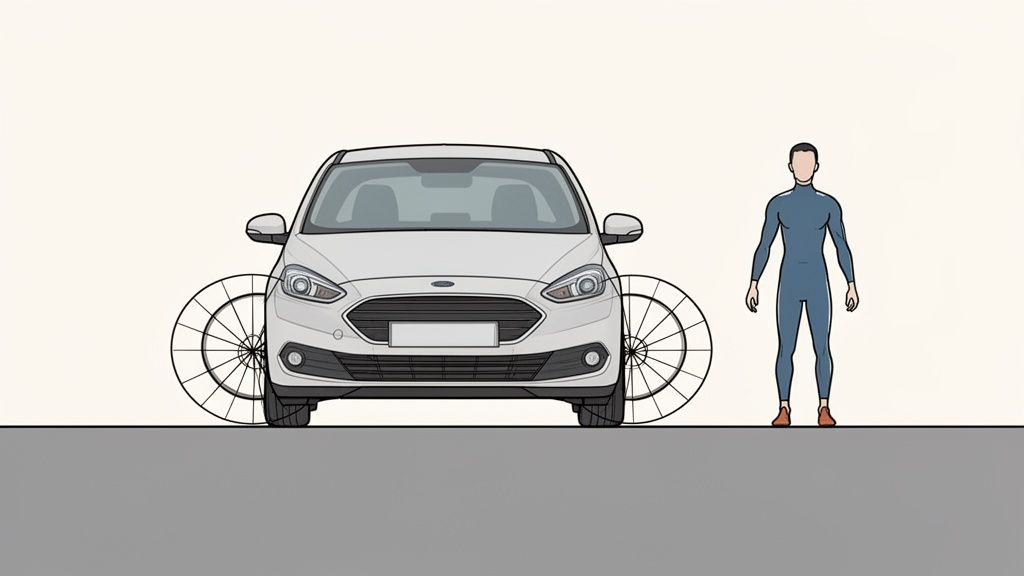
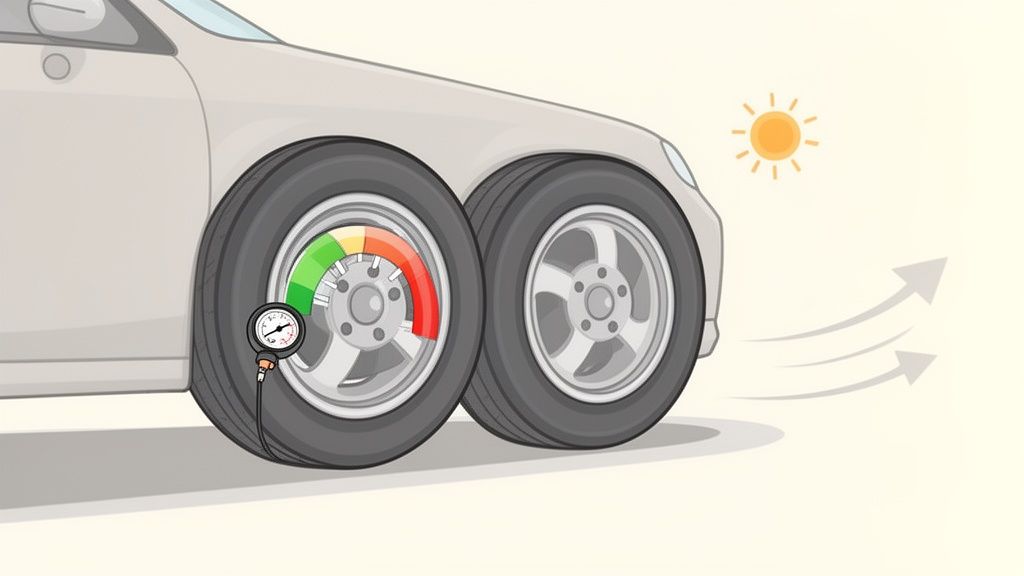
The biggest culprit is also the easiest to fix—uneven tire pressure. Think of it like a runner’s shoes. If one shoe's sole is softer or flatter than the other, the runner is going to naturally drift to that side. Your car works on the same basic principle.
The Overlooked Power of PSI
When a tire on the right side is underinflated, it creates more friction with the road. This "rolling resistance" literally drags that side of the car, causing it to pull. This is especially common here in Texas, where our wild temperature swings can make tire pressure fluctuate significantly.
You'd be surprised how little of a difference can cause a big problem. Even a 5 PSI difference—say, 28 PSI on the left and 33 PSI on the right—is enough to make your car pull relentlessly toward the low side. It’s the easiest fix in the book, yet it’s overlooked by a staggering 70% of drivers, according to one major survey. For a detailed guide, you can learn more about maintaining correct tire pressure in our blog.
Your first step is a quick check with a tire pressure gauge. If you find the pressures are off, inflating them to the manufacturer’s recommended level could solve the problem instantly. You can find that number on the sticker inside your driver's side door jamb.
When the Tire Itself Is the Problem
If your tire pressures are perfect but the car still pulls, the issue might be something called radial pull. This isn't something you can see; it's an internal defect in the tire's construction that essentially makes it act like it’s cone-shaped, forcing the car to drift.
Though it's an invisible problem, there's a simple test you can do right in your driveway to diagnose it:
- Rotate the front tires: Just swap the front left tire with the front right tire.
- Test drive the car: Take it for a short drive and pay close attention to whether the pull has changed.
If the car now pulls to the left instead of the right, you've almost certainly found your culprit—a tire with radial pull. But if the pull stays on the right, the problem is likely something else, like your alignment or brakes.
How Brake Problems Can Cause Your Car to Pull
So, you’ve checked the tire pressure and you’re pretty sure the alignment is solid, but your car still wants to drift over to the right. The next stop on our diagnostic journey is your brake system. We usually only think about brakes when we’re trying to stop, but a fault in the system can absolutely cause a pull, even when you’re just cruising down I-75. It's a major safety issue that needs to be addressed right away.
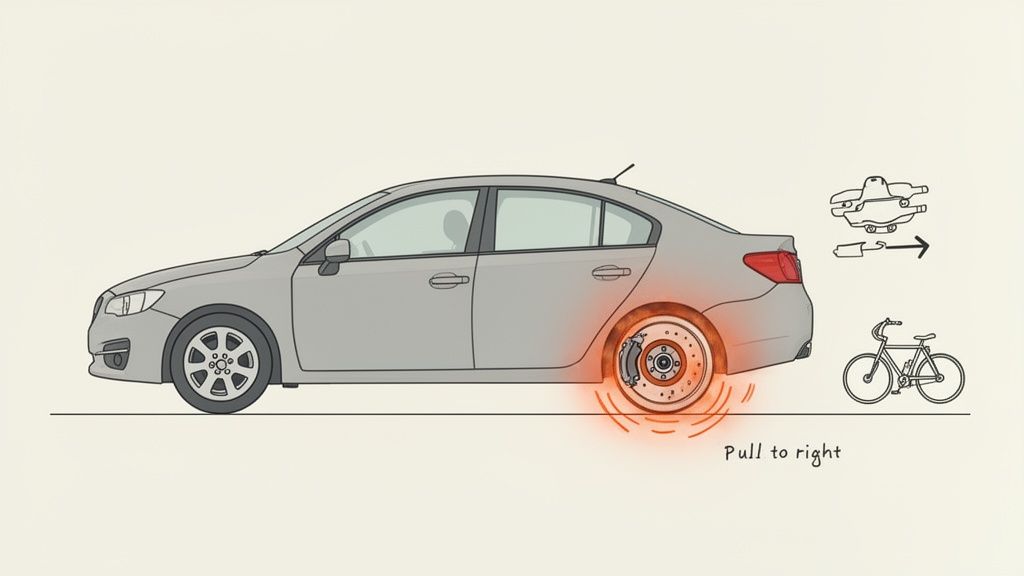
Think about an old bicycle brake that just won’t let go of the wheel. Even when you release the lever, one of the pads keeps dragging, slowing you down and making you work harder. A similar problem can happen in your car, and the most common culprit is a stuck or seized brake caliper.
When One Brake Won't Let Go
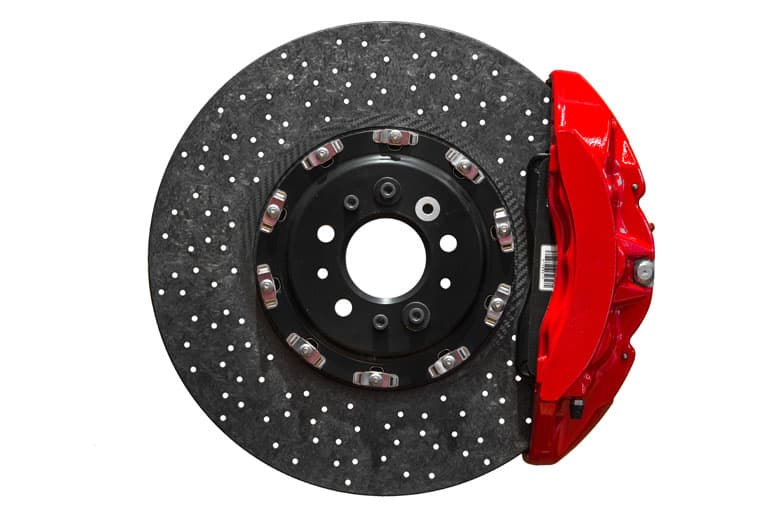
A brake caliper acts like a hydraulic clamp. When you press the brake pedal, it squeezes the brake pads against the spinning rotor, bringing your car to a stop. When you lift your foot, it’s supposed to release its grip completely. But sometimes, due to rust, road grime, or a failing internal piston, it gets stuck and doesn't fully retract.
If the caliper on your right front wheel seizes up, it's like that wheel's brake is always on, even if just slightly. This constant drag creates a ton of friction and pulls your vehicle toward that side. Here's the key diagnostic question: does the car pull all the time, or only when you hit the brakes? If the pull is constant, a stuck caliper is a top suspect.
Safety Warning: A dragging brake generates extreme heat. This can quickly damage the rotor, pads, and even the wheel bearing. In a worst-case scenario, the heat can boil your brake fluid, causing a complete loss of braking on that wheel.
Other Telltale Signs of a Brake Problem
Besides the constant pulling, a stuck caliper usually sends out a few other distress signals. You just have to know what to look (and smell) for.
- A Burning Smell: The friction from a constantly dragging brake creates a very distinct, sharp, and acrid smell, a lot like burning carpet. You'll probably notice it most after you've stopped and gotten out of the car.
- One Wheel Is Hotter Than the Others: After driving for a bit, carefully walk up to the wheel on the side that’s pulling. If that wheel hub feels much hotter to the touch than the others, that's a dead giveaway for a dragging brake. Use caution—it can get extremely hot.
- Visible Smoke: In a severe case, a badly seized caliper can generate so much heat that you’ll see smoke coming from the wheel well. If this happens, pull over as soon as it's safe and call for roadside assistance.
- Reduced Fuel Economy: Forcing the engine to overcome that constant drag takes a lot more energy. If you suddenly notice your gas mileage taking a nosedive, a stuck brake could be the reason.
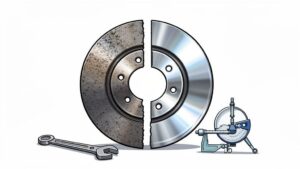
These symptoms are clear signs that your brake system needs a professional eye. You can learn more about how to inspect brake rotors to get an idea of what our technicians are checking for. If you’re around Richardson and spot any of these signs, don’t wait. Bring your vehicle into Kwik Kar for a full safety inspection.
Diagnosing Worn Suspension and Steering Parts
So, you’ve done your homework. You checked the tire pressure, ruled out a brake problem, and even got a professional wheel alignment. But your car still pulls to the right. When this happens, it’s a strong sign the issue is buried a little deeper in your car’s suspension and steering system.
Over thousands of miles, especially on the roads around Richardson, these critical components start to wear down. You might feel it as a vague looseness in the steering wheel or a constant need to correct course, a wandering that an alignment just can't seem to fix.
Think of your car's steering and suspension like the joints in your body—the hips, knees, and ankles. When they're healthy, movement is precise and stable. But as they age, they can become loose and less supportive. The same thing happens in your car, creating "play" or "slop" that prevents the wheels from holding their correct position.
Key Parts That Cause Pulling When Worn
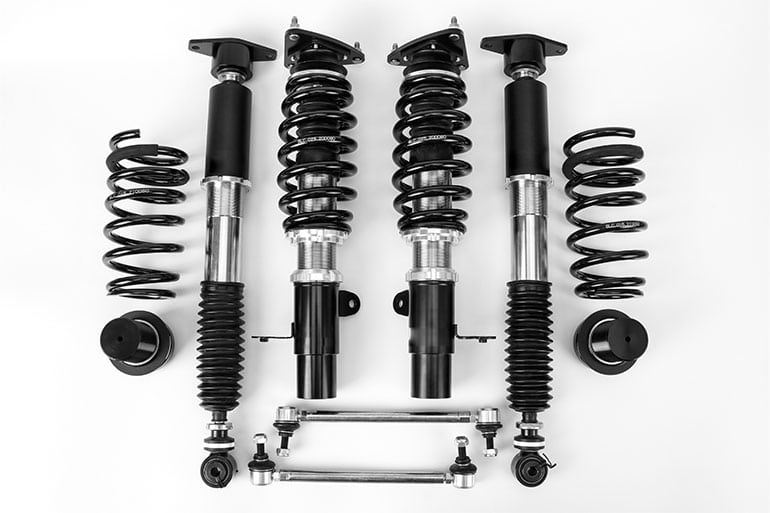
A handful of specific parts are tasked with keeping your wheels pointed exactly where you want them. When even one of these components fails, it introduces enough unwanted movement to cause that persistent pull, a problem that’s especially common in higher-mileage vehicles.
Here are the usual suspects:
- Ball Joints: These are the main pivot points connecting the wheels to your car's suspension. A worn-out ball joint allows the entire wheel assembly to wobble and shift, throwing off the angles and causing a drift.
- Tie Rod Ends: These little parts are the direct link from your steering rack to your wheels, translating your steering wheel movements into turning. When they get loose, the steering feels sloppy and the wheels can wander on their own.
- Control Arm Bushings: These rubber or polyurethane insulators absorb road shock and allow the control arms to pivot smoothly. Once they crack, tear, or degrade, the control arm itself can shift, knocking the alignment out of spec and causing a pull.
A car's suspension is a dynamic system. Even if an alignment is perfect while the car is stationary on a rack, worn parts can allow the wheels to shift out of alignment as soon as the car is moving and under load.
This is the classic reason a simple alignment check sometimes misses the real problem. The weight of the vehicle and the forces of driving are what expose the looseness, something that isn't always obvious when the car is sitting on a lift.
Finding the culprit requires a hands-on inspection by a technician who knows what to feel for. They can manually check for play in each joint and bushing, spotting the subtle movements that tell them a part has failed. Because everything is so connected, a professional evaluation is the only way to pinpoint the exact fault without just throwing parts at the problem.
If your car feels loose or the pulling won't go away, it’s time to have an expert take a closer look. Let one of the technicians at Kwik Kar in Richardson get it on a lift to make sure your vehicle is stable, predictable, and safe on the road.
Your Action Plan for a Smoother, Straighter Drive
Okay, so you’ve noticed your car is pulling to the right. That’s your vehicle sending a clear signal that something needs a closer look. Instead of feeling overwhelmed by all the possibilities, you can follow a simple, straightforward plan to figure out what's going on.
Think of it as starting with the easiest checks first. This helps rule out the simple stuff before you dive into anything more complex, saving you time and giving you valuable information if you do need to see a professional.
A Three-Step Approach to a Straighter Ride
Start with what you can safely observe and check yourself. This initial information is incredibly valuable, whether you solve the problem on the spot or need to explain the symptoms to a technician later.
Perform an At-Home Tire Check: Before you do anything else, grab a good tire pressure gauge. Check the PSI in all four tires and make sure they match the manufacturer's recommended level, which you can find on a sticker inside your driver's door jamb. An underinflated tire on the right side is a surprisingly common—and easily fixed—cause of pulling.
Observe When the Pull Happens: Pay close attention next time you're driving. Does the car pull all the time, or does it only happen when you hit the brakes? Maybe it’s just when you accelerate? This one observation is the single most important clue you can gather.
Schedule a Professional Inspection: If your tires are properly inflated but the car still pulls, it’s time to let an expert take over. A persistent pull often points to an issue with your alignment, brakes, or suspension that requires specialized tools to diagnose correctly.
Relying on certified technicians isn't just about getting a fix; it's about making sure your vehicle is safe to drive. Advanced diagnostic equipment can spot things like a worn ball joint or a failing brake caliper that a simple visual check would miss, stopping a small problem from turning into a dangerous one.
Don't keep fighting your steering wheel on the roads around Richardson. The team at Kwik Kar is ready to give you a clear diagnosis and expert service to get you driving straight and safe again.
Common Questions About A Pulling Car
Even after you’ve noticed your car pulling to one side, it’s normal to have a few more questions. We get it. Here are some straightforward answers to the questions we hear most often from drivers right here in Richardson, helping you figure out what to do next for your car’s health and your safety.
Is It Safe to Drive if My Car Is Pulling?
Honestly, we don’t recommend it. Driving a car that’s pulling is a constant fight with the steering wheel, and it seriously impacts your control. A minor pull from a low tire might not feel like a big deal, but if the cause is a stuck brake caliper or a bad suspension part, you're dealing with a major safety hazard. That kind of problem can make it harder to stop or steer safely in an emergency.
If the pull is sudden, aggressive, or you hear grinding noises or smell something burning, pull over as soon as it’s safe to do so and call for a tow. Don't risk it.
Why Does My Car Seem to Pull Right Only on Certain Roads?
You're not imagining it! This is usually caused by something called road crown. Roads are designed with a slight arch, highest in the middle, to let rainwater drain off the sides. This design naturally makes your car want to drift toward the shoulder.
The real test is to find a large, flat parking lot. If your car still pulls to one side there, you know the problem is with your vehicle, not the road.
How Much Will It Cost to Fix My Car?
This is the big question, and the answer really depends on what’s causing the pull. The cost can swing pretty wildly.
Here’s a quick breakdown of some common repairs:
- Tire Pressure Adjustment: Usually free or a very minor charge.
- Wheel Alignment: This is a very common solution, typically costing between $80 and $200.
- Brake Repair: Replacing a stuck caliper can run from $250 to over $500 per wheel, depending on your car.
- Suspension Parts: Fixing something like a worn-out ball joint or tie rod could be several hundred dollars.
Getting a proper diagnosis is always the first step before you can get a solid price.
Don't let a steering problem ruin your peace of mind or put your safety at risk. The ASE-certified technicians at Kwik Kar have the advanced diagnostic tools to find the exact reason your car is pulling and get you back to driving straight. Schedule your inspection today by visiting us at https://www.kkrichardson.com.