Common Signs Your Vehicle Has a Coolant Leak
If you spot a puddle under your car, catch a sweet smell from the engine bay, or watch your temperature gauge creep upward, stop driving and follow these checks immediately. A coolant leak is one of the few car problems where ignoring it for even a short drive can turn a $150 hose repair into a $2,500 head gasket job. Even small external leaks can cause engine overheating within minutes under load, so the first decision you make matters.
Do this right now:
- Pull over safely and shut off the engine.
- Wait at least 30 minutes before touching anything under the hood.
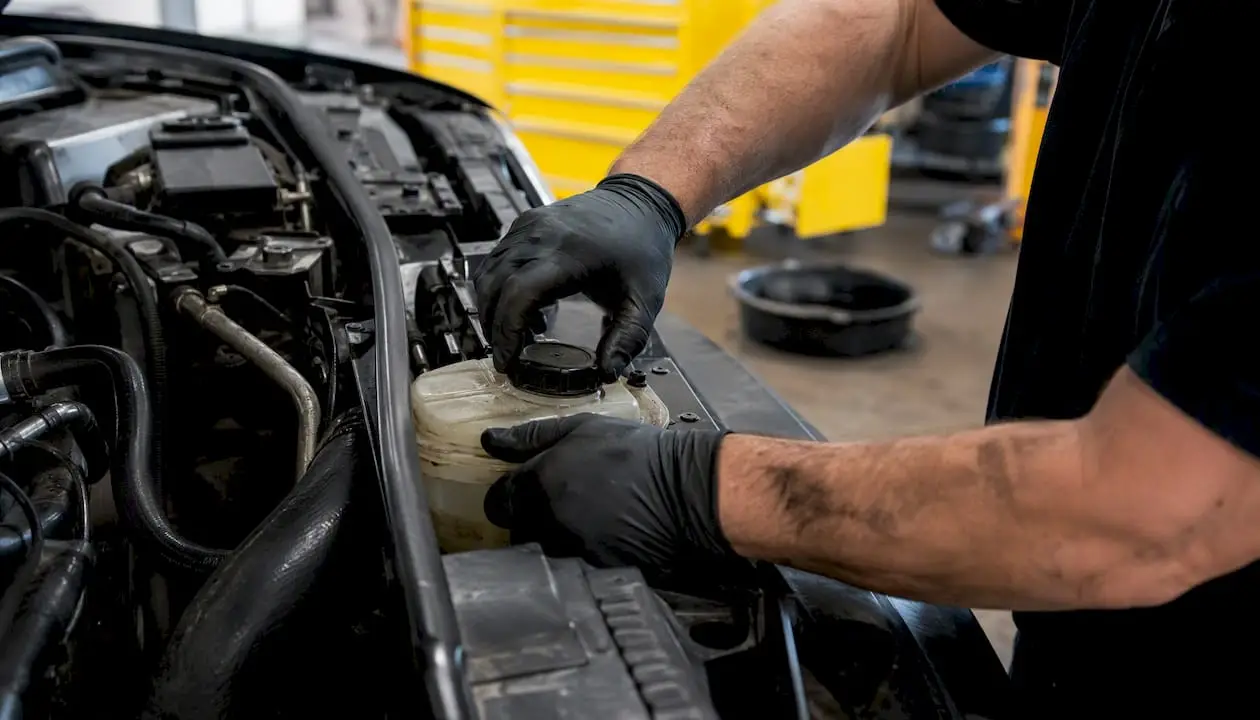
- Check the coolant reservoir (the translucent plastic tank near the radiator) for level and color.
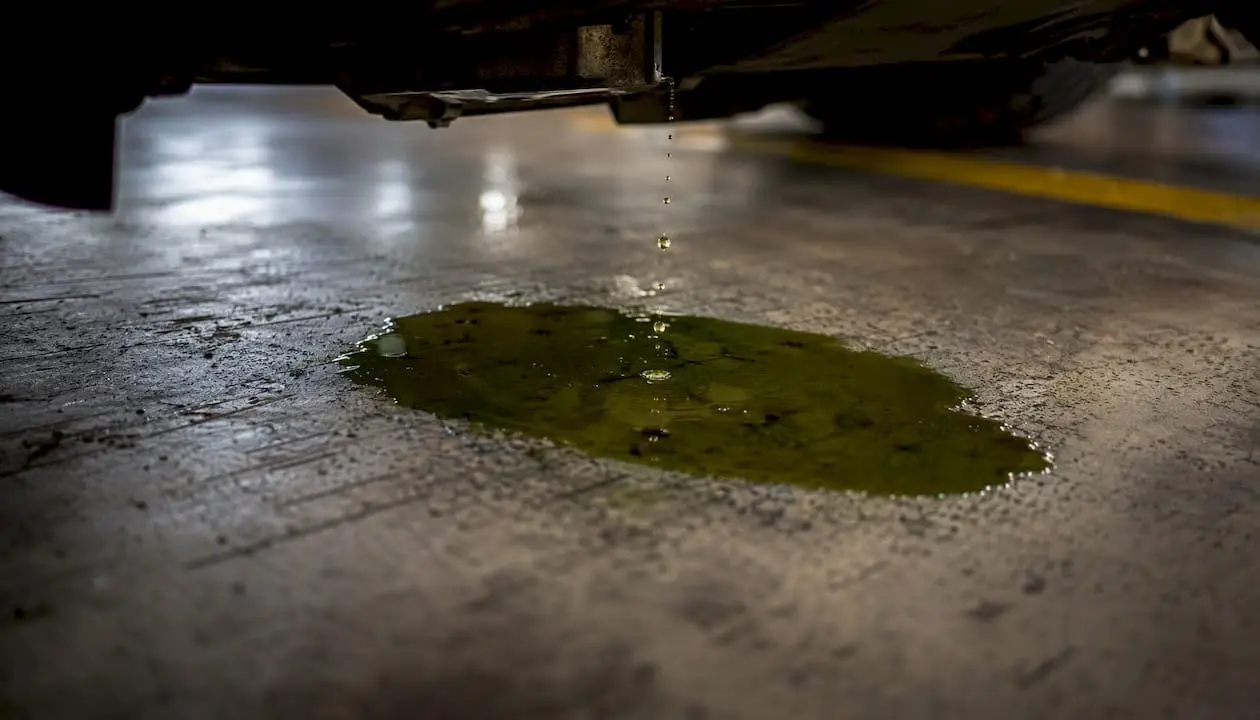
- Note the puddle color: bright green, orange, or pink fluid is coolant. Clear water from the A/C is normal.
- Never open a hot radiator cap. Pressurized coolant can spray and cause serious burns.
- Keep children and pets away from any spilled fluid immediately.
If the temperature gauge is rising or you see steam, do not drive another mile. If the leak is minor, the temperature is stable, and the reservoir shows fluid, a careful short drive to the nearest shop may be acceptable — but only as a last resort.
Table of Contents
- How to diagnose a coolant leak step by step
- Is it safe to drive with a coolant leak?
- Temporary fixes and what they actually do
- Permanent repairs: what the shop does, what it costs
- When you need a professional and what to expect
- Handling and disposing of coolant safely
- Key Takeaways
- What experienced technicians see that most guides don’t tell you
- Cooling-system repair in Richardson, TX: Kwik Kar Oil Change & Auto Care
- Useful sources
- FAQ
How to diagnose a coolant leak step by step
A systematic approach saves you from replacing parts that aren’t the problem. Start with the easiest checks and escalate only if needed.
- Cold visual inspection. With the engine cold, inspect every hose from end to end, squeeze them gently (they should feel firm, not mushy or brittle), and check each clamp for rust or looseness. Examine the radiator surface for cracks or staining.
- Check the reservoir and cap. A cracked reservoir or a failed radiator cap (which should hold pressure to spec) causes slow, persistent coolant loss. Caps are inexpensive and often overlooked.
- Look for dried residue. White or rust-colored crust on any fitting, hose joint, or metal surface marks a past or active leak point.
- Pressure test the cooling system. Shops use a cooling-system pressure tester to reveal slow or hidden leaks that aren’t visible at idle. The tester attaches to the radiator neck and pumps the system to its rated pressure; any leak shows up as a pressure drop. This is the single most reliable diagnostic step for external leaks and is worth requesting early.
- UV dye trace. A small amount of fluorescent dye added to the coolant glows under an ultraviolet light, pinpointing leaks that are too slow to form a visible puddle. Shops commonly recommend this before replacing expensive components.
- Internal leak checks. If you lose coolant with no visible external source, suspect the head gasket. Signs include milky or frothy oil on the dipstick, white exhaust smoke with a sweet smell, and bubbling in the coolant reservoir. A compression test, leak-down test, or chemical block test (which detects combustion gases in the coolant) confirms the diagnosis.
Pro Tip: Pull the oil dipstick and show a sample to your technician. Milky, caramel-colored oil is the fastest indicator of an internal coolant failure and changes the entire repair plan.
- OBD-II codes related to coolant temperature (P0115–P0119) or overheating events confirm the system is under stress and add urgency to the diagnosis.
- Pressure testing and UV dye tracing are standard professional methods that prevent unnecessary parts replacement — ask for both before authorizing a major repair.
Is it safe to drive with a coolant leak?
The honest answer: usually no, and the risk escalates fast. Driving with a coolant leak is dangerous because even a small loss can escalate to head gasket failure or complete engine replacement if the engine overheats. Here’s how to read the situation.
Stop driving immediately if:
- The temperature gauge is above the normal range or climbing.
- You see steam from under the hood.
- You smell burning coolant or see smoke.
- The leak is heavy enough to leave a continuous trail.
- The reservoir is empty or nearly empty.
A short, careful drive to the nearest shop may be acceptable if:
- The leak is a slow drip, not a stream.
- The temperature gauge is stable and in the normal range.
- The reservoir shows fluid above the minimum line.
- You can reach a shop within a few miles without highway speeds or heavy load.
Even in the “acceptable” scenario, check the temperature gauge every few minutes and pull over immediately if it rises. Repeated overheating warps cylinder heads, destroys head gaskets, and can seize the engine entirely. A tow costs $75–$150; an engine replacement costs several thousand dollars.
Decision guide:
- Temperature rising or steam present → tow, do not drive.
- Stable temperature, minor drip, reservoir has fluid → drive carefully to the nearest shop, no highway.
- Milky oil or white exhaust smoke → tow, possible internal leak, driving makes it worse.
- Reservoir empty, unknown leak source → tow.
Temporary fixes and what they actually do
Temporary measures buy you time to reach a shop. They are not permanent solutions, and treating them as such is one of the most common mistakes vehicle owners make.
| Fix | What it can do | What it cannot do |
|---|---|---|
| Top up coolant (cold engine only) | Restores level, prevents immediate overheating | Does not seal the leak source |
| Replace radiator cap | Fixes pressure loss from a failed cap seal | Does nothing for a cracked hose or radiator |
| Tighten or replace hose clamp | Stops a clamp-related drip quickly | Won’t fix a cracked hose or radiator tank |
| Commercial stop-leak product | May seal small radiator pinholes or hairline cracks | Cannot fix a blown head gasket, failed water pump, or heater core |
| Radiator tape or epoxy patch | Temporary seal on a small external crack | Not pressure-rated; fails under heat and pressure cycling |
Safe application rules:
- Always top off coolant on a cold engine. Opening the radiator cap on a hot engine releases pressurized steam that causes severe burns.
- Avoid mixing coolants of different types (green DEXCOOL vs. orange OAT, for example) without checking compatibility. Mixing incompatible formulas causes gel-like deposits that clog the system. For guidance on which fluid to use, the coolant vs. antifreeze explainer covers compatibility rules clearly.
- Stop-leak products can clog heater cores and small passages in some cooling systems. Use them only as a last resort to reach a shop, not as a long-term fix.
Permanent repairs: what the shop does, what it costs
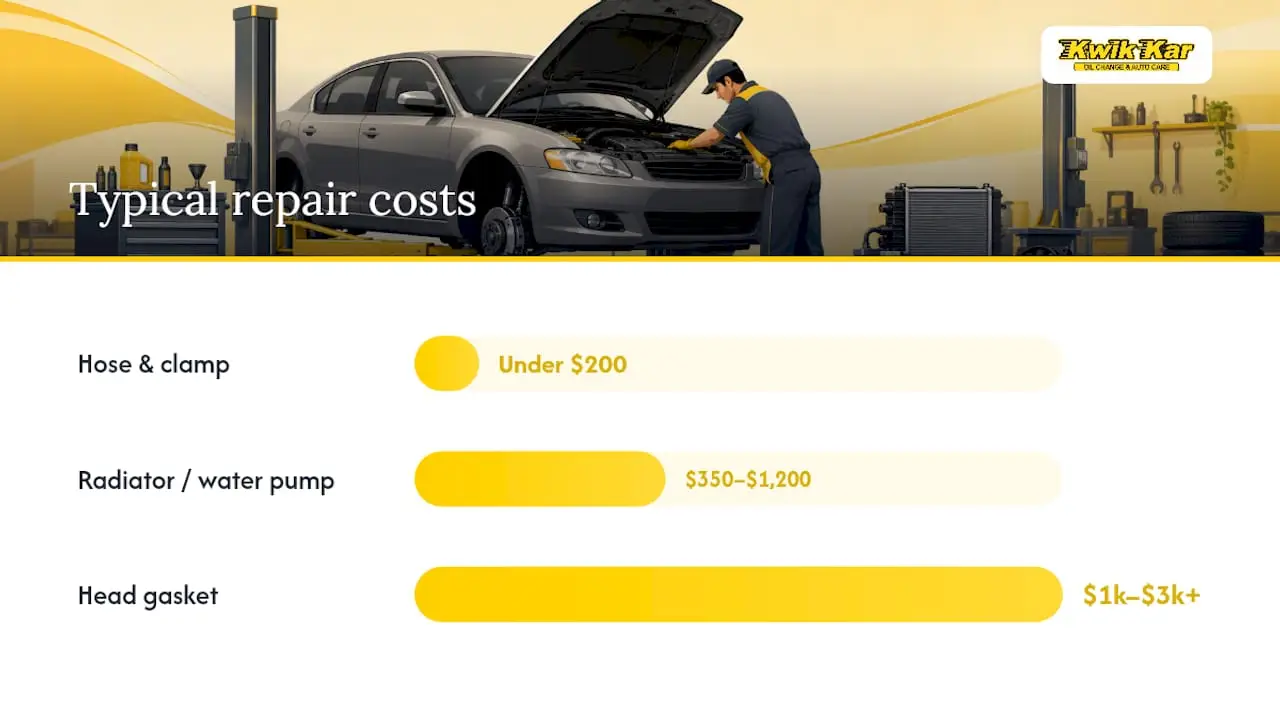
Typical 2026 U.S. repair cost ranges run under $200 for hose and clamp jobs, $350–$1,200 for radiator or water pump replacement, and $1,000–$3,000 or more for head gasket repairs depending on the engine and labor rates.
| Repair | What the mechanic does | Typical U.S. cost | Estimated time |
|---|---|---|---|
| Hose and clamp replacement | Remove old hose, install new hose and clamps, refill and bleed coolant | Under $200 | 1–2 hours |
| Radiator replacement | Drain system, swap radiator, refill and pressure test | $350–$1,200 | 2–4 hours |
| Water pump replacement | Remove pump, install new unit, refill and bleed system | $350–$1,200 | 2–5 hours |
| Thermostat housing | Replace housing and gasket, refill system | $150–$200 | 1–2 hours |
| Heater core replacement | Remove dashboard, replace core, reassemble, refill | $350–$1,200 | 5+ hours |
| Head gasket repair | Machine head, replace gasket, reassemble, test | $1,000–$3,000+ | — |
A note on labor overlap: When a water pump is driven by the timing belt, replacing both at the same time saves significant money. The labor to access the timing belt covers the pump as well, so the incremental cost of adding the pump is mostly just parts. Skipping it means paying full labor again when the pump eventually fails.
- Fix hoses, clamps, and the radiator cap immediately — these are inexpensive and prevent cascading damage.
- Heater core and head gasket repairs can be scheduled, but do not delay if you see internal leak signs.
- Always ask whether the water pump and timing components should be replaced together when the shop is already in that area of the engine.
When you need a professional and what to expect
Some leaks are beyond safe DIY territory. Call a mechanic when you see any of these:
- Milky or frothy oil on the dipstick (internal leak, possible head gasket).
- White smoke from the exhaust with a sweet smell.
- Coolant loss with no visible external source after a thorough inspection.
- Coolant smell or wet carpet inside the cabin (heater core).
- The engine has already overheated once.
What a shop will do:
- Perform a cooling-system pressure test to locate external leaks.
- Use UV dye to trace slow or hidden leaks.
- Run a compression test or chemical block test if an internal leak is suspected.
- Pull OBD-II codes and check temperature sensor data.
- Provide a written estimate with digital inspection photos before any work begins.
Questions worth asking your technician:
- Does the estimate include a pressure test, or is that a separate diagnostic fee?
- Should the water pump and timing belt be replaced at the same time?
- What warranty covers the repair?
- Will you receive digital photos of the leak source and the completed repair?
An ASE-certified technician follows a structured diagnostic process rather than guessing at parts. That discipline is what separates a shop that fixes the problem from one that replaces parts until the symptom goes away.
Handling and disposing of coolant safely
Ethylene-glycol antifreeze is toxic to people, pets, and the environment. Its sweet taste makes it especially dangerous to animals and children, who may drink it if it pools on a garage floor or driveway.
- Wear nitrile gloves when handling coolant. Avoid prolonged skin contact and wash hands thoroughly after any exposure.
- Clean up spills immediately with absorbent material (cat litter or shop rags), then rinse the area with water. Do not hose coolant into storm drains.
- Collect drained coolant in a sealed container. Never pour it down a drain, into the ground, or into a trash can.
- Take used coolant to an auto parts store, a full-service repair shop, or a municipal hazardous-waste collection site. Many auto parts retailers accept used coolant for recycling at no charge.
- In the U.S., improper disposal of coolant may violate EPA regulations and local ordinances. Check with your city or county for specific drop-off locations.
Ethylene-glycol is acutely toxic to cats and dogs even in small amounts. If you suspect a pet has ingested coolant, contact a veterinarian immediately.
Key Takeaways
A coolant leak that’s caught early costs a fraction of what it costs once the engine overheats — the difference between a hose repair and a head gasket job is often just one ignored warning sign.
| Point | Details |
|---|---|
| Stop driving if temperature rises | A climbing gauge or steam means tow, not drive — overheating causes irreversible engine damage. |
| Diagnose with a pressure test first | Cooling-system pressure testing and UV dye locate leaks before expensive parts are replaced. |
| Repair costs vary widely | Hose jobs run under $200; radiator or water pump replacement $350–$1,200, and head gasket repairs reach $1,000–$3,000+ depending on engine and labor. |
| Temporary fixes have hard limits | Stop-leak products may seal small pinholes but cannot fix a blown head gasket or failed water pump. |
| Kwik Kar Oil Change & Auto Care | ASE-certified diagnostics, digital inspection photos, and warranty-backed repairs for cooling-system work in Richardson, TX. |
What experienced technicians see that most guides don’t tell you
The most expensive coolant repairs we see at Kwik Kar Oil Change & Auto Care are almost never caused by a sudden catastrophic failure. They’re caused by a slow leak that was noticed weeks earlier and ignored. A driver smells something sweet, checks the reservoir, sees it’s “still okay,” and keeps driving. Two weeks later, the engine overheats on the highway and the head gasket is gone.
The pattern is predictable: a small hose seep or a weeping water pump costs a few hundred dollars to fix. The same car, driven another month on a low reservoir, costs ten times that. What makes this frustrating from a technician’s standpoint is that the early warning signs are unmistakable — a sweet smell, a slow drop in reservoir level, a faint stain on the driveway. The fluid has been quietly failing you long before the temperature gauge moves.
The other mistake we see constantly is owners using stop-leak products as a permanent fix. Those products have a legitimate role: they can seal a small pinhole and get you to a shop safely. But poured into a system with a failing water pump or a compromised head gasket, they clog passages and turn a manageable repair into a much messier one. Diagnose first, then decide whether a stop-gap is appropriate.
Cooling-system repair in Richardson, TX: Kwik Kar Oil Change & Auto Care
A confirmed coolant leak deserves a confirmed diagnosis, not a parts-swapping guess. At Kwik Kar Oil Change & Auto Care, the cooling-system diagnostic process starts with a pressure test and UV dye trace before any repair is authorized, so you know exactly what’s leaking and why.

Every repair is performed by ASE-certified technicians who provide digital inspection photos and a written estimate before work begins, and you can also ask about their Ceramic Coating Calgary – The PPF Company services for vehicle surface protection. Kwik Kar is recognized by both CARFAX and RepairPal, and offers special discounts for military personnel and first responders. Whether you’re dealing with a leaking hose, a cracked radiator, a failing water pump, or a suspected head gasket, the shop handles the full range of cooling-system repairs with warranty-backed work. For engine diagnostics and repair in Richardson, TX, book your appointment online or call the shop directly.
Useful sources
- Engine coolant leaks – why do they happen and what should you do? | RAC Drive
- Coolant Leak: Causes, Repair Cost & Is It Safe To Drive? | AutOwner
- Coolant Leak: Causes & How to fix it | MechanicBase
- Radiator Fluid Leak Warning: Can You Drive Your Car or Risk Engine Failure? – Ask A Mechanic
- Coolant Leak Repair Cost in 2026 | Empire Auto Protect
- Kwik Kar Richardson: Expert Oil Change & Auto Care Services
FAQ
Can you drive your car with a coolant leak?
Only if the leak is a slow drip, the temperature gauge is stable, and the reservoir shows fluid — and only for a short, low-speed drive to the nearest shop. If the gauge rises or you see steam, pull over immediately and tow the vehicle.
How much does it usually cost to fix a coolant leak?
Costs range from under $200 for a hose or clamp replacement to $350–$1,200 for a radiator or water pump, and $1,000–$3,000 or more for a head gasket repair, depending on the engine and labor rates.
What is the most common place for a coolant leak?
Radiator hoses and clamps are the most frequent source, followed by the radiator itself and the water pump. These external leaks are usually visible as colored puddles under the front of the engine.
Is it worth fixing a coolant leak?
Yes, almost always. A small external leak repaired early costs a fraction of the engine damage that results from overheating. Even a modest hose repair prevents the kind of head gasket failure that can cost several thousand dollars or total the vehicle.