You’re driving home through Richardson after a long day. Traffic on US-75 is crawling, the sun is beating down, and the air conditioning is working hard just to keep the cabin comfortable. Then you glance at the temperature gauge. It’s climbing higher than usual.
That moment gets your attention fast.
Most drivers think about coolant only when a warning light comes on or steam shows up from under the hood. But coolant in engine systems is one of the main reasons your car can survive Texas heat, stop-and-go traffic, and daily commuting without breaking down. When the cooling system does its job, you barely notice it. When it doesn’t, the repair bill can get serious in a hurry.
A lot of confusion comes from the name. People hear “coolant” and “antifreeze” and assume it’s just colored liquid that keeps the engine from getting too hot. It does that, but it also prevents freezing, protects metal parts from corrosion, supports proper system pressure, and helps modern engines stay in the temperature range they were designed to run in.
For Richardson drivers, this matters more than people think. Hot pavement, long idling periods, school pickup lines, delivery routes, and summer road trips all put stress on the cooling system. If you’ve got an older vehicle, a high-mileage commuter car, or a work truck that’s on the road every day, paying attention to coolant can save you from a tow, a warped engine, or a roadside emergency.
Why Your Engine Needs to Keep Its Cool in Richardson
A common local breakdown starts the same way. A driver is inching along in traffic, maybe near Central Expressway, maybe headed across town for errands, and the car seems fine until it isn’t. The A/C may start feeling weaker. The gauge creeps up. Then the driver notices a hot smell or sees steam.
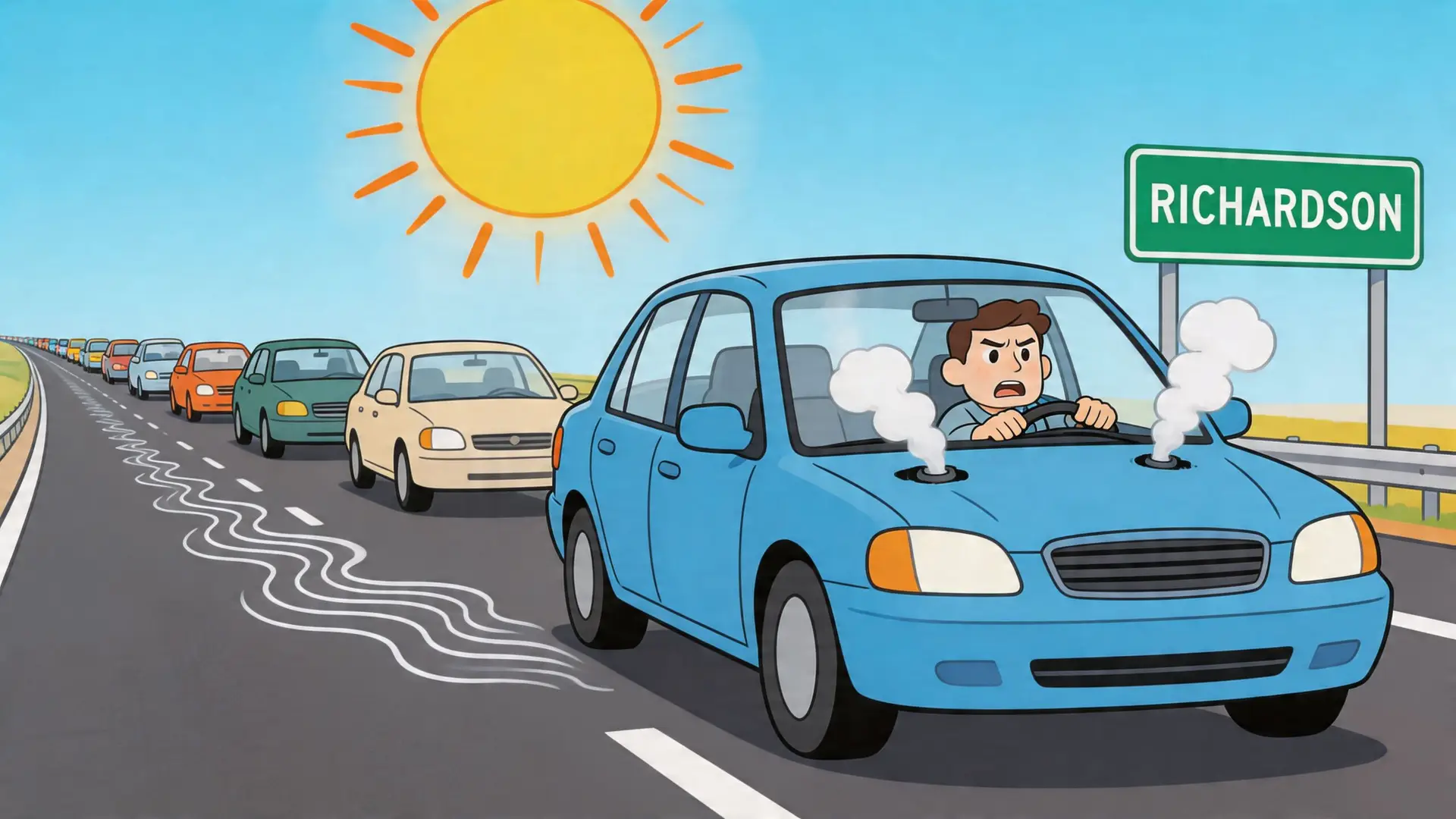
That situation feels sudden, but cooling problems usually build over time. A hose gets weak. Coolant gets old. A small leak starts. The radiator can’t shed heat as well as it should when the car is barely moving. In Richardson heat and traffic, those small issues show up faster.
Why heat and traffic are a tough combination
Your engine creates a lot of heat every time it runs. Highway airflow helps the radiator release that heat. Slow traffic doesn’t give you the same help, so the cooling system has to rely more on the radiator fan, proper coolant flow, system pressure, and a healthy thermostat.
If one part is off, the whole system has less room for error.
That’s one reason coolant matters so much. It isn’t just sitting in a tank. It’s constantly moving heat away from the engine and toward the radiator so the engine can stay in a safe operating range.
Local rule of thumb: If your car runs hotter in traffic than it does at speed, don’t ignore it. That’s often your first warning that the cooling system needs attention.
Coolant’s importance shows up beyond individual repairs. The global automotive coolant market was valued at USD 5.40 billion in 2024 and is projected to reach USD 8.31 billion by 2033 because these fluids regulate engine temperature and help prevent overheating and catastrophic failure. That’s a market signal, but for drivers here, the core takeaway is simpler: engines depend on this fluid every single day.
What Richardson drivers should take from that
For commuters, coolant helps keep a daily driver reliable. For families, it helps prevent being stranded with kids in the car on a hot afternoon. For small business fleets, it helps reduce downtime from avoidable overheating problems.
A cooling system doesn’t need much attention compared with some other parts of the car. But when it’s neglected, the consequences can be much bigger.
The Three Vital Jobs of Engine Coolant
On a Richardson afternoon, your engine can build heat fast, especially in slow traffic with the A/C running. Coolant is the fluid that helps your engine handle that stress without overheating or wearing itself out.
Your cooling system works a lot like your body’s circulatory system. The water pump keeps fluid moving, the radiator releases heat, and the coolant carries that heat away from the engine while also protecting the parts it touches. That last part matters more than many drivers realize.
Engine coolant is usually a mix of water, glycol, and protective additives. Each part of that mix has a job, and the system depends on all three working together.
Job one is heat control
The first job is to pull heat away from the engine and carry it to the radiator, where it can be released. Without that flow, heat stays trapped in the metal parts of the engine, and temperatures rise quickly.
Water transfers heat very well, which is why early engines used it. But plain water has a narrow safety range for real driving. As Dober explains in its history of engine coolants, the shift to ethylene glycol and a 50/50 mix with water greatly expanded temperature protection while keeping strong heat-transfer performance.
For Richardson drivers, that extra boil protection matters in summer traffic, during long idle times, and on days when the cooling fan has to do more of the work.
Job two is freeze protection
North Texas is hot much of the year, but freeze protection still matters.
A proper coolant mixture lowers the freezing point so the fluid does not turn solid during a winter cold snap. If coolant freezes, it can expand inside the engine, radiator, or hoses and crack expensive parts. That kind of damage can happen from one bad night.
Job three is corrosion protection
This job gets overlooked all the time.
Coolant also carries additives that protect aluminum, steel, copper, seals, and other materials inside the cooling system. Those additives help prevent rust, internal corrosion, scale buildup, and water pump wear. If the additives are depleted, the fluid may still look normal in the reservoir, but it is no longer protecting the system the way it should.
That point confuses a lot of drivers. A full reservoir does not always mean healthy coolant. Old coolant can be contaminated or chemically worn out even when the level looks fine.
Good coolant removes heat, resists freezing, and protects the inside of the system from corrosion.
Why water alone is a short-term emergency option
If you are stranded, adding water may help you get to a safer location or to a repair shop. As a regular fill, though, water leaves out two major protections. It does not give you the same freeze and boil protection as coolant, and it does not contain the additives that protect the system’s metal parts and seals.
A simple way to remember it:
- Water carries heat well
- Glycol widens the safe temperature range
- Additives protect parts inside the system
- The right mixture lets the cooling system do all three jobs at once
That is why coolant is more than colored liquid in a reservoir. It is a working chemical mixture designed to protect your engine in real conditions, especially in Richardson heat where a small cooling problem can turn into a roadside breakdown fast.
A Journey Through Your Car's Cooling System
Coolant makes more sense when you follow its path through the car. Each part has one job, but they depend on each other. If one piece fails, the whole system struggles.
The trip starts with circulation
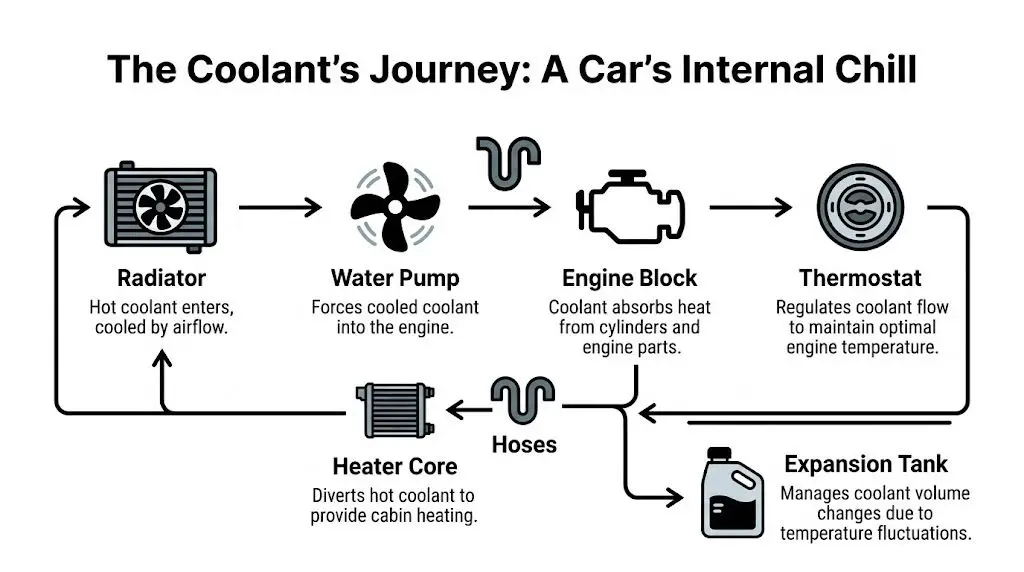
The water pump is the part that keeps coolant moving. If you want a simple analogy, it’s the heart of the system. It pushes coolant through the engine and radiator so heat doesn’t stay trapped in one place.
The coolant flows through passages in the engine block and cylinder head, where it absorbs heat from combustion and from hot metal around the cylinders. This is hard work. In heavy-duty diesel engines, coolant removes exactly one-third of the total heat energy produced, while the other two-thirds are converted to work or expelled through the exhaust. That gives you a good idea of how important the fluid is, even if your vehicle isn’t a diesel truck.
The thermostat decides when flow changes
After coolant absorbs engine heat, it reaches the thermostat. This part works like a gatekeeper.
When the engine is cold, the thermostat stays closed so the engine can warm up properly. That helps fuel efficiency, emissions control, and cabin heat. Once the engine reaches operating temperature, the thermostat opens and lets hot coolant move to the radiator.
When a thermostat sticks closed, heat can’t leave the engine like it should. When it sticks open, the engine may take too long to warm up.
A thermostat doesn’t create cooling. It controls when full cooling starts.
The radiator sheds the heat
Next stop is the radiator, which acts like a heat exchanger. Hot coolant enters the radiator, passes through narrow tubes and fins, and releases heat to the outside air.
When you’re driving at speed, air moving through the grille helps a lot. In Richardson traffic, the radiator fan becomes much more important because natural airflow is limited. If that fan isn’t working correctly, a car may run fine on the highway but start heating up in stop-and-go traffic.
The supporting parts matter more than people think
A cooling system also depends on smaller pieces that rarely get attention until something leaks.
Here’s what they do:
- Hoses connect the major parts and carry coolant from one area to another. A weak hose can swell, crack, or seep before it fully fails.
- The radiator cap helps maintain pressure in the system. Pressure matters because it raises the boiling point of the coolant.
- The overflow or expansion tank gives coolant somewhere to go as it expands with heat and contracts as it cools.
- The heater core uses hot coolant to provide heat inside the cabin.
Why pressure and flow are so important
A lot of overheating problems aren’t caused by “bad coolant” alone. They come from a flow or pressure problem. If the pump can’t circulate enough fluid, if the thermostat won’t open, if the radiator can’t shed heat, or if a leak lowers system pressure, the engine can run hotter than it should.
That’s why a cooling system diagnosis is rarely about one part in isolation. The fluid, pump, thermostat, fan, cap, radiator, hoses, and reservoir all work as one loop.
Decoding Coolant Types Colors and Chemistries
Coolant gets confusing fast because bottles on the shelf use different colors, different labels, and different claims. A lot of drivers were taught that color tells you what coolant you have. That used to be more helpful than it is now.
Today, color alone is not a reliable way to identify coolant chemistry.
Why the right formula matters
Modern engines are designed around specific coolant chemistry and a specific mix ratio. That’s not just a preference from the manufacturer. It affects how the system handles heat, corrosion, seals, metals, and service intervals.
The MS Motorservice technical overview notes that a 50:50 monoethylene glycol mix has a 10 to 20 percent lower thermal absorption capacity than pure water, so vehicles are engineered with higher pump velocities and larger radiators to maintain operating temperatures between 90°C and 105°C. In plain language, your engine was designed around a specific fluid behavior. Changing the formula or ratio can change how well the system works.
The main coolant families
Here’s a simple comparison to make the categories easier to sort out.
| Coolant Type | Common Colors | Technology | Typical Service Life | Best For |
|---|---|---|---|---|
| IAT | Often green | Inorganic Additive Technology | Shorter service life | Many older vehicles |
| OAT | Often orange, red, yellow, or purple | Organic Acid Technology | Longer service life | Many newer vehicles |
| HOAT | Varies by maker | Hybrid Organic Acid Technology | Varies by OEM | Vehicles that need a blended additive package |
That table helps with orientation, but the most important part is still the owner’s manual or OEM specification.
Why “universal” can be risky
A universal coolant may sound convenient, but convenience and compatibility aren’t always the same thing. Different engines use different metals, gasket materials, and additive requirements. A fluid that’s safe for one vehicle may be the wrong choice for another.
That’s especially true for high-mileage vehicles that may already have some scale, wear, or gasket aging. A mismatch doesn’t always cause an instant problem. Sometimes it gradually shortens component life.
If you want a plain-language refresher before checking your own vehicle, this guide on the difference between coolant and antifreeze is a useful starting point.
A better rule than following color
Use this order instead:
- Check the owner’s manual
- Match the OEM-required chemistry
- Use the proper mix ratio
- Don’t mix types unless the manufacturer specifically allows it
If you remember only one thing from this section, remember this: the correct coolant in engine systems is determined by specification, not by color.
Warning Signs Your Cooling System Needs Attention
Cooling system problems usually announce themselves before the engine completely overheats. The trouble is that many drivers miss the clues or wait too long because the car still seems drivable.
The gauge is often your first warning
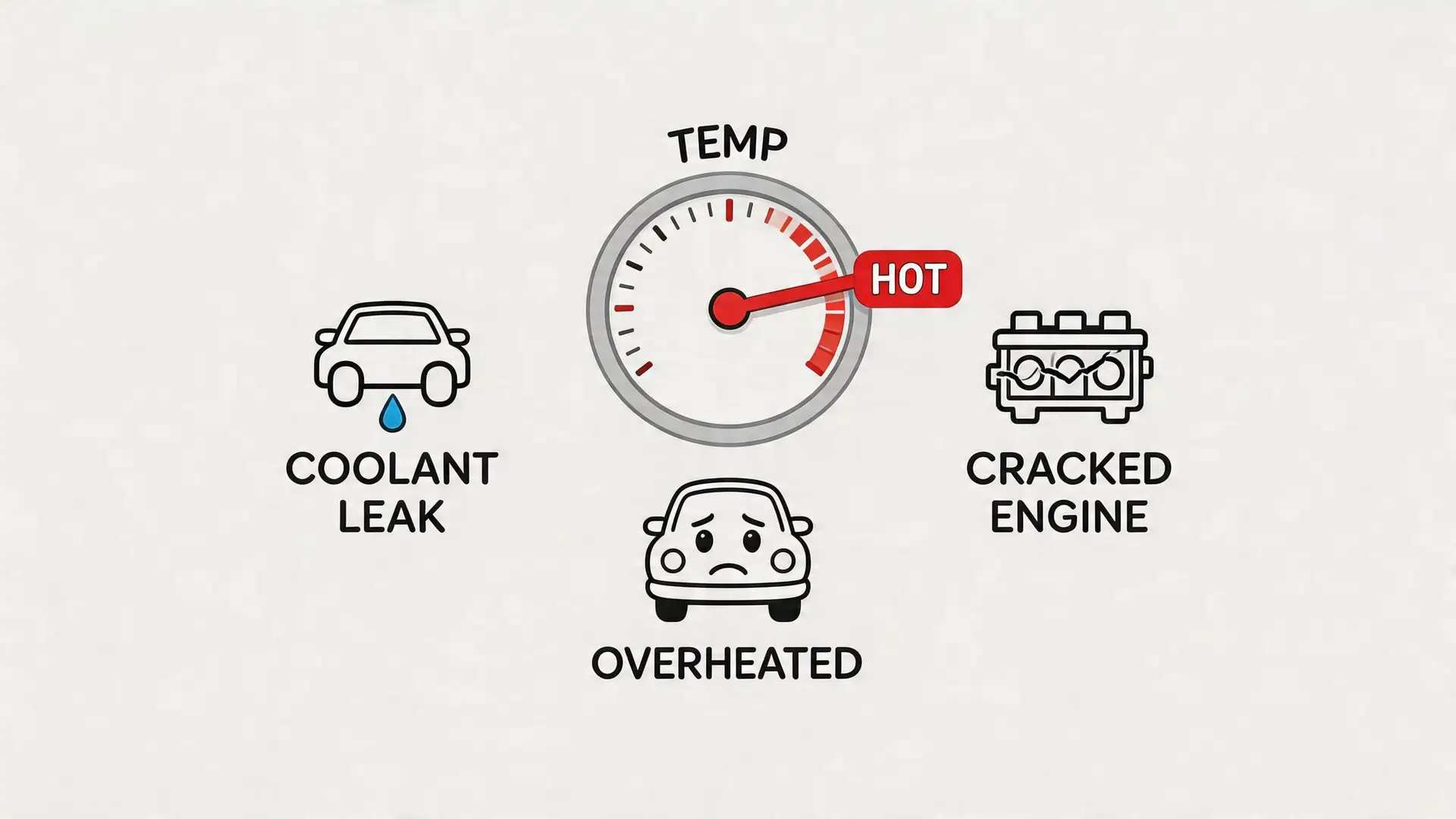
If the temperature gauge runs hotter than normal, climbs while idling, or swings up and down, pay attention. Those patterns can point to low coolant, a sticking thermostat, trapped air, weak radiator fan performance, or poor circulation.
An overheating warning light deserves the same urgency. By the time that light comes on, the system is already under stress.
The smells and puddles matter
A sweet smell after driving often suggests coolant is leaking and burning off on a hot engine surface. A puddle under the vehicle can be another clue, though leaks don’t always hit the ground where you expect. Coolant may drip from one spot and travel along a splash shield or crossmember before it falls.
Look for:
- Sweet odor after shutdown that wasn’t there before
- Bright or stained residue around hose connections, the radiator, or the reservoir
- Recurring low level in the reservoir even when you haven’t seen a visible puddle
- Steam from under the hood, especially in traffic or after parking
A radiator problem is one common cause. If you want to understand the usual failure points, this article on what causes radiator leaks gives a practical breakdown.
Some symptoms point to specific parts
Different signs often suggest different faults.
| Symptom | Common possibility |
|---|---|
| Hot at idle, better on highway | Fan issue or airflow problem |
| Runs hot quickly after startup | Thermostat may be stuck |
| Coolant level keeps dropping | External leak or slow internal loss |
| No cabin heat and temperature issues | Low coolant or air in system |
| Steam or visible boil-over | Pressure loss or major overheating event |
Don’t wait for visible steam. A cooling system can be in trouble long before you see smoke or vapor.
A short visual can help if you’re trying to recognize these signs:
What drivers often misunderstand
One of the biggest mistakes is topping off coolant again and again without asking why it’s low. Coolant doesn’t get “used up” like fuel. If the level keeps dropping, something is changing in the system.
Another common mistake is assuming the engine is safe because it cools back down later. Some faults show up only under certain conditions, like long idling, heavy A/C load, or climbing grades. That intermittent pattern is still a warning.
When you catch the issue early, the repair may be a hose, cap, or thermostat. When you ignore it, the same problem can end with a much larger engine repair.
Performing a Safe Coolant Check and When to Get a Flush
A basic coolant check is one of the few under-hood inspections most drivers can do safely at home, but only if the engine is cold. That point matters.
Never open a hot radiator cap. Hot coolant is under pressure and can cause serious burns.
How to check coolant safely
Start in the morning or wait until the vehicle has fully cooled down.
Then follow these steps:
- Park on level ground so the reservoir reading is accurate.
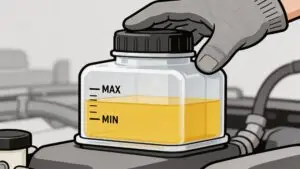
- Find the overflow reservoir. It’s usually a translucent plastic tank with level marks.
- Check the level against the markings. Most tanks show a low and full range for a cold engine.
- Look at the condition of the fluid. Healthy coolant usually looks clean and consistent. Dirty, rusty, oily, or sludgy coolant needs professional attention.
- Check around hoses and fittings for dried residue, stains, swelling, or damp spots.
If the level is a little low and you’re in a genuine emergency, adding distilled water may help you reach a repair facility. But that should be temporary, not your long-term fix.
Safety note: If you’re adding anything to the system, use only what your vehicle manufacturer allows and get the mixture corrected as soon as possible.
What the different services actually mean
Drivers often hear three terms that sound interchangeable, but they’re not.
- Top-off means adding fluid to bring the level back up. This is only helpful when the chemistry is still correct and the reason for low level has been addressed.
- Drain and fill removes some old coolant and replaces it with fresh coolant. It’s better than a top-off but doesn’t clean the entire system.
- Flush is a more complete service that removes old coolant and contaminants from the system before refilling with the proper formula.
For aging vehicles or vehicles with neglected maintenance, a full flush can be the smarter move because old coolant can leave behind corrosion and deposits.
When a flush makes sense
Service timing depends on the coolant type and the manufacturer’s recommendation. Some coolants last longer than older formulas, but “long-life” doesn’t mean “forever.”
The issue has gotten more important as formulations have changed. A 2025 trend noted by oil-testing.com is the shift toward Nitrite-Free OAT coolants for modern aluminum engines, and mixing them with older types can dilute inhibitors, causing corrosion and water pump failure. That’s one reason professional, OEM-specific service matters more than it used to.
For practical maintenance, these situations usually justify a closer look:
- The coolant looks contaminated
- You’ve had repeated low-level warnings
- The vehicle is older or high mileage
- You don’t know what type is currently in the system
- A repair opened the cooling system
- You’re preparing the car for seasonal stress
Even in North Texas, seasonal prep still matters. If you like doing preventive maintenance before temperature swings hit, this guide on how to winterize your vehicle includes a useful broader checklist that pairs well with cooling system service.
Air pockets are another hidden problem
After cooling system repairs or low-coolant events, trapped air can create hot spots and erratic temperature behavior. That’s why refilling fluid alone isn’t always enough. The system may need to be bled properly so coolant can circulate the way it should.
If you want to understand that part better, Kwik Kar has a practical article on how to bleed air from a cooling system.
When to hand it to a technician
A home check is good for spotting obvious issues. It’s not enough for diagnosing hidden leaks, pressure loss, fan problems, internal contamination, or the wrong chemistry in the system.
One option for drivers in Richardson is Kwik Kar Oil Change and Auto Care, where fluid service, cooling system inspection, and coolant maintenance can be paired with routine visits so problems get caught early instead of after an overheat event.
The Hidden Dangers of Coolant Neglect
A lot of Richardson drivers only worry about coolant when the temperature gauge starts climbing on US-75 or while idling through a long red light on Belt Line. By that point, the problem may already be doing more than heating up the engine.
Fire risk is more real than many drivers realize
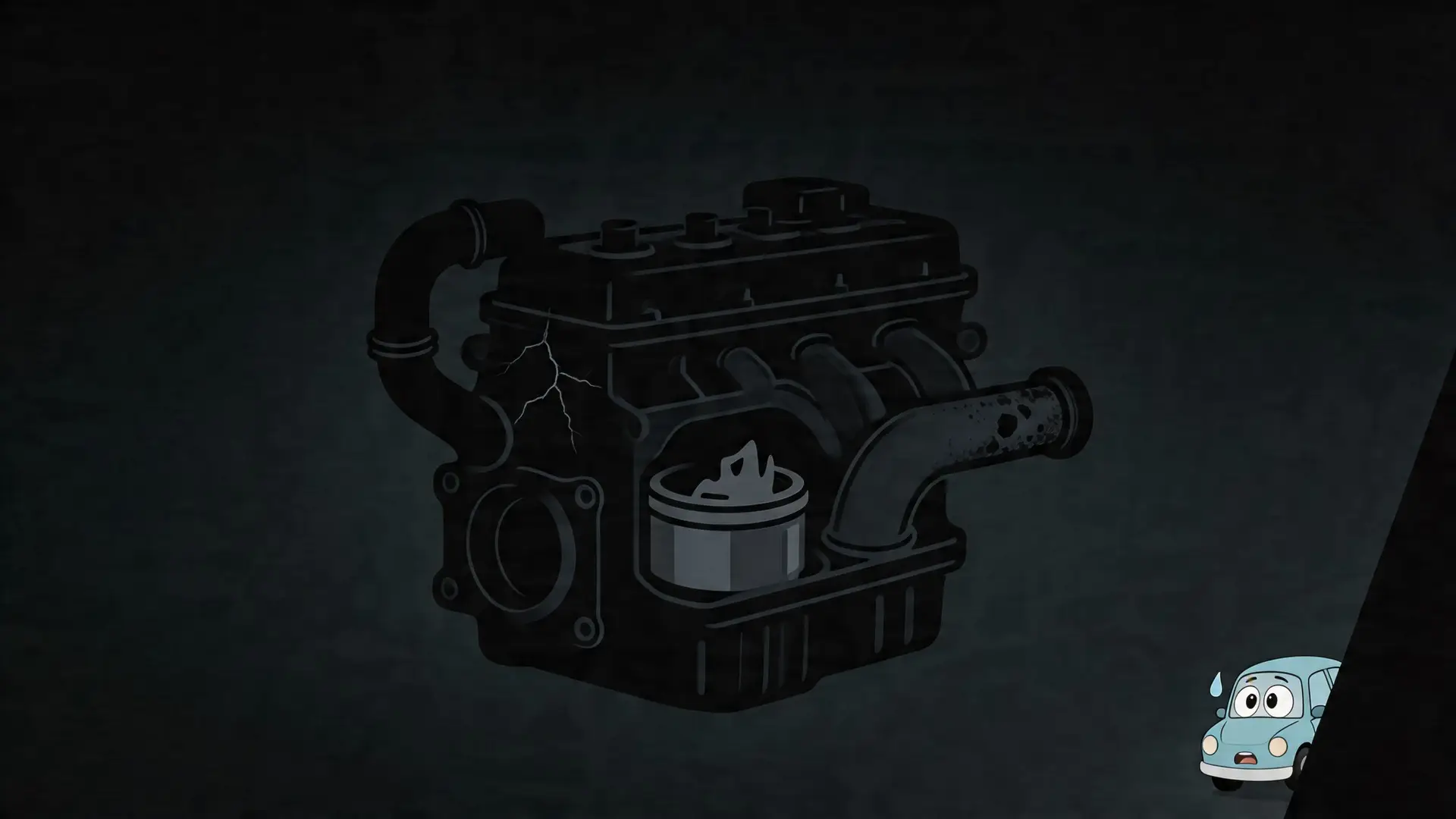
Coolant leaks can create a safety hazard under the hood, especially in Texas heat. If leaking coolant reaches very hot engine parts, it can ignite instead of dripping away.
The GMB coolant safety overview states that coolant can auto-ignite on hot engine surfaces, and also notes that even a small amount can be deadly to a child and harmful to pets. That matters for commuters in stop-and-go traffic, drivers of older vehicles with aging hoses, and families who park in a garage or driveway where leaks may go unnoticed at first.
Toxicity is a family and pet safety issue
Many coolants contain ethylene glycol, which has a sweet smell and taste that can attract children and animals. A tiny puddle on the garage floor can turn into a serious poisoning risk fast.
If you see green, orange, pink, or yellow fluid under the car, do not assume it is harmless water from the A/C. Wipe it up carefully, keep pets away from the area, and store any coolant container tightly sealed and out of reach.
A coolant leak can threaten your engine, your safety, and the people or pets around your home.
Why small leaks deserve quick action
Small leaks fool people because the car may still seem to run fine for days or weeks. But the cooling system works like a closed loop under pressure. Once that pressure starts slipping, coolant can boil sooner, circulation can get weaker, and hot spots can develop inside the engine.
That is one reason minor seepage around a hose clamp, radiator seam, or water pump should not be brushed off. In Richardson traffic, where cars spend plenty of time idling in high heat, a slow leak has more chances to turn into an overheat, a roadside breakdown, or engine damage that costs far more than early repair.
A professional pressure test helps find those quiet problems before they grow. For local drivers, that kind of inspection at Kwik Kar can be a practical way to catch a leak while it is still a maintenance job instead of a major repair.
Richardson Driver FAQs About Engine Coolant
Is it okay to mix different colors of coolant
Usually, no. Color is not a dependable guide to chemistry anymore. Two coolants that look similar can use different additive packages, and mixing them can reduce protection or create compatibility problems. Follow the vehicle manufacturer’s specification, not the dye color.
Can I use water in an emergency
Sometimes, yes, but only as a temporary step to get somewhere safe. Distilled water is the better choice if that’s your only option. Then have the system checked and refilled with the correct coolant mix as soon as possible.
Why is my coolant low if I don’t see a leak
The leak may be small, intermittent, or hard to spot. Coolant can seep from a hose connection, radiator seam, water pump area, or cap and evaporate on hot parts before it leaves a puddle. Air trapped after previous service can also affect the level in the reservoir.
How often should coolant be checked
A quick visual check during routine maintenance is smart. Many drivers have the level inspected at each oil change because it’s easy to do regularly and problems are more likely to be caught early.
Is old coolant really a problem if the car isn’t overheating
Yes. Coolant can lose corrosion protection before it causes an immediate overheating symptom. That means the system may be wearing internally even if the gauge still looks normal.
What’s the safest response if my car starts overheating
Turn off the A/C, move to a safe place, shut the engine down if needed, and let it cool. Do not remove the radiator cap while it’s hot. If steam is coming out or the temperature climbs rapidly, treat it as a serious problem and arrange for inspection rather than trying to drive farther.
If your temperature gauge has been creeping up, your coolant level keeps dropping, or you just want a cooling system checked before Texas heat pushes it too far, Kwik Kar Oil Change and Auto Care offers routine maintenance, diagnostics, and cooling system service for Richardson drivers who want to catch problems early and stay safer on the road.