When we talk about “dirty” brake fluid, it’s not dirty in the same way your engine oil gets grimy with soot and sludge. Instead, it becomes contaminated—and the main culprit is moisture absorbed straight from the air. This water contamination silently lowers your brake fluid's boiling point, creating a serious risk of brake failure that can affect any car, truck, or SUV.
Your Brakes' Silent Enemy
Think of your car's brake system as its circulatory system. In this critical network, brake fluid is the lifeblood, transferring the force from your foot on the pedal directly to the brakes to bring you to a stop. This hydraulic system depends entirely on a fluid that cannot be compressed. But what happens when that lifeblood is compromised?
The Myth of "Dirty" Fluid
Unlike motor oil that gets dark from heat and carbon, brake fluid’s biggest enemy is invisible: water. Brake fluid is naturally hygroscopic, which is just a technical way of saying it’s designed to absorb moisture. Over time, it pulls tiny water molecules from the atmosphere through microscopic pores in your brake lines, hoses, and seals. This happens slowly and steadily, whether you drive your car every day or it sits in the garage for weeks.
What starts as a clean, clear, or light amber-colored liquid gradually darkens as it becomes contaminated. This isn’t just a cosmetic issue—it’s a chemical change that systematically degrades your vehicle's single most important safety feature.
As water mixes with the fluid, its core properties change. The most critical one is its boiling point. Fresh brake fluid has a very high boiling point to handle the intense heat your brakes generate. But once water gets in, that boiling point plummets. If the fluid boils under hard braking, it creates vapor bubbles in the brake lines. Vapor, unlike liquid, is easily compressed. The terrifying result? Your brake pedal feels spongy or goes straight to the floor, and the car doesn't stop.
To give you a clearer picture, here’s how clean and contaminated brake fluids stack up.
Clean vs. Contaminated Brake Fluid At a Glance
This table breaks down the essential differences between fresh brake fluid and fluid that has been compromised by moisture and age.
| Characteristic | New, Clean Brake Fluid | Old, Contaminated Brake Fluid |
|---|---|---|
| Appearance | Typically clear or light amber | Dark, cloudy, or murky brown |
| Boiling Point | High (e.g., 401°F+ for DOT 3) | Dangerously low (can drop below 284°F) |
| Water Content | <1% | Often 3% or more |
| Performance | Firm, responsive pedal feel | Spongy pedal, potential for brake fade or failure |
| Corrosion Risk | Low; contains corrosion inhibitors | High; moisture promotes rust inside lines & calipers |
| Safety | Optimal; provides reliable stopping power | Compromised; high risk under heavy braking |
As you can see, the change is more than just color. Contaminated fluid puts your entire braking system, and your safety, at risk.
Why It Affects Every Driver
This isn't a problem reserved for high-performance cars or old beaters; it affects every single vehicle on the road. Whether you're navigating the daily commute in Richardson, running errands with the family, or heading out on a long Texas road trip, the integrity of your brake fluid is non-negotiable. A single moment of brake fade during a sudden stop can be the difference between a close call and a serious accident.
It's also vital to use the right type of fluid for your car, as different vehicles have different requirements. You can learn all about the various specifications in our guide on brake fluid DOT ratings.
The Invisible Threat How Moisture Ruins Brake Fluid
Your brake fluid's most important job is to be incompressible, but its very chemistry has a built-in weakness. The entire problem boils down to a single word: hygroscopic. In simple terms, this means brake fluid is designed to absorb water straight from the air.
Think of it like a new sponge sitting on a bathroom counter. Even if you never get it wet, it will slowly pull moisture out of the humid air and become damp. Your brake fluid does the exact same thing, constantly drawing in water vapor through microscopic pores in the rubber hoses and seals of your brake system.
This process is slow, quiet, and completely unavoidable. It happens whether your car is tackling daily traffic on Richardson highways or just sitting in the garage for weeks at a time.
From Absorption to Danger
So, why is a little water such a big deal? That absorbed moisture doesn't just dilute the brake fluid; it completely changes how it behaves under pressure. The most critical problem is a massive drop in the fluid's boiling point.
Under normal driving conditions, hitting your brakes generates a huge amount of heat. Fresh, clean brake fluid is made to handle these extreme temperatures without boiling. But once water gets into the system, it creates a dangerous weak link that can lead to total brake failure.
This hygroscopic nature is a silent threat most drivers never think about. Unlike your engine oil, brake fluid gets worse all on its own, absorbing around 2% of moisture from the atmosphere every year, no matter how much you drive. With just 3% moisture content, a standard DOT 3 fluid can lose a staggering 25% of its boiling point.
The image below shows just how dramatic the difference is between clean and contaminated fluid.
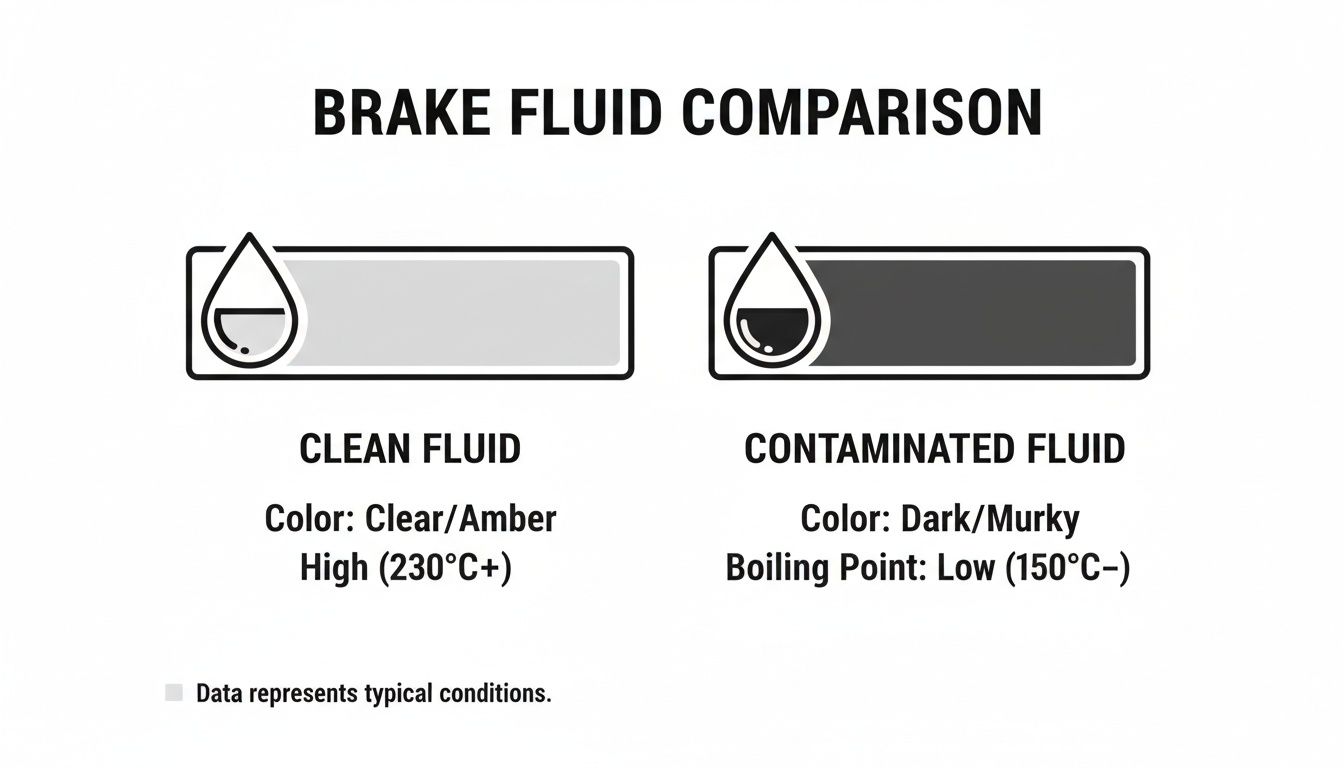
This side-by-side comparison makes the visual decay obvious and highlights the drop in boiling point that directly puts your safety at risk.
The Real-World Risk of a Low Boiling Point
Picture this: you're driving down the road and suddenly have to slam on your brakes to avoid an obstacle. The intense heat created by that hard stop can cause the water in your brake fluid to boil, creating pockets of vapor inside the brake lines.
Vapor, unlike liquid, is highly compressible. When you press the brake pedal, you're no longer applying firm hydraulic pressure to the brakes—you're just squeezing air bubbles. This results in a "spongy" pedal that sinks to the floor, and your car fails to stop effectively.
This scary event, known as brake fade, is the real danger of driving with old, dirty brake fluid. It turns your most important safety system into an unpredictable liability. Once you understand this, it's easy to see why staying on top of your brake fluid service is so important.
To get a better idea of the right service schedule for your vehicle, you can learn more about how often a brake fluid flush is needed in our article.
Warning Signs Your Car Needs a Brake Fluid Flush
Long before a warning light ever flashes on your dashboard, your car has its own ways of telling you something is wrong. When it comes to dirty brake fluid, the clues are often subtle changes you can feel, see, and even hear. Learning to spot these early signs is the key to preventing a serious brake failure.
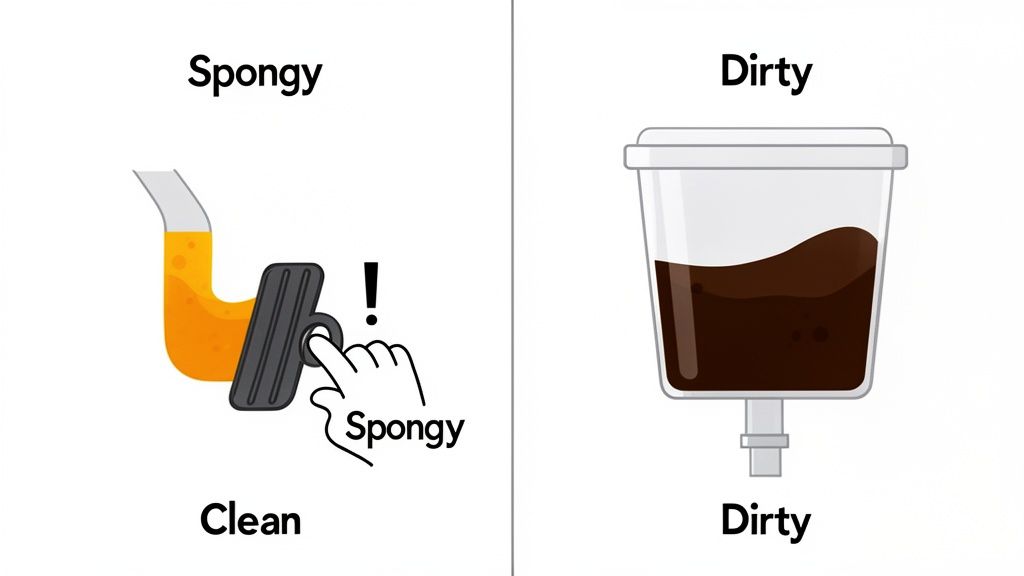
The most common and frankly, most unnerving, sign is a change in how your brake pedal feels underfoot. If you notice it’s become spongy, soft, or sinks further to the floor than it used to, that’s a major red flag. This mushy feeling means air and moisture have worked their way into the brake lines, compromising the fluid's ability to do its job and putting your stopping power at risk.
Visual and Auditory Clues
Beyond the feel of the pedal, a quick look under the hood can tell you a lot. Go ahead and find the brake fluid reservoir. Fresh, healthy brake fluid should be nearly clear, with a slight yellow or amber tint.
If the fluid in your reservoir looks dark, murky, or brown like old coffee, it has become contaminated. This color change is a clear sign that moisture and other particles have degraded the fluid, and a professional inspection is needed immediately.
You should also pay attention to any new sounds when you brake. While strange noises often point to worn-out brake pads or rotors, they can also signal a problem that’s being made worse by old fluid. Grinding or squealing sounds, especially if they come with a soft pedal, should never be ignored. Be on the lookout for these other signs, too:
- Brake Warning Light: It might seem obvious, but a dashboard brake light is an urgent signal. It’s often triggered by a low fluid level, which could mean you have a leak or your brake pads are severely worn down.
- Increased Stopping Distance: Does it feel like your car is taking longer and longer to come to a full stop? That gradual loss of performance is a classic symptom of contaminated fluid that can no longer transfer hydraulic force effectively.
Now, if you're feeling the opposite—a pedal that’s stiff or hard to press—other parts of your brake system might be the culprit. To explore that specific problem, you can learn more about what causes a hard brake pedal in our detailed guide. Ignoring any of these warning signs is a gamble you don’t want to take. It's always the safest bet to get a professional opinion whenever you notice a change in your braking.
More Than Just Moisture: Other Dangers Lurking in Your Brake Lines
While moisture is definitely public enemy number one for your brake fluid, it’s not the only threat hiding in your brake lines. Other types of contamination can be just as destructive—if not more so—to your car’s stopping power and the sensitive components that make up the system.
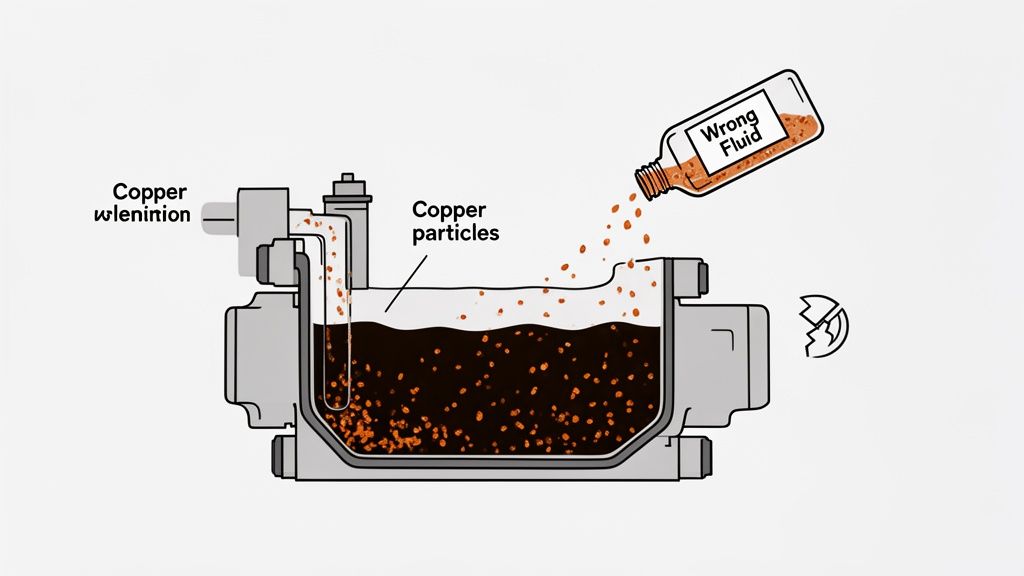
One of the worst-case scenarios is cross-contamination from incompatible fluids. Just imagine someone accidentally topping off the brake reservoir with power steering fluid or even windshield washer fluid. This isn’t a small mistake; it's a catastrophic problem for your entire brake system.
These other fluids are petroleum-based, which creates a nasty chemical reaction with the glycol-based chemistry of your brake fluid. The immediate result is an assault on the rubber seals and hoses throughout the system. Those seals will swell, go soft, and eventually fall apart, leading to major internal leaks and a sudden, total loss of hydraulic pressure.
The Threat of Internal Corrosion
Another hidden danger comes from inside the brake system itself, especially on older cars or those with a lot of miles on the clock. Your brake fluid comes fortified with a cocktail of anti-corrosion additives meant to protect the metal parts of your brake lines, calipers, and master cylinder. But over time, these important additives simply wear out.
Once those inhibitors are gone, the mix of moisture and heat starts to eat away at the metal components from the inside. This corrosion releases microscopic copper particles right into your brake fluid. It's a big reason why dirty brake fluid often looks so dark and murky.
The presence of copper in your brake fluid is more than just a sign of age—it's a direct indicator that your brake fluid's protective additives have failed. Your brake system is now actively corroding itself from within, putting critical components at risk.
This internal decay is a progressive problem. Contamination from the wrong fluid, for example, is one of the most severe failures we see in automotive brake systems. In one documented case, an investigation found that power steering fluid added by a previous owner caused a vehicle's brake seals to fail completely. It just goes to show that contamination isn't always a slow burn; sometimes, it's one mistake with devastating results. You can learn more about the dangers of brake fluid contamination at Steve's Auto Care.
Copper Content as a Critical Warning
As professionals, we actually use the level of copper particles as a precise way to measure the fluid’s health. The amount of dissolved copper is measured in parts per million (PPM), and while a tiny amount is expected over time, there’s a very clear safety limit.
Technicians follow a simple rule of thumb:
- Below 200 PPM: The fluid's corrosion inhibitors are still doing their job.
- At or Above 200 PPM: The fluid is considered highly corrosive. It needs to be flushed immediately to stop further damage to expensive parts like the ABS module.
For anyone driving a vehicle with more miles on the odometer, this kind of internal contamination is a major concern. It’s also why a quick look at the fluid’s color isn’t always enough to tell you what’s really going on inside your brake lines.
How Professionals Test for Dirty Brake Fluid
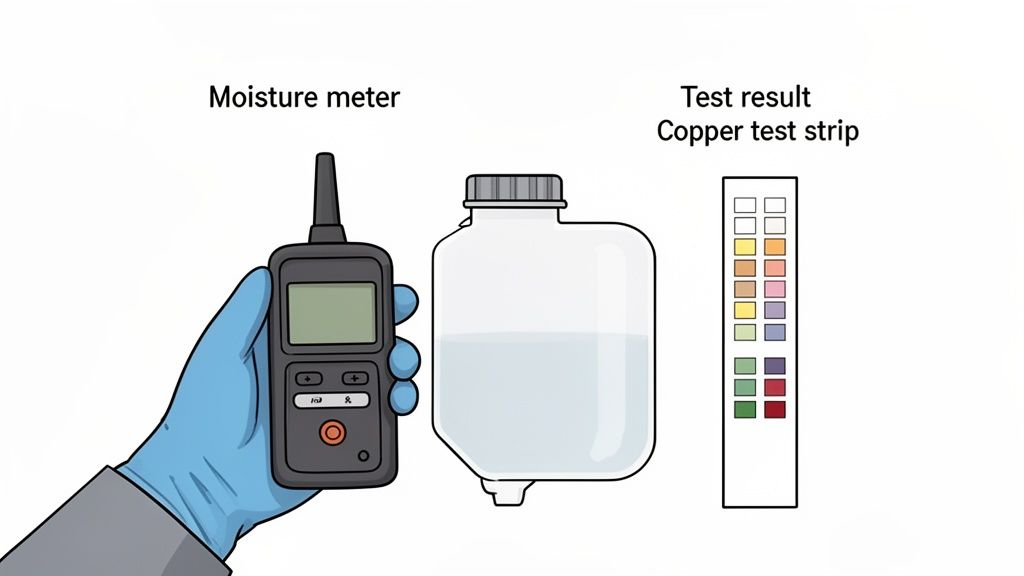
While you might be able to spot obviously dirty brake fluid just by its dark, murky color, a visual check only scratches the surface. To truly know what’s going on inside your brake lines, certified technicians rely on specialized tools for precise, scientific measurements. This approach takes all the guesswork out of it, ensuring your safety is based on hard data, not just appearances.
One of the most critical tools in a pro’s toolbox is an electronic moisture tester. Think of it like a digital thermometer, but for water content. A technician simply dips the probe into your brake fluid reservoir, and in seconds, the device gives an exact percentage of water contamination. This instantly tells us if the fluid's boiling point has dropped into a dangerous range.
Beyond Water Content Testing
But moisture isn’t the only enemy. To get the full picture, technicians also need to check for internal corrosion by measuring the copper levels in the fluid. For this, we use simple but highly effective chemical test strips.
A technician dips a test strip into the brake fluid, and it changes color depending on how much dissolved copper is present. This reading, measured in parts per million (PPM), is a direct signal that the fluid's anti-corrosion additives are used up and the system is starting to rust from the inside out.
Using these two tests together—one for moisture and one for copper—gives a complete and accurate diagnosis of your brake fluid’s health.
Interpreting the Professional Test Results
When a technician runs these tests, they’re looking for specific numbers that signal it’s time for a brake fluid flush. The results are clear and definitive, leaving no doubt about what your brake system needs to stay safe.
- Moisture Content: If the electronic tester shows water content at 3% or more, the fluid’s boiling point has been seriously compromised. At this point, a full brake fluid flush is strongly recommended to restore safe stopping power and prevent brake fade.
- Copper Levels: A test strip showing copper levels at or above 200 parts per million (PPM) is a major red flag. This means the fluid can no longer protect your brake lines and expensive parts like the ABS module from corrosion.
By combining these advanced diagnostic methods, professional technicians can confidently determine the exact condition of your brake fluid. This scientific approach ensures that your braking system gets the precise service it needs, when it needs it, keeping you safe on the road.
Your Vehicle's Brake Fluid Service Schedule
Here’s something a lot of drivers don’t realize: your brake fluid service schedule isn't like an oil change. It’s less about how many miles you’ve driven and more about how much time has passed. The biggest enemy of your brake fluid is moisture, which it naturally absorbs over time. This makes its maintenance schedule follow the calendar, giving you a predictable way to stay ahead of problems.
As a general rule, most carmakers recommend a full brake fluid flush every two to three years or about every 30,000 miles—whichever comes up first. Following this timeline is your best defense against the risks of dirty brake fluid, making sure it's replaced long before it can affect your stopping power. Think of it as a small, routine investment in your safety and your car's long-term health.
Why Service Intervals Vary
That two-to-three-year window is a great starting point, but it's not set in stone. A few key factors can speed up how quickly your brake fluid gets contaminated, which means your car might need service a bit sooner.
- Humid Climates: If you live somewhere with high humidity, like we have here in the Richardson area, there's a lot more moisture in the air. Your brake system will naturally absorb that moisture, shortening your fluid's effective lifespan.
- Driving Habits: Are you someone who brakes hard often, tows heavy loads, or drives through hilly country? All that activity creates extra heat, which puts more stress on the fluid and causes it to break down faster.
- Vehicle Age: On older cars, the seals and hoses in the brake system can become a bit more porous over time. This can create tiny openings for moisture to sneak in more easily.
Brake fluid absorbs moisture at a surprisingly consistent rate—about 2% per year, according to research. At that pace, it can reach a critical point of saturation in as little as 18 months. If you want to dive deeper into the science behind these brake fluid service intervals, check out this detailed explanation on NAXJA.org.
The main goal is to get the old fluid out before its boiling point drops to a dangerous level. Sticking to a time-based schedule is the most reliable way to make sure your brakes are always ready to perform exactly when you need them.
To keep your braking consistent and avoid issues from dirty brake fluid, it's a good idea to understand how often you need a brake fluid flush for your specific car and driving style. If you’re ever in doubt, a quick, professional test can give you a clear and definitive answer.
Frequently Asked Questions About Dirty Brake Fluid
It's natural to have questions about car maintenance, especially when it involves something as critical as your brakes. Getting clear, straightforward answers is key to staying safe. Here are a few of the most common questions we hear from drivers about dirty brake fluid and how to handle it.
Can I Just Top Off My Brake Fluid?
While it might seem like an easy fix for a low reservoir, just topping off your brake fluid is a bad idea. Think of it like pouring a cup of clean water into a murky, stagnant puddle—it doesn't fix the underlying contamination.
The only real solution is a complete brake fluid flush. This is the only way to get all the moisture, bits of copper, and other grime out of the system. A full flush replaces every drop of the old, compromised fluid, bringing your brake performance and safety back to where they should be. Topping off might make the pedal feel a little better for a short time, but it leaves all those dangerous contaminants circulating in your brake lines.
Topping off brake fluid is a temporary band-aid, not a long-term solution. A complete flush is essential for removing harmful moisture and contaminants that degrade braking performance and cause internal corrosion.
Is Dark Brake Fluid Always a Bad Sign?
In almost all cases, yes. Brand-new brake fluid is a clear or light amber color. Over time, as it soaks up moisture from the air and starts to break down chemically, it turns a dark brown or even black. That color change is your most reliable clue that the fluid is old and full of contaminants.
If you pop the hood and see fluid in the reservoir that looks like old coffee, take it as a clear sign. It’s definitely time to have a professional take a look and, more than likely, perform a full flush.
What Happens If I Use the Wrong Type of Fluid?
Using the wrong type of brake fluid is one of the most destructive mistakes you can make for your braking system. Pouring DOT 4 fluid into a system designed for DOT 3, or even worse, accidentally adding something like power steering fluid, can be a complete disaster.
Different fluids have completely different chemical properties. Mixing them can lead to:
- Seal Damage: The wrong fluid can make the rubber seals in your master cylinder and calipers swell up, get brittle, and fail entirely.
- System Failure: Once those seals degrade, you’re looking at internal leaks and a sudden, total loss of hydraulic pressure. The result is complete brake failure.
Always double-check your owner’s manual or talk to a technician to make sure you’re using the exact fluid your vehicle needs.
How Much Does a Brake Fluid Flush Cost?
A professional brake fluid flush is one of the more affordable preventative maintenance services out there, though the exact cost depends on your vehicle and location. It's a very small price to pay for making sure your car's most important safety feature is working perfectly.
At Kwik Kar Oil Change and Auto Care, our ASE-certified technicians can test your brake fluid and perform a complete flush to keep you safe on the road. Schedule your appointment online today!