Engine Misfire Causes: What They Are and How to Find Them
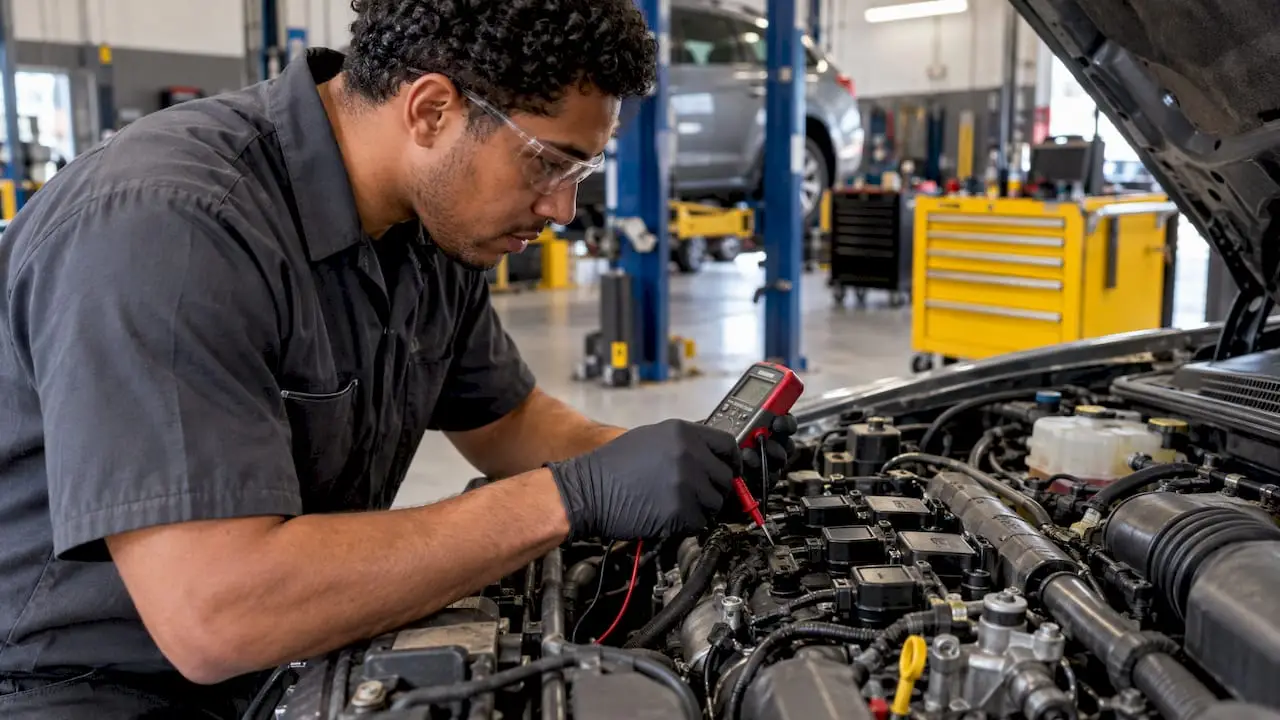
An engine misfire happens when one or more cylinders fail to burn their air-fuel mixture properly. The cause is almost always a loss of spark, a wrong air-fuel mixture, or a loss of cylinder compression, according to AA1Car’s misfire diagnosis guide. In practice that means worn spark plugs, a weak ignition coil, a clogged fuel injector, a vacuum leak, or, less often, internal engine wear. Here is how to tell which one you are dealing with, and when to stop driving.
TL;DR
- Most misfires trace back to three things: ignition (plugs, coils, wires), fuel delivery (injectors, pressure), or air and compression (vacuum leaks, worn internals).
- A steady check engine light means get the car checked soon. A flashing light means a severe misfire: reduce speed and get service as soon as possible.
- Where and when it misfires is a clue: at idle often points to a vacuum leak, under load often points to ignition or fuel supply.
- A scan tool gives you a code such as P0300 or P0301, but the code names the cylinder or the symptom, not the failed part.
- If your car is misfiring in Richardson, Plano, Garland or Addison, call Kwik Kar Richardson at (972) 644-1851.
Table of Contents
- What an engine misfire actually is
- Misfire symptoms to recognize
- The main causes of an engine misfire
- What the timing of the misfire tells you
- How technicians diagnose a misfire
- Is it safe to drive with a misfire?
- Misfires, emissions and Texas inspections
- Our perspective: diagnose first, then repair
- Misfire diagnosis and repair at Kwik Kar Richardson
- How to reduce the odds of a misfire
- FAQ
- Get your misfire checked in Richardson
- Sources
What an engine misfire actually is
A gasoline engine needs three things in each cylinder at the right moment: a measured amount of fuel and air, enough compression to squeeze that mixture, and a spark to light it. Remove any one and the cylinder fails to fire cleanly. The engine stumbles, the crankshaft speeds up and slows down unevenly, and you feel it as a shake or a hesitation.
The engine computer watches for this. According to the EPA, onboard diagnostics can detect misfire-related problems before a driver notices a loss of performance, and the Check Engine light and stored trouble codes act as the early warning. That is why a car can set a code before it feels wrong at all.
Misfire symptoms to recognize
The signs vary with how many cylinders are affected and how often. Common ones, as listed by The AA, include:
- A rough idle
- Sluggish acceleration
- Unexpected stalling
- A lit engine light
- Unusual exhaust smoke
Chase’s maintenance guide adds shaking or jerking, a sudden loss of power during acceleration, poorer fuel economy, and popping or spitting sounds.
Some misfires are brief. The engine may stumble, lose RPM, and then recover, and it may recur randomly or only under certain conditions. That pattern is the hardest to chase, which is covered below.
The main causes of an engine misfire
The list below runs from the most common and least expensive to the least common and most involved. Each category has its own feel, which helps narrow the search.
Ignition system faults
Ignition problems are the usual suspects. Capital One’s overview names worn spark plugs, damaged plug wires, failing ignition coils and sensor errors as common triggers.
- Spark plugs. The electrodes wear down over time, the gap widens, and the spark gets weaker. Plug life depends heavily on plug type and the engine, so follow the interval in your owner’s manual. Our guide to bad spark plug symptoms shows what to watch for.
- Ignition coils. A coil turns battery voltage into the spark. When one weakens, its cylinder misfires, often worse when the engine is hot or under load. See bad ignition coil symptoms and tests.
- Plug wires and boots. On engines that use them, cracked insulation lets voltage leak away before it reaches the plug.
Fuel delivery problems
If a cylinder gets too little fuel, the mixture runs lean and fails to ignite reliably. AA1Car lists clogged injectors, low fuel pressure and fuel delivery failures as typical lean-condition causes.
- Clogged or sticking injectors. Deposits restrict the spray pattern. Our walkthrough on testing fuel injectors explains the basics.
- Restricted fuel filter or weak pump. Pressure drops under heavy demand, so the engine hesitates when you accelerate or climb. Read the signs of a clogged fuel filter.
Air and sensor problems
Unmetered air entering the engine leans out the mixture. Cracked vacuum hoses, a leaking intake manifold gasket and a faulty mass airflow sensor are the usual culprits. Oxygen sensors can also feed bad data into fuel trim, as covered in our piece on bad O2 sensor symptoms.
Mechanical and compression problems
This is the least common group but the most serious. Any fault that reduces piston or valve sealing can cause a misfire. MotorTrend points to worn piston rings, burned valves, leaking head gaskets and valvetrain failures. These misfires do not go away when you replace plugs or coils, and they usually need a compression test to confirm.
What the timing of the misfire tells you
When and how the engine stumbles is one of the best clues a technician gets from you. These are patterns, not verdicts.
| When it happens | Likely direction | Why |
|---|---|---|
| Only at idle, clears at higher RPM | Vacuum leak or intake problem | Manifold vacuum is highest at idle, so a leak has the biggest effect there |
| Under load or climbing a hill | Weak coil, worn plug, low fuel pressure | Demand for spark energy and fuel peaks |
| Only when cold, then smooths out | Fuel or sensor issue, sometimes a sticking injector | Mixture control is different before warm-up |
| Random cylinders, changes day to day | Fuel supply, vacuum leak, or a sensor problem | Not tied to one component |
| One cylinder, every time | Plug, coil, injector or compression in that cylinder | The fault is local |
Misfire at idle
A misfire that shows only at idle and settles as RPM rises suggests a vacuum leak, according to OBD2Scout’s diagnostic guide, because the leak’s effect is more pronounced where manifold vacuum is highest. A hissing sound under the hood is a hint, though many leaks make no sound you can hear.
Misfire under load
When the engine asks for more, weak parts show up. A coil that works fine at a stoplight can break down when cylinder pressure rises during hard acceleration, such as merging onto US-75 or the George Bush Turnpike. A fuel pump or filter that cannot keep up produces a similar stumble. Because the same symptom can come from either side, the cylinder and code details matter.
Random misfires and P0300
Code P0300 means the computer detected misfires that are not confined to one cylinder. It is a symptom code, not a part. Common sources are fuel supply, vacuum leaks, a failing sensor, or several worn components at once. Codes P0301, P0302 and so on point to a specific cylinder, which makes the search faster.
Intermittent misfires are particularly hard to diagnose because they may only occur under certain loads, temperatures or operating conditions, as noted in the AA1Car guide. Tell your technician when it happens: cold start, highway speed, after a fill-up, in wet weather.
How technicians diagnose a misfire
A good diagnosis finds the cause before parts are replaced. MotorTrend describes the typical toolkit: reading the PCM trouble codes, cylinder-balance tests, swapping suspected coils or injectors between cylinders, and compression testing.
The usual order:
- Scan for codes and freeze-frame data. This shows which cylinder misfired and at what speed, load and temperature.
- Inspect the basics. Plugs, coils, boots, hoses and the air intake.
- Swap to confirm. If a coil moves from cylinder 3 to cylinder 5 and the misfire follows, the coil is the problem.
- Check fuel. Pressure and injector performance.
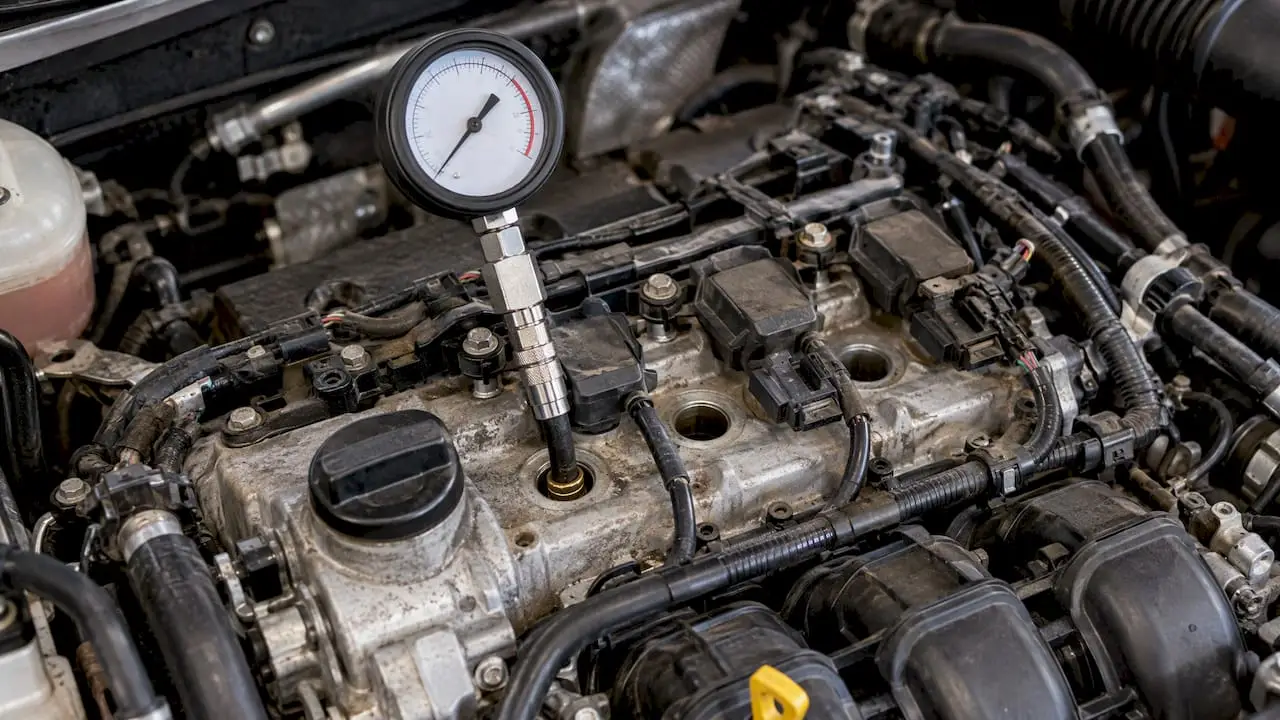
- Test compression if the simple parts check out. On most engines, cranking compression should be 140 to 160 PSI or higher in every cylinder, according to AA1Car. A cylinder well below the others points to a mechanical fault.
Pro tip: Do not clear the code before a shop sees the car. The stored data is the best map of where the problem began.
Is it safe to drive with a misfire?
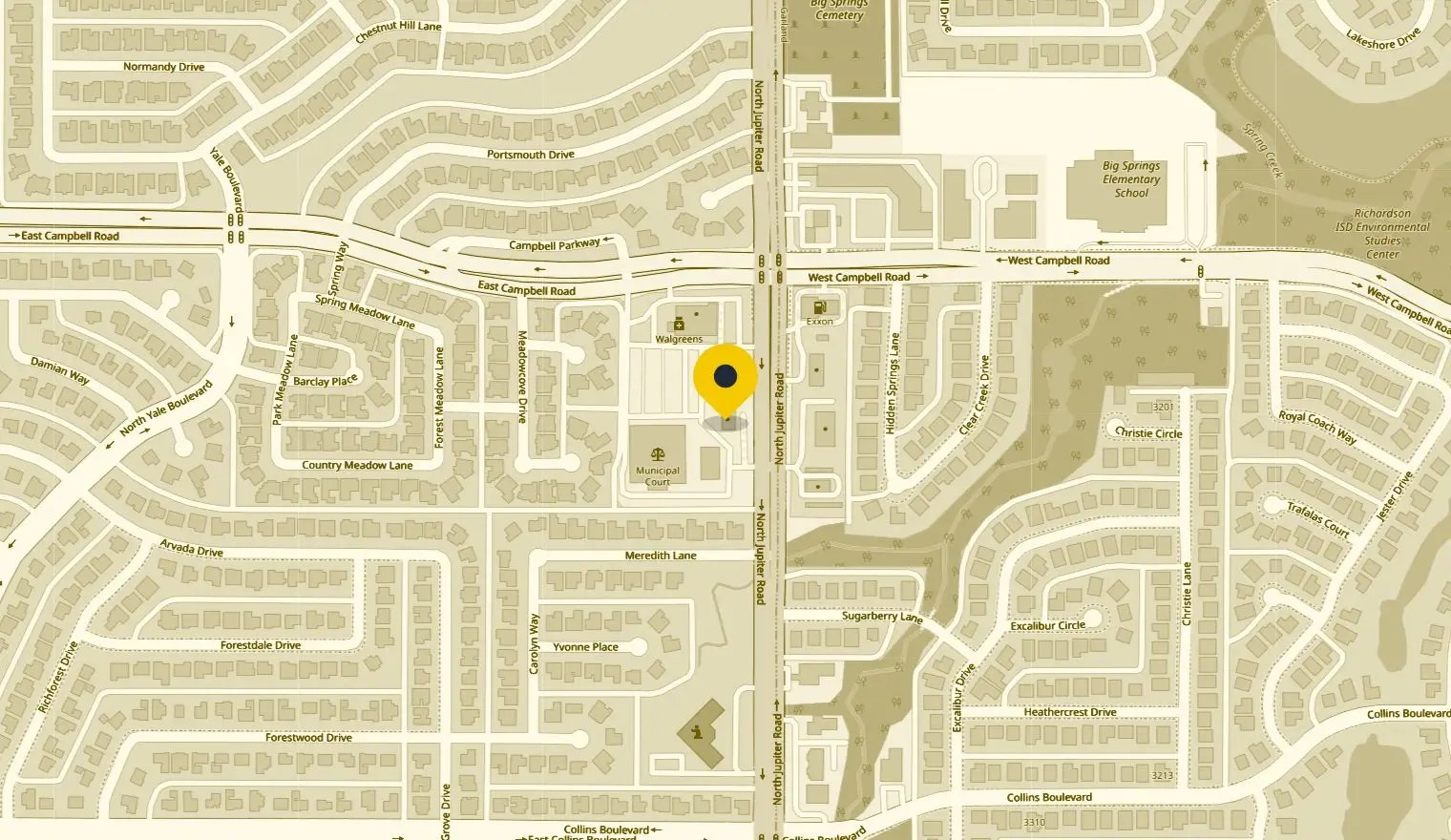
It depends on the light. According to the EPA, a steady Check Engine light means the computer found a problem and service is needed, and it is not normally an instruction to stop immediately. A blinking or flashing light indicates a severe misfire. In that case reduce speed and seek service as soon as possible, because even a short period of severe misfire can seriously damage emissions-control parts, especially the catalytic converter.
The heat is the reason. Unburned fuel reaches the exhaust and burns inside the converter. Manufacturers have documented the risk: a 2018 NHTSA safety recall covering certain Alfa Romeo models describes misfires raising catalytic-converter temperatures enough to threaten nearby wiring and increase the risk of a stall or fire. That is one manufacturer’s recall, not a rule for every car, but it shows why a flashing light deserves prompt attention. Our guide to a flashing check engine light covers what to do in the moment.
If the engine shakes hard, loses power on the road, or the light flashes, pull over when it is safe and arrange a tow or a short, gentle drive to a shop. Not every misfire is an emergency, and a mild, steady-light stumble can usually wait for a scheduled visit, but it should not wait for months.
Misfires, emissions and Texas inspections
Texas ended most non-commercial passenger vehicle safety inspections on January 1, 2025. Emissions testing remains required for qualifying vehicles in applicable counties, and Dallas, Tarrant, Denton, Collin and several other large counties still have emissions requirements. Commercial vehicle safety inspections continue in Texas.
That matters here because an active misfire, or a stored misfire code, can keep a vehicle from passing an emissions test. We explain the connection in why a check engine light fails inspection.
Our perspective: diagnose first, then repair
We see the same pattern often. A driver replaces a part because a forum said so, the misfire returns, and the money is gone. A misfire code points to a cylinder or a symptom. It does not name the failed part.
That is why we start with diagnostics. Our ASE-certified technicians read the codes, look at the data, and confirm the cause before recommending a repair. Our digital vehicle inspections let you see what we see, so the recommendation is clear before you approve anything.
Maintenance is the quiet fix for many misfires. Plugs, filters and fuel-system service done at the manufacturer’s recommended intervals prevent much of what causes a stumble in the first place. Intervals differ by engine and vehicle, so your owner’s manual is the starting point.
Qualifying repairs we perform are backed by our 24-month/24,000-mile limited warranty. Coverage applies to qualifying repairs only, and we will go over what applies to your repair.
Kwik Kar
Misfire diagnosis and repair at Kwik Kar Richardson
If your car is stumbling, shaking or showing a Check Engine light, Kwik Kar Oil Change & Auto Care in Richardson, TX handles check engine light diagnostics, tune-ups, spark plugs and ignition repair, and fuel system and injection service. When the cause turns out to be internal, our engine repair and replacement service is available. We serve drivers across Richardson, Plano, Garland, North Dallas and Addison, and offer discounts for military and first responders. Call (972) 644-1851.
How to reduce the odds of a misfire
You cannot prevent every failure, but a few habits cut the odds:
- Follow the spark plug and fuel filter intervals in your owner’s manual.
- Keep up with oil changes. Our oil change page explains what preventive maintenance includes.
- Address a Check Engine light early, while the data is fresh and the problem is small.
- Mention any change in idle, throttle response or fuel economy at your next visit.
- Use quality fuel and consider periodic fuel-system service if your manufacturer or technician recommends it.
FAQ
What causes an engine misfire most often?
Worn spark plugs and failing ignition coils are the most frequent causes, followed by fuel delivery problems such as clogged injectors and vacuum leaks. Mechanical problems like low compression are less common but more serious. A diagnosis confirms which one applies to your engine.
Can I keep driving with a check engine light and a rough idle?
With a steady light and mild symptoms, you can usually drive carefully to schedule service soon. If the light flashes, the EPA advises reducing speed and getting service as soon as possible to protect the catalytic converter. Heavy shaking or power loss means stop driving and call for help.
Does a P0300 code mean I need new spark plugs?
Not necessarily. P0300 means random or multiple-cylinder misfires were detected, and plugs are only one possible cause. Vacuum leaks, fuel delivery faults and sensors can set it too, so testing should come before parts.
Why does my engine misfire only at idle?
Misfires that appear at idle and fade at higher RPM often suggest a vacuum leak or intake problem, because manifold vacuum is highest at idle. A technician can confirm this with a smoke test or by checking hoses and gaskets.
Is a misfire covered by the Kwik Kar warranty?
Our 24-month/24,000-mile limited warranty applies to qualifying repairs only, not to every service or inspection. Ask us about coverage for your specific repair when you schedule.
Get your misfire checked in Richardson
If your engine is stumbling, call Kwik Kar Richardson at (972) 644-1851 or schedule an appointment online. We will find the cause and explain your options.
Sources
- How To Diagnose & Repair Engine Misfires, AA1Car
- Random Misfires, AA1Car
- Shop Class: How to Diagnose an Engine Misfire, MotorTrend
- What Causes an Engine to Misfire?, Capital One
- What happens when an engine misfires?, The AA
- Engine Misfire: Causes and Signs, Chase
- How to Diagnose Misfires with an OBD2 Scanner, OBD2Scout
- Environmental Fact Sheet, U.S. EPA
- Important Safety Recall, NHTSA
- Texas vehicle inspections no longer required in 2025, FOX 4