If you've ever poured honey and then poured water, you've seen viscosity in action. Simply put, viscosity is a fluid's resistance to flow. For your car's engine, this single property is the most critical factor in its health and longevity. It's what dictates how well the oil protects your engine, both on a cold start and under intense, sizzling heat.
What Is Engine Oil Viscosity and Why It Matters
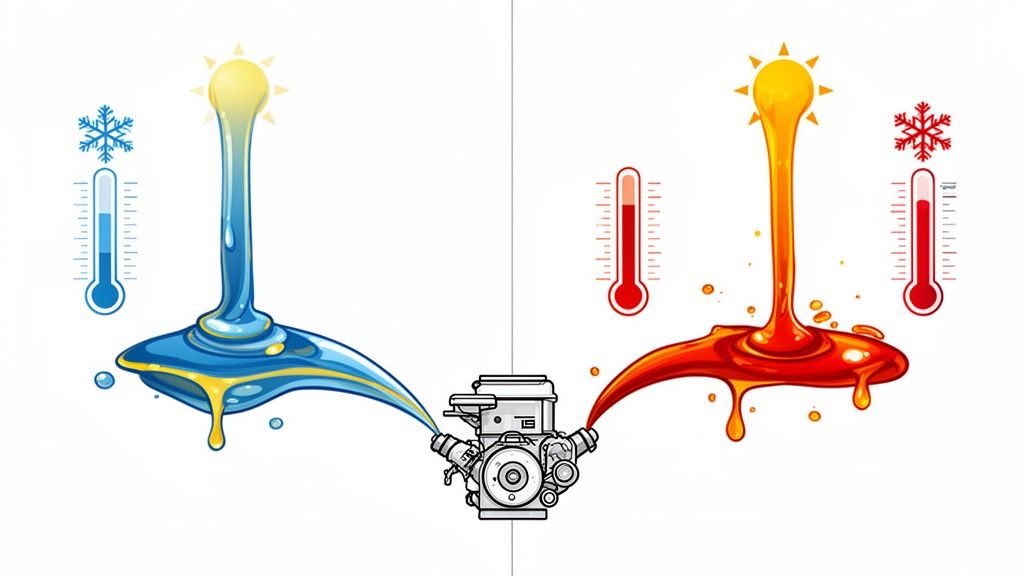
Think about what's happening inside your engine: dozens of metal parts are moving at incredible speeds, separated only by a microscopically thin film of oil. The viscosity of that oil determines just how strong and resilient that protective film is.
If the oil is too thin, it can get squeezed out from between moving parts, leading to damaging metal-on-metal contact. On the other hand, if it's too thick, it can't flow quickly enough to get where it needs to go, especially when you first start the car. This leaves vital components unprotected when they’re most vulnerable.
The whole game is about finding that "just right" balance. Your engine oil needs to be thin enough to circulate instantly on a frosty morning but also thick enough to hold up when your engine is running at full temperature. Getting this right is the secret to protecting your investment.
The Science of Flow and Protection
Viscosity is more than just a number on a bottle; it’s a physical property with a direct, real-world impact on your engine. The Society of Automotive Engineers (SAE) developed a grading system to make sure that a "10W-30" from one brand performs just like a "10W-30" from another.
Here's exactly what the right viscosity does for your car:
- Reduces Friction: A proper oil film creates a cushion between moving parts like pistons, bearings, and camshafts. This allows them to glide past each other smoothly instead of grinding away.
- Prevents Wear: By stopping that direct metal-to-metal contact, the correct viscosity is your engine's number one defense against premature wear. It's what helps a car last for 200,000 miles and beyond.
- Manages Heat: Oil is also a coolant. It circulates through the engine, pulling heat away from high-friction areas like the piston rings and carrying it back to the oil pan to dissipate.
The idea of managing viscosity has come a long way. The first oil standards, dating back to 1911, only measured oil performance at a single hot temperature. It wasn't until a major update in 1976 that the crucial 'W' grades for winter (cold) performance were introduced, opening the door for the amazing multigrade oils we use today.
From Early Standards to Modern Engineering
The history of motor oil really shows you how far engine technology has advanced. Back in 1923, a typical car needed an oil change every 800-1,000 miles. A big reason for this was that the simple "monograde" oils couldn't cope with temperature changes.
Today's oils offer incredible protection for thousands of miles, thanks to decades of progress in fluid dynamics. To learn more about how modern maintenance schedules pay off, you can explore the benefits of a regular oil change in our other guide. This evolution is precisely what allows today's powerful, efficient engines to run smoothly for so long.
How to Read Oil Grades Like 5W-30 and 0W-20
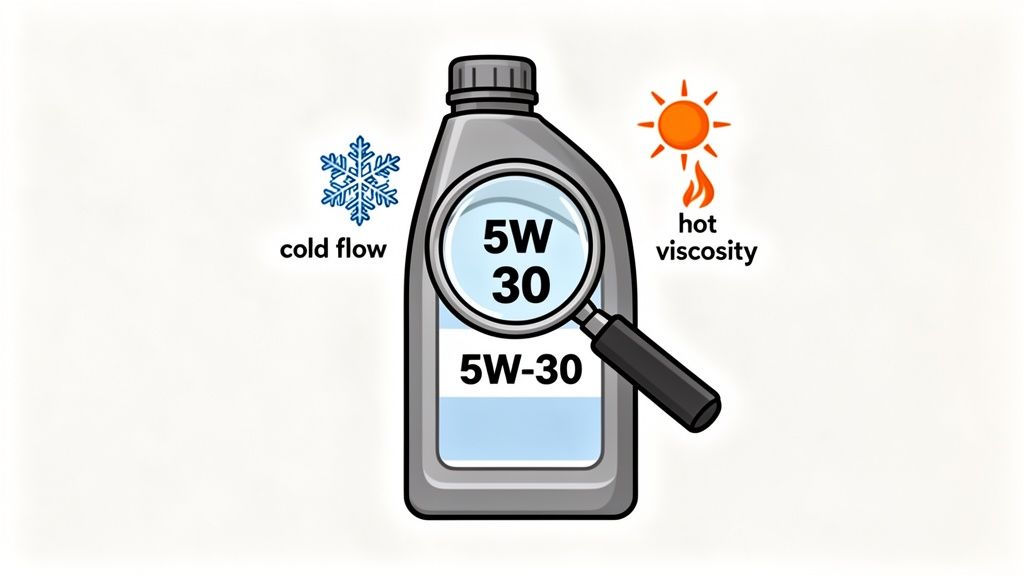
Those numbers and letters on an oil bottle, like 5W-30 or 0W-20, aren't just a jumble of industry jargon. They’re a language, created by the Society of Automotive Engineers (SAE), that tells you exactly how that oil will behave at different temperatures. Learning to speak this language is the key to protecting your engine.
This two-part code signifies a "multigrade" oil, which is engineered to perform well when your engine is cold and when it's hot. This was a huge improvement over old-school "monograde" oils that forced drivers to swap out their oil with the changing seasons. Let's look at what each part of that code really means for your car.
The First Number and the "W"
The first part of the grade, like the "5W" in 5W-30, tells you all about the oil's performance in cold weather. That "W" stands for Winter, not weight. It’s a rating of how easily the oil can flow through your engine during a cold start, like on a chilly morning.
Simply put, a lower number before the "W" means the oil is thinner and moves more freely at low temperatures.
- 0W-20: This oil is exceptionally thin when cold. It circulates almost instantly to protect critical engine components during a frigid startup.
- 5W-30: A very common choice, this oil is a bit thicker than a 0W grade when cold but still provides fantastic flow for quick lubrication.
- 10W-40: This oil is thicker when cold and is typically found in older engines or specific high-performance applications that call for it.
Getting this "W" rating right is critical. You want to make sure your engine isn't starved for oil during those first few crucial seconds after you turn the key.
A cold start is tough on an engine. In fact, an engine can sustain up to 60% of its total wear in the first few moments of operation before the oil is fully circulating. Fast oil flow is everything.
The Second Number After the Dash
On the flip side, the second number in the grade—the "30" in 5W-30—describes the oil's viscosity once the engine is fully warmed up, which is typically around 212°F (or 100°C). For this number, higher is thicker. It measures how well the oil resists thinning out under the intense heat of a running engine.
This is important because it ensures the oil maintains a strong, protective film over all the moving parts when your engine is working its hardest. If an oil gets too thin at operating temperature, it can't prevent metal-on-metal contact, leading to rapid wear and tear.
To get a better handle on how temperature impacts your oil, check out our guide on whether to check your oil when the engine is hot or cold. Getting this balance right is what total engine protection is all about.
The Evolution from Monograde to Modern Synthetic Oils
To really get why today’s engine oils are so good at protecting your car, it helps to take a quick look back. The journey from simple, single-grade oils to the advanced synthetics we use now is a story of smart chemical engineering that has made our engines more reliable and powerful than ever.
Picture a time when you had to change your car's oil with the seasons, just like you’d swap out your winter coat for a t-shirt. In the early days of the automobile, drivers were stuck with what we call monograde oils. These oils had only one fixed thickness, meaning they were either too sludgy for cold winters or too watery for hot summers.
The Hassle of Monograde Oils
This single-grade system was a huge headache for car owners. Back in the early 20th century, engine oils were rated by the Society of Automotive Engineers (SAE) with just one number. You might use a thicker SAE 30 or 40 oil in the summer, but that same oil would turn into something like molasses in the winter, making cold starts a nightmare and risking serious engine damage.
Because of this, oil changes were needed as often as every 800 to 1,000 miles—a far cry from today’s lengthy service intervals. This constant need for maintenance is what drove chemists to find a better solution.
The Magic of Multigrade Oils
The game completely changed in the 1950s with the invention of multigrade oils. Finally, here was an oil that could act thin when it was cold and stay thick when it got hot, getting rid of the need for seasonal oil changes.
So, how does that work? The secret is in special additives called Viscosity Index (VI) Improvers. Think of them as tiny, coiled-up polymer springs. When the oil is cold, they stay wound up tight, letting the oil flow easily. As your engine warms up, they uncoil and expand, which keeps the oil from thinning out too much.
This clever tech allows a single oil, like a 5W-30, to behave like a thin 5-weight oil for easy cold starts and a robust 30-weight oil for protection at high operating temperatures.
The Rise of Superior Synthetics
Building on that breakthrough, engineers took lubrication to a whole new level with full synthetic oils. While conventional oil is refined from crude petroleum, synthetics are built from the ground up in a lab, using pure and uniform molecules. This precision engineering creates an oil that performs exceptionally well under all conditions.
- Superior Temperature Resistance: Synthetic oils are fantastic at resisting breakdown under extreme heat, and they stay fluid at freezing temperatures far better than conventional oils can.
- Enhanced Purity: Since they're engineered from pure chemicals, synthetics have virtually no impurities. This helps keep your engine cleaner and dramatically reduces sludge buildup.
- Longer Engine Life: The strong, stable film that synthetic oil creates provides unmatched protection against wear and tear, helping extend the life of modern, high-performance engines.
This constant improvement is what allows today's engines to be both incredibly powerful and impressively durable. If you're thinking about making the switch for your own vehicle, our guide on switching from conventional to synthetic oil can walk you through the pros and cons.
Matching Oil Viscosity to Your Car and Climate
So, you’ve got a handle on what those numbers on the oil bottle mean. That's a great start! But the real trick is knowing which specific viscosity is the right choice for your car. It's definitely not a one-size-fits-all situation; the right oil is a careful match between your vehicle's age, your driving habits, and the climate you live in.
This chart gives you a quick visual of how engine oil has evolved to keep up with the demands of modern driving.
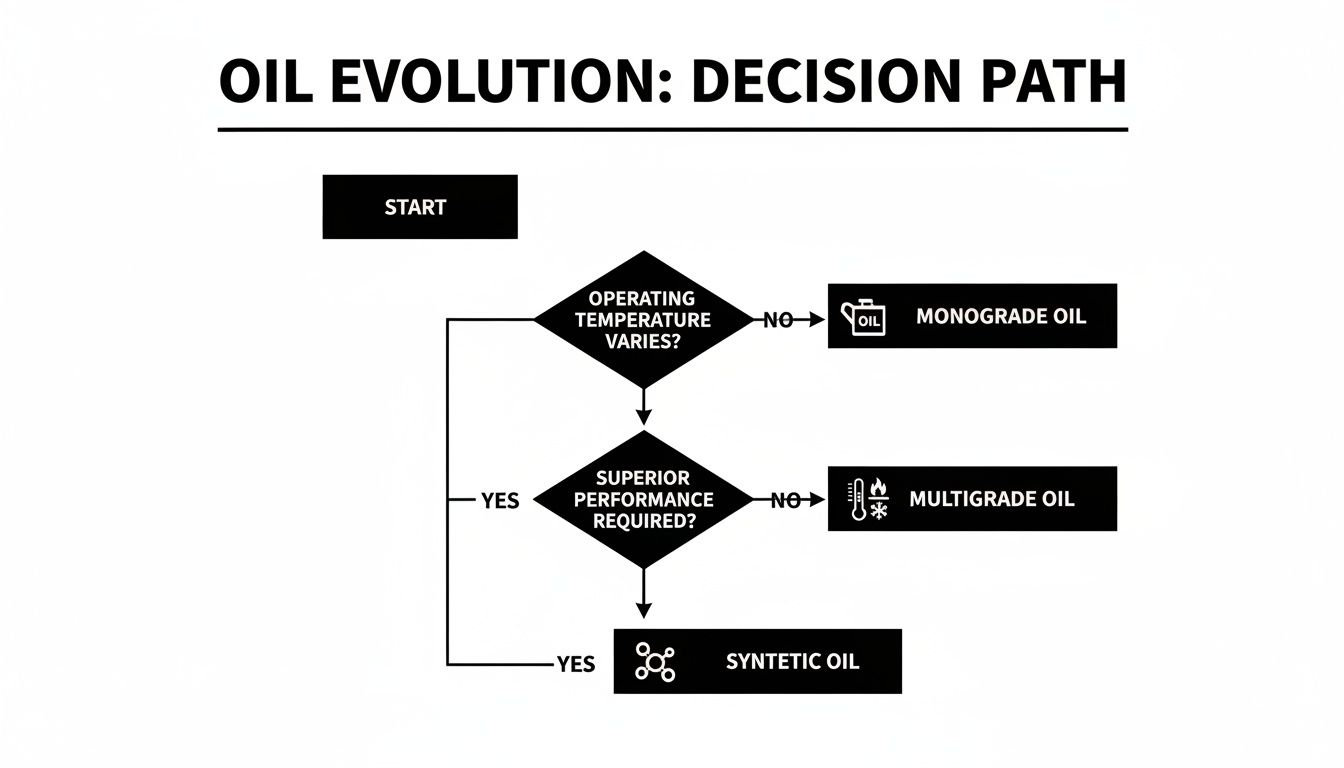
As you can see, we've come a long way from simple, single-grade oils. Today's advanced multi-grade oils are engineered marvels, designed to perform perfectly across a huge range of temperatures. That’s exactly why we can fine-tune our oil choice for any engine and any climate.
How Climate Impacts Your Oil Choice
The outside temperature has a huge say in how your engine oil behaves. For drivers in cold climates, a lower "W" number is a must-have. It ensures the oil stays thin enough to flow and protect the engine during a freezing start. Of course, choosing the right oil is just one part of the puzzle; there are other essential winter car preparation tips to keep your vehicle running smoothly when the temperature drops.
But for those of us dealing with intense Richardson, TX summers, our main concern is the opposite: preventing the oil from getting too thin in the heat. A crucial factor here is the oil's High-Temperature, High-Shear (HTHS) rating, which measures its ability to hold up under extreme heat and stress. A high-quality oil will maintain a strong, protective film even when your engine is baking in stop-and-go traffic on a 100°F day.
Matching Viscosity to Engine Age and Type
Your car's age and the way its engine was built are just as important as the weather. Automakers recommend specific viscosities for good reason, and it’s always best to start with their guidance.
- Newer Vehicles: Modern engines are amazing feats of engineering, built with extremely tight clearances to squeeze out every last bit of fuel efficiency. They typically need thin, low-viscosity oils like 0W-20 or 5W-20 to minimize friction and meet those demanding economy standards.
- Older, High-Mileage Vehicles: Once an engine gets past 75,000 miles, a little bit of wear is natural. This can create tiny gaps between moving parts. Switching to a slightly thicker oil—like a 5W-30 or 10W-30—can help fill those gaps, cushioning components, reducing engine noise, and sometimes even slowing down minor oil consumption.
Here's a quick guide to help you make sense of it all for your car here in Richardson.
Recommended Oil Viscosity by Vehicle Type and Climate
| Vehicle Profile | Common Viscosity Grades | Reasoning |
|---|---|---|
| Newer Sedans/SUVs (Under 75k miles) | 0W-20, 5W-20 | Designed for tight engine tolerances to maximize fuel economy. Flows easily on cooler mornings and handles Texas heat well. |
| High-Mileage Sedans/SUVs (Over 75k miles) | 5W-30, 10W-30 | Provides a thicker film to cushion worn parts, reduce engine noise, and minimize oil consumption in older engines. |
| Performance Cars/Heavy-Duty Trucks | 5W-40, 15W-40 (Diesel) | Offers superior protection under high heat and heavy loads, resisting thinning and ensuring components stay lubricated during demanding use. |
| Hybrid Vehicles | 0W-16, 0W-20 | Ultra-low viscosity oils reduce drag for maximum fuel efficiency, which is critical for hybrid systems that frequently start and stop the engine. |
This table serves as a general guideline, but your owner's manual is always the ultimate authority. If you're ever unsure, our team at Kwik Kar is here to help you make the perfect choice for your vehicle's specific needs.
Think of it this way: the right oil is like a liquid gasket for your engine. In a high-mileage car, a thicker oil helps restore a tight seal, improving compression and quieting a tired engine. In a new car, a thin oil cuts down on drag, giving you a direct boost in gas mileage.
Picking the right viscosity is one of the most practical things you can do for your engine's health and longevity. It’s all about making sure your engine has the perfect protection for the job it does every single day.
Getting Expert Help at Kwik Kar Richardson
While knowing how to read an oil bottle is a great first step, picking the absolute perfect oil can still feel a little daunting. The good news? You don't have to figure it out all on your own. This is where leaning on professional expertise really pays off, ensuring your engine gets exactly what it needs to run strong for years.
At Kwik Kar, our ASE-certified technicians are here to be your trusted advisors. We don't just glance at your owner's manual—we use it as our starting point. From there, our team combines the manufacturer (OEM) specs with a deep understanding of your specific vehicle and the real-world demands of driving right here in Richardson.
A Personalized Approach to Your Oil Change
Navigating rush hour on US-75 or just surviving another blistering Texas summer puts a unique kind of stress on your engine. Our technicians get that. We'll help you select an oil that offers solid protection against high-heat breakdown, factoring in your car's age, mileage, and even your daily driving habits.
This expert advice goes beyond just picking a viscosity grade; it’s about choosing the right type of oil for the job.
- For newer cars, we often recommend a full synthetic oil that meets the latest ILSAC GF-6 standards. This gives you top-tier wear protection and helps with fuel economy.
- For high-mileage vehicles, we might suggest a specialized formula. These oils have conditioners designed to keep old seals flexible and help reduce any oil consumption.
Choosing the right oil is one of the best forms of preventive maintenance you can do. It stops that harmful sludge and gunk from building up, which can save you from some seriously expensive repairs down the road.
Peace of Mind You Can Trust: Our commitment to quality is backed by our affiliations with CARFAX, RepairPal, and NAPA AutoCare. These partnerships mean you receive service that meets the highest industry standards, every single time.
We are also proud to support our local heroes. To show our thanks, we offer special discounts for military personnel, first responders, and healthcare providers. When you come to Kwik Kar Richardson, you’re not just getting an oil change; you’re gaining a dedicated partner in your vehicle's health. Let our experts give you the clarity and confidence to keep your engine running smoothly.
Frequently Asked Questions About Oil Viscosity
Even after you get the basics down, oil viscosity brings up a few common questions. We hear them all the time at the shop, and getting straight answers is the best way to cut through the myths and make smart choices for your car.
Let's walk through some of the questions we hear most from drivers just like you. Getting these details right will help you keep your engine protected and running at its best, no matter what you drive or where you're headed.
What Happens If I Use the Wrong Oil Viscosity?
Using the wrong oil is one of the most common—and preventable—mistakes you can make. Your engine probably won't seize up right away, but you're setting the stage for everything from poor performance to serious long-term damage. It’s a total mismatch for what your engine needs.
For example, putting an oil that's too thick (like 10W-40 in a car built for 0W-20) can starve important parts of lubrication on a cold start. That thick, slow-moving oil can’t get where it needs to go, causing extra wear on components like camshafts and bearings during those first critical seconds. You’ll likely notice a drop in gas mileage, too, since the engine has to work harder just to pump the oil.
On the other hand, an oil that’s too thin is just as bad, especially in high heat. A thinner-than-recommended oil might not create a strong enough protective film between moving parts when your engine is hot. This can lead to more engine noise, higher oil consumption, and eventually, metal-on-metal contact that causes damage you can't reverse.
Using the wrong viscosity is like asking an athlete to run a marathon in hiking boots or sprint in flip-flops. While they might be able to do it, their performance will suffer, and the risk of injury skyrockets. The right oil viscosity is the proper footwear for your engine, ensuring it performs exactly as intended.
Can I Switch Between Synthetic and Conventional Oil?
Absolutely. This is one of the biggest myths in car care, but the truth is you can safely switch between synthetic and conventional oils—and even between different brands. All modern engine oils are made to be fully compatible with each other. In fact, that's exactly what a "synthetic blend" is: a mix of conventional and synthetic oils.
Making the jump from conventional to a full synthetic is a great upgrade, particularly for newer engines or older cars with high mileage. Synthetic oils give you much better protection in both extreme cold and high heat, they last longer, and they come with powerful detergents that can actually help clean out sludge buildup inside your engine.
You don't need any special "flush" or procedure. When you're ready to upgrade, you just get your oil changed with the new type. The only thing to keep in mind is that once you feel the difference in protection and see the longer time between oil changes, you probably won't want to go back.
Is a 0W-20 Oil Too Thin for a Hot Texas Summer?
This is a fantastic question and a huge concern for drivers here in Richardson and across Texas. It seems logical that a "0W" oil would be too thin for our brutal summer heat, but that comes from a common misunderstanding of how multigrade oils are rated.
The first number, the "0W," only describes how the oil behaves when it's cold. It’s a measure of its ability to flow easily during a cold start, which is actually a good thing even on a warm Texas morning. A 0W oil circulates and protects your engine's vital parts faster than a 5W or 10W oil, regardless of the outside temperature.
The number that really counts for high-heat protection is the second one—the "20" in 0W-20. This number is a guarantee that the oil will hold its required thickness and protective film even when your engine is running at full temperature. Modern engines in cars and trucks are built with extremely tight clearances and are specifically designed to run on these thinner, more efficient oils. A quality 0W-20 synthetic will protect your engine perfectly, even when you're stuck in traffic on a 100°F day.
Still have questions? The best way to get a definitive answer for your car is to talk to an expert. At Kwik Kar Oil Change and Auto Care, our ASE-certified technicians can help you choose the perfect oil to keep your engine running smoothly for years to come. Visit us in Richardson or book your appointment online at https://www.kkrichardson.com today.