Diagnose Hard Shifting Automatic Transmission in One Hour, Richardson
Most hard shifts in an automatic transmission trace back to a hydraulic or control problem: low or contaminated fluid, worn shift solenoids, valve body wear, or a speed sensor feeding bad data to the transmission control module. Check your fluid level and look for leaks right away. If both check out clean, the next move is a professional diagnostic scan, not a blind fluid flush or a parts swap.
TL;DR:
- Most hard shifts in automatic transmissions are caused by hydraulic or electronic issues, with low or burnt fluid being the most common culprit.
- Diagnosing the problem requires a thorough scan of trouble codes, live data, and pressure tests before considering fluid flushes or parts replacement.
- Costs for repairs vary from $100 to $400 for fluid service to over $6,000 for full rebuilds, with proper diagnostics saving owners from unnecessary expense.
- Cold weather can cause temporary hard shifts due to thickened fluid, but persistent problems after warming up indicate a deeper issue.
- Different transmission types show distinct symptoms: clunks in automatics, jerking in CVTs, and hesitations in dual-clutch transmissions, which influence the diagnostic approach.
Table of Contents
- What Causes a Hard Shifting Automatic Transmission?
- How Mechanics Diagnose a Hard Shift
- DIY Checks You Can Safely Try First
- What Repairs Cost and How Long They Take
- Why a Qualified Shop Diagnosis Protects Your Wallet
- Hard Shifting Feels Different Depending on Your Transmission Type
- Our Take: Diagnose Before You Guess
- Book a Transmission Diagnostic With Kwik Kar Oil Change & Auto Care
- Sources
- FAQ
What Causes a Hard Shifting Automatic Transmission?
A transmission that bangs into gear or hesitates before catching is telling you something specific about its hydraulic or electronic health. The cause almost always falls into a handful of categories, and knowing which one narrows your repair bill fast.
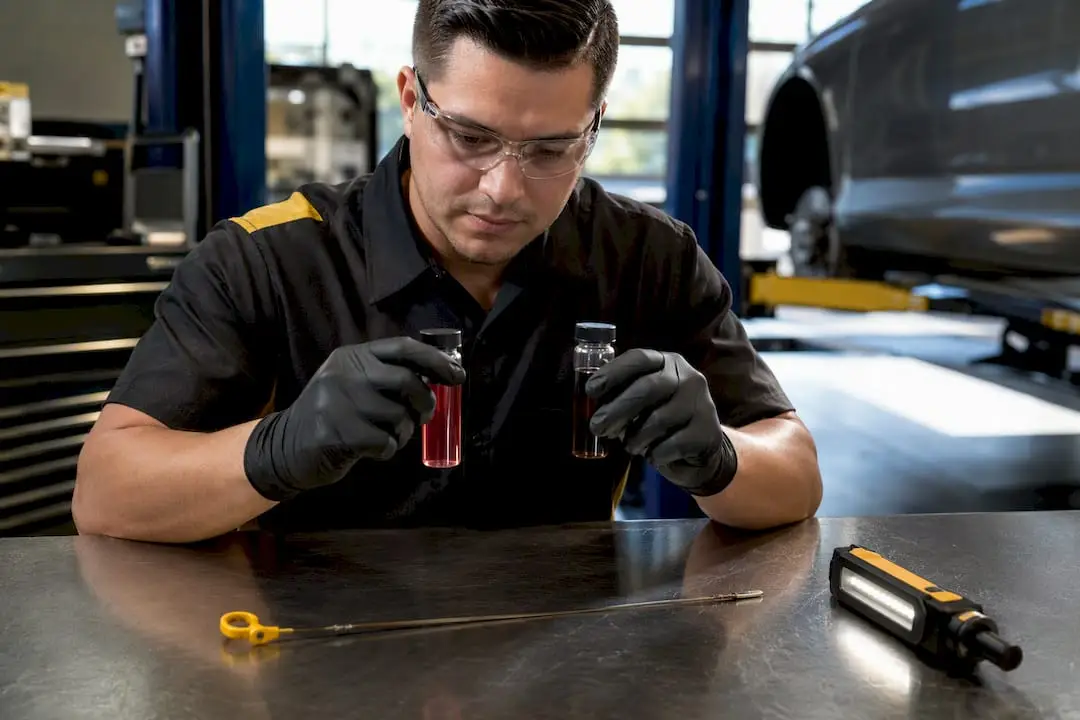
Low or degraded transmission fluid is the single most common culprit. Fluid does three jobs at once: it lubricates moving parts, cools the system, and creates the hydraulic pressure that engages each gear. When the level drops or the fluid breaks down, that pressure control window narrows and shifts turn abrupt. Fresh fluid should be a clear red or pink. If yours looks dark brown, smells burnt, or sits below the fill line, that’s your first answer. AAA’s fluid guidance points to fluid condition as a leading cause of delayed or hard engagement, and recommends sticking to the interval your manufacturer specifies rather than a generic schedule.
Electronic faults are the piece owners most often overlook. A failing transmission speed sensor sends the transmission control module (TCM) inaccurate data, and the module can default to high line pressure as a protective measure. That default mode is exactly what produces a jarring shift. Consumer Reports notes that some of these problems now require a software update or dealer-level reprogramming rather than a mechanical fix, especially on newer vehicles with drive-by-wire shift logic.
Mechanical wear inside the transmission tells a similar story through different parts:
- Shift solenoids control fluid routing to each gear set. A stuck or failing solenoid can delay or force a shift.
- Valve body wear or contamination disrupts the same fluid pathways on a larger scale, often across multiple gears at once.
- Torque converter or clutch pack wear causes abrupt, almost violent engagement rather than a smooth handoff between gears.
- Worn transmission mounts let the drivetrain shift under load, which can feel like a hard shift even when the transmission itself is healthy.
- Older vacuum modulators or shift cables, found on some older vehicles, drift out of adjustment and throw off shift timing entirely. CarParts lists these alongside sensor and solenoid failures as the most common electronic and mechanical causes.
One more wrinkle: cold weather thickens transmission fluid, and a hard shift on a cold start that smooths out after a mile or two is often normal. A hard shift that persists once the fluid is warm is not.
How Mechanics Diagnose a Hard Shift
A shop visit for hard shifting problems should follow a defined sequence, not a guess. Model-specific diagnosis matters here because the same symptom can point to a $150 fix on one vehicle and a $2,000 fix on another.
- Pull trouble codes and log live data. A technician connects an OBD/TCM scan tool to read stored codes and watch input/output speed sensor readings and line pressure in real time.
- Run hydraulic pressure and solenoid actuation tests. These confirm whether the valve body is routing fluid correctly and whether a solenoid is sticking or failing to fire.
- Inspect or lab-test the fluid. A drain-and-inspect check (or a lab analysis for contamination and worn friction properties) tells the technician whether fluid condition is the root cause or just a symptom of something else.
- Road test with instrumentation. This replicates the hard shift under load and confirms exactly which gear change is affected.
- Determine if a TCM reflash or relearn procedure applies. Some vehicles need a dealer-level reprogramming tool; others can be corrected with a standard relearn after a repair.
Pro Tip: Ask the shop to show you the live-data printout before any repair is approved. A hard shift caused by a sensor reading 200 RPM off from actual speed looks completely different on paper than one caused by low line pressure, and the printout proves which one you’re dealing with.
DIY Checks You Can Safely Try First
Before you book an appointment, a few checks take ten minutes and can save you a diagnostic fee if the answer turns out to be simple.
- Check the fluid level and color. Park on level ground, follow your owner’s manual for whether the check happens with the engine warm or cold (this varies by model), and pull the dipstick if your vehicle has one. Clear red or pink fluid is healthy; brown or burnt-smelling fluid is not.
- Look underneath for leaks. A reddish or brown puddle under the transmission, a burning smell, or fresh drips on the driveway are signs AAA Club Alliance flags as warranting immediate inspection.
- Inspect transmission mounts for visible cracking or excessive movement when you rev the engine in park.
- Try a battery disconnect to reset the TCM if you suspect a minor software glitch. This is a limited test, not a fix, and it will not resolve a hydraulic or mechanical fault.
Stop there. Do not open the transmission pan looking for internal damage, and do not pay for a blanket flush if you suspect contamination without a diagnostic confirming it. Flushing already-degraded fluid through a worn valve body can push debris into places that make the repair worse.
What Repairs Cost and How Long They Take
Repair costs for a hard shifting automatic transmission span a wide range, and the gap between the low end and the high end is almost entirely a function of what the diagnostic finds.
- Fluid top-up or drain-and-fill: 30 to 90 minutes, generally in the $100 to $400 range.
- Solenoid pack or valve body service: 2 to 6 hours depending on how accessible the transmission is, typically $300 to $1,500.
- Torque converter replacement or full transmission rebuild: multi-day jobs, often $2,000 to $6,000 or more depending on the vehicle.
J.D. Power’s cost data puts common sensor or solenoid repairs in a $180 to $900 mid-range band, which lines up with what most independent shops quote for that category of work. Vehicles with tightly packed engine bays, particularly performance and luxury models, tend to land at the higher end of any given range because labor time multiplies when a technician has to remove more components to reach the transmission.
The reason to get a diagnostic first rather than requesting a flush or a rebuild outright is straightforward: AAA’s repair guide specifically warns against blanket flushes or “severe use” services that aren’t called for in your owner’s manual. A proper scan and pressure test often rules out the expensive end of that range before you ever authorize it.
Why a Qualified Shop Diagnosis Protects Your Wallet
Misdiagnosis is the expensive mistake in transmission work, and it happens most often when a shop skips straight to a repair without pulling live data first. ASE-certified technicians working from dealership-level diagnostic tools catch the difference between a $200 sensor and a $3,000 rebuild before either one gets ordered.
When you bring your car in for a hard shift, ask for:
- A printed or digital log of scanned trouble codes and live sensor data
- Photos of the fluid condition, not just a verbal description
- A written estimate itemizing parts and labor separately
- A clear repair-time estimate and an explanation of where parts are sourced
Diagnostics are backed by ASE-certified technicians, digital vehicle inspections you can review yourself, and warranty coverage on completed repairs. The shop is also recognized by CARFAX and RepairPal, names drivers often consider when comparing repair shops.
Hard Shifting Feels Different Depending on Your Transmission Type
Not every automatic transmission fails the same way, and knowing which type is under your hood changes what a hard shift actually means.
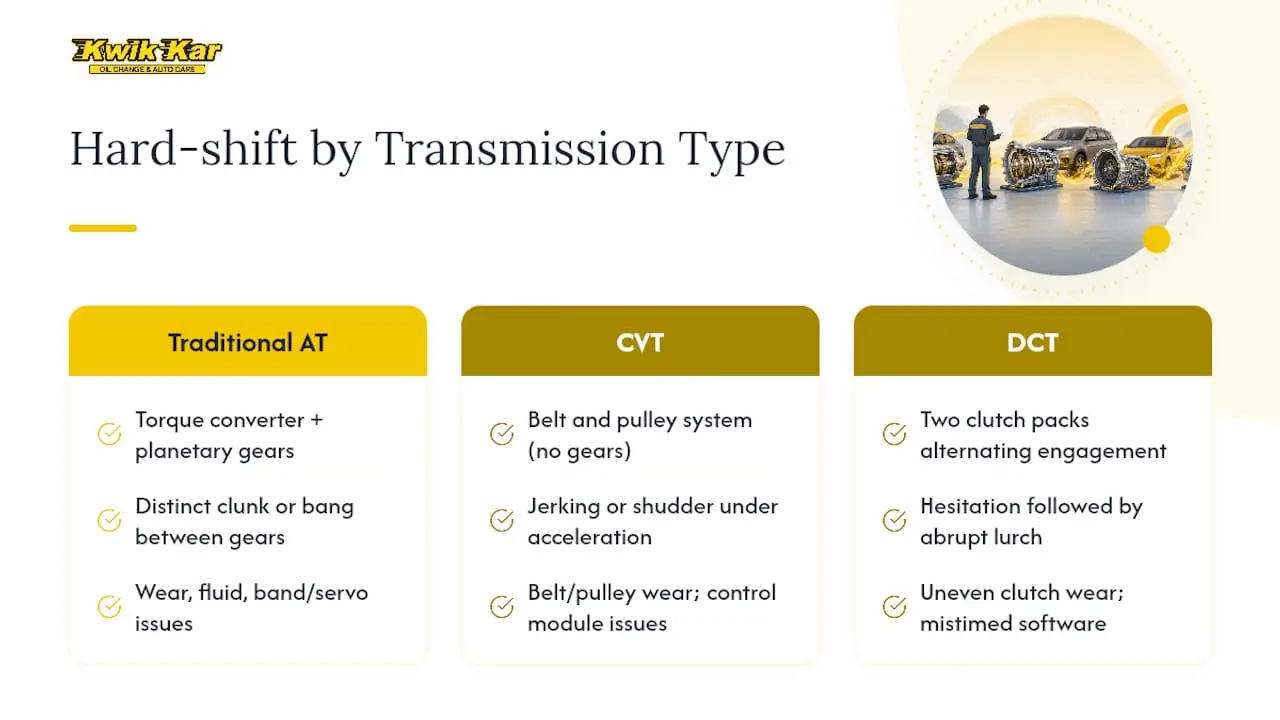
A traditional automatic transmission, built around a torque converter and planetary gear sets, produces the classic symptom: a distinct clunk or bang between specific gears, often worse from first to second or second to third. This is the pattern most of the causes above describe directly.
A continuously variable transmission (CVT) doesn’t shift through fixed gears at all, so a “hard shift” on a CVT usually shows up as a jerking or shuddering sensation under acceleration rather than a bang between numbered gears. That symptom often points to belt or pulley wear, or a control module trying to simulate gear steps that aren’t mechanically there.
A dual-clutch transmission (DCT) shifts using two separate clutch packs that hand off engagement to each other. When one clutch pack wears unevenly or the control software mistimes the handoff, the result is a hesitation followed by an abrupt lurch, most noticeable in stop-and-go traffic or from a dead stop. DCT hard shifts lean more heavily toward software and clutch-actuator causes than fluid pressure issues.
Because the failure points differ so much by design, the same complaint, “it’s shifting hard,” needs a different diagnostic path depending on which of these three systems you’re driving.
Our Take: Diagnose Before You Guess
The advice repeated across most transmission guides treats hard shifting as a fluid problem first and software problems as an afterthought. That ordering is backwards for a growing share of vehicles on the road today. Speed sensor drift and TCM logic errors now cause as many hard-shift complaints as worn solenoids do, and they get missed because they don’t show up on a visual fluid check.
Our position: skip the instinct to authorize a flush or a parts swap before a scan tool has actually confirmed the fault. A one-hour diagnostic that reads live sensor data and pressure values costs a fraction of an unnecessary rebuild, and it tells you definitively whether you’re looking at a $150 fix or a $2,000 one. The owners who spend the most on transmission repair are usually the ones who paid for a guess instead of a scan first.
Prioritize the diagnostic. Everything else, fluid service, solenoid replacement, mount repair, follows from what that scan actually finds.
— Kwik Kar
Book a Transmission Diagnostic With Kwik Kar Oil Change & Auto Care
A hard shift you keep driving on rarely stays a small problem. Kwik Kar Oil Change & Auto Care runs a full diagnostic process for hard-shifting transmissions right here in Richardson: OBD/TCM code scans, live sensor data, fluid condition checks, and a road test to confirm exactly what’s wrong before any repair is quoted.

Diagnostics and repairs are performed by ASE-certified technicians and are supported by a warranty on completed work. Whether the fix turns out to be a fluid service, a solenoid replacement, or something bigger, you’ll get a written estimate before any work starts.
Start with an engine diagnostic to pinpoint the cause, or head straight to transmission repair and clutch services if you already suspect internal wear. Call your local Kwik Kar Oil Change & Auto Care in Richardson or book online to get your transmission checked before a hard shift turns into a bigger repair bill.
Sources
- AAA guide to auto repair
- Your car maintenance checklist
- How to check and maintain your transmission fluid
- Possible causes of a hard-shifting automatic transmission
FAQ
How Can I Fix a Hard Shifting Automatic Transmission?
Start with a fluid level and leak check, since low or degraded fluid is the leading cause of hard shifts according to AAA. If the fluid looks clean and full, schedule a professional diagnostic scan to check for solenoid, sensor, or valve body faults rather than guessing at a repair.
Does a Hard Shift Mean a Bad Transmission?
Not necessarily. A hard shift often points to a fixable issue like low fluid, a failing speed sensor, or a stuck solenoid rather than internal transmission damage. A proper diagnostic scan and pressure test are the only reliable way to tell the difference.
How Much Does It Cost to Fix a Hard Shifting Transmission?
Costs vary widely depending on the cause: a fluid service typically runs $100 to $400, solenoid or valve body work falls in the $300 to $1,500 range, and a torque converter replacement or rebuild can reach $2,000 to $6,000 or more. J.D. Power places common sensor and solenoid repairs around $180 to $900.
What Causes a Stiff Automatic Gear Shift?
The most frequent causes are low or contaminated transmission fluid, a failing speed sensor sending bad data to the control module, or worn shift solenoids disrupting fluid routing. CarParts also lists valve body wear and, on older vehicles, worn vacuum modulators as contributing factors.