Diagnose Transmission Shudder: Brake & Neutral Tests for Richardson
A transmission shudder is most often torque converter lockup chatter caused by degraded or wrong-spec ATF, and a proper transmission fluid exchange resolves many recent-onset cases. If the shuddering is mild, intermittent, and free of warning lights, a fluid service is the right first move. If you smell burning fluid, feel heavy slipping, or see a check engine light, stop driving and get it looked at before the damage spreads.
TL;DR:
- A transmission shudder often results from degraded or incorrect transmission fluid, with fluid exchange usually resolving most recent-onset cases.
- The shudder typically occurs between 35 and 50 mph during light throttle, especially when the torque converter locks up, and stops in neutral or when braking.
- Tests such as applying the brake or shifting into neutral at the same speed can confirm if the transmission is the source of the shudder.
- Costs for correction mostly involve a fluid change costing $150 to $300, while more extensive repairs like torque converter replacement can reach several thousand dollars.
- Early maintenance, such as regular fluid changes around 60,000 to 80,000 miles, can prevent transmission shudder and costly repairs.
Table of Contents
- What Transmission Shudder Feels Like and When It Strikes
- Why Transmission Shudder Happens: The Real Causes
- Diagnosing Transmission Shudder: What to Check First
- What Fixing Transmission Shudder Actually Costs
- Preventing Transmission Shudder Before It Starts
- What a Professional Shop Does When You Bring In a Shudder
- Should You Drive to the Shop or Call a Tow?
- Kwik Kar Transmission Services and How to Book
- Sources
- FAQ
What Transmission Shudder Feels Like and When It Strikes
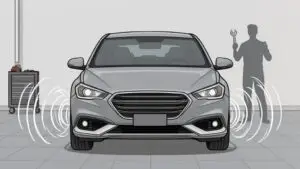
Drivers usually describe it as a buzzy, chattering vibration that feels like rolling over rumble strips on the highway shoulder. It comes through the floorboard, sometimes the steering wheel, and it tends to show up in a specific speed window rather than across your whole drive.
Most shudder happens during light throttle at steady speeds between 35 and 50 mph, right when the torque converter locks up to improve fuel economy. You might feel it accelerating gently onto a highway ramp or holding speed on a slight grade. It often disappears at idle, in park, or under hard acceleration when the converter unlocks.
A few quick checks help confirm the transmission is the source:
- The shudder stops or changes character when you shift to neutral at speed.
- It goes away when you lightly tap the brake, which unlocks the converter.
- It repeats at the same speed and throttle position every time.
- Notably, this can happen with zero dashboard warning lights and no stored trouble codes, which is why so many drivers assume it’s minor and put off getting it checked.
Why Transmission Shudder Happens: The Real Causes
Shudder almost always traces back to one of a handful of mechanical or hydraulic failures, and each one produces a slightly different feel.
- Degraded or wrong-spec ATF. Fluid loses its friction modifiers over time or was never the correct formulation to begin with, and the torque converter clutch starts grabbing and releasing instead of locking smoothly. This “stick-slip” behavior is the single most common and most fixable cause of shudder.
- Worn torque converter lockup clutch. The friction material glazes or wears thin with age, so it can’t hold a clean lockup even with good fluid.
- Worn clutch packs inside the transmission. Internal wear causes uneven engagement that mimics converter shudder but points to deeper mechanical fatigue.
- Failing TCC solenoid or valve body faults. Electrical or hydraulic control problems disrupt the pressure signals that tell the converter when to lock, creating erratic engagement.
- Mounts, driveshaft, or unbalanced tires. These aren’t transmission issues at all, but a bad motor mount or an out-of-balance wheel can produce a vibration that feels similar. Rule them out before assuming the worst.
- CVT-specific wear. Vehicles with a continuously variable transmission are especially sensitive to fluid condition, and belt or chain wear paired with the wrong CVT fluid is a frequent culprit in these units.
Certain vehicles have known fluid sensitivities. Some GM 8-speed transmissions used a factory fill that absorbs moisture more readily than it should, degrading friction properties over time; switching to an updated synthetic ATF often reduces recurrence.
Pro Tip: Write down the exact speed and throttle condition where the shudder happens before your appointment. “Every time I hold 42 mph on flat ground” gives a technician a target to reproduce, which speeds up diagnosis considerably.
Diagnosing Transmission Shudder: What to Check First
Two low-cost tests can tell you a lot before you ever call a shop.
The brake test. Hold a steady speed where the shudder occurs, then lightly touch the brake pedal without slowing down much. This forces the torque converter to unlock. If the shudder disappears, converter lockup is almost certainly the source.
The neutral test. At a safe, steady speed, shift briefly into neutral. If the shudder stops immediately, that also points to the transmission rather than the engine or suspension.
What the tests tell you: shudder that vanishes in neutral or under light braking points to the transmission. Shudder that persists in both cases usually means engine, driveline, or tire balance, not the transmission at all.
Beyond those two checks, a full diagnostic workflow looks like this:
- Check the fluid’s color and smell. Fresh ATF is usually red or amber; dark, burnt-smelling fluid signals overheating or breakdown.
- Inspect the pan for metal flakes, which indicate internal wear rather than a simple fluid problem.
- Scan for trouble codes such as P0741, which flags a torque converter clutch performance fault.
- Run pressure checks, solenoid bench tests, and a post-repair road test to confirm the fix actually holds.
The decision tree is simple: try a fluid service first unless you find metal in the pan or a persistent code that points to internal damage. Fluid issues are common and fixable; metal in the pan is not.
What Fixing Transmission Shudder Actually Costs
Repair costs vary widely depending on what’s actually wrong, but the general pattern holds across most shops.
- Fluid service. A drain-and-fill replaces roughly 40 to 50 percent of the fluid, a full exchange replaces nearly all of it, and a machine flush cycles fluid through the cooler lines too. Fluid or additive service commonly runs $150 to $300 and resolves the majority of recent-onset shudder cases.
- Friction-modifier additives. These can serve as a diagnostic tool. If an additive temporarily eliminates the shudder, the root cause is likely fluid chemistry, not worn clutch material. Used alone and repeatedly, though, additives can mask a mechanical problem that will eventually get worse.
- Solenoid or valve body service. This involves more labor since the technician has to access internal hydraulic components, and it runs higher than a straightforward fluid exchange.
- Torque converter replacement or full transmission rebuild. This is the most expensive path, ranging from several hundred to a few thousand dollars depending on labor rates and vehicle. It’s also the outcome a timely fluid service is specifically designed to prevent.
The math favors acting early. A $150 to $300 fluid exchange now is a fraction of what a converter replacement or rebuild costs later, and catching the issue while it’s still fluid-related is the difference between a same-day fix and a multi-day repair.
Preventing Transmission Shudder Before It Starts
Most shudder is preventable with maintenance that takes a fraction of the time a repair does.
- Follow your manufacturer’s exact ATF specification and service interval. Many vehicles benefit from a fluid service around 60,000 to 80,000 miles, sooner if you tow or drive in heavy Texas heat.
- Avoid repeated heavy towing and prolonged overheating. If towing is part of your routine, a transmission cooler upgrade can meaningfully extend fluid life.
- Get fluid checked the moment you notice odd engagement, hesitation, or a delayed shift, and replace the filter whenever you have fluid service done.
- Keep your service records and share your last transmission service date when you book an appointment.
Pro Tip: If you’re not sure when your transmission fluid was last changed, check your maintenance folder or ask your previous shop. “Unknown” fluid age is one of the most common reasons a preventable shudder turns into an expensive one.
What a Professional Shop Does When You Bring In a Shudder
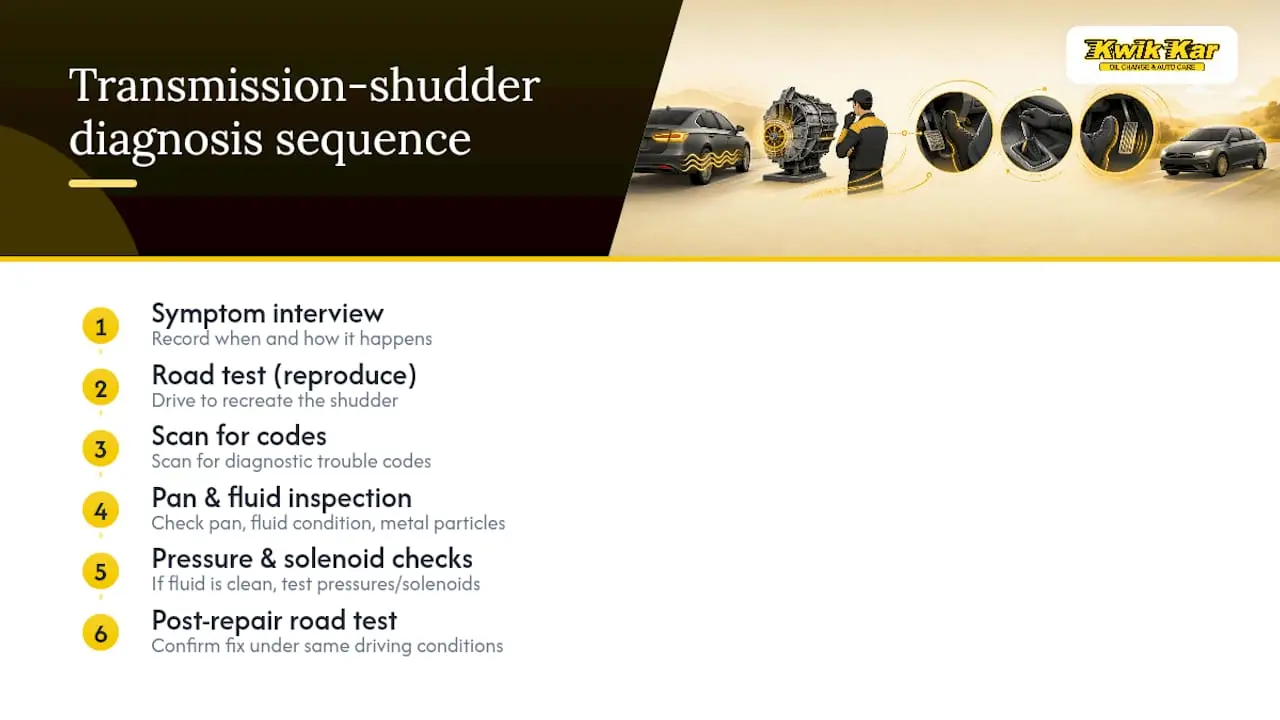
A proper diagnosis follows a sequence: a symptom interview, a road test to reproduce the shudder, a scan for codes, a pan and fluid inspection, then pressure and solenoid checks if the fluid looks clean. A post-repair road test confirms the fix actually worked under the same conditions that caused the problem.
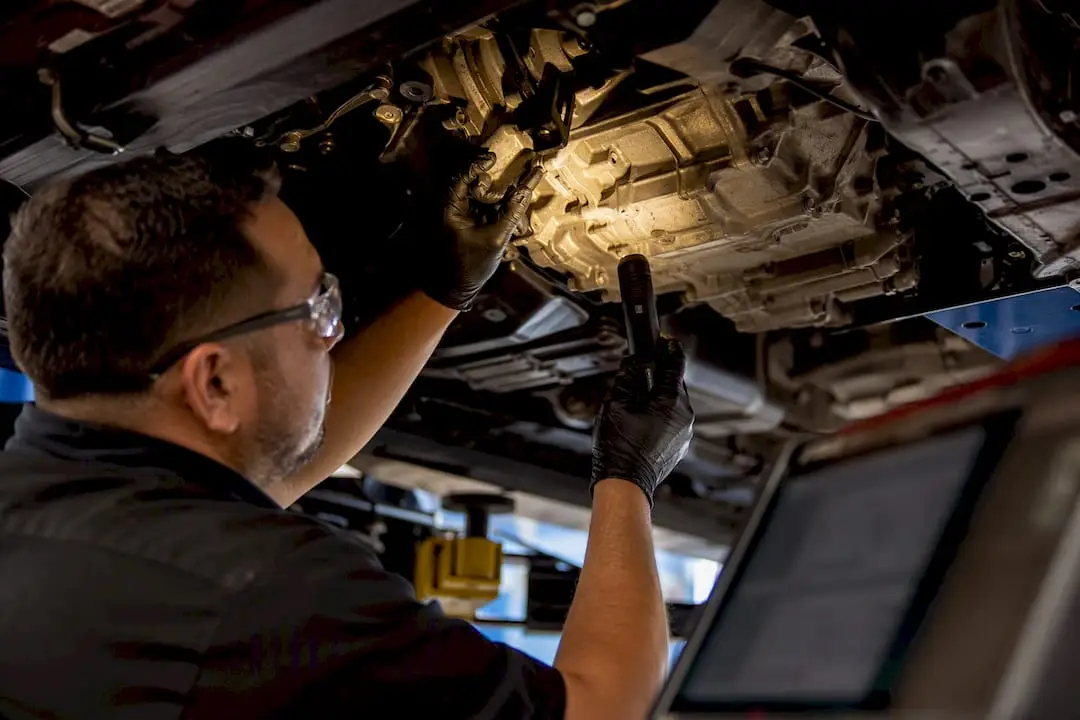
At Kwik Kar Oil Change & Auto Care, that diagnosis is handled by ASE-certified technicians who document findings with digital vehicle inspections, so you see exactly what they found in your fluid and pan, not just a verbal summary. Metal particles or burnt fluid move the diagnosis from routine maintenance to mechanical repair; clean fluid with a clear code often means a straightforward fix.
Before your appointment, write down when the shudder happens, your last known fluid service date, and how to reproduce it on a road test.
Should You Drive to the Shop or Call a Tow?
If the shudder is mild, intermittent, and there’s no burning smell, no heavy slipping, and no metal in sight, driving carefully to a shop for a same-day fluid service is usually reasonable. If you notice a burning odor, pronounced slipping, or metal flakes on the dipstick, stop driving and arrange a tow instead. Continuing to drive on a damaged converter or worn clutch pack can turn a $200 fluid service into a multi-thousand-dollar rebuild in a matter of weeks.

The repair priority order worth remembering: fluid service first, then solenoid or valve body work, then torque converter replacement, and rebuild only as a last resort. Ignored shudder rarely stays mild. It tends to progress from occasional chatter to constant slipping as friction surfaces degrade further, so the sooner you diagnose it, the more options you have.
Kwik Kar Transmission Services and How to Book
Kwik Kar Oil Change & Auto Care is the straightforward alternative to guessing at the fix yourself or waiting until a mild shudder turns into a stranded car in Richardson. Our ASE-certified technicians run the full diagnostic sequence, from fluid inspection to solenoid checks, and back their work with transparent digital reporting and a 24-month/24,000-mile warranty, so you know exactly what you’re paying for and what’s covered if something comes back.

We offer transmission fluid exchange, full diagnostics, and transmission and clutch repair, alongside common maintenance services like oil changes, brakes, batteries, and state inspections. When you call to book, tell your service advisor when the shudder happens, your last known fluid service date, and whether you’ve noticed any burning smell or slipping. That detail lets our technicians reproduce the problem faster and get you an accurate diagnosis on the first visit.
Ready to get it checked? Schedule your visit through our transmission repair and clutch services page and let our team confirm whether a fluid exchange will solve it or whether something deeper needs attention.
Sources
This guide draws on repair analysis from RevisionTown, Jalopnik, EngineerSkill.blog, and Rohnert Park Transmission. For related symptoms, see our posts on torque converter failure signs and slipping transmission symptoms.
- Torque converter shudder: how to fix | Jalopnik
- Torque Converter Shudder: Causes, Symptoms & Complete Repair Guide 2025 – RevisionTown
- Engineerskill
FAQ
How do you fix transmission shudder?
Most recent-onset cases respond to a full transmission fluid exchange with the manufacturer-specified ATF, which restores the friction modifiers that control smooth converter lockup. If shudder persists after a fluid service, or if metal is found in the pan, the fix escalates to solenoid, valve body, or torque converter repair.
What does a transmission shudder feel like?
It feels like a buzzy vibration similar to driving over rumble strips, usually felt through the floorboard between 35 and 50 mph during light acceleration. It typically stops if you tap the brake lightly or shift briefly into neutral.
What are the first signs of transmission failure?
Early warning signs include shudder or hesitation during acceleration, delayed engagement when shifting into gear, unusual noises, and fluid that looks dark or smells burnt. Catching these signs early, before slipping becomes constant, is what keeps a repair affordable.
How much does it cost to fix a torque converter shudder?
A fluid or additive service commonly runs $150 to $300 and resolves many cases tied to degraded fluid. If the converter itself is worn and needs replacement, cost climbs into the several hundred to a few thousand dollar range depending on labor and vehicle. Kwik Kar Oil Change & Auto Care provides exact pricing after a diagnostic inspection, since costs depend on what the fluid and pan inspection actually reveal.