Let's get right to it: how much does a tune up cost? The short answer is you can expect to pay anywhere from $130 to over $340 for a standard service. But the final number on your invoice really depends on your car and where you take it.
One thing's for sure—this isn't your grandfather's tune-up anymore. Modern vehicles demand a much more detailed approach.
What a Modern Car Tune Up Really Costs
Forget what you might know about old-school tune-ups. Today, it’s less about a quick part swap and more like a comprehensive annual physical for your vehicle. Decades ago, a tune-up meant a mechanic twisting a few screws on a carburetor and popping in new spark plugs. It was a straightforward mechanical job.
Today’s cars are incredibly sophisticated machines, run by complex computer systems. The "tune-up" has evolved right along with them, becoming a detailed health check-up designed to catch problems before they leave you stranded.
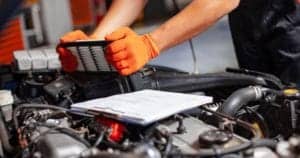
The process is now a blend of preventative maintenance and high-tech diagnostic inspection. A certified technician won't just look under the hood; they'll connect a diagnostic scanner to your car's computer to read error codes, check sensor data, and make sure all the digital systems are talking to each other correctly. This digital deep-dive is crucial for spotting subtle issues that could snowball into expensive repairs down the road.
From Simple Fixes to Smart Maintenance
This shift from mechanical tweaks to digital diagnostics is why the pricing has changed. Back in the day, a basic tune-up was a simple, low-cost affair. Now, you’re looking at an average cost of $130 to $340 for a standard service.
Industry experts point out that for a typical sedan needing new spark plugs, ignition wires, and filters, an independent shop will often charge between $150 and $250. Dealerships, on the other hand, might push that bill over $300 with their premium diagnostic fees and labor rates. If you want to see how these routine costs add up, Synchrony offers a great breakdown of vehicle maintenance expenses.
Here’s a quick look at what you can generally expect to pay depending on who you go to and what you drive.
Estimated Tune Up Cost at a Glance
This table gives a ballpark idea of tune-up costs. Remember, these are just estimates—your final price will depend on your specific vehicle's needs and local labor rates.
| Service Provider | Standard Sedan (4-Cylinder) | SUV / Truck (6-Cylinder) | Luxury / European (8-Cylinder) |
|---|---|---|---|
| Independent Repair Shop | $150 – $250 | $200 – $350 | $400 – $700+ |
| Dealership | $250 – $400 | $350 – $550 | $600 – $1,200+ |
| Chain Service Center | $130 – $220 | $180 – $300 | Varies widely |
Ultimately, a modern tune-up is an investment in your car's long-term health. It’s the difference between proactively maintaining performance and reactively fixing a breakdown on the side of a busy road.
Think of it this way: a tune-up is your best defense against unexpected car trouble. It restores your engine's efficiency, improves gas mileage, and gives you peace of mind.
This preventative service is designed to bring your car back to peak reliability. The core services almost always include:
- Replacing Spark Plugs: This is key for ensuring your fuel burns properly, giving you optimal power and better gas mileage.
- Inspecting Ignition System Components: A technician will check the coils and wires that deliver the electrical spark.
- Changing Filters: The engine air filter and fuel filter get swapped out so your engine can breathe clean air and get uncontaminated fuel.
- Checking Fluids and Belts: All essential fluids are topped off, and the belts are inspected for any signs of cracking or wear.
Here at Kwik Kar in Richardson, TX, our ASE-certified technicians combine this hands-on work with the latest diagnostic tools. We give you a crystal-clear picture of your vehicle's health so you can drive with confidence.
What Services Your Tune Up Should Include
When you hear the phrase "car tune-up," you might picture a mechanic just swapping out a few old parts. But the reality of a modern tune-up is a lot more involved, which is why it's such a critical investment in your car's health and performance. The price tag isn't just for a couple of components; it reflects a whole checklist of services.
Think of it like this: you aren't just buying parts. You're paying for a skilled technician's time and expertise to get your engine running in perfect harmony again. Every single step works together to boost your fuel efficiency, restore power, and head off much more expensive repairs down the road. It’s a process that goes way beyond a simple oil change.
This infographic does a great job of showing how the focus of a tune-up has shifted over the years from basic mechanical replacements to complex system analysis.
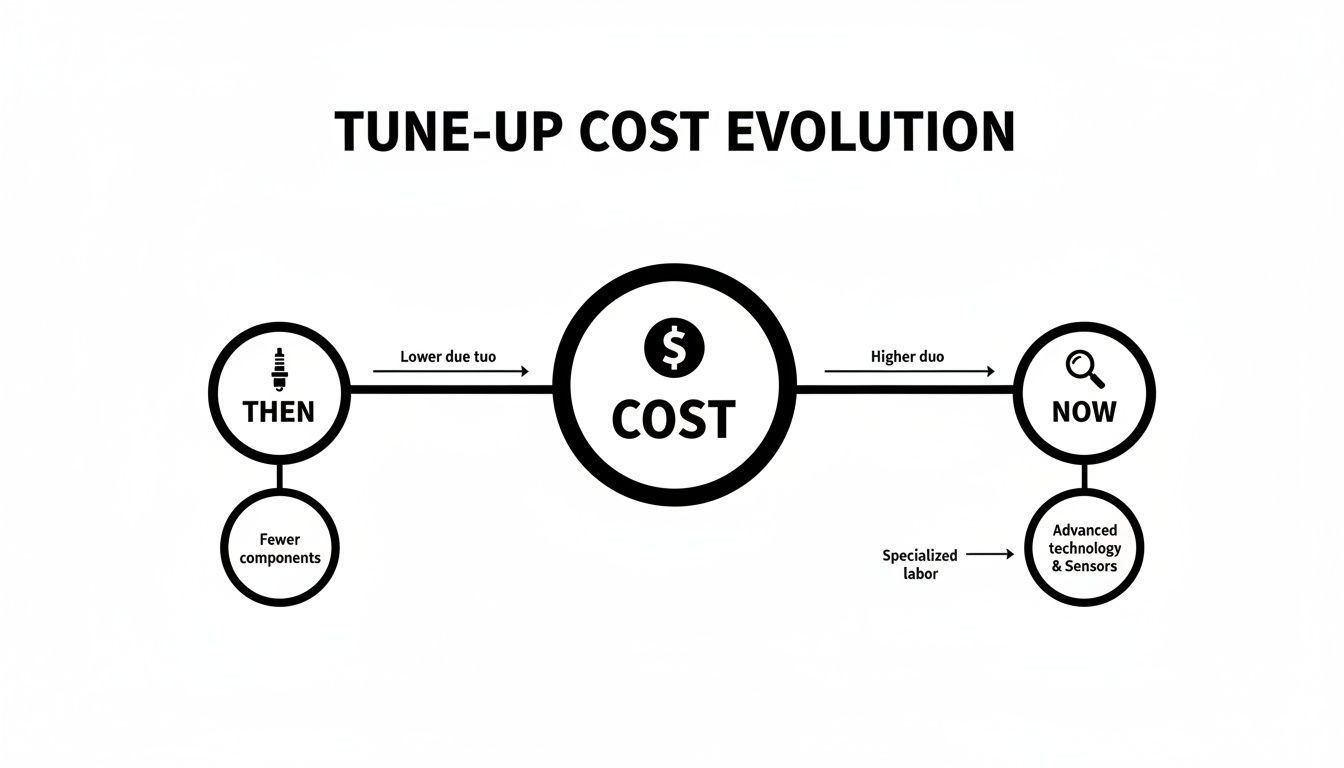
As you can see, older tune-ups were all about physical parts like spark plugs. Today, it’s just as much about using advanced diagnostic tools to make sure the entire engine management system is dialed in correctly.
Core Components of a Quality Tune Up
So, what are you actually paying for? A certified technician will systematically inspect and replace key parts that wear out with time. Here’s a quick breakdown of the essential services that should always be on the list.
Spark Plug Replacement: Fresh spark plugs are the heart and soul of any real tune-up. They create the spark that ignites the fuel and air in your engine. When they get old and worn out, you'll feel it in the form of engine misfires, sluggish acceleration, and just plain awful gas mileage. If you think you're already having issues, our guide on bad spark plug symptoms can help you spot the warning signs.
Ignition System Inspection: The technician won't just stop at the plugs. They'll also check related parts like the ignition coils and wires, which are responsible for delivering that high-voltage jolt to the spark plugs. If one of these fails, the spark never happens, leading to a rough idle or a car that won't start at all.
Filter Replacements: Your engine needs two things to run well: clean air and clean fuel. A tune-up almost always includes replacing the engine air filter and the fuel filter. A clogged air filter is like making your engine breathe through a dusty mask—it suffocates its power and kills efficiency.
A comprehensive tune-up is all about proactive care. It addresses the small, inexpensive wear-and-tear items before they cause a domino effect of expensive, system-wide failures.
Beyond the Basics: Fluid and System Checks
A truly thorough service doesn't stop with plugs and filters. It also includes a series of crucial inspections to make sure all the related systems are in good shape.
- Fluid Level and Condition Check: This covers your engine oil, coolant, and transmission, brake, and power steering fluids. If any of these are low or dirty, it can lead to overheating and catastrophic failure of major components.
- Belt and Hose Inspection: A technician will look for any cracks, fraying, or soft spots in the serpentine belt and the various hoses under the hood. A snapped belt can disable your car instantly, leaving you stranded.
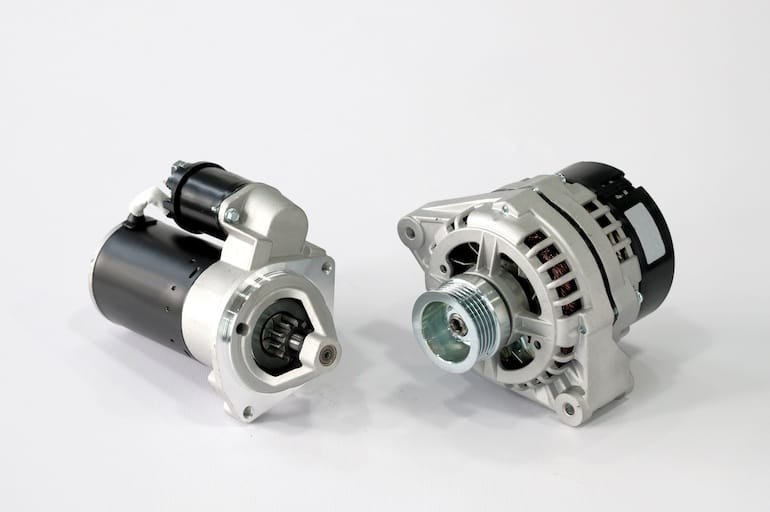
- Battery and Charging System Test: The shop will test the battery's health and confirm the alternator is charging it properly. This simple check can prevent the headache of getting stranded with a dead battery.
Here at Kwik Kar, our ASE-certified technicians perform every one of these steps. We make sure your vehicle leaves our Richardson shop running as smoothly and reliably as possible.
Key Factors That Drive Your Final Price
The final figure on your tune-up invoice isn't pulled out of thin air. Think of it more like a recipe where different ingredients—your car's specifics, your location, and your parts choices—all combine to create the total cost. Understanding these factors helps you see the "why" behind the price and know what to expect when you get a quote.
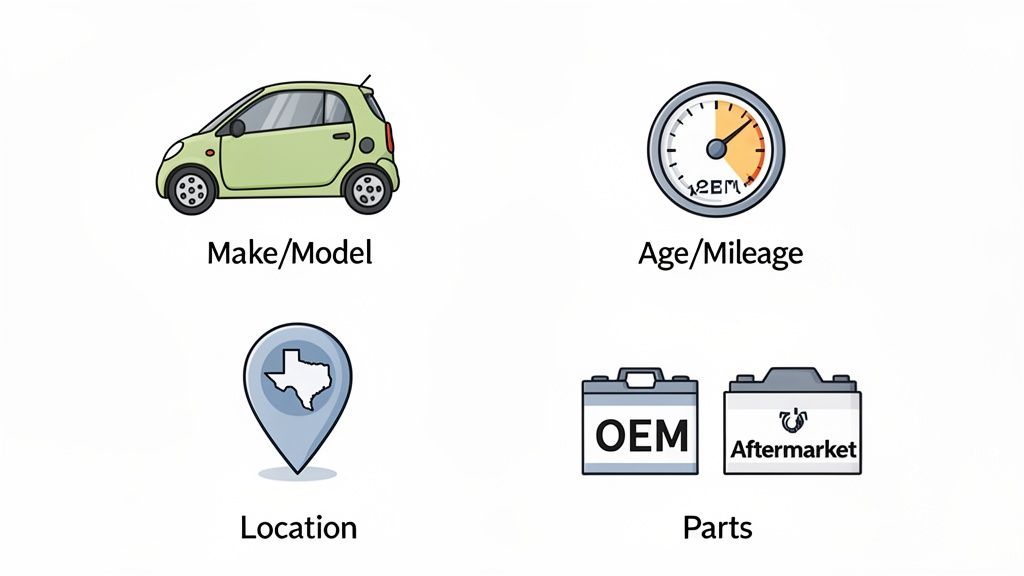
Four main variables will really move the needle on how much a tune-up costs. Knowing what they are puts you in a much better position to budget for the service and ask the right questions at the shop.
Your Vehicle's Make and Model
The single biggest price driver is the car you drive. There’s a world of difference between servicing a domestic sedan like a Honda Accord and tuning up a European luxury vehicle like a BMW. This all comes down to two things: parts cost and how complex the job is.
For example, the spark plugs for a common Honda might cost around $8 to $15 each. But the high-performance iridium or platinum plugs for a BMW? Those could easily run $25 to $50 per plug. Luxury and performance brands often require specialized tools and more time-consuming procedures, which naturally increases the labor bill.
It's a well-known trend in the auto world. A survey from Consumer Reports showed that Buick and Lincoln owners tend to pay the least for maintenance over ten years—sometimes only a quarter of what Land Rover owners spend. For a tune-up, that might translate to $200 for the Buick versus $400 or more for the BMW, especially with dealership markups that can climb as high as 60%. You can see a full breakdown of how ownership costs vary by brand on ConsumerReports.org.
Age and Mileage of Your Car
Just like people, cars need a bit more attention as they get older. A vehicle with over 100,000 miles on the odometer is going to need a more intensive tune-up than a newer car with only 30,000 miles.
An older car’s tune-up is less about routine replacement and more about addressing the accumulated wear and tear of years on the road.
Components like belts, hoses, and fluids that might still be fine on a newer car are often due for replacement on a high-mileage vehicle. This means the service naturally becomes more involved, adding both parts and labor to the final cost.
Your Geographic Location
Believe it or not, where you live matters. Labor rates for auto mechanics can vary quite a bit from one city to another, driven by the local cost of living and simple market demand. A tune-up at a shop here in Richardson, TX, will likely have a different price tag than the exact same service performed in a different state.
This local factor is a crucial piece of the puzzle. It’s always best to get quotes from trusted local shops to get an accurate picture for your specific area.
Quality of Replacement Parts
Finally, you have a choice when it comes to the parts themselves. This is one area where you have some control over the final bill.
- OEM (Original Equipment Manufacturer) Parts: These are made by your car’s manufacturer and are identical to the parts your vehicle came with from the factory. They guarantee a perfect fit but are almost always the most expensive option.
- Aftermarket Parts: Made by third-party companies, these parts are designed to fit and function like the originals. Quality can range from excellent to just okay, but they are consistently more affordable.
The choice between these parts can directly impact your final bill. The same goes for fluids—for instance, the type of oil you choose makes a difference. You can learn more in our article about the differences between synthetic vs. conventional oil.
To see how these elements play out, here’s a quick comparison of how your choices can swing the final price.
How Different Factors Impact Tune Up Costs
A comparative look at how vehicle type, parts quality, and service location can affect the final price of a car tune-up.
| Factor | Lower Cost Scenario | Higher Cost Scenario | Estimated Price Impact |
|---|---|---|---|
| Vehicle Type | Domestic sedan (e.g., Honda Accord) | European luxury SUV (e.g., BMW X5) | $150 – $400+ |
| Parts Quality | Standard aftermarket parts | OEM (Original Equipment Manufacturer) parts | $50 – $250+ |
| Geographic Area | Shop in a rural or suburban area | Dealership in a major metropolitan city | $50 – $200+ |
As you can see, the combination of a luxury vehicle, OEM parts, and a high-cost area can easily double or even triple the price of a tune-up compared to a more common car with aftermarket parts. It really pays to understand what you're paying for.
DIY Tune Up vs Professional Service
When your car is due for a tune-up, the age-old question pops up: should you roll up your sleeves and do it yourself, or hand the keys over to a pro? It’s the classic trade-off between cost, time, and risk. Making the right call for your car and your wallet starts with understanding what each option really involves.
The biggest draw for a DIY tune-up is, of course, the potential savings on labor. Since labor can easily make up 50% or more of the final bill, it’s a tempting thought. If you’re mechanically inclined and already have a decent tool collection, it can be a satisfying way to get to know your vehicle better while saving some cash.
But going it alone isn’t always as straightforward as it seems.
The Realities of a DIY Tune Up
Taking the DIY route requires more than just a can-do attitude. Servicing a modern vehicle properly means having a specific set of tools that goes well beyond a basic socket set. You'll likely need:
- A torque wrench to tighten spark plugs to the manufacturer's exact specifications—too tight or too loose can cause big problems.
- Specialized spark plug sockets and gapping tools.
- A diagnostic code reader to understand what your car's computer is trying to tell you.
- Various filter wrenches and other hand tools you might not have lying around.
Investing in these tools can quickly chip away at your initial savings, sometimes adding up to hundreds of dollars. Then there's your time. A job that a seasoned mechanic knocks out in an hour or two could easily eat up your entire weekend, especially if you run into a stubborn bolt or an unexpected problem.
Perhaps the biggest risk is making a mistake. Cross-threading a single spark plug or using the wrong type of fluid can lead to serious engine damage—a repair far more expensive than the original tune-up. The decision to tackle a project yourself versus hiring a pro is a common one in all areas of car care, as highlighted in this guide on DIY car care versus professional application.
The Value of Professional Expertise
Choosing a certified shop like Kwik Kar for your tune-up offers a different kind of value: peace of mind. You're not just paying for parts and an hour of labor; you're paying for expertise and the assurance that the job is done right.
Professional service turns a potentially risky weekend project into a guaranteed outcome. You are investing in the technician’s years of training, specialized diagnostic equipment, and accountability for their work.
Certified technicians use advanced diagnostic scanners that can spot subtle electronic issues a basic DIY code reader would miss entirely. They've done this exact service on hundreds of cars just like yours, giving them an efficiency and an eye for detail that only comes from deep experience.
Most importantly, shops that are ASE, CARFAX, and RepairPal certified—like Kwik Kar in Richardson—stand behind their work. If something isn't right after the service, you have recourse. That guarantee is a powerful counterweight to the risks of a DIY repair, making professional service a smart investment in your vehicle’s long-term health and reliability.
The Hidden Costs of Skipping a Tune Up
It's easy to look at a car tune-up as just another bill to pay. But that’s a common mistake. A better way to think about it is as a critical investment in your car's future—a shield against the massive, unexpected repair bills that catch so many drivers completely off guard. The hard truth is, skipping routine maintenance doesn't actually save you money. It just pushes the cost down the road, and it usually comes back with interest.
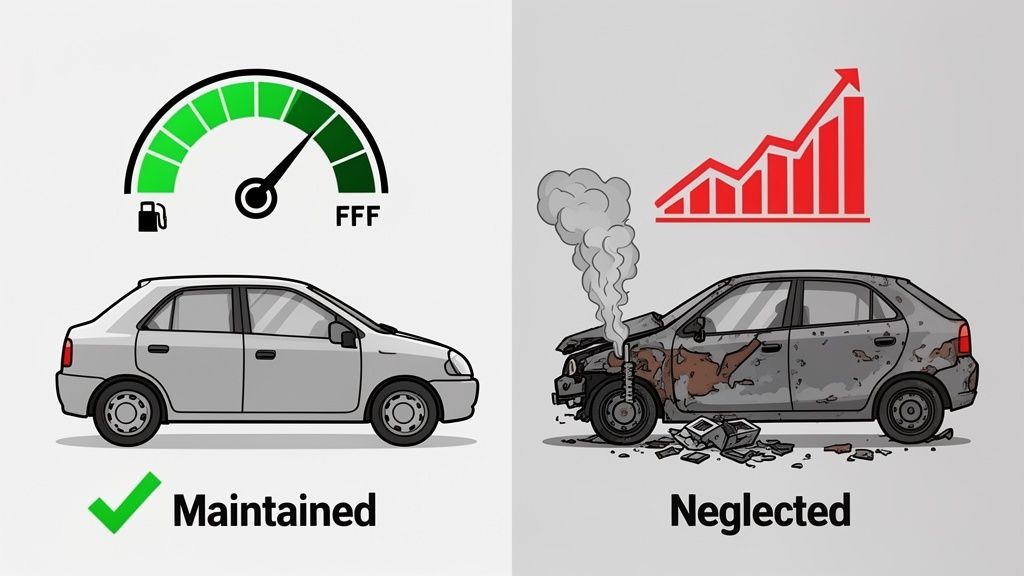
When you ignore the small, affordable fixes that are part of a tune-up, you start a domino effect that can lead to some truly catastrophic failures. These aren't just little inconveniences; they're the kind of budget-breaking problems that could have been easily avoided.
The Domino Effect of Neglect
Let's walk through a real-world example. A new set of spark plugs might be a relatively small part of a tune-up bill. But if you skip it, the old, worn-out plugs can't burn fuel efficiently anymore. This starts sending unburnt fuel into the exhaust system, which superheats and eventually destroys the catalytic converter. That's a repair that can easily run from $1,500 to $3,000.
Just like that, a minor issue snowballs into a major financial headache. And it doesn't stop there. Neglecting your tune-ups can lead to other serious and pricey problems, like needing a significant ignition repair or replacement.
Skipping a tune-up is like ignoring a small leak in your roof. At first, it's just a drip. But before you know it, you're dealing with a collapsed ceiling and a flooded living room—a problem far bigger and more expensive than the initial fix ever would have been.
More Than Just Repair Bills
The financial pain of neglect goes way beyond a single big repair bill. The consequences add up over time, draining your wallet in ways you might not even connect back to that missed appointment.
- Plummeting Fuel Efficiency: An engine that's not running right has to work much harder, burning more gas just to get you down the road. With worn-out spark plugs and clogged filters, your fuel economy could drop by 10-20%. That adds up to hundreds of dollars wasted at the pump every year.
- Failed Emissions Tests: Here in Texas, your vehicle has to pass a state emissions test. Components that get checked during a tune-up are often the main reason for a failed test, which means you're on the hook for mandatory repairs before you can legally drive your car again.
- Severe Engine Damage: Proactive maintenance isn't just about performance; it’s about preventing a total disaster. Think of tune-ups as inflation fighters in a world where car repair costs are only going up. Getting full services every 30,000 miles can cut your chances of a major repair by 35%, saving an average of $1,200. For older cars, a tune-up that includes a timing belt can stop engine damage that costs anywhere from $4,000 to $10,000 to fix.
In the end, the choice is pretty clear. The modest cost of a regular tune-up is your best defense against the hidden, long-term, and wallet-busting expenses of neglect.
Why Richardson Drivers Trust Kwik Kar
When it comes down to it, choosing an auto shop is all about trust. Sure, you're asking "how much does a tune up cost," but what you're really asking is who you can count on for a straight answer and work that’s done right the first time. Here in Richardson, drivers keep coming back to Kwik Kar because we earn that trust from the moment you walk through our door.
Our reputation for excellence isn't just something we talk about; it's something we've proven time and again. Our shop is staffed with ASE-certified technicians—the gold standard in the auto repair world. That expertise is backed up by recognitions from names you already know and trust, like CARFAX, RepairPal, and NAPA AutoCare. You get dealership-level quality without the dealership-sized bill.
A Commitment to Our Community
We're part of this community, and we believe in taking care of those who take care of all of us. That’s why we’re proud to offer special discounts for military members, first responders, and healthcare workers. It’s just a small way for us to say thank you for everything you do.
At Kwik Kar, seeing is believing. We use state-of-the-art diagnostic tools to show you exactly what’s going on with your vehicle. No guesswork, no pressure—just a clear, accurate picture so you can make the right call for your car.
We invest in the best technology and ongoing training for one simple reason: it means we can tackle anything your car throws at us, from a basic check-up to a tricky diagnostic puzzle. You can learn more about how our ASE and RepairPal certifications directly benefit you and your vehicle.
Ready to see what honest, hassle-free auto care feels like? Give us a call for a straightforward estimate or schedule your appointment today.
Frequently Asked Questions About Tune Up Costs
Even after breaking it all down, you probably still have a few questions floating around. Let's tackle some of the most common ones we hear from drivers right here in our Richardson shop to clear up any final confusion.
How Often Should I Get a Tune Up?
This is the big one, and the honest answer is: it depends. Most modern cars can go a long time between major services, typically somewhere in the 60,000 to 100,000-mile range. But your owner's manual is always the final word on the matter.
Think of the manual as your car's specific health plan. Always check the manufacturer's suggested maintenance schedule first. Keep in mind that if you do a lot of tough driving—like constant stop-and-go traffic on 75—you might need service a bit sooner to keep everything running smoothly.
Is a Tune Up the Same as an Oil Change?
Not at all—they're completely different animals. An oil change is a quick, routine job focused on one thing: replacing your engine's oil and filter. It’s absolutely vital for lubrication, but it doesn't touch the ignition system, other filters, or involve any deep performance diagnostics.
Here’s a good way to think about it: An oil change is like grabbing a quick, healthy lunch. A tune-up is like going for your full annual physical—the doctor checks your vitals, runs tests, and makes sure your entire system is in top shape for the year ahead. Both are critical for your health, but they serve very different purposes.
Can a Tune Up Fix My Check Engine Light?
It certainly can, but it's not a magic bullet. The check engine light can pop on for hundreds of reasons, from something as simple as a loose gas cap to a major transmission issue. A key part of any modern tune-up is running a diagnostic scan to read the specific error code that triggered the light.
If that code points to a worn-out spark plug, a failing ignition coil, or a clogged fuel filter—all things that are addressed during a tune-up—then yes, the service will absolutely solve the problem and turn off the light.
Ready to give your car the expert attention it deserves? The ASE-certified technicians at Kwik Kar Oil Change and Auto Care combine dealership-level skill with the honest, transparent service you expect from a local shop. Schedule your tune-up with us today and drive with confidence.