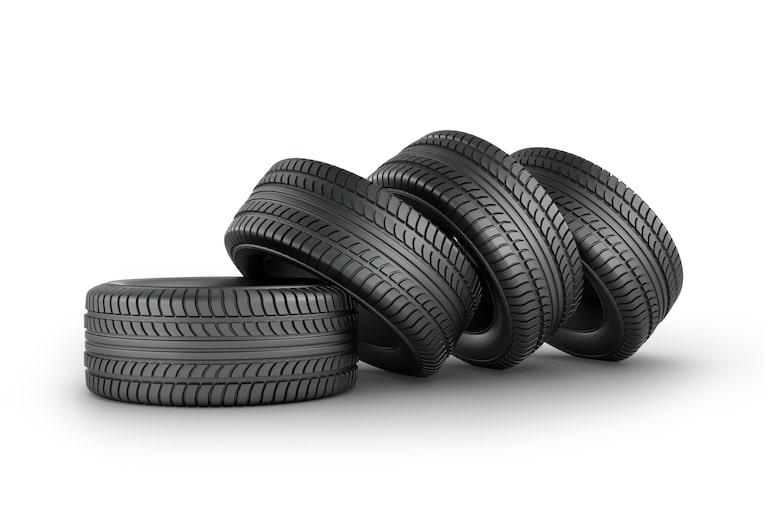
If you ask most experienced mechanics or check your owner's manual, you'll get a pretty consistent answer: rotate your tires every 5,000 to 8,000 miles. A good way to remember this is to get it done every other oil change, or roughly every six months.
Think of it like any other routine maintenance. You change your oil to protect your engine, and you rotate your tires to protect your investment in them. Sticking to this simple schedule is the single best way to prevent uneven wear and keep your car handling exactly how it should.
Unpacking the Standard Tire Rotation Schedule
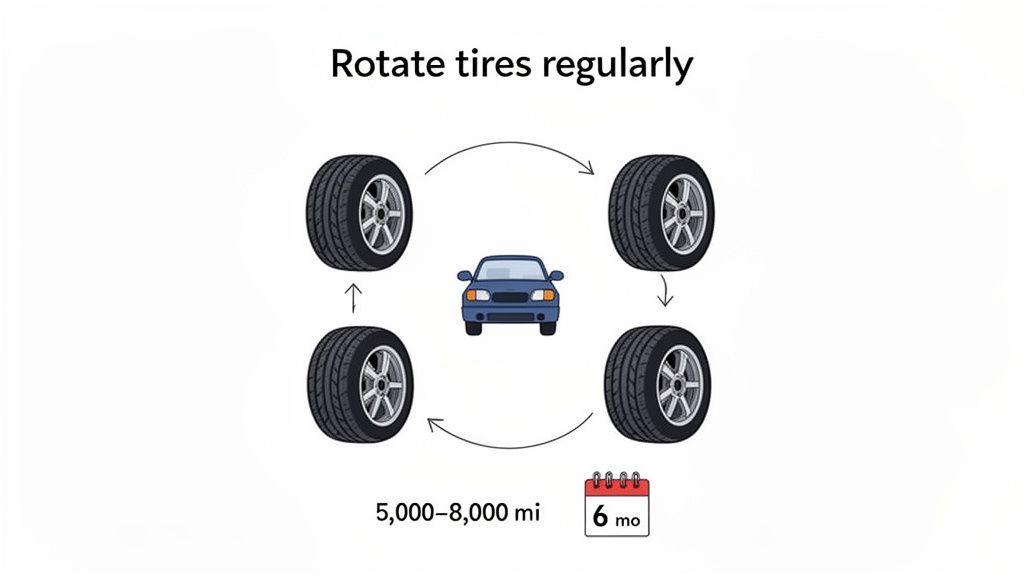
That 5,000 to 8,000-mile rule of thumb isn't just a number someone pulled out of thin air. It's a time-tested guideline based on the simple physics of how cars work, and it's been the industry standard for decades for a good reason.
On most vehicles, the front tires have a much tougher job than the rears. They bear the brunt of the braking forces, handle all the steering, and support the heavy weight of the engine. All that extra stress means they wear down significantly faster.
This is especially true for the front-wheel-drive cars that make up the majority of vehicles on the road today. Since the front wheels are doing both the steering and the pulling, they experience dramatically uneven wear compared to the rear tires, which are essentially just along for the ride.
A Quick Reference for Common Vehicles
While the 5,000 to 8,000-mile range is a fantastic starting point, your vehicle’s drivetrain—that is, which wheels receive power from the engine—can create slightly different wear patterns. To give you a more specific idea, we've put together a quick cheat sheet.
Recommended Tire Rotation Intervals at a Glance
This table breaks down the general guidelines based on your car's drivetrain, helping you fine-tune your maintenance schedule.
| Drivetrain Type | Recommended Rotation Interval (Miles) | Common Rotation Pattern |
|---|---|---|
| Front-Wheel Drive (FWD) | 5,000 – 7,500 | Forward Cross |
| Rear-Wheel Drive (RWD) | 6,000 – 8,000 | Rearward Cross |
| All-Wheel Drive (AWD) | 5,000 – 7,000 | X-Pattern or Rearward Cross |
| Electric Vehicles (EVs) | 5,000 – 6,000 | Varies by Manufacturer |
As you can see, the interval changes slightly depending on which tires are doing the most work. The goal is always the same: keep the wear as even as possible across the board.
By redistributing the wear evenly across all four tires, you ensure none of them wear out prematurely. This simple maintenance task not only saves you money but also preserves predictable handling and braking, which is crucial for safety.
Ultimately, staying on top of your tire rotations is one of the easiest and most cost-effective ways to care for your vehicle. For a more detailed breakdown, check out our guide on the cost of tire rotation.
Why Regular Tire Rotation Is Not Optional
It’s easy to think of tire rotation as just another suggested maintenance item on a long checklist, something you can put off. That’s a common—and costly—mistake. In reality, tire rotation is a fundamental part of responsible car ownership that directly impacts your wallet and, more importantly, your safety on the road.
Skipping it is like a long-distance runner deciding to only train one leg. The imbalance will inevitably lead to bigger problems down the line.
Your vehicle’s tires go through drastically different levels of stress. The front tires, especially on a front-wheel-drive car, do most of the heavy lifting. They handle all the steering forces, absorb the majority of the braking friction, and carry the heavy weight of the engine. Because of this uneven workload, they wear down much faster than the tires in the back.
Extend the Life of Your Tires
The most immediate and obvious benefit of regular tire rotation is financial. Let's be honest, a new set of quality tires can easily set you back anywhere from $500 to over $1,000. By simply moving each tire to a different spot on the vehicle at regular intervals, you allow the tread to wear down evenly across the whole set.
This simple maintenance task can add thousands of miles to the life of your tires, pushing back that expensive replacement day. It’s all about getting the maximum value out of your investment and avoiding a situation where two tires are bald while the other two still have plenty of life left.
An analysis by industry experts shows that consistent rotations can extend tire life by up to 20%. Over the lifetime of a vehicle, that can translate into saving the entire cost of one full set of tires.
Ensure Safer and More Predictable Handling
Beyond just saving money, consistent tire rotations are absolutely crucial for your safety. When your front tires are significantly more worn than the rears, your car's handling becomes unbalanced and unpredictable. This imbalance can have serious consequences in critical moments.
Imagine you have to slam on the brakes or swerve to avoid something on a wet road. That uneven tread depth can cause a world of trouble:
- Reduced traction on the worn-out tires, which dramatically increases the risk of hydroplaning.
- Longer braking distances, as the tires with less tread struggle to grip the pavement.
- Poor cornering stability, making the vehicle feel sluggish, unresponsive, and much harder to control.
A professional rotation ensures all four tires keep a similar tread depth, giving you balanced grip and predictable performance. It means your car will respond exactly how you expect it to, whether you're navigating a sharp turn or reacting to a sudden stop in traffic.
Improve Fuel Efficiency
Finally, even tire wear actually helps your fuel economy. When tires wear down unevenly, it increases their rolling resistance—that’s the force your engine has to overcome just to keep the tires moving. The more resistance, the harder your engine has to work, and the more fuel it burns.
While the savings at each fill-up might seem small, they really do add up over time. By keeping your tires properly rotated, you ensure they roll as smoothly and efficiently as possible, helping you squeeze a few more miles out of every single gallon.
How Your Car and Driving Style Change the Rules
That standard 5,000 to 8,000-mile guideline for tire rotation is a fantastic starting point, but it’s definitely not a one-size-fits-all rule. Think of it more like a general recommendation that needs fine-tuning based on your specific car and, just as importantly, how you drive it.
Your vehicle's drivetrain and your daily habits on the road are the two biggest factors that can change the game, either shortening that interval or letting you stretch it out a bit longer. To really nail down the right schedule, you have to look at the unique forces your tires are up against every day.
The Drivetrain Difference
Your car's drivetrain—the system that sends power from the engine to the wheels—has a huge say in which tires wear out the fastest. Each setup creates its own distinct wear pattern, and that means your rotation strategy needs to match.
Front-Wheel Drive (FWD): This is the most common setup you’ll find. The front wheels are the workhorses, handling everything from steering and braking to pulling the car forward. Because they do so much, the front tires can wear down twice as fast as the ones in the back. For FWD cars, sticking closer to the 5,000-mile mark for rotations is a smart move.
Rear-Wheel Drive (RWD): On RWD vehicles, the job is split more evenly. The front tires manage the steering, while the rear tires push the car forward. This balanced workload generally leads to more even wear, so you can often push the rotation interval out to the 7,000 to 8,000-mile range without worry.
All-Wheel Drive (AWD): AWD systems are sophisticated, constantly distributing power to all four wheels. To keep these complex systems from suffering expensive damage, it is critical that all four tires wear down at almost the exact same rate. This need for uniformity means AWD vehicles actually require more frequent rotations, usually every 5,000 to 7,000 miles.
AWD owners, this is especially for you: a difference in tread depth of just 2/32 of an inch between tires can start to strain the vehicle’s drivetrain. Ignoring rotations can lead to some seriously expensive repairs down the road.
How Your Driving Habits Accelerate Wear
Beyond the mechanics of your car, your personal driving style plays a massive role in the tire-wear equation. Some habits are simply tougher on your rubber, and if they sound familiar, you'll need to adjust your rotation schedule to compensate.
If any of these describe your daily drive, you should probably think about rotating your tires more often, maybe as frequently as every 4,000 to 5,000 miles.
Aggressive Driving: Are you quick on the gas pedal or someone who takes corners with a bit of speed? Hard braking, fast acceleration, and sharp cornering literally scrub rubber off your tires, particularly on the outside edges of the front ones.
Heavy Loads: If you regularly haul heavy cargo in your truck bed or tow a trailer, you’re putting a ton of extra strain on your rear tires. The added weight compresses the rubber and increases friction with the road, quickly creating uneven wear between the front and back.
City Traffic: Stop-and-go driving might not seem intense, but it’s surprisingly hard on your tires. All the constant braking, accelerating, and tight turns you do in city traffic cause much faster wear than cruising at a steady speed on the highway.
At the end of the day, the best rotation schedule is a personalized one. By looking at both your car’s setup and your daily driving demands, you can create a maintenance plan that gets the most life out of your tires and keeps you driving safely.
Five Telltale Signs Your Tires Need Rotation Now
While sticking to a mileage-based schedule is a great practice, your car has its own ways of telling you it needs attention. Think of it like this: a schedule is a guideline, but your car provides the real-time feedback. Listening to your vehicle and performing quick visual checks can help you spot the need for a rotation before a small issue snowballs into a big problem.
Learning these warning signs empowers you to be a proactive car owner. Don't wait for your next scheduled service if you notice any of these five symptoms—addressing them early is the best way to protect your tire investment and keep your ride safe.
This visual guide breaks down the most common symptoms that signal it's time to rotate those tires.
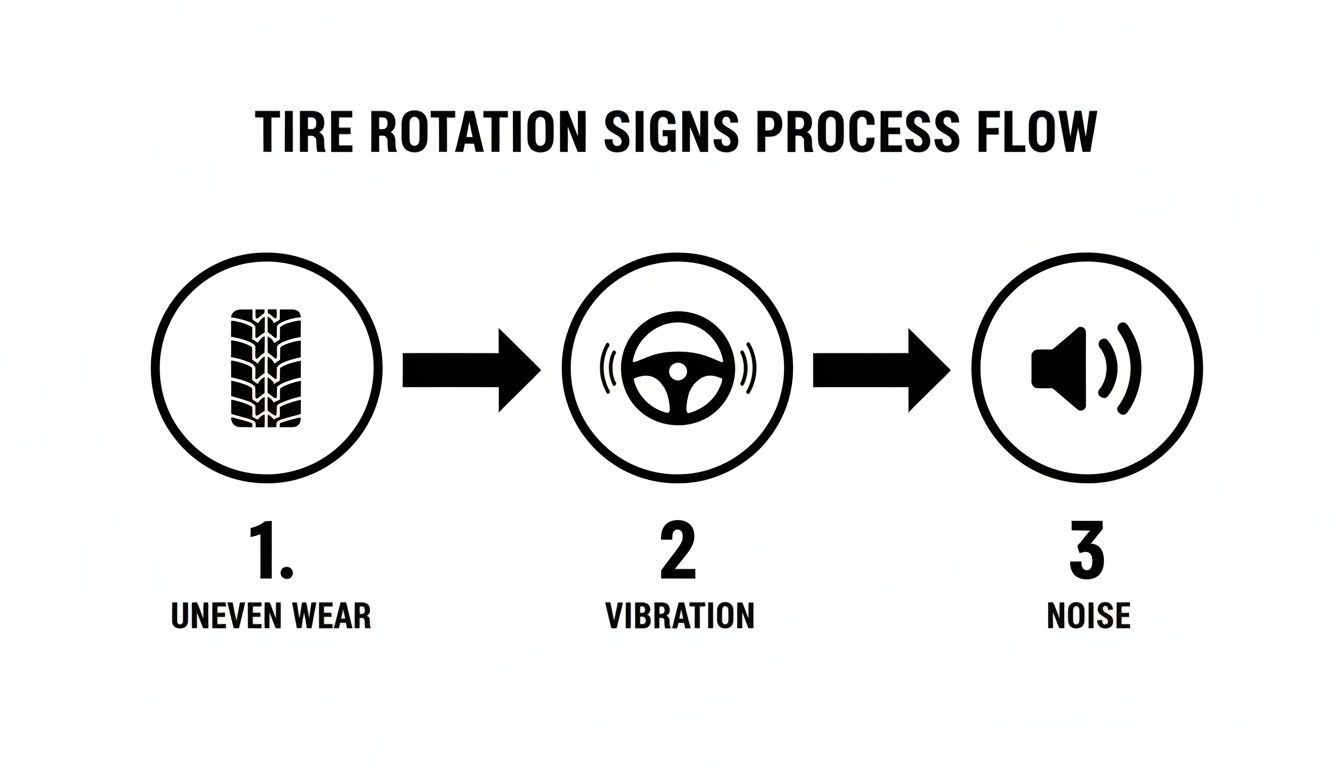
As you can see, the symptoms often progress from something you can see (uneven wear) to things you can feel (vibrations) and hear (unusual noises).
1. Uneven Tread Wear
This is the most direct, visual sign your tires need to be moved. Since front tires wear faster on most vehicles, you’ll often see the difference if you look closely. Run your hand over the tread; does one edge feel sharper than the other? This is called feathering. You might also see cupping, which looks like scalloped dips have been scooped out of the rubber. Both are clear indicators of uneven wear.
2. Noticeable Vibration at High Speeds
If you feel a slight but persistent vibration through your steering wheel or the floorboard, especially when driving over 45 mph, your tires are a likely culprit. As tires wear unevenly, their balance gets thrown off, causing them to wobble slightly at higher speeds. While other issues can cause vibrations, an overdue rotation is one of the most common reasons for that shaky feeling.
A vibration you feel in your steering wheel usually points to an issue with the front tires. If the vibration is felt more through your seat, the problem is likely with the rear tires.
3. Unusual Humming or Whirring Noises
Your tires should roll quietly on a smooth road. If you start hearing a rhythmic humming or whirring sound that gets louder as you accelerate, it’s often due to irregular tread wear. The uneven surfaces of the tire create a distinct noise pattern as they slap against the pavement. That sound is a clear audible cue that your tires aren't meeting the road uniformly.
4. Pressure Loss in One Tire
Are you constantly adding air to one specific tire? While a slow leak from a nail or puncture is possible, consistent pressure loss in just one tire can also be a symptom of uneven wear creating a poor seal with the wheel rim. Checking that you have the correct tire pressure is fundamental to tire health, and if one tire is always low, it's a sign it needs a closer look and probably a rotation.
5. Reduced Handling Performance
Finally, you know how your car should feel on the road. If it starts to feel less responsive when you turn or seems to pull slightly to one side, unevenly worn tires could be the cause. Worn front tires have less grip, which can make your car feel sluggish and less precise around corners. This decline in handling is a serious safety concern that a timely rotation can often fix right up.
What Happens During a Professional Tire Rotation?
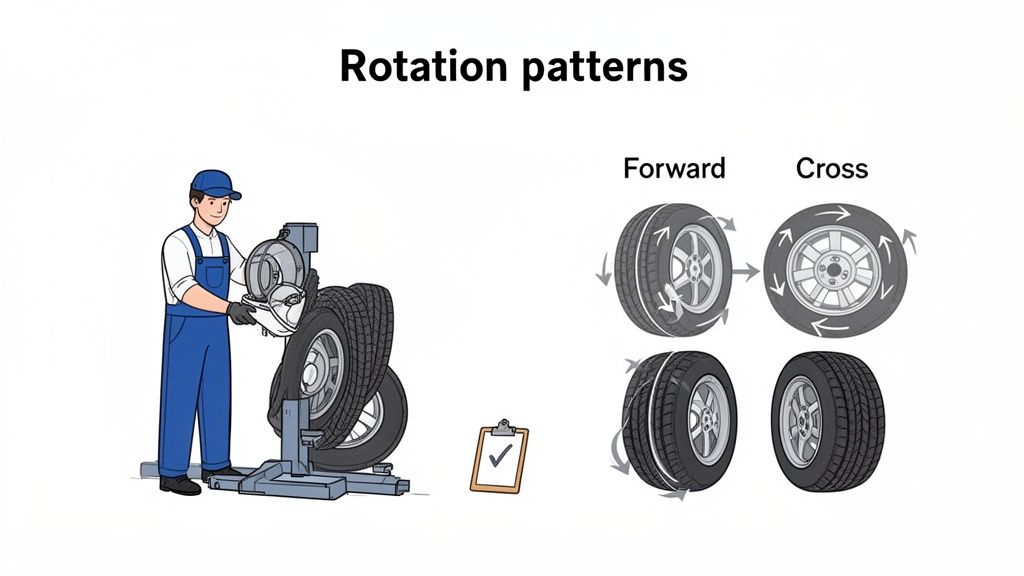
A professional tire rotation is way more than just playing musical chairs with your wheels. It’s a precise service designed to get every last mile out of your tires and keep you safe on the road. This involves specific patterns and safety checks that you just don't get with a DIY garage session.
When you bring your vehicle to a certified shop like Kwik Kar, our technicians aren't just swapping tires at random. They’re choosing a specific rotation pattern based on your vehicle's drivetrain, the type of tires you have, and the unique wear they see. Think of it like a choreographer planning a dance—every single move has a purpose.
Choosing the Correct Rotation Pattern
The whole point is to move the tires to new positions that will counteract their old wear patterns. This ensures they wear down evenly over their lifespan. A trained technician will look at your car and decide on the best approach.
- Forward Cross: This is a common pattern for front-wheel-drive vehicles. The front tires move straight back, while the rear tires cross over to the opposite sides up front.
- X-Pattern: Also a popular choice for FWD cars, this pattern swaps all four tires diagonally. The front-left tire moves to the rear-right spot, and so on.
- Rearward Cross: This is the go-to pattern for rear-wheel and all-wheel-drive vehicles. The rear tires move straight to the front, while the front tires cross over to opposite sides on the rear axle.
The right pattern is everything. Using a Rearward Cross on a front-wheel-drive car, for example, wouldn’t properly fix the heavy wear on the front tires. Professional service guarantees the correct, most effective pattern is used every single time.
More Than Just Moving Wheels
Beyond picking the right pattern, a professional service includes several other critical steps. First, the technician inspects each tire for damage. They’re looking for punctures, cracks in the sidewall, or weird wear that could point to an alignment or balance problem. Since the wheels are already off, this is also the perfect time for a complimentary brake inspection.
Most importantly, a certified tech uses a calibrated torque wrench to tighten the lug nuts to the exact specifications from your vehicle’s manufacturer. Overtightening can actually damage the wheel and brake rotor, while undertightening is a huge safety risk. This precision is one of the biggest benefits of professional service—it gives you peace of mind that your wheels are secure and the job was done right.
Rotation, Balancing, and Alignment: The Trifecta of Tire Care
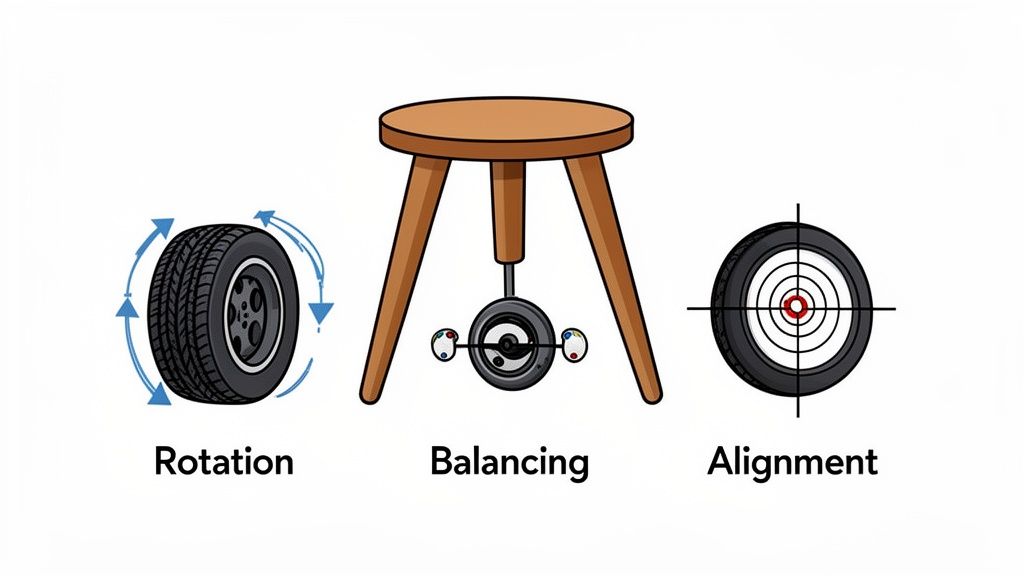
To really get the best performance, longest life, and maximum safety from your tires, a rotation is just one piece of a much bigger puzzle. Think of it as a three-legged stool—for total stability, rotation needs to work in concert with balancing and alignment.
These three distinct services form the trifecta of complete tire care. And while they all sound similar, each one solves a completely different problem. Understanding how they support one another is the key to maintaining a smooth, safe ride. Ignoring one can easily undermine the benefits of the others, leading to premature wear and potential handling issues down the road.
Defining Each Service
Let's clear up the confusion and break down exactly what each service accomplishes. Each has a specific job that directly impacts your vehicle's performance and the longevity of your tires.
Tire Rotation: This service is all about where the tire sits on your car. Its sole purpose is to make sure all four tires wear down evenly by moving them to different positions on the vehicle.
Wheel Balancing: This addresses the tire and wheel assembly itself. A technician corrects tiny imbalances in weight distribution by adding small counterweights, which eliminates those annoying vibrations you feel at higher speeds.
Wheel Alignment: This focuses on your vehicle’s suspension, not the tires. It's about adjusting the angles of your wheels so they are perfectly perpendicular to the ground and parallel to each other. In short, it’s what makes your car drive straight.
Think of it this way: Rotation is about fighting wear over time, balancing is about a smooth ride, and alignment is about driving straight. Each is critical, but they are not interchangeable.
It's common for drivers to mix these services up, but they each solve a unique problem. The table below breaks down the core differences at a glance.
Rotation vs. Balancing vs. Alignment
| Service | What It Does | When It's Needed |
|---|---|---|
| Tire Rotation | Moves tires to different positions on the vehicle to promote even tread wear. | Every 5,000-8,000 miles or with every oil change. |
| Wheel Balancing | Adds small counterweights to the wheel to correct weight imbalances, preventing vibration. | With every rotation, when you get new tires, or if you feel a vibration. |
| Wheel Alignment | Adjusts the angles of the suspension to ensure wheels are parallel to each other and perpendicular to the road. | Annually, after hitting a major pothole, or if the car pulls to one side. |
Understanding these distinctions helps you know what your car needs and when, so you can keep it running smoothly and safely.
When to Bundle Your Services
Knowing how often you should rotate your tires is just the start; knowing when to add these other services is just as important. For maximum efficiency, bundling them makes perfect sense.
A good rule is to have your wheel balance checked with every tire rotation—or roughly every 5,000 to 8,000 miles. Since the wheels are already off the car for the rotation, a balance check is a quick and logical addition.
Alignment, on the other hand, is needed less frequently. A good practice is to schedule an alignment check once a year. However, you should get it checked immediately if you hit a significant pothole, smack a curb, or notice your car pulling to one side. By coordinating these three services, you create a complete maintenance system that protects your tire investment, improves fuel economy, and ensures your vehicle is as safe as possible.
Trust Kwik Kar With Your Next Tire Rotation
Now that you know the why behind regular tire rotations, the next question is who you can trust to get the job done right. That’s where we come in. Here at Kwik Kar in Richardson, we’ve built our reputation on combining the skill of ASE-certified technicians with the precision of modern equipment, ensuring your vehicle gets the expert care it deserves.
We know that trust isn't given; it's earned. Our professional certifications from respected names like CARFAX, RepairPal, and NAPA AutoCare are more than just logos on the wall—they're a promise of our commitment to high standards and your complete satisfaction. When you drive away, you can feel confident that every bolt was tightened and every adjustment was made correctly and safely.
Why Choose Kwik Kar?
Choosing the right auto shop is about more than just maintenance; it's about peace of mind. We aim to provide a service experience that protects your investment and, most importantly, keeps your family safe on the road.
- Expertise You Can Count On: Our ASE-certified team has the deep training and real-world experience to service all makes and models.
- A Focus on Our Community: We proudly offer exclusive discounts for military personnel, first responders, and healthcare providers as a small way of saying thank you.
- More Than Just Rotations: We're a full-service, certified tire shop ready to handle everything from balancing and alignment to any other auto repair needs that come your way.
Your tires are arguably the single most important safety feature on your vehicle. Entrusting their care to a certified, reputable shop is a critical decision that directly impacts handling, braking, and your safety on the road.
Let us help you get the most life out of your tires and keep your vehicle performing at its best. Come experience the Kwik Kar difference for yourself.
Protect your investment and make sure your vehicle is ready for the road ahead. Schedule your appointment with Kwik Kar Oil Change and Auto Care today and let our certified experts take care of the rest.