That sudden, unnerving amber glow on your dashboard can trigger instant anxiety. Is your car on the brink of a major breakdown, or is it just a minor glitch? Seeing that light pop on is never fun, but understanding what it means is the first step toward a calm, methodical response.
The check engine light, officially known as the Malfunction Indicator Lamp (MIL), is your vehicle's main way of telling you that its onboard diagnostic system has detected a problem. This system is always monitoring hundreds of components and sensors, from engine performance to emissions output. When any sensor reports data outside of its normal operating range, it logs a "trouble code" and illuminates the light to get your attention.
Steady vs. Flashing: The Critical Difference
Not all check engine lights are created equal, and the way it behaves is your biggest clue to the severity of the problem.
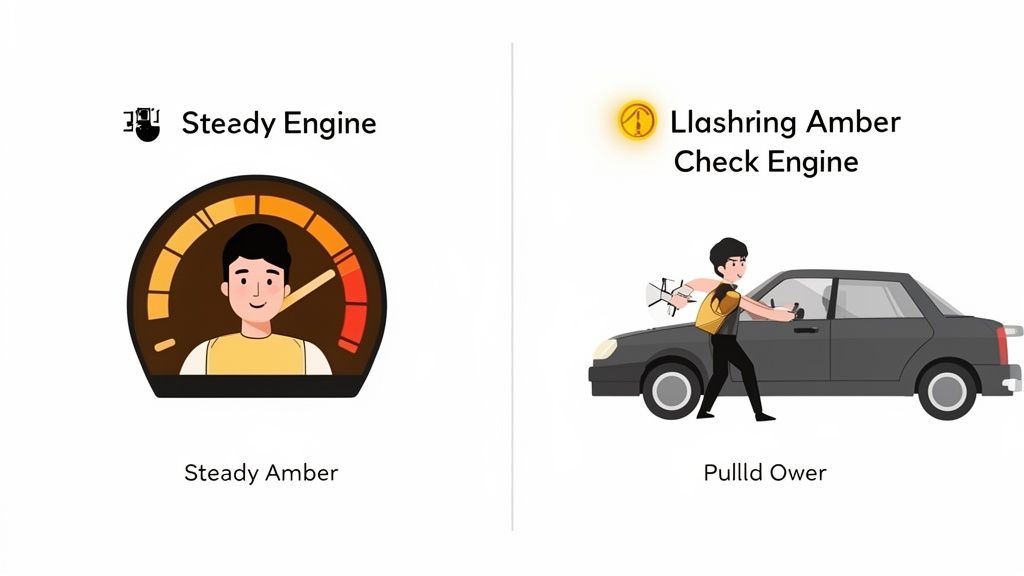
A steady, solid light is the most common signal you'll see. It typically indicates a non-emergency issue that needs to be addressed soon but doesn't require you to pull over immediately. This could be something as simple as a loose gas cap or a failing sensor.
On the other hand, a flashing check engine light is a critical warning. This almost always signals a severe engine misfire, which can quickly overheat and destroy your catalytic converter—a repair that can easily cost thousands of dollars. If your light is flashing, you need to pull over as soon as it's safe and turn off the engine to prevent catastrophic damage.
Here's a quick reference guide to help you decide what to do next based on the light's behavior.
Check Engine Light Status: What to Do Next
| Light Status | What It Means | Your Immediate Action |
|---|---|---|
| Steady | A non-urgent issue has been detected. | Check for obvious issues (like a loose gas cap). Plan to have the vehicle diagnosed soon. |
| Flashing | A severe, potentially damaging problem is occurring. | Pull over safely, turn off the engine immediately, and call for professional assistance. Do not continue driving. |
This simple distinction is the first and most important step in figuring out your next move.
This decision tree shows the immediate actions to take based on whether the check engine light is steady or flashing.
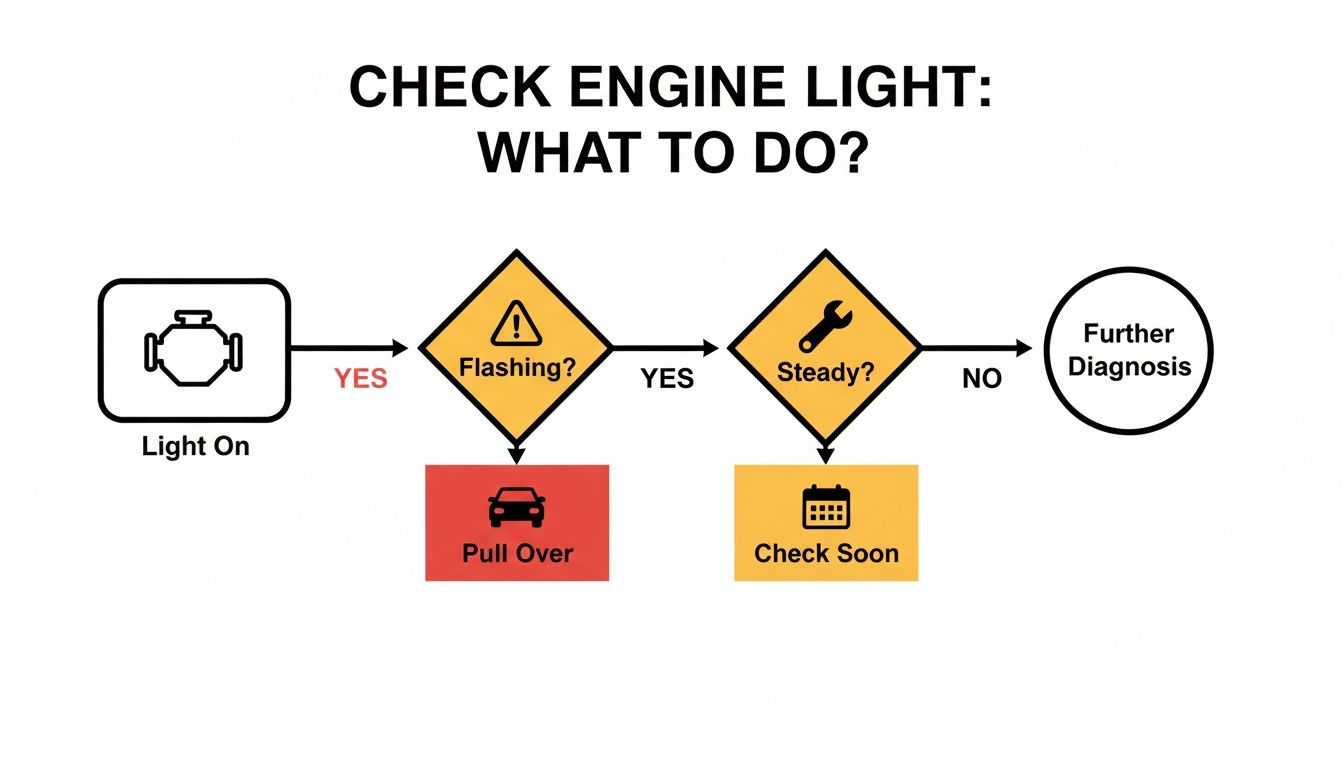
The flowchart visualizes the crucial first step in your diagnostic process: assess the light's behavior to determine the urgency of the situation.
The biggest mistake you can make is ignoring the light altogether. A small issue today, like a faulty oxygen sensor, can lead to poor fuel economy and eventually cause much bigger problems if left unchecked.
Ignoring the light is a gamble that rarely pays off. For a deeper dive into the specific systems that can trigger the alert, you can learn more about what the check engine light means in our detailed guide. Think of this light not as a problem, but as an early warning system designed to save you money and keep you safe.
Easy DIY Checks You Can Perform in Minutes
Before you even think about booking a diagnostic appointment, take a few minutes to play detective yourself. You'd be surprised how often that annoying light is triggered by something you can fix in five minutes flat, right in your own driveway.
These simple checks won't solve every mystery, of course, but they can quickly rule out some of the most common—and minor—culprits.
Let’s start with the number one offender: the gas cap. It sounds almost too simple, but a loose, damaged, or even missing gas cap is one of the top reasons a check engine light switches on. Your car’s fuel system needs to be a sealed, pressurized environment, and that cap is what creates the vacuum.
When the seal is compromised, fuel vapors escape, which triggers an alert from the evaporative emission control system (EVAP). It’s a small part doing a big job for your car's emissions.
Inspecting Your Gas Cap
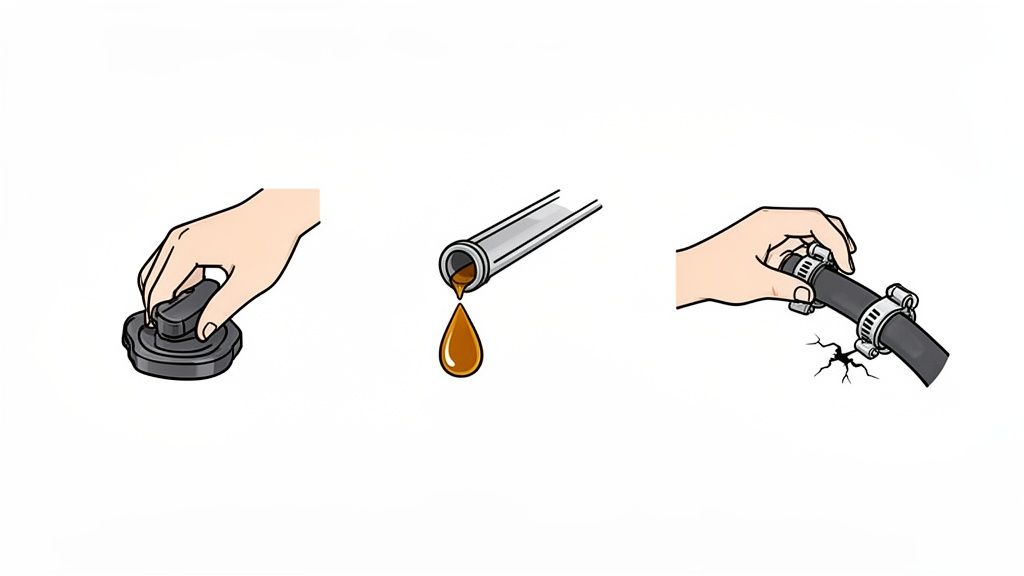
First things first, just try tightening it. Give it a few good clockwise turns until you hear it click several times. Modern caps are designed to do that once they’re secure. If it was just a little loose, that might be all it takes.
Keep in mind, it can take a few trips around town for the car's computer to recognize the fix and turn the light off. If you’re still seeing it after a day or two of normal driving, it’s time for a closer look. Unscrew the cap and give it a quick inspection.
- Check the Seal: Look at the rubber O-ring or gasket on the cap's inner rim. Is it cracked, dry and brittle, or gone altogether?
- Look for Damage: Inspect the plastic cap itself. Any obvious cracks could be enough to break that crucial seal.
If you spot any damage, the fix is easy and cheap. A new gas cap is an inexpensive part you can grab at any auto parts store, and it often solves the problem instantly.
Quick Visual Inspections Under the Hood
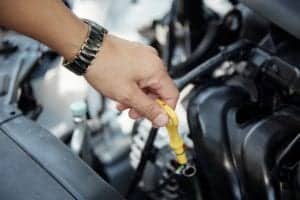
If the gas cap isn’t the issue, pop the hood and do a quick visual sweep. You don't have to be a mechanic to spot something that looks wrong. Be on the lookout for any cracked, disconnected, or bulging hoses, as these can create vacuum leaks that are notorious for triggering the light.
While you're there, take a look at your essential fluids. Low fluids won't always set off the check engine light directly, but they can be a symptom of a bigger problem that will. For a more detailed walkthrough, check out our guide on how to check your car fluids.
Pro Tip: Pay special attention to the area around the engine oil cap and dipstick. If you see any milky or sludgy-looking gunk, it could be a sign of a serious problem, like coolant leaking into your engine. That’s something that needs immediate professional attention.
Getting comfortable with these basics is a great first step. And if you're interested in learning more, exploring general DIY auto repair can give you the confidence to tackle other car issues. But if these simple checks don’t make the light go away, it’s time to bring out a diagnostic tool and dig a little deeper.
Using an OBD-II Scanner to Read Trouble Codes
If you've checked the gas cap and haven't spotted any obvious red flags, it's time to dig a little deeper. We need to move past the visual inspection and get some real data from the car itself. This is where your vehicle's On-Board Diagnostics (OBD-II) system becomes your best friend.
Think of the OBD-II system as your car’s internal health monitor. It’s a sophisticated computer that constantly keeps tabs on engine performance, emissions, and other critical functions. When it detects a problem, it logs a specific trouble code and flips on that check engine light.
Every vehicle manufactured since 1996 is equipped with an OBD-II port, which is your direct line into that computer. By plugging a scanner into this port, you can pull the exact Diagnostic Trouble Code (DTC) that triggered the light. This simple step turns a vague, mysterious warning into a concrete clue.
Locating Your Vehicle's OBD-II Port
First things first, you have to find the port. Don't worry, it's almost always inside the cabin on the driver's side, usually somewhere under the dashboard. You're looking for a 16-pin connector that’s shaped a bit like a trapezoid.
Here are the most common hiding spots:
- Directly under the steering column, just above the pedals.
- To the left of the steering wheel, sometimes tucked behind a small pop-out panel.
- In or around the center console, occasionally near the storage area.
If you're still having trouble, a quick online search for your car's year, make, and model plus "OBD-II port location" will show you exactly where to look.
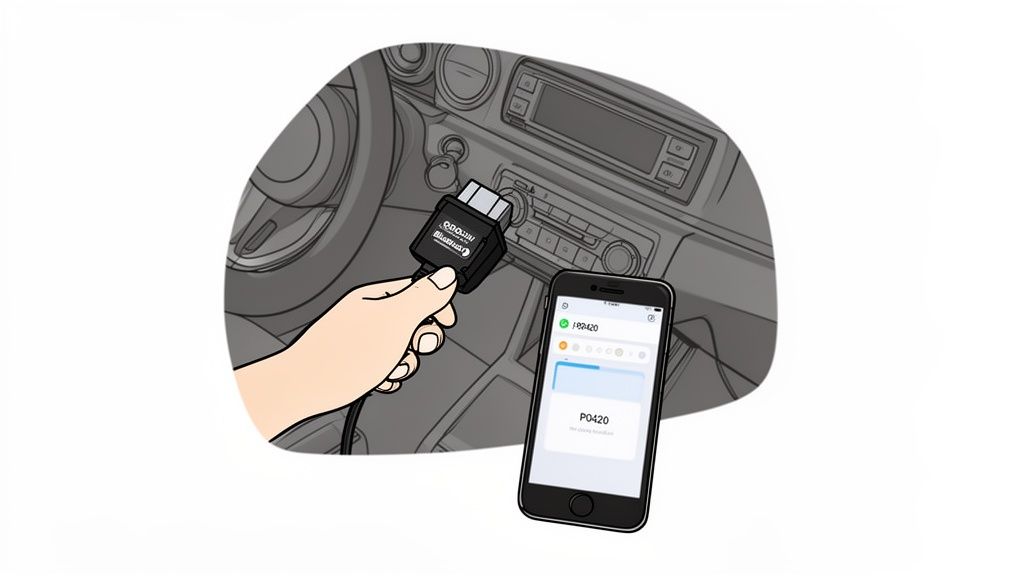
Once you’ve located it, you’ll need a tool to talk to the computer. You have two main options: a classic handheld scanner or a modern Bluetooth adapter that syncs with an app on your smartphone.
Key Takeaway: An OBD-II scanner is your most powerful tool for an initial diagnosis. It translates the check engine light into a specific code, giving you a clear starting point for understanding the problem instead of just guessing.
It's also interesting to note that some vehicles are just more prone to these lights than others. A massive CarMD analysis of over 19.5 million vehicles found that brands like Mitsubishi and Mercedes-Benz had some of the lowest frequencies of check engine light issues. This kind of data just goes to show how different cars have very different maintenance needs.
How to Connect and Read the Codes
Pulling the codes is a surprisingly quick and painless process. It only takes a few minutes, and the general steps are nearly identical whether you're using a dedicated scanner or a smartphone adapter.
Using a Handheld Scanner:
- Make sure your car is turned completely off before you start.
- Plug the scanner's cable securely into the OBD-II port.
- Turn the key to the "On" position, but do not start the engine. This gives power to the car's computer and the scanner without the engine running.
- The scanner will power up. Just follow the on-screen prompts to "read" or "retrieve" the codes. It might take a moment to establish a connection.
- Jot down the code or codes it displays. They typically start with a letter (like "P" for Powertrain) and are followed by four numbers.
Using a Bluetooth Adapter:
- Plug the adapter into the port. You should see a light on the device confirming it has power.
- Turn your key to the "On" position, just like with a handheld scanner.
- Open the Bluetooth settings on your smartphone and pair it with the adapter.
- Launch your chosen OBD-II app (popular ones include Torque or OBD Fusion) and connect to the adapter within the app.
- Find the function for reading fault codes, and the app will display whatever your car has logged.
Now you have it—a code like "P0420" or "P0300." This isn't just a random string of characters; it's the exact same starting point a professional technician uses. You’re no longer just staring at a light; you're actively on the path to finding a solution.
Decoding the Most Common Engine Light Codes
Pulling a Diagnostic Trouble Code (DTC) is a massive step forward, but the code itself is just a clue. It’s not the final diagnosis. Now the real detective work begins—connecting that string of letters and numbers to what’s actually happening under your hood.
Think of these codes as your car’s way of pointing you toward the system that's struggling. They don't name the exact broken part, but they narrow down the possibilities in a huge way. Knowing how to interpret the most common ones empowers you to have a much more informed conversation, whether you plan to tackle a fix yourself or bring it to a pro.
Codes Related to Your Emissions System
A huge chunk of check engine light issues are tied to the emissions system. It’s a complex network of sensors and parts, but a few usual suspects are responsible for the vast majority of problems. These codes often start with "P04XX."
Here are a few you're likely to encounter:
P0420 – Catalyst System Efficiency Below Threshold: This is one of the more infamous codes because it points to a potential issue with your catalytic converter. While it could mean the converter itself has failed (an expensive repair), it's often triggered by something simpler, like a faulty oxygen sensor or an exhaust leak that's throwing off the readings.
P0442 – Evaporative Emission System Leak Detected (Small Leak): Remember that loose gas cap? This is the exact code it often triggers. The system has detected a tiny leak in the fuel vapor system, and the gas cap seal is the number one culprit.
P0171 – System Too Lean (Bank 1): This code means your engine is getting too much air or not enough fuel. Common causes range from a failing Mass Airflow (MAF) sensor to a vacuum leak from a cracked hose or even a clogged fuel injector. You’ll probably feel this one as rough idling or poor acceleration.
Connecting the code to a symptom is everything. For example, a P0171 code paired with a faint hissing sound from the engine bay almost screams vacuum leak. A code alone is just data; a code plus symptoms tells a story.
Engine Performance and Misfire Codes
When the problem starts affecting how your car actually drives, you’ll often see codes related to engine misfires or sensor failures. These have a direct impact on performance and fuel economy, so you'll want to address them quickly.
The P0300 Series – Misfire Detected:
The generic code P0300 means a random, multiple-cylinder misfire is happening. If you get a more specific code like P0301 or P0302, the last number tells you exactly which cylinder is misfiring (P0301 is cylinder #1, P0302 is cylinder #2, and so on). A misfire usually feels like a shudder, stumble, or hesitation when you step on the gas.
The most common causes are pretty straightforward:
- Worn-out spark plugs
- A bad ignition coil
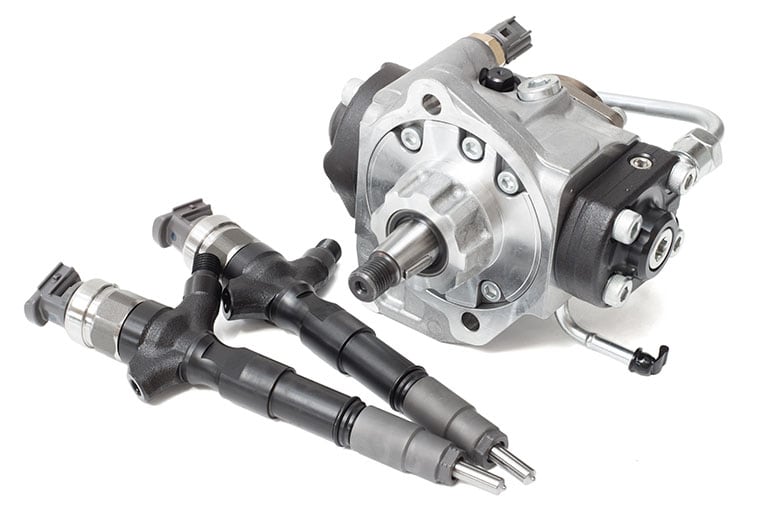
- Clogged or failing fuel injectors
A failing oxygen sensor is another frequent offender, often throwing a code like P0135. This sensor's job is to measure unburned oxygen in your exhaust so the car's computer can get the air-fuel mixture just right. When it fails, you’ll see a noticeable drop in gas mileage, and if left unchecked, it can eventually damage your expensive catalytic converter.
To make things a bit clearer, this table breaks down some of the most common codes you might pull.
Common Diagnostic Trouble Codes (DTCs) and Their Meanings
| DTC Code | Common Cause | Severity Level | Noticeable Symptoms |
|---|---|---|---|
| P0420 | Failing catalytic converter, bad O2 sensor | Moderate to High | Reduced power, poor fuel economy |
| P0171 | Vacuum leak, bad MAF sensor | Moderate | Rough idle, hesitation |
| P030X | Bad spark plug, faulty ignition coil | High | Shaking, poor acceleration |
| P0135 | Failing Oxygen (O2) Sensor | Moderate | Decreased fuel efficiency |
Ultimately, pulling a code is your starting line, not the finish line. Now that you know how to check engine light codes and what some of the most common ones mean, you can make an informed decision about your next move.
When to Trust the Pros at Kwik Kar Richardson
Knowing how to pull a check engine light code with a basic scanner is a great first step, but knowing your own limits is even more important. That little code is often just the beginning of the story, not the final chapter. It’s a clue that points you in a direction, but it rarely pinpoints the exact root cause.
This is where the line between a quick DIY fix and professional diagnostics gets drawn. We’ve seen it countless times: a driver replaces an oxygen sensor based on a code, only to have that pesky light pop back on a week later. Why? Because the real culprit was a sneaky vacuum leak or a failing fuel pressure regulator.
The scanner did its job by reporting what the sensor saw, but it couldn't see the bigger picture.
Beyond the Basic Code Reader
At Kwik Kar Richardson, our ASE-certified technicians aren't just using a simple code reader. Our diagnostic equipment is a whole different league, allowing us to dig much deeper. We can:
- Analyze Live Data Streams: We watch your car’s sensors report data in real-time, looking at things like fuel trim, engine temperature, and airflow. This lets us spot weird irregularities that a static trouble code would never show.
- Perform Functional Tests: Our tools can actually command specific parts on your car to operate. Think of it like forcing an EVAP system valve to cycle so we can test its function directly, right then and there.
- Access Manufacturer-Specific Data: We can tap into a deeper level of diagnostic information that generic consumer scanners can't even see. This gives us the full story of your vehicle's health.
This level of detail is absolutely crucial for getting the repair right the first time. Without it, you’re just throwing parts at a problem, hoping one sticks. That gets expensive fast, and the real issue might still be causing damage.
A classic example we see is a code for a misfire on cylinder three. The quick guess is a bad spark plug. But our advanced diagnostics might show that the fuel injector for that cylinder is actually failing—a problem that would have been completely missed if we only treated the most obvious symptom.
The Growing Complexity of Modern Vehicles
Cars today are more complex than ever, especially as emissions standards get tighter and tighter. In fact, the global market for automotive emission test equipment is projected to grow significantly, all because of these evolving regulations. You can learn more about the trends in automotive emissions testing and see just how intricate these systems have become.
What does this mean for you? Your car's computer is monitoring more systems with more sensitivity than ever before.
When your DIY efforts hit a dead end, or if a code points to something complicated like the transmission or catalytic converter, it’s time to call in the experts. Our team has the advanced tools and the hands-on experience to interpret the data correctly, saving you a world of time, money, and frustration.
Trusting a professional for a thorough engine diagnostic service is the surest way to get the job done right.
Your Check Engine Light Questions Answered
Even after you’ve pulled the codes, it's completely normal to have a few lingering questions. That little light has a way of causing confusion and stress. Let's walk through some of the most common concerns we hear from Richardson drivers so you can feel more confident about what to do next.
The first thought that usually pops into anyone's head is, "Is my car even safe to drive right now?" It’s the most important question, and the answer really depends on what the light—and your car—are telling you.
Can I Keep Driving With The Check Engine Light On?
If your check engine light is steady and solid, and the car feels completely normal, there’s usually no need to panic. No weird noises, no shaking, no problem getting up to speed—these are all good signs. It generally means you can continue driving for a bit, but you'll want to get it diagnosed sooner rather than later.
A flashing light is a different story entirely. This isn't a suggestion; it's a serious warning. A flashing light signals a severe issue, most often a major engine misfire. This can dump raw, unburned fuel into your exhaust system, which will absolutely destroy your catalytic converter in a hurry. That's a repair bill nobody wants.
If your light is flashing, or if you experience any of these symptoms, your next move is to pull over as soon as it's safe and shut off the engine:
- A sudden, noticeable loss of power or acceleration.
- The car starts shaking, shuddering, or idling very roughly.
- You see smoke coming from the exhaust pipe or from under the hood.
- You hear loud or unusual noises, like knocking, grinding, or popping.
In any of those situations, your best bet is to call for a tow. Driving any further could turn a repairable problem into catastrophic engine damage.
Will The Light Turn Off By Itself?
Sometimes, yes! Your vehicle's onboard computer is always running checks and monitoring systems. If the issue that triggered the light was just a temporary hiccup or something you’ve already fixed, the light may go off on its own.
The classic example is a loose gas cap. Once you tighten it, the car needs to complete a few "drive cycles" to verify the problem is gone. A drive cycle is just a sequence of starting the car, driving it under different conditions (city and highway speeds), and turning it off. After a few successful cycles without detecting a leak, the system clears the code and the light goes out.
But if the light stays on after a few days of normal driving, it’s telling you there’s a persistent problem that needs attention. Ignoring it won't make it go away.
Does It Always Mean An Expensive Repair?
This is a huge misconception that causes a lot of unnecessary anxiety. While the check engine light can point to a major issue, it very often signals something relatively minor and affordable to fix. If you're curious about how these warning systems vary, especially with newer technology, this article offers a helpful Electric Car vs Gas Car Comparison.
Here are a few common culprits that won't break the bank:
- A faulty gas cap ($15 – $50)
- A failing oxygen sensor ($100 – $300)
- Worn-out spark plugs ($50 – $200)
The most important thing is to address the issue promptly. Taking care of a simple fix now is the best way to prevent a small problem from snowballing into a much more serious and costly repair down the road.
When you need clear answers and a professional diagnosis you can trust, bring your vehicle to Kwik Kar Oil Change and Auto Care. Our ASE-certified technicians have the advanced tools and expertise to find the root cause of your check engine light and get you back on the road safely. Schedule your diagnostic service with us today!