That sinking feeling when the check engine light pops on is something we all know. It’s not just the fear of a big repair bill—it's the nagging worry about finding a mechanic who won’t take you for a ride. And that worry is completely valid. A recent 2026 Consumer Affairs survey found that a staggering 78% of drivers feel some level of distrust toward auto shops, usually because they’re afraid of being overcharged or sold services they don’t need.
This guide is designed to cut through that anxiety. We’re laying out a straightforward, practical plan to help you find a trustworthy mechanic right here in the Richardson area. It’s all about knowing what to look for and what questions to ask.
What Makes a Mechanic Trustworthy?
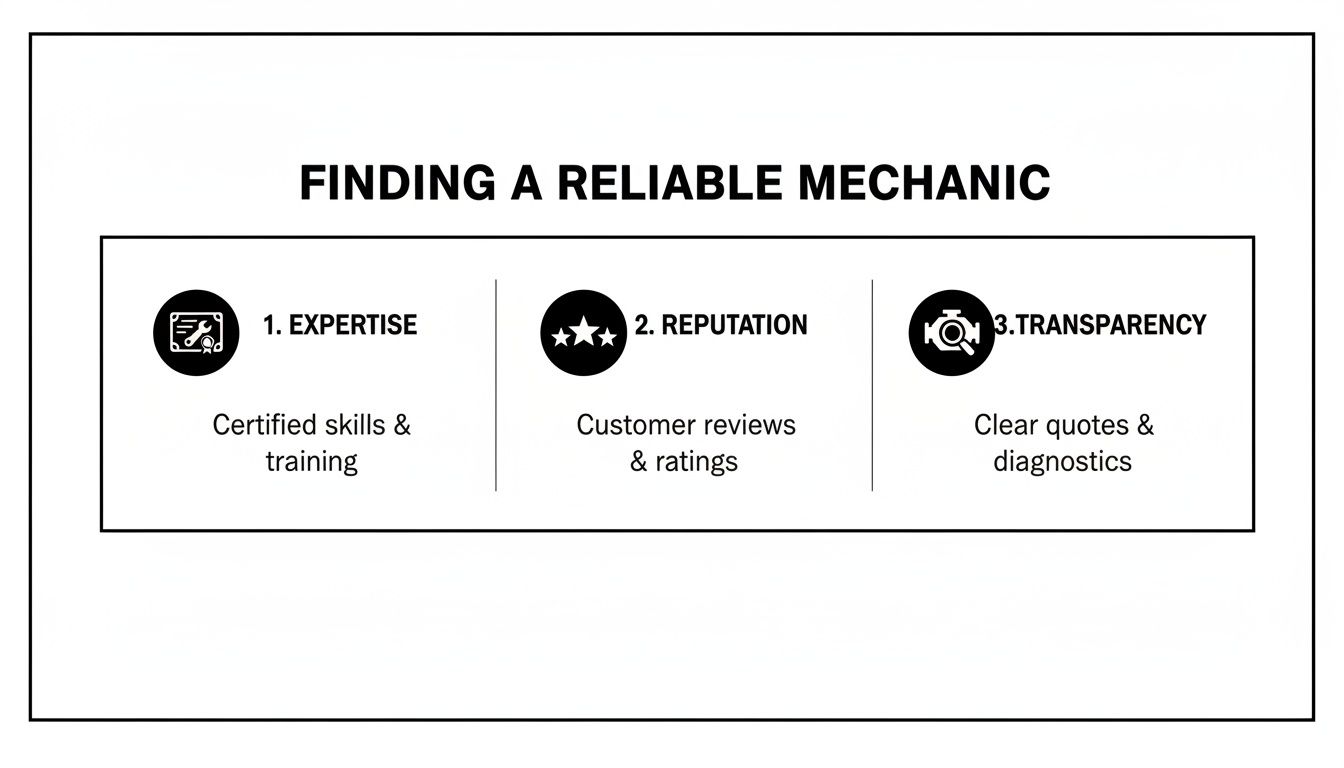
Finding a great mechanic isn't about luck; it's about looking for the right signals. A reliable shop doesn't just fix cars—they build your confidence with every interaction. Your search should center on three key areas.
Verifiable Expertise: You want to see proof of skill. Look for shops that employ ASE-certified technicians. This certification is the gold standard in our industry, proving a mechanic is committed to their craft and up-to-date on the latest vehicle technology.
A Strong Local Reputation: Word travels fast. A shop’s reputation in the community is one of its biggest assets. Consistent positive feedback is a clear sign that a business treats its customers right. You can see what our own customers have to say about the service we provide.
Clear, Transparent Communication: A good mechanic will explain the problem in plain English. They should give you a detailed written estimate before any work begins and never pressure you into making an immediate decision.
This infographic breaks down these core ideas into a simple visual guide.
When you run into car trouble, it's easy to feel overwhelmed. To make things simpler, here’s a quick comparison to help you spot the good signs and avoid the bad ones.
Trustworthy Mechanic vs. Questionable Shop At a Glance
| Attribute | Trustworthy Mechanic | Questionable Shop |
|---|---|---|
| Estimates | Provides a detailed, written estimate upfront. | Gives a vague verbal quote or starts work without approval. |
| Communication | Explains the issue clearly and shows you the problem. | Uses confusing jargon and pressures you to decide now. |
| Technicians | Employs ASE-certified or factory-certified staff. | Lacks visible certifications or avoids talking about training. |
| Reputation | Has strong, consistent online reviews and local referrals. | Has negative reviews, no online presence, or a bad local rap. |
| Parts | Shows you the old parts that were replaced. | Disposes of old parts before you can see them. |
| Guarantees | Offers a clear warranty on both parts and labor. | Offers no warranty or has a very limited, unclear policy. |
| Shop Vibe | The shop is organized, clean, and professional. | The workspace is messy, disorganized, and chaotic. |
Keeping these differences in mind will help you quickly tell whether you're in good hands or if you should head for the door. By focusing on expertise, reputation, and transparency, you can find a shop that values quality work and happy customers.
Reading Between the Lines of Certifications and Reviews
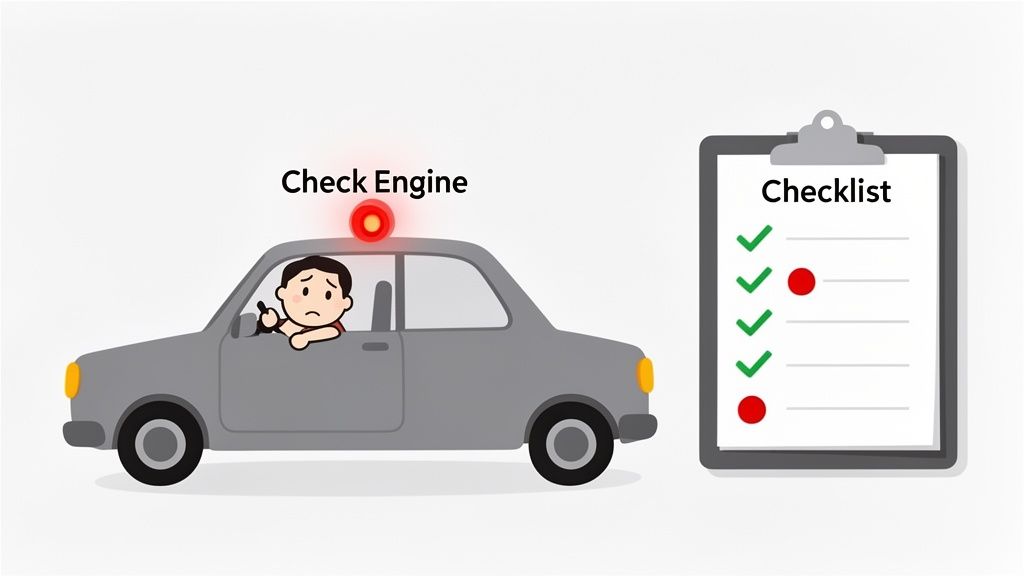
When you're trying to find a trustworthy mechanic, certifications and online reviews feel like a great place to start. And they are! But not all five-star ratings or fancy logos tell the whole story. To truly understand a shop’s commitment to quality and customer care, you need to learn how to look a little deeper.
A shop's credentials aren't just for show. When you see logos from groups like ASE, RepairPal, or NAPA AutoCare, it means that shop has met specific, verifiable standards for training, equipment, and service. It’s a good sign they take their craft seriously.
Decoding Mechanic Certifications
An "ASE-Certified" logo is one of the biggest green flags you can find. The National Institute for Automotive Service Excellence (ASE) is the gold standard for proving a technician knows their stuff. But even here, there are different levels to understand.
There's no mandatory national license for auto mechanics, which makes ASE certification so important. It gives technicians a clear way to prove their skills across nine different vehicle systems. In fact, consumer research from AAA highlights just how crucial this is, finding that many drivers are wary of repair shops. You can check out this consumer research from AAA to see the full report.
- ASE-Certified Technician: This means a mechanic has passed at least one specialty exam and has two years of proven, on-the-job experience.
- ASE-Certified Master Technician: This is the highest level of certification. A Master Tech has passed a whole series of exams (eight for cars and light trucks) and has to re-certify every five years to stay current.
Finding a shop with an ASE-Certified Master Technician on staff is a huge win. It means you’ve got a true expert available who can diagnose and handle even the trickiest repairs. To learn more, check out our guide on what these certifications mean for your repair.
Analyzing Online Reviews Like a Pro
Online reviews work because of social proof—a psychological shortcut where we trust what others say and do. It's a powerful tool, and you can learn more by understanding social proof in more detail. When it comes to reviews, it’s all about the quality of the feedback, not just the sheer number of ratings.
I once found a fantastic shop because their manager respectfully explained a misunderstanding in a bad review—that level of care told me everything I needed to know about their professionalism and commitment.
Don’t just glance at the overall star rating. You need to dig into the comments on Google, Yelp, and other platforms. Are you seeing consistent themes? Maybe everyone raves about their honest communication, or maybe you see a pattern of complaints about surprise fees on the final bill.
A single bad review isn’t a deal-breaker. Sometimes, things just go wrong. What really matters is how the shop responds. A professional, thoughtful reply that tries to make things right shows they value their customers and take accountability. On the other hand, a defensive comment—or worse, total silence—is a major red flag.
Asking the Right Questions Before Committing
Once you’ve got a promising shop on your list, that first phone call or visit is much more than a simple service inquiry—it’s an interview. You’re the one doing the hiring, and the right questions will tell you everything you need to know about a shop’s expertise, honesty, and customer service.Moving past a basic "How much will it cost?" is how you find a mechanic you can truly trust. A great shop won’t see your questions as a hassle; they'll see them as a chance to earn your business and build confidence. They should be happy to educate you.
Questions That Reveal Expertise and Transparency
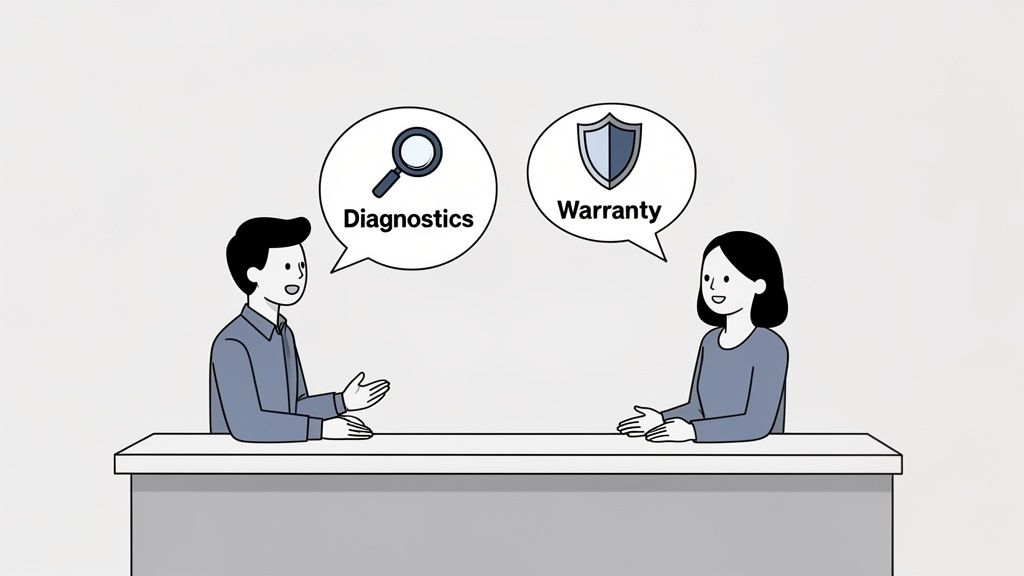
Start by digging into how they diagnose problems. A vague answer here is a huge red flag. Any professional shop worth its salt will have a clear, structured process for figuring out what’s actually wrong with your car.
A great way to open the conversation is by asking, "What does your diagnostic process involve, and is the fee applied toward the repair if I move forward?" A confident shop will walk you through their method, whether it involves computer scans, a hands-on inspection, or road tests. Knowing if that diagnostic fee gets credited to the final bill also tells you a lot about their focus on fair pricing versus just collecting fees.
A service advisor who patiently explains technical issues in plain English is a strong indicator of a customer-focused shop. If they make you feel small for asking questions, it's time to walk away.
Another powerful question revolves around their guarantees. Be direct and ask, "What kind of warranty do you offer on your parts and labor?" Reputable shops always stand behind their work. A standard warranty is usually 12 months or 12,000 miles, but you’ll find that many top-tier shops—especially those in networks like NAPA AutoCare—offer much better coverage, sometimes up to 36 months/36,000 miles. A weak or nonexistent warranty suggests they lack confidence in their own repairs.
Parts, Policies, and Real-World Scenarios
The parts they install have a huge impact on your vehicle's performance and longevity. It's perfectly reasonable—and smart—to ask, "Do you use OEM or aftermarket parts, and do I have a choice?"
Here’s the quick breakdown:
- OEM (Original Equipment Manufacturer) parts are made by your car's manufacturer. They are a guaranteed perfect fit but usually cost more.
- Aftermarket parts are made by other companies. They can be a high-quality, cost-effective alternative, but quality can vary.
A trustworthy mechanic will explain the pros and cons of each, giving you options based on your budget and the specific repair. For example, they might strongly recommend an OEM timing belt because it's a critical component, but offer a reliable aftermarket brand for brake pads to help you save some money.
The key is that they explain the difference and empower you to make the choice. If a shop is dismissive or only offers one option without a good reason, they might not have your best interests at heart.
How to Spot Red Flags and Avoid Common Repair Scams
Finding a shop with all the right certifications and positive reviews is a great start, but it's only half the story. To really protect your wallet, you need to know how to spot the warning signs of a less-than-honest operation. Think of it as your best defense against inflated bills and work you never needed in the first place.
This is a real concern for a lot of drivers. The 2023 Global Mechanics Trust Index, for instance, gave Dallas a trust score of just 36.0 out of 100. That number reflects a broader sentiment; AAA reports that 73% of drivers are worried about being overcharged, and 76% fear being sold unnecessary repairs. You can read the full Global Mechanics Index research to see how trust issues play out across the country.
Watch Out for High-Pressure Tactics
A trustworthy shop will give you the facts and let you decide. If a service advisor is leaning on you for a quick "yes" on a major repair, that's a huge red flag. Be wary of phrases like, "This is a one-time offer," or "I can't let you drive it off the lot like this."
These are classic pressure tactics meant to make you panic and agree. The best response is to stay calm and firm. Simply say, "Thanks for the information. I'm going to need a little time to think about it." A good shop will always respect your right to get a second opinion.
The Suspiciously Low Phone Quote
Here's a scam as old as time: you call for a price on a common repair, and a shop gives you a surprisingly low quote without ever laying eyes on your car. It's almost always a bait-and-switch. They get you in the door with a price that's too good to be true, and once your car is on the lift, the "real" (and much more expensive) problems are suddenly "discovered."
A true professional knows they can't diagnose a car over the phone. They might give you a general price range, but they'll always be clear that the final cost depends on a physical inspection.
Key Takeaway: A detailed, written estimate is non-negotiable. If a shop refuses to provide one before starting work, or if the estimate is vague and lacks a breakdown of parts and labor, you should walk away.
Common Repair Scams to Avoid
Once you know what to look for, these schemes become much easier to spot. Keep an eye out for these classic moves when vetting a new mechanic:
- The Surprise "Urgent" Upsell: You came in for a simple oil change, but now you're being handed a laundry list of "critical" repairs that just can't wait. Always ask the mechanic to walk you over and show you the supposed problem. For anything major and unexpected, getting a second opinion is a smart move.
- Refusing to Show Old Parts: A transparent mechanic will have no problem showing you the worn-out parts they replaced. If they "forgot" or claim the parts were already tossed, it might be because nothing was ever replaced at all.
- The Vague Diagnosis: If the service advisor is throwing around a lot of technical jargon but can't explain the problem in simple terms, they might be doing it on purpose. Some shops bank on your confusion to get you to approve work you don't fully understand or actually need.
Using a Trial Run to Build Long-Term Trust
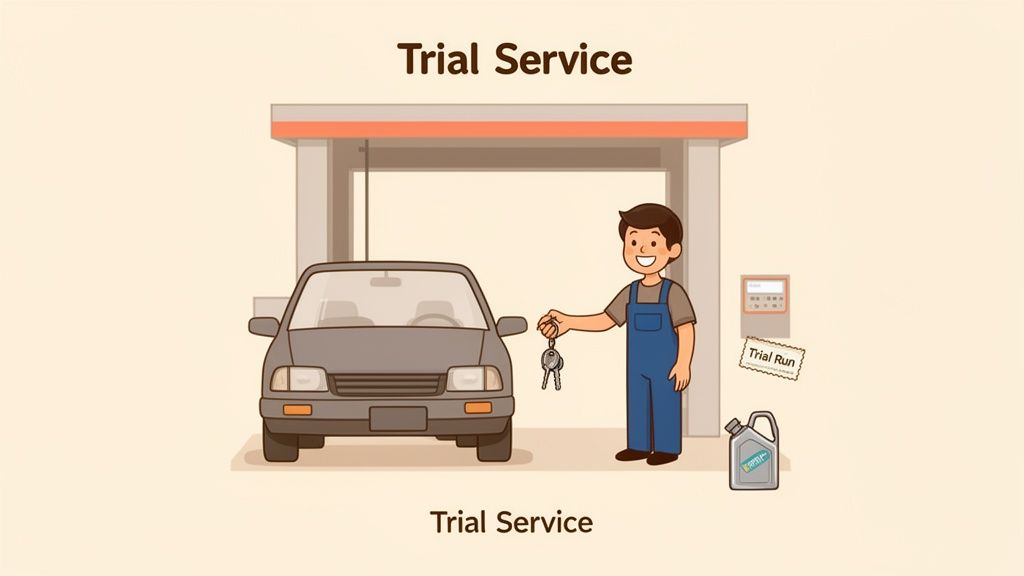
So you’ve done your homework, sifted through reviews, and have a promising mechanic in mind. What's next? The worst time to find out if you made the right choice is when your car is on the back of a tow truck. A much smarter approach is to start small.
Think of it as a first date for your car. You wouldn’t commit to a long-term relationship without one, right? Scheduling a small, low-stakes service is the perfect way to see how a shop really operates without risking a huge repair bill.
What to Look for During a Trial Service
This first visit is your best opportunity to observe a shop's true character when the pressure is off. The little things often tell you everything you need to know about their standards and how they'll treat you when something major goes wrong.
Ask yourself, what’s the whole experience like?
- Booking an Appointment: Was scheduling straightforward? Did they sound helpful and clear about when they could get you in?
- The Shop Itself: Take a look around. Is the waiting area clean? Are the service bays organized? A shop that takes pride in its appearance usually takes pride in its work.
- How They Communicate: Did a service advisor greet you promptly and professionally? More importantly, did they listen to your concerns and explain the work without a ton of confusing jargon?
- Respect for Your Time: Was your appointment honored, or did you end up waiting around? Did they provide a realistic timeframe for the job and stick to it?
A shop’s true colors show during minor interactions. If they treat a simple oil change with professionalism and respect, it's a strong sign they’ll handle a major repair with the same level of care.
From a Small Job to a Lasting Partnership
By starting with a minor service—like a state inspection or a basic oil change—you can confirm your choice with very little risk. If the whole process feels right, you've just found a reliable automotive partner.
When a shop gets familiar with your vehicle through regular maintenance, they start to learn its quirks. They can spot small issues before they snowball into expensive, headache-inducing problems. This proactive care not only saves you money but gives you invaluable peace of mind. Instead of scrambling for help during an emergency, you'll already have a trusted expert on speed dial.
If you’re ready to see how a professional shop handles the small stuff, you can easily schedule an appointment for routine maintenance and start building that trust today.
Your Questions on Finding a Great Mechanic Answered
Even with all the research in the world, you’ll probably still have a few questions lingering. Let's be honest, auto repair can feel like a foreign language sometimes, but getting clear answers is what separates a good decision from a costly one.
Think of this as a quick Q&A to clear up some of the most common concerns we hear from drivers. Getting the right info empowers you to pick the best shop for your car and your wallet, so let’s get you some clarity.
Should I Choose a Dealership or an Independent Shop?
This is the classic debate, and there’s no single right answer. It really boils down to your car, your budget, and the problem at hand.
Dealerships have deep, specialized knowledge of one specific brand. They use Original Equipment Manufacturer (OEM) parts, which is a big deal for newer cars, especially with complex electronics or anything related to a warranty claim. You know you’re getting the exact part designed for your vehicle.
Of course, that specialization usually comes at a premium. A top-notch independent shop, on the other hand, can often deliver the same high-quality work at a much friendlier price point. Plus, you often get a more personal touch—it’s not uncommon for the owner to be the one looking under your hood.
Here’s a simple way to think about it:
- Head to the Dealership for: Tricky warranty repairs, specific recalls, or very complex, model-specific computer issues on a new car.
- Pick an Independent Shop for: Most routine maintenance (oil changes, tires), common repairs like brakes and suspension, and almost all post-warranty work where you’re looking for great value.
For the vast majority of your car's needs, a great independent shop gives you the best of both worlds.
How Do I Get a Second Opinion on a Major Repair?
Getting a quote for a major repair that makes your jaw drop is a terrible feeling. This is where a second opinion isn't just smart—it's essential. The trick is making sure that second opinion is completely unbiased.
First, get a detailed, itemized estimate in writing from the first shop. It needs to list all the parts (ask for part numbers) and the estimated labor hours. Now, here's the important part: when you call the second shop, do not tell them what the first shop quoted you.
Simply explain the symptoms your car is having—the noises, the smells, the warning lights—and ask them to perform their own diagnostic inspection. A truly honest shop will want to diagnose the problem from scratch anyway. This is the only way to get a fresh, unbiased assessment.
Once you have that second written estimate, you can finally compare them. Look at the diagnosis itself, the parts they recommend, and the labor costs. If the two diagnoses are worlds apart, that’s a huge red flag for one of the shops. You may have just saved yourself a bundle.
How Do I Know If a Recommended Service Is Necessary?
This is where trust really comes into play. It’s a huge source of anxiety for drivers, and a good mechanic knows it. Transparency is everything.
A trustworthy mechanic should have no problem showing you why a service is needed. If they say you need new brake pads, ask them to show you the old ones and point out the wear. If they recommend a transmission fluid flush, ask to see the condition of your current fluid next to a sample of fresh fluid.
These aren't "gotcha" questions. A good shop sees them as a chance to educate you and build a long-term relationship.
If a mechanic or service advisor gets defensive, evasive, or seems annoyed by your questions, take that as a serious warning sign. You can also pull out your owner's manual and check their recommendation against the factory-recommended maintenance schedule. If what they're suggesting isn't on the schedule, ask them to explain exactly why your car needs it now.
At Kwik Kar Oil Change and Auto Care, we believe trust is built on transparency, honesty, and great work. Our ASE-certified technicians are always ready to answer your questions and show you exactly what your car needs, so you can feel completely confident in your service. Schedule your service with us today and feel the peace of mind that comes from having a mechanic you can truly count on.