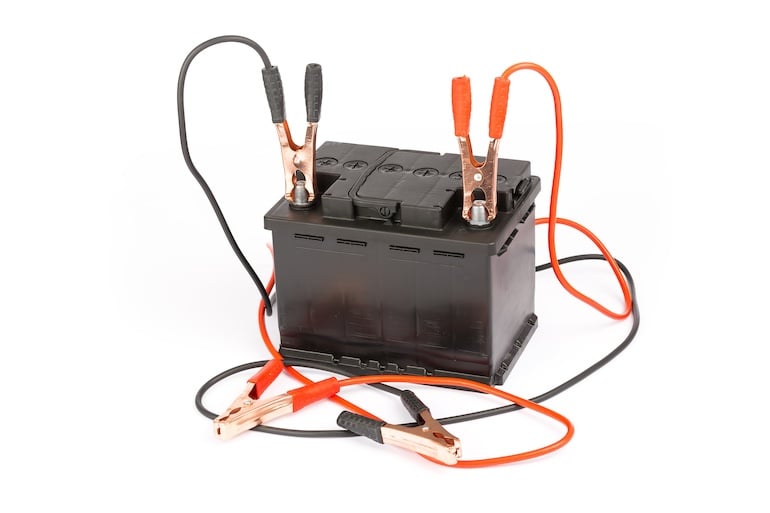
Picture this: It's a chilly winter morning here in Richardson, TX. You're already running late, you hop in your car, turn the key, and… click. Nothing. Just dead silence. To jump-start a car battery, you’ll need a source of power—either another car with a set of jumper cables or a portable jump starter. The whole idea is to safely connect that power source to your battery, giving it just enough of a jolt to fire up the engine.
That Sinking Feeling of a Dead Car Battery

That immediate shock of a dead battery is a real gut-wrenching moment that can completely derail your plans. The dreaded click-click-click—or even worse, total silence—is a frustration every driver knows. But it doesn't have to be a day-ruiner. Knowing why it happens and what to do next puts you right back in the driver's seat.
And this isn't some rare occurrence. In fact, projections show that battery failures will sideline over 74.8 million vehicles globally in 2026 alone. That's a staggering number. Knowing how to safely jump-start your car can save you a ton of time and the expense of a tow truck.
For a quick reference before you dive into the full process, here's a handy table outlining the key steps.
Jump Starting at a Glance: Key Steps and Safety
| Step | Action Required | Critical Safety Tip |
|---|---|---|
| Preparation | Park cars, turn off engines, wear safety gear. | Never let the jumper cable clamps touch each other. |
| Red Clamps | Connect red clamp to the positive (+) terminal of the dead battery. | Ensure a solid, secure connection on the terminal. |
| Other Red Clamp | Connect the other red clamp to the positive (+) terminal of the working battery. | Double-check you are connecting to the positive terminal. |
| Black Clamp | Connect black clamp to the negative (-) terminal of the working battery. | Do not connect to the dead battery's negative terminal yet. |
| Final Black Clamp | Connect the final black clamp to an unpainted metal surface on the dead car's frame. | Grounding away from the battery prevents dangerous sparks. |
| Starting | Start the working car, let it run for a few minutes, then try to start the dead car. | If it doesn't start, wait a bit longer before trying again. |
This table is your quick-start guide, but reading the detailed steps that follow is crucial for doing the job safely and correctly.
Why Do Car Batteries Fail, Anyway?
A car battery is more than just a box that holds a charge; it's a complex chemical device that's surprisingly sensitive to its surroundings. Here in Texas, with our dramatic temperature swings, batteries take a real beating.
These are the usual suspects behind a dead battery:
- Extreme Temperatures: Both blistering heat and freezing cold can wreak havoc on a battery's internal chemistry, making it harder for it to hold a charge.
- Short Trips: If you're only making quick, short drives around town, your car's alternator never gets enough time to fully recharge the battery. Over time, this slowly drains its power.
- Leaving the Lights On: It’s a classic for a reason. Accidentally leaving your headlights, dome lights, or any other accessory on is a surefire way to find a dead battery the next morning.
- Old Age: Just like anything else, car batteries don't last forever. Most have a lifespan of about 3 to 5 years. As they get older, their ability to hold a strong charge fades.
A dead battery is more than just a pain; it’s your car sending you a message. While a jump-start can get you going, it’s also a clear warning that your battery or your car's charging system might need a professional look.
This guide is here to walk you through those first practical steps, turning a potential roadblock into a minor speed bump. Whether you've got a classic set of jumper cables or a modern portable starter, you can get this done.
Gathering Your Gear for a Successful Jump
Before you can tackle a dead car battery, you need to have the right tools ready to go. Having the correct gear on hand transforms a moment of panic into a totally manageable task. Your main tool will either be a set of traditional jumper cables or a more modern portable jump starter.
Jumper cables are the classic solution, but they do require a second running vehicle to provide the power. Not all cables are created equal, though. The thickness of the wire (gauge) is a huge factor. A lower gauge number, like 6-gauge, means you have a thicker, more effective cable that moves power much more efficiently than a flimsy, thin one (like 10-gauge).
Cable length is another thing you'll be thankful for in a tight spot. A set that's 16-20 feet long can be a real lifesaver in an awkward parking situation where you can’t get the two cars nose-to-nose. To keep everything organized and protected from the elements, a dedicated jumper cable bag is a smart investment.
Portable Jump Starters
The modern alternative is a portable jump starter—a compact lithium-ion battery pack that doesn't need a second car at all. These devices are incredibly convenient, especially if you're stranded alone, and most come with built-in safety features that prevent common, and costly, mistakes.
When shopping for one, look for these key functions:
- Reverse-Polarity Protection: This is a must-have. It prevents sparks and serious electrical damage if you accidentally mix up the positive and negative clamps.
- Sufficient Power: Check the peak amps and cranking amps. You need to make sure the device is powerful enough for your vehicle's engine size—a V8 truck needs a lot more juice than a 4-cylinder sedan.
- USB Ports: Many new units double as a power bank for charging your phone. That alone can be a huge plus in an emergency situation.
Portable starters have become a game-changer, especially for solo drivers. Their built-in safety mechanisms offer serious peace of mind, dramatically reducing the risk of electrical damage that can happen from incorrectly connecting old-school cables.
Essential Safety Equipment
No matter which power source you're using, a few other items are non-negotiable for doing the job safely. You should always have these stashed away in your vehicle's emergency kit.
Your safety checklist should always include:
- Safety Glasses: A non-negotiable for protecting your eyes from potential sparks or battery acid spray.
- Gloves: A simple pair of work gloves keeps your hands clean and provides a helpful layer of insulation.
- A Reliable Flashlight: Dead batteries rarely happen on bright, sunny afternoons. They love dark garages and poorly lit parking lots. A good flashlight is absolutely essential for correctly identifying the battery terminals.
Being prepared with this gear makes the whole process of jump-starting a car battery much smoother and, most importantly, safer.
Connecting Jumper Cables The Right Way
This is where the rubber meets the road, and paying close attention to safety is non-negotiable. Once the cars are positioned correctly—close, but absolutely not touching—and you've turned off all the lights and electronics, you're ready to get connected. The order you connect the cables in isn't just a friendly suggestion; it’s a critical safety step designed to prevent dangerous sparks and protect your car’s delicate electronics.
First things first, you need to identify the battery terminals. The positive terminal is almost always marked with a plus sign (+) and might have a red plastic cover. The negative terminal will have a minus sign (-). If you see a bunch of crusty, colorful buildup on the terminals, you'll need to clean them off to get a good connection. Heavy corrosion can easily block the flow of electricity, and our guide on how to clean car battery corrosion can walk you through that process safely.

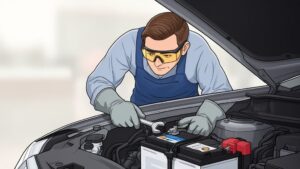
As you can see, having the right gear on hand is half the battle. Sturdy cables, some safety equipment, and a good light source are your best friends for a successful and safe jump.
The Correct Connection Sequence
Alright, let's walk through the four connections you need to make. I like to use the "Red to Dead, Red to Donor" memory trick to keep things straight and manage the circuit safely. Always handle one clamp at a time, and never, ever let them touch each other once they're connected to a battery.
- Red Clamp to the Dead Battery: Grab one of the red (positive) clamps and attach it firmly to the positive (+) terminal of the dead battery. Give it a little wiggle to make sure it has a solid, metal-on-metal grip.
- Red Clamp to the Donor Battery: Now, take the other red clamp and attach it to the positive (+) terminal of the working car's battery.
- Black Clamp to the Donor Battery: Next, take one of the black (negative) clamps and connect it to the negative (-) terminal of the working car's battery.
- Black Clamp to a Ground Point: This is the most important step for safety. Attach the final black clamp to a clean, unpainted metal surface on the engine block or frame of the car with the dead battery. A solid nut on a strut tower or a bolt on the engine itself are perfect spots.
Why ground on the frame? Connecting that last clamp directly to the dead battery's negative post can create a spark. Since car batteries can release flammable hydrogen gas, a spark right next to the battery is an explosion risk. Grounding away from the battery completes the circuit just as effectively but keeps any potential sparks far from those fumes.
Don't just brush this off. A study by the NHTSA looking at over 2,200 battery-related incidents found that 444 injuries were caused by improper jump-starting. This is a big reason why modern portable jump starters are becoming so popular—they often include spark-proof technology to prevent these exact kinds of accidents.
Starting The Engines
With all four clamps securely in place, it’s time to bring the dead car back to life.
Go ahead and start the engine of the working car. Let it run for at least a few minutes. This gives its alternator a chance to send a charge over to the dead battery, giving it a little boost to get going.
Now, try to start the car with the dead battery. If it cranks and starts right up, you're in business! If you just hear a click or it turns over very slowly, don't panic. Just wait another five minutes with the working car running to let more of a charge build up, then try again. Once it starts, let both cars run for a bit.
Troubleshooting a Failed Jump Start
You’ve followed all the steps—cables are connected, the other car is running, and you turn the key. But instead of your engine roaring to life, you get… nothing. Or worse, a sad little clicking sound. It’s a frustrating moment, but don't give up just yet.
A failed jump start isn't always a sign of a completely dead battery. More often than not, it's a solvable problem, and the key is to pay close attention to what your car is trying to tell you.
Decoding the Clicks and Silence
The noise your car makes (or doesn't make) when you try to start it is your biggest clue. Are you hearing a rapid-fire click-click-click, or is it just one solid CLICK followed by silence? These two sounds point to very different culprits.
A frantic, rapid clicking is actually a pretty good sign. It usually means your battery is just exceptionally drained and isn't getting quite enough power from the jump to fully turn the engine over. The starter is getting some electricity and is trying to engage, but it just doesn't have the juice.
The fix here is simple: patience. Let the donor car run for another 5 to 10 minutes while everything is still connected. This gives its alternator time to push a more substantial charge into your dead battery, building up enough power for a successful start.
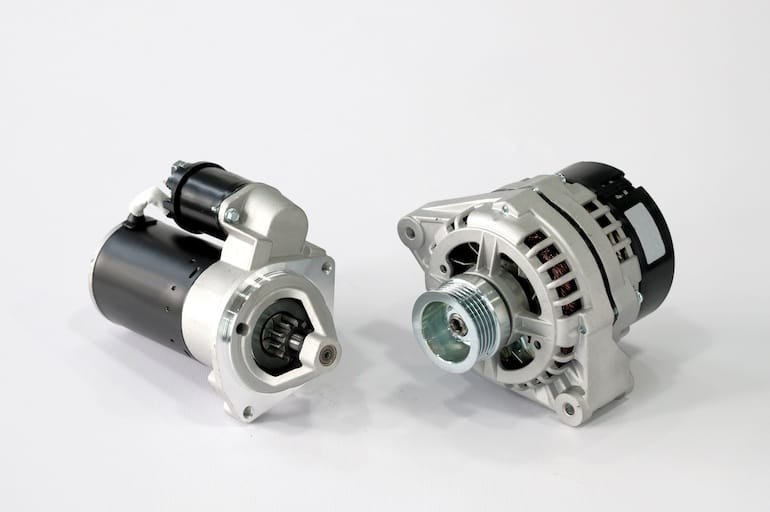
On the other hand, a single, loud click followed by dead air often points away from the battery and toward your starter motor. If the battery has enough power to make the starter try to engage (that's the click), but the engine doesn't crank, the starter itself might be failing.
What Your Car Is Telling You Jump Start Troubleshooting
If you're still not sure what's going on, the sounds and symptoms can act like a diagnostic guide. This table breaks down what your car might be doing and what the most likely problem is.
| Symptom | Potential Cause | What to Do Next |
|---|---|---|
| Rapid Clicking Noise | The dead battery is extremely low on charge and just needs more time. | Let the working car run for 5-10 more minutes to build up a charge, then try again. |
| Single, Solid Click | The starter motor may be failing, or you have a very poor electrical connection. | Check that all cable clamps have a solid, metal-to-metal grip. If they do, you might have a starter issue. |
| No Sound, No Lights | Your battery is completely dead, or the jumper cable connection is poor. | Wiggle the clamps to ensure a good connection on the terminals and ground point. Also, check for heavy corrosion. |
| Engine Cranks Slowly | The connection is weak, or the battery is still very low on charge. | Improve your clamp connections and let the donor car run for a few more minutes. |
Think of this table as a quick reference guide to help you make an informed decision when you're stuck in a frustrating no-start situation.
A completely dead battery can sometimes act like an electrical black hole, preventing a jump from working at all. If your car shows zero signs of life—no dashboard lights, no sounds—the battery might be so far gone it can't even transfer the current to the starter.
If you suspect this is the case, you can learn more about checking its baseline health with our article on how to test a battery with a multimeter. This can help you figure out if the battery has any life left in it.
Other potential issues include heavily corroded battery terminals that are blocking the flow of electricity, or jumper cables that are too thin to carry enough power. Always double-check that your clamps have a firm, clean grip on bare metal.
If you’ve tried all this and your car still won’t start, the battery itself may have an internal failure and simply can't hold a charge anymore. At that point, it’s time to call in the professionals.
When Your Battery Needs More Than a Jump
A successful jump-start gets your engine roaring back to life, but it's important to remember that it’s often just a temporary fix. Think of it as automotive first aid, not a cure. If you find yourself repeatedly needing a jump, that’s a clear signal a bigger issue is lurking, one that could leave you stranded again if you ignore it.

Sometimes, the battery itself is sending some very obvious warning signs that it’s time for a replacement. These aren’t subtle hints; they’re clear indicators that another jump-start won't solve the root problem.
Recognizing Critical Battery Failure
In some cases, a battery is so far gone that trying another jump is pointless and even unsafe. If you notice any of the following, professional help isn't just a good idea—it's necessary.
Keep an eye out for these red flags:
- A Cracked or Leaking Case: Any visible cracks or bulging in the battery's plastic casing are serious. If you see fluid leaking, that's battery acid, which is highly corrosive and dangerous. Stay clear.
- The Smell of Rotten Eggs: This distinct, unpleasant odor is caused by sulfuric acid leaking from the battery. It’s a sign of a severe internal problem and means the battery is off-gassing dangerous, flammable fumes.
- Repeated Failures: Does your car battery die every few days or weeks? If a battery can’t hold a charge for a reasonable amount of time after being jumped and driven, it has likely reached the end of its 3-to-5-year lifespan.
A jump-start revives a drained battery, but it cannot fix a failed one. If the battery has an internal issue like a dead cell or simply can't hold a charge anymore, no amount of jumping will bring it back to life permanently.
If you’re dealing with any of these scenarios, it’s probably time to start thinking about a replacement. For those comfortable with the process, our guide on how to remove a car battery can provide some useful steps.
When to Trust the Professionals at Kwik Kar
Instead of guessing, you can get a definitive answer. At Kwik Kar of Richardson, we go beyond simple voltage checks. Our ASE-certified technicians use advanced diagnostic equipment to perform a full battery and charging system test. This test measures a battery's cold-cranking amps and internal resistance, letting us predict failure before you’re stuck in a parking lot again.
If it turns out you need a replacement, we’ll handle the installation professionally and securely. Our team ensures the new battery is the correct size and type for your vehicle, cleans the terminal connections, and properly secures it in place. We also take care of disposing of your old battery safely and responsibly.
Choosing a professional service offers something a DIY jump can't: total peace of mind. With backing from CARFAX and NAPA AutoCare, you can drive away from Kwik Kar confident that the job was done right. We're here to turn a recurring problem into a reliable, long-term solution.
Frequently Asked Questions About Jump Starting
Getting your car running again is a huge relief, but it often leaves you with more questions. The jump start is just the first step. Knowing what to do next is crucial to avoid being stranded again tomorrow. Let's tackle some of the most common questions we hear from drivers after they've brought a dead battery back to life.
How Long Should I Drive My Car After a Jump Start?
Plan on driving your car for at least 30 minutes right after a successful jump. Ideally, you want to get on a highway or a road where you can maintain a steady speed. Stop-and-go city traffic isn't nearly as effective. This gives your car's alternator enough uninterrupted time to put a decent charge back into the battery.
A classic mistake is to start the car, let it idle in the driveway for five minutes, and then shut it off. That's a surefire way to find yourself with another dead battery. The alternator needs those sustained engine RPMs to generate a real electrical current. If you only have a short errand to run, do yourself a favor and take the scenic route.
Can I Jump Start My Car in the Rain?
Technically, yes, but it's risky and we strongly advise against it. Water is a fantastic conductor of electricity, and trying to jump a car in a damp environment significantly increases the chance of a dangerous electrical shock or a short circuit that could damage your car's electronics.
Your personal safety is always the top priority. If it's anything more than a light drizzle, the smartest and safest move is to wait for the weather to clear up or call for professional roadside assistance. A quick fix simply isn't worth the risk of injury.
If you absolutely have no other choice, be extremely careful. Make sure the metal clamps of the jumper cables never touch the wet ground or each other. If you're using a portable jump starter, keep the unit completely shielded from any moisture.
Does Revving the Engine of the Good Car Help?
Yes, it absolutely does. Revving the donor car's engine can speed things up quite a bit. Once all the cables are properly connected, have the driver of the working car gently press the gas to hold the engine speed around 2,000 RPM. Let it run like that for a couple of minutes before you even try to start the dead car.
This makes the alternator spin faster, which generates more electrical current to send over to your drained battery. It’s especially helpful if your battery is exceptionally low on power. There's no need to floor it—just a steady, slightly elevated engine speed is all you need to give it that extra charging boost.
Can a Completely Dead Battery Be Jump Started?
This really comes down to what "completely dead" means in your situation. If the battery is just drained because you left the headlights on or a door ajar, a jump start will almost certainly get it going again.
However, if the battery is "dead" because of an internal failure—like a shorted cell or it has simply reached the end of its natural lifespan—it can't be revived. In that state, the battery has lost its ability to hold a charge. A tell-tale sign of this is when your car starts with the jump but dies the second you disconnect the cables. That's a classic symptom of a battery that needs to be replaced, not recharged.
If your battery can't hold a charge or you're tired of dealing with the uncertainty, let the experts at Kwik Kar Oil Change and Auto Care help. We can perform a comprehensive battery and charging system test to pinpoint the exact problem and, if needed, professionally install a new battery to get you back on the road with confidence. Schedule your battery service today!