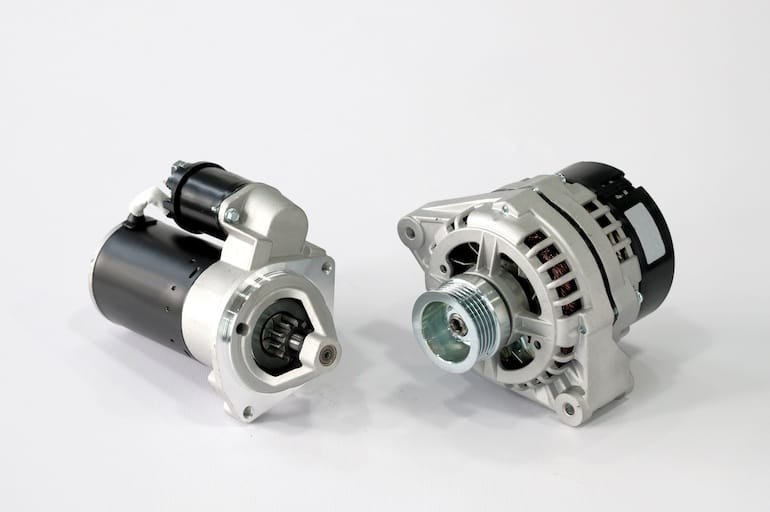
That dreaded moment you turn the key and nothing happens is every driver's nightmare. While many immediately assume a dead battery is to blame, another critical component is often the real culprit: the starter. As the unsung hero of your daily commute, the starter motor is responsible for the crucial first step of turning over the engine. When it begins to fail, it sends out subtle, and sometimes not-so-subtle, warnings that are easy to misinterpret. Recognizing the early signs of a bad starter is especially important in the demanding Richardson climate, where extreme heat can accelerate wear and tear on your vehicle's electrical system. Ignoring these symptoms can escalate from a minor inconvenience to a major disruption, potentially leaving you stranded at the worst possible time.
This guide is designed to demystify starter problems by breaking down the eight most common warning signs. For each symptom, we will detail what's happening under the hood, describe simple diagnostic checks you can safely perform yourself, and clarify when it’s time to bring your vehicle to the ASE-certified technicians at Kwik Kar for a professional inspection. Proactively identifying these issues not only prevents unexpected breakdowns but also helps you manage your vehicle's long-term health. To avoid unexpected breakdowns and keep your car running smoothly, understanding proactive vehicle care is key. You can refer to your ultimate fleet vehicle maintenance checklist for a broader look at preventative strategies. Our goal is to empower you with the knowledge needed to take control, ensuring reliability and peace of mind every time you get behind the wheel.
1. Engine Cranks But Won't Start
One of the most perplexing signs of a bad starter is when your engine cranks strongly but refuses to actually start. You turn the key, hear the familiar rrr-rrr-rrr sound of the engine turning over, but it never catches and roars to life. This indicates that the starter motor is receiving power and is mechanically strong enough to turn the crankshaft, but a critical part of the ignition sequence is failing.
While the starter itself is doing part of its job, this symptom often points to an electrical failure within the starter assembly or its related components. The starter solenoid, for instance, might be engaging the motor but failing to send the necessary voltage to the ignition system to create a spark.
Why This Happens
The starter system isn't just a motor; it's a circuit. When you turn the key, the starter solenoid has two jobs: push the starter gear forward to engage the engine's flywheel, and close a high-amperage circuit to power both the starter motor and the ignition system. If the solenoid's internal contacts are worn or corroded, it can successfully power the motor (cranking the engine) but fail to complete the secondary circuit for the ignition coil and spark plugs. The engine turns, but with no spark, it will never ignite the fuel.
This issue is especially common in Richardson, where high summer heat and humidity can accelerate the degradation of electrical components and contacts within the starter solenoid.
What You Can Do
If you experience this symptom, it's crucial not to drain your battery by continuously trying to start the engine.
- Limit Your Attempts: Try starting the vehicle no more than 3-4 times. Repeated attempts can overheat the starter motor and deplete your battery, complicating the diagnostic process.
- Check the Obvious: Ensure your battery terminals are clean and tight. A poor connection can sometimes cause enough of a voltage drop to crank the engine but not enough to power the ignition system fully.
- Rule Out Other Culprits: While a faulty starter is a strong possibility, a no-start condition can also be caused by a failed fuel pump or problems with the ignition system itself. For example, if you suspect the issue might be related to a lack of spark, you can learn more about bad spark plug symptoms.
Ultimately, this is a clear signal that your vehicle needs professional attention. An ASE-certified technician at Kwik Kar can perform a "voltage drop test" on the starter circuit to pinpoint exactly where the electrical failure is occurring. They can quickly determine if the fault lies with the starter, the ignition, or the fuel system, saving you from replacing the wrong parts.
2. Clicking Noise Without Engine Rotation
One of the most classic and recognizable signs of a bad starter is a distinct clicking sound when you turn the key, followed by silence from the engine. You might hear a single, solid click or a rapid-fire click-click-click, but the engine itself makes no effort to turn over. This sound indicates that the starter solenoid is receiving the signal to start, but there isn't enough electrical power reaching the starter motor to actually spin the engine.
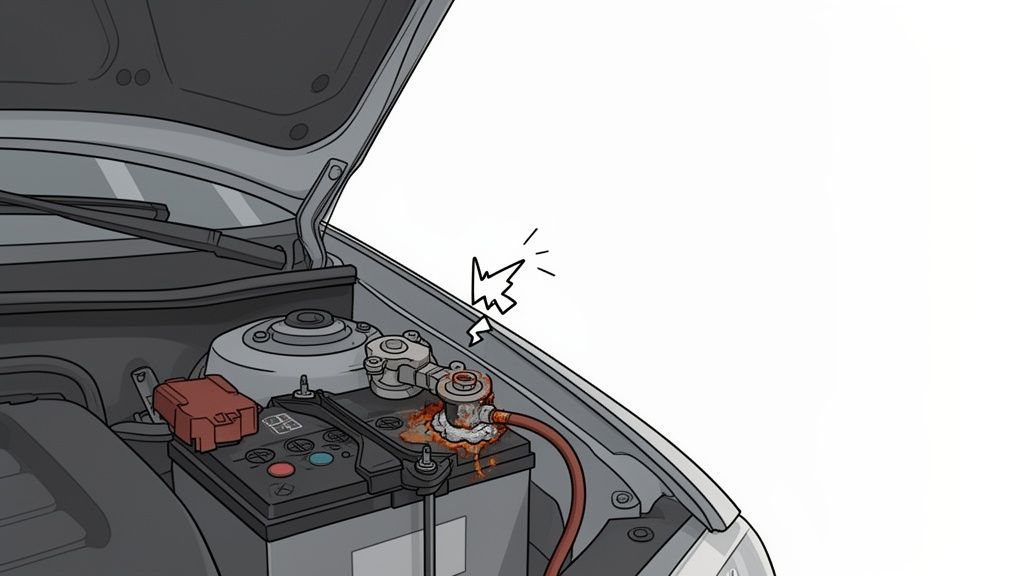
The clicking is the sound of the starter solenoid engaging and attempting to close the high-amperage circuit. When there's insufficient voltage, the solenoid's electromagnet is too weak to hold the connection, causing it to repeatedly open and close, which creates the rapid clicking noise. This is a clear signal of an electrical issue that is preventing the starter from doing its job.
Why This Happens
This symptom almost always points to a power delivery problem. The starter motor requires a massive amount of amperage to crank a heavy engine, and any disruption in that power supply will cause it to fail. The clicking sound is the solenoid trying to work but failing because the electrical current is too weak. Common causes include a dead or severely drained battery, a faulty alternator that isn't recharging the battery, or corroded and loose battery terminal connections.
In the humid Richardson climate, battery terminal corrosion is a particularly frequent culprit. This chalky buildup acts as an insulator, preventing the full flow of electricity from the battery to the starter, leading to the clicking sound even if the battery itself is fully charged.
What You Can Do
If you hear clicking, your immediate goal is to diagnose the power source without causing further issues.
- Inspect Battery Terminals: Before anything else, pop the hood and look at your battery terminals. If you see white or blue-green corrosive buildup, this is likely your problem. Cleaning them might solve the issue, but the underlying cause of the corrosion should still be inspected.
- Check Battery Power: Turn on your headlights or interior lights. If they are very dim or don't turn on at all, your battery is likely dead. If they are bright, the battery might have enough charge to power accessories but not the high-draw starter motor, pointing towards a bad connection or a failing starter. To better understand your battery's health, you can learn more about how long a car battery should last.
- Avoid Repeated Attempts: Continuously turning the key will only drain any remaining battery power and could potentially damage the starter solenoid.
This symptom requires immediate professional testing. A technician at Kwik Kar can test not only your battery's charge but also its ability to hold a load (a "load test"). They can also inspect the entire starting and charging system, including the alternator and all connections, to confirm whether you need a new battery, a terminal cleaning, or a replacement starter.
3. Grinding or Whirring Noise During Starting
One of the most alarming and unmistakable signs of a bad starter is a loud, harsh grinding or high-pitched whirring sound when you turn the key. This awful metal-on-metal noise is a clear indication of a mechanical failure. It means the starter motor's pinion gear is not meshing correctly with the engine's flywheel (or flexplate on automatic transmissions), causing the gears to grind against each other instead of engaging smoothly.
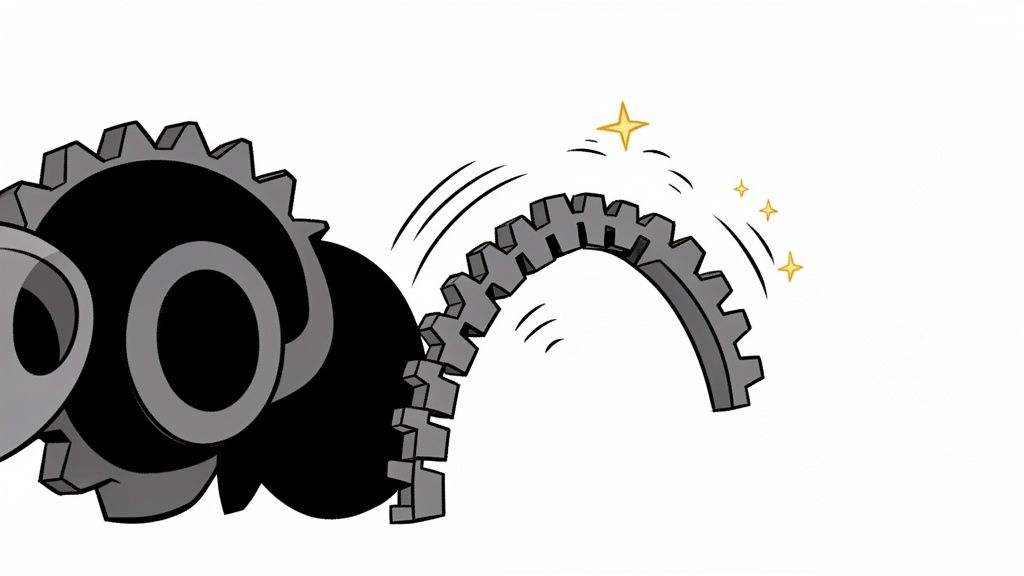
Unlike a simple click or a no-crank situation, this grinding sound points directly to a physical problem within the starter motor itself or its alignment. Ignoring this symptom is a fast track to more severe and expensive engine damage, making it a critical warning sign for any driver.
Why This Happens
This mechanical failure occurs when the starter's pinion gear, which is pushed out by the solenoid to spin the flywheel, fails to engage properly. There are several reasons this happens. The teeth on the pinion gear or the flywheel's ring gear could be worn down, stripped, or broken from years of use. Alternatively, the starter solenoid might be failing to extend the gear fully, causing only the tips of the teeth to collide and grind.
In some cases, the starter motor itself may have come loose from its mounting bolts, or internal components like bushings are so worn that the gear can no longer maintain proper alignment. This issue is particularly prevalent in high-mileage vehicles common in the Richardson area, where years of start-stop cycles take their toll on mechanical parts.
What You Can Do
If you hear a grinding noise, the most important action is to stop what you are doing immediately to prevent further damage.
- Stop Trying to Start: Every attempt grinds away more metal from both the starter gear and your engine's flywheel. Replacing a flywheel is a far more labor-intensive and expensive job than replacing a starter.
- Avoid "Banging" the Starter: While an old trick, hitting the starter can misalign it further or damage internal components, worsening the grinding problem.
- Arrange for a Tow: Do not risk driving the vehicle or repeatedly attempting to start it. The safest and most cost-effective option is to have it towed to a professional service center like Kwik Kar for a proper diagnosis.
This is a symptom that demands immediate professional attention. A certified technician can remove the starter and inspect both the starter's pinion gear and the flywheel's ring gear for damage. They will confirm if the issue is a faulty starter, a damaged flywheel, or simply loose mounting bolts, ensuring the correct repair is made the first time. This is especially crucial for aging family vehicles or small business fleet vans in Richardson that rely on consistent operational integrity.
4. Intermittent Starting Issues (Starts Inconsistently)
One of the most frustrating and unpredictable signs of a bad starter is when your vehicle starts perfectly one day and completely fails the next. You turn the key and get nothing but a click or silence, only for it to start up flawlessly an hour later. This inconsistency can make diagnosing the issue difficult and leaves you feeling uncertain every time you get behind the wheel.
This erratic behavior often points to an emerging electrical or mechanical problem within the starting system. The starter doesn't just fail all at once; it often degrades over time, with components that work some of the time but not all of the time. This symptom is a clear warning sign that a complete failure is likely imminent, potentially leaving you stranded without notice.
Why This Happens
Intermittent starting problems are usually caused by a few key issues. A common culprit is the starter solenoid, which can develop "dead spots" on its internal electrical contacts due to wear and tear. When the starter's internal mechanism lands on one of these dead spots, the circuit can't be completed, and the car won't start. A slight jolt or another attempt might move it just enough to make contact again.
Another frequent cause is a loose or corroded electrical connection either at the battery terminal, the starter solenoid, or the ground wire. These poor connections can sometimes allow enough current to pass through, but other times they can't, leading to a no-start condition. The extreme temperature fluctuations in Richardson, from cool mornings to scorching afternoons, can cause metal components to expand and contract, making these connection issues even more unpredictable.
What You Can Do
When dealing with an intermittent starting problem, gathering information is key to a quick and accurate diagnosis.
- Keep a Log: Note when the failures occur. Is it when the engine is hot or cold? Does it happen more in the morning? This information can help a technician pinpoint the cause.
- Check Battery Connections: A quick visual inspection can save you a trip to the shop. Make sure your battery terminals are clean, free of corrosion, and screwed on tightly. A loose connection is a very common cause of intermittent issues.
- Don't Ignore It: While the car might start eventually, this is a progressive problem. Each failure puts more strain on the system. Continuing to rely on the vehicle for critical trips, like commuting on US-75, is a significant risk.
Ultimately, an intermittent starting issue requires professional diagnostics to isolate the faulty component. The ASE-certified technicians at Kwik Kar can perform a comprehensive electrical system evaluation, testing not just the starter but also the battery, alternator, and all related wiring. This ensures they find the true source of the problem, preventing you from being stranded when you least expect it.
5. Slow Cranking or Weak Engine Turnover
One of the most common and often misdiagnosed signs of a bad starter is when your engine cranks slowly or sounds weak. You turn the key, and instead of the crisp, quick rrr-rrr-rrr sound you expect, you hear a sluggish, labored rrrrr…..rrrrr…..rrrrr. It sounds as if the engine is struggling to turn over, almost like the battery is about to die.
This symptom directly points to a lack of sufficient electrical power reaching or being utilized by the starter motor. While a weak battery is the most frequent cause, this slow crank is a classic indicator that the starter motor itself is failing, drawing too much current to overcome internal resistance from worn-out components.
Why This Happens
A starter motor requires a massive amount of amperage to turn the engine's crankshaft. If the motor is old, its internal components, like the brushes and windings, can wear down. This increases electrical resistance, forcing the motor to draw excessive current from the battery just to perform its job. This extra load can make even a healthy battery appear weak.
Furthermore, corroded or loose connections at the battery terminals, starter solenoid, or engine ground can also restrict current flow, effectively starving the starter of the power it needs. In Richardson, the combination of summer heat and stop-and-go traffic puts immense strain on both batteries and starter motors, accelerating this type of wear and making slow cranking a familiar problem for local drivers.
What You Can Do
A slow crank is a progressive issue; it will only get worse until the vehicle fails to start at all. Addressing it early is key.
- Test the Battery First: The first and easiest step is to rule out the battery. Most auto parts stores offer a free battery test, or you can visit Kwik Kar for a comprehensive diagnostic. A load test will confirm if the battery can deliver the necessary cranking amps.
- Inspect Connections: Visually check your battery terminals and cables. Look for any fuzzy, blue-green or white corrosion. Clean the terminals thoroughly with a wire brush and ensure all connections are tight.
- Don't Keep Cranking: Forcing a weak starter to turn over repeatedly can cause it to overheat and fail completely. It can also drain a good battery, leaving you stranded.
If your battery tests fine and the connections are clean, the starter motor is the primary suspect. The technicians at Kwik Kar can perform a starter draw test, which measures the amount of amperage the starter is pulling. An abnormally high reading is a definitive sign of an internal starter failure, confirming that a replacement is needed to restore your vehicle's reliable starting power.
6. Starter Remains Engaged After Engine Starts (Grinding When Running)
Among the most alarming and destructive signs of a bad starter is a loud, metallic grinding noise that continues after the engine has already started. This isn’t a brief sound during cranking; it's a persistent, high-pitched whirring or grinding that signals the starter motor has failed to disengage from the engine's flywheel. This is a critical failure that requires immediate action to prevent severe mechanical damage.
This dangerous symptom indicates that the starter’s pinion gear is still meshed with the flywheel's ring gear, even as the engine spins at hundreds or thousands of RPMs. The starter motor is being spun at speeds it was never designed to handle, which can quickly destroy both the starter and the much more expensive flywheel.
Why This Happens
The starter solenoid is responsible for retracting the pinion gear the instant the engine starts and you release the key. If the solenoid's internal contacts weld themselves together due to an electrical surge or severe wear, or if the plunger mechanism itself becomes stuck, it will fail to pull the gear back. The pinion gear remains locked in place, grinding against the flywheel as it spins with the running engine.
This is often seen in vehicles with faulty aftermarket starters installed incorrectly or in older fleet vehicles where constant use has caused solenoid burnout. Electrical shorts in the ignition circuit can also keep the solenoid energized, preventing it from disengaging properly.
What You Can Do
If you hear this grinding sound after your car starts, your immediate response is crucial to minimize catastrophic damage.
- STOP The Engine Immediately: Do not continue to drive the vehicle for any reason. The longer the grinding continues, the more damage is being done to your flywheel and starter.
- Do Not Restart The Engine: Attempting to restart the vehicle will only worsen the damage. Every crank cycle that ends with grinding is actively destroying expensive components.
- Have It Towed: This is not a situation where you can "limp" to a repair shop. The only safe option is to have your vehicle towed to a professional facility like Kwik Kar for an immediate inspection.
When you bring your vehicle in, request that the technician inspect both the starter and the flywheel for damage. A technician can quickly diagnose if the issue is a stuck solenoid, welded contacts, or an ignition switch malfunction. Insisting on a quality replacement starter and asking for it to be function-tested before you leave can prevent a repeat failure.
7. Burning Smell from Engine Compartment During Starting
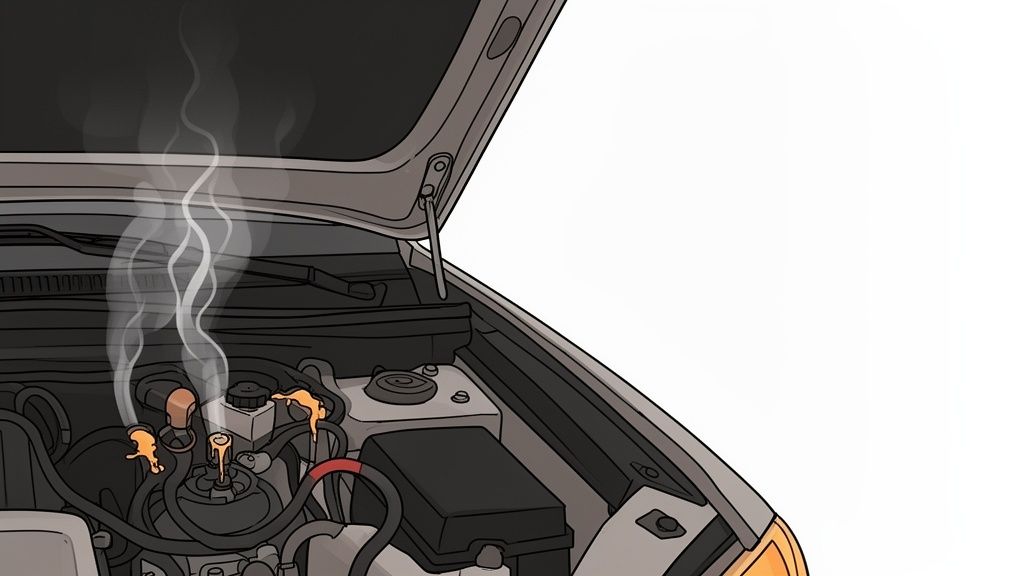
One of the most alarming signs of a bad starter is an acrid, burning smell coming from the engine bay, especially when you try to start the vehicle. This odor, often resembling burnt plastic or an electrical fire, is a serious red flag that the starter motor is overheating. It suggests an intense electrical problem is occurring, such as a short circuit or an excessive current draw that is literally cooking the motor's internal wiring and insulation.
This symptom is a critical warning. The extreme heat generated can not only destroy the starter but also melt surrounding wires and plastic components, posing a significant fire risk. If you notice this smell, you should stop trying to start the car immediately.
Why This Happens
A burning smell is a direct result of electrical distress. The starter motor requires a massive amount of electrical current to turn over the engine. If there's an internal short, a seized motor, or a continuous power supply due to a stuck solenoid, the electricity has nowhere to go but to convert into heat. This extreme heat quickly overwhelms the wiring's insulation, causing it to melt and burn.
This issue can be exacerbated by corroded battery connections or undersized cables that create high resistance, forcing the starter to work even harder and draw more current than it's designed for. In the high-temperature environment of a Richardson summer, an already struggling starter is much more likely to overheat and fail in this dangerous way.
What You Can Do
A burning smell linked to the starting system is a true emergency that requires immediate and cautious action.
- Stop All Starting Attempts: Do not turn the key again. Every attempt sends more current to the overheating component, increasing the risk of a fire.
- Safety First: If possible, do not park the vehicle in a garage or near any flammable materials. Let the engine bay cool down and keep an eye out for any visible smoke.
- Get a Tow: This is not a symptom you can "limp home" with. The vehicle is unsafe to operate and should be towed directly to a professional repair shop like Kwik Kar for an immediate inspection.
When you bring your vehicle in, our ASE-certified technicians will not just look at the starter. They will perform a comprehensive evaluation of the entire starting and charging circuit, including the battery, alternator, and all related cables. This ensures they identify the root cause of the overload, preventing a brand new starter from suffering the same fate.
8. No Response to Ignition Key (Dead Silence)
The most alarming symptom is when you turn the key and get absolute silence. There is no cranking, no clicking, and no sounds from the engine compartment. This complete lack of response signifies a total failure in the power delivery to the starting system. It’s a dead stop that leaves you with very few immediate options.
This scenario points to one of three primary culprits: a completely dead battery, a catastrophic failure in the connection between the battery and the starter, or a completely failed starter motor or solenoid. The entire starting circuit has been interrupted, preventing any electrical current from initiating the starting process.
Why This Happens
The starting circuit requires a massive, uninterrupted flow of electrical current from the battery. If the battery is completely discharged, there is simply no power to give. Similarly, severe corrosion on the battery terminals can act as a barrier, blocking electricity from ever reaching the starter. Finally, the starter motor itself can suffer an internal electrical failure, such as a burnt-out armature or a completely seized solenoid, rendering it incapable of responding to the command from the ignition switch.
In Richardson, this can happen to vehicles parked for extended periods, allowing the battery to fully drain, or to high-mileage cars where the starter finally gives out after years of service. It's one of the clearest signs of a bad starter or a related critical power failure.
What You Can Do
When faced with total silence, your diagnostic options are limited, but you can take a few steps to narrow down the problem before calling for a tow.
- Check Your Lights: Turn on your headlights or interior dome light. If they are dim or don't turn on at all, the problem is most likely a dead battery. If the lights are bright, the battery has power, pointing the blame more directly at the starter or a major wiring issue.
- Attempt a Jump-Start: If you have jumper cables, a jump-start is the best next step. If the car starts, your battery was the issue. However, a dead battery can sometimes be a symptom of a failing charging system. You can learn more about bad alternator symptoms to see if that might be the root cause.
- Inspect Battery Terminals: Perform a quick visual inspection of your battery terminals. If they are covered in fuzzy, bluish-white corrosion, a poor connection is likely the culprit.
If a jump-start fails and the battery connections look clean, do not continue trying to turn the key. The issue is almost certainly with the starter or a major electrical fault. Your vehicle will need to be towed to a professional. The technicians at Kwik Kar can perform a comprehensive electrical system test to diagnose the exact point of failure, whether it's the battery, alternator, starter, or the cables connecting them.
8-Point Comparison of Bad Starter Symptoms
| Symptom | 🔄 Diagnostic Complexity | Resource Requirements | ⚡ Urgency / Time to Fix | 📊 Expected Outcome (⭐) | 💡 Quick Tip |
|---|---|---|---|---|---|
| Engine Cranks But Won't Start | Medium — multiple systems (fuel/ignition) to check | Diagnostic tools, fuel pressure test, spark testing, possible parts (plugs/coils/fuel pump) | Medium — schedule prompt diagnosis (next-day) | ⭐⭐⭐ — often resolved after targeted repair | Limit start attempts (3–4); test fuel & ignition together |
| Clicking Noise Without Engine Rotation | Low–Medium — electrical vs solenoid | Battery load tester, terminal cleaning, starter bench test | High — check immediately to avoid being stranded | ⭐⭐⭐⭐ — commonly battery/connection fixable | Check/clean terminals first; try Neutral start; avoid repeated jump-starts |
| Grinding or Whirring Noise During Starting | Low — mechanical starter/flywheel issue obvious | Starter removal, flywheel inspection, replacement parts | High — stop attempts and tow to shop | ⭐⭐ — starter replacement usually required; possible flywheel repair | Stop starting to avoid flywheel damage; tow for inspection |
| Intermittent Starting Issues (Starts Inconsistently) | High — intermittent faults need live observation | Voltage drop kit, battery capacity tester, live-start monitoring | Medium–High — unreliable; repair soon | ⭐⭐⭐ — fixable but may need multiple tests/visits | Log occurrences (time/temp), test during an appointment |
| Slow Cranking or Weak Engine Turnover | Medium — battery vs starter required testing | CCA/load test, voltage drop analysis, terminal cleaning, starter bench test | Medium — address before condition worsens | ⭐⭐⭐ — often battery or starter; sometimes both | Test battery first, clean cables, consider battery + starter replacement for old vehicles |
| Starter Remains Engaged After Engine Starts | Low — clear solenoid/starter failure but critical | Immediate tow, starter & solenoid replacement, flywheel inspection/repair | Critical — stop engine immediately; tow now | ⭐⭐ — emergency replacement; possible extensive repair | STOP engine immediately; do not drive; tow and inspect flywheel |
| Burning Smell from Engine Compartment During Starting | Medium — electrical overheating/shorts | Wiring inspection, resistance testing, thermal scan, starter replacement | Critical — immediate service due to fire risk | ⭐⭐ — urgent repair; may require wiring and starter replacement | Stop attempts; avoid enclosed areas; tow for full electrical evaluation |
| No Response to Ignition Key (Dead Silence) | Low–Medium — power delivery failure common causes | Battery voltage/capacity test, terminal inspection, starter continuity tests | High — immediate attention (jump-start or tow) | ⭐⭐⭐ — often battery-related; if not, deeper electrical or starter fault | Try jump-start if safe; if unsuccessful, tow for comprehensive electrical testing |
Drive Confidently: Trust Kwik Kar for Your Starter Needs
Navigating the complexities of your vehicle's starting system can feel daunting, but recognizing the early warnings is a powerful tool. From the distinct, sharp click of a failing solenoid to the slow, labored groans of a weak motor, each of the signs of a bad starter we've detailed serves as a crucial signal from your car. These symptoms are not mere annoyances; they are direct indicators that a key component is on the verge of failure, threatening to leave you stranded at the most inconvenient time.
Ignoring these issues is a gamble. An intermittent starting problem can quickly escalate into a complete no-start situation, turning a routine trip to the grocery store or a daily commute into a roadside emergency. By understanding what these sounds and behaviors mean, you transform from a passive driver into a proactive vehicle owner, capable of addressing problems before they spiral out of control and lead to more extensive, costly damage.
From Diagnosis to Decision: Your Next Steps
The journey from identifying a symptom to implementing a solution requires precision and expertise. While preliminary checks like testing your battery or ensuring clean connections can sometimes resolve an issue, a professional diagnosis is essential for confirming a failing starter. Our ASE-certified technicians at Kwik Kar use advanced diagnostic equipment to test the entire starting and charging system, ensuring we isolate the true source of the problem. This prevents you from replacing a part that isn't broken and saves you both time and money.
Once a faulty starter is confirmed, the conversation turns to replacement. This is a critical decision point where quality matters immensely. Choosing the right replacement part can significantly impact your vehicle's future reliability and performance. For many owners, especially those with newer vehicles or those who prioritize longevity, understanding the differences between OEM vs. aftermarket parts can help you make an informed decision about the quality and cost of your repair. We are happy to discuss these options with you, providing transparent advice tailored to your vehicle's needs and your budget.
Why Proactive Maintenance is Your Best Defense
Ultimately, the goal is not just to fix a broken starter but to foster a relationship with your vehicle built on awareness and preventative care. A starter doesn't fail overnight; it provides clues. By listening to your car and acting on these early signs of a bad starter, you are investing in your own peace of mind. You ensure that your vehicle remains a reliable partner for your family, your work, and your daily life in and around Richardson.
Don't let a small symptom become a major headache. Take control of your vehicle's health today. Empowered with this knowledge, you can drive confidently, knowing that you are prepared to act at the first sign of trouble and that a trusted partner is ready to help.
Don't wait for a starting problem to leave you stranded. If you've noticed any of these symptoms, schedule a comprehensive starting system diagnostic with the certified experts at Kwik Kar Oil Change and Auto Care. Visit us online at Kwik Kar Oil Change and Auto Care to book your appointment and ensure your vehicle is ready to start reliably every time.