Texas Safety vs Emissions: What Drivers Must Do Now
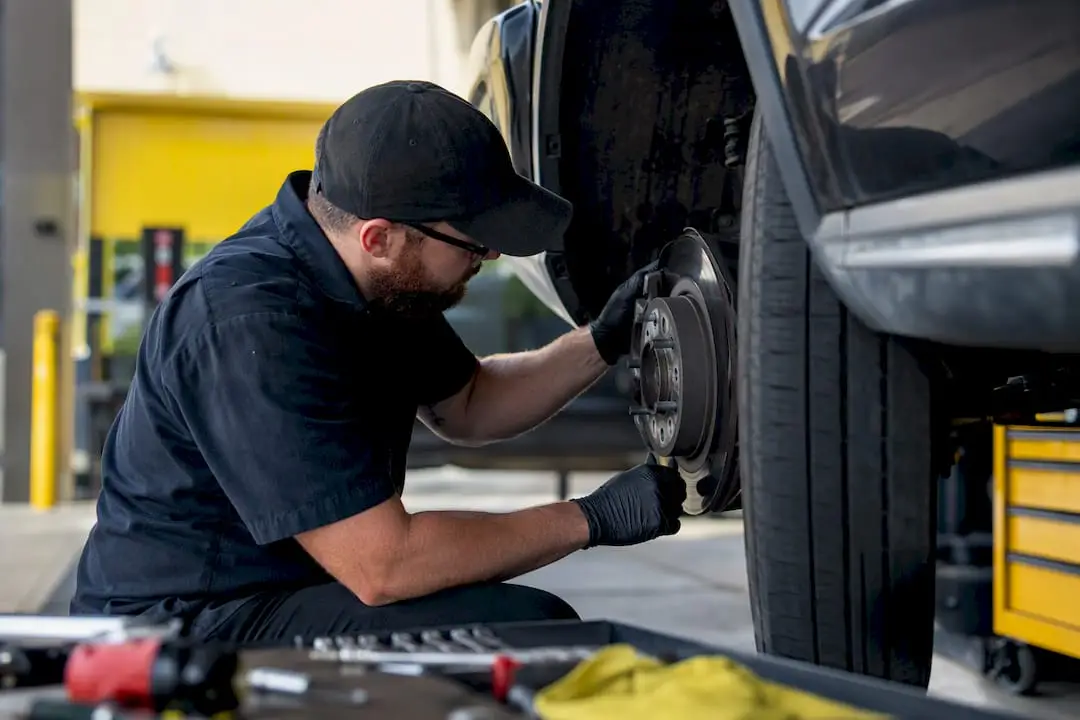
Texas no longer requires an annual safety inspection for most non-commercial vehicles. As of January 1, 2025, House Bill 3297 ended that mandate statewide. But if you live in one of 17 designated counties, an emissions test still stands between you and a renewed registration sticker.
That is the real story behind Texas safety vs emissions: one requirement disappeared, and the other did not. Here’s what still applies to your vehicle:
- No more mandatory safety inspection for private, non-commercial vehicles anywhere in Texas.
- Emissions testing remains mandatory in affected counties for eligible gasoline vehicles.
- You still pay an inspection-replacement fee at registration, and your car’s mechanical safety is now your responsibility.
Key Takeaways
Texas dropped mandatory safety inspections for non-commercial vehicles in 2025, but emissions testing still blocks registration renewal in 17 affected counties.
| Point | Details |
|---|---|
| Safety inspection ended | HB 3297 removed the annual mandate for non-commercial vehicles effective January 1, 2025. |
| Emissions rules unchanged | Gasoline vehicles 2 to 24 years old in affected counties still need OBDII emissions testing. |
| Fee still applies | The state collects a $7.50 inspection-replacement fee at registration regardless of the repeal. |
| Bexar County joins in 2026 | Bexar County begins emissions testing on November 1, 2026. |
| Readiness monitors matter | Recently cleared codes or a disconnected battery can cause an automatic fail until you drive a mixed cycle. |
| Get both checks at once | Kwik Kar Oil Change & Auto Care’s ASE-certified technicians run OBDII pre-checks alongside a safety review. |
Table of Contents
- What Changed in Texas Law and What It Means for You
- Which Texas Counties Still Require an Emissions Test
- How the OBDII Emissions Test Actually Works
- Your Pre-Test Checklist Before Registration Renewal
- What to Do if You Fail or Your Monitors Are Not Ready
- The Real Gap Between Safety and Emissions Rules
- Get Your Emissions Pre-Check and Safety Review Done Together
- Sources
- FAQ
What Changed in Texas Law and What It Means for You
House Bill 3297 eliminated the yearly safety inspection sticker for non-commercial vehicles registered in Texas. The Texas Department of Public Safety (DPS) confirms the change took effect January 1, 2025, and makes clear that owners, not the state, now carry responsibility for keeping brakes, tires, lights, and steering in safe working order.
The catch is that “inspection” hasn’t vanished from your registration paperwork. Texas still collects an inspection-replacement fee when you renew, and the Texas Department of Motor Vehicles (TxDMV) lists the standard amount at $7.50, with a different rate for vehicles paying a two-year registration cycle upfront. Many drivers assume that fee still buys them a physical safety check. It doesn’t.
A few things stayed exactly the same:
- Commercial vehicles, including many fleet and for-hire vehicles, still require periodic safety inspections.
- Emissions inspections continue in affected counties, independent of the safety inspection repeal.
- The inspection-replacement fee is administrative. It funds state programs; it does not certify your car is roadworthy.
If your registration renewal notice still says “inspection required,” read it carefully. It likely refers to the emissions side, not brakes and lights.
Which Texas Counties Still Require an Emissions Test
Seventeen counties currently run emissions testing programs, concentrated around the Dallas-Fort Worth, Houston, Austin, and El Paso metro areas. Bexar County is set to join the program on November 1, 2026, according to reporting on the rollout in San Antonio, so drivers there should watch for updated registration notices well before that date.
Not every vehicle in those counties gets tested. The Texas Commission on Environmental Quality (TCEQ) restricts the emissions program to gasoline-powered vehicles between 2 and 24 years old. Diesel vehicles, motorcycles, and vehicles outside that age window are typically exempt, along with a handful of other categories DPS lists on its program pages.
Here’s what determines whether you’re on the hook:
- County of registration. Only the 17 listed counties (soon 18, with Bexar) require the test.
- Vehicle age. Gasoline vehicles 2 to 24 years old fall inside the testing window.
- Fuel type. Diesel and electric vehicles generally sit outside the program.
If your vehicle qualifies and you skip the test, your registration renewal will carry a TCEQ noncompliance remark, and the county tax office will block the sticker until you clear it. This is where the practical difference between Texas safety inspection requirements and safety inspection vs emissions testing becomes obvious: one is gone, the other still stops you at the counter.
How the OBDII Emissions Test Actually Works
The test itself doesn’t involve a mechanic checking your brakes or headlights. Certified stations plug into your vehicle’s onboard diagnostics port and pull data the computer has already been collecting, according to DPS inspection criteria. The system evaluates pollutants like nitrogen oxides (NOx), volatile organic compounds (VOCs), and carbon monoxide (CO), all tracked through your engine’s own sensors.
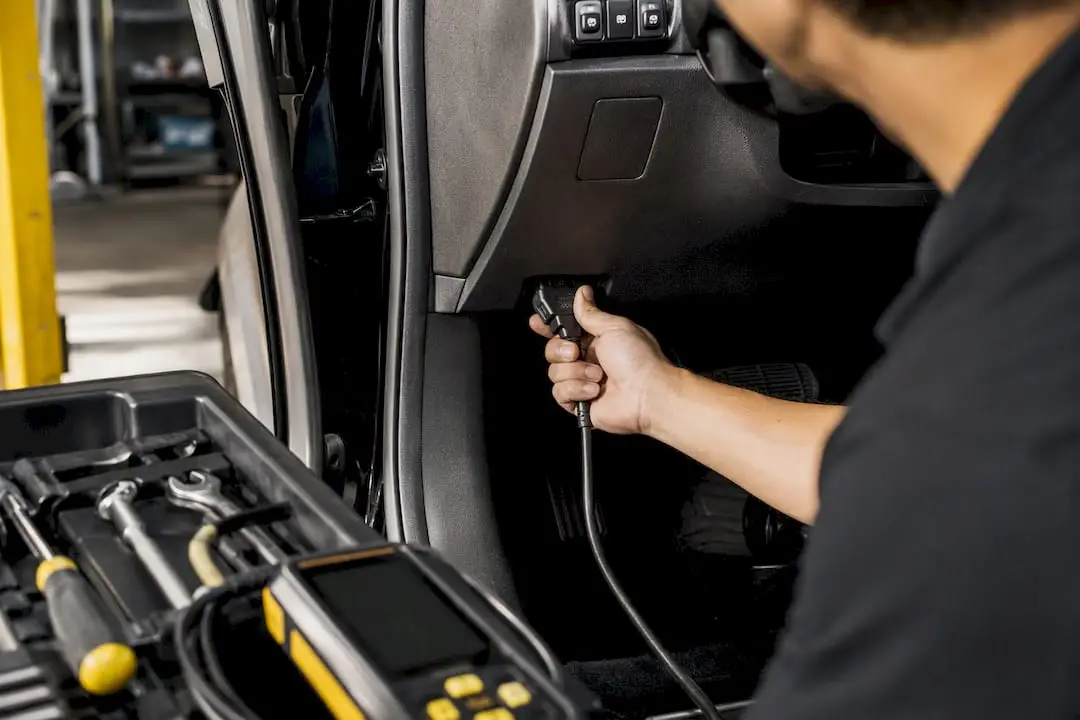
The part that trips up most drivers is the readiness monitor system. Your vehicle’s computer runs a series of internal self-tests, called monitors, covering everything from the catalytic converter to the oxygen sensors. Each monitor reports “ready” once it has completed its evaluation cycle, or “not ready” if it hasn’t run yet. Too many “not ready” monitors, and the vehicle fails automatically, even if nothing is mechanically wrong.
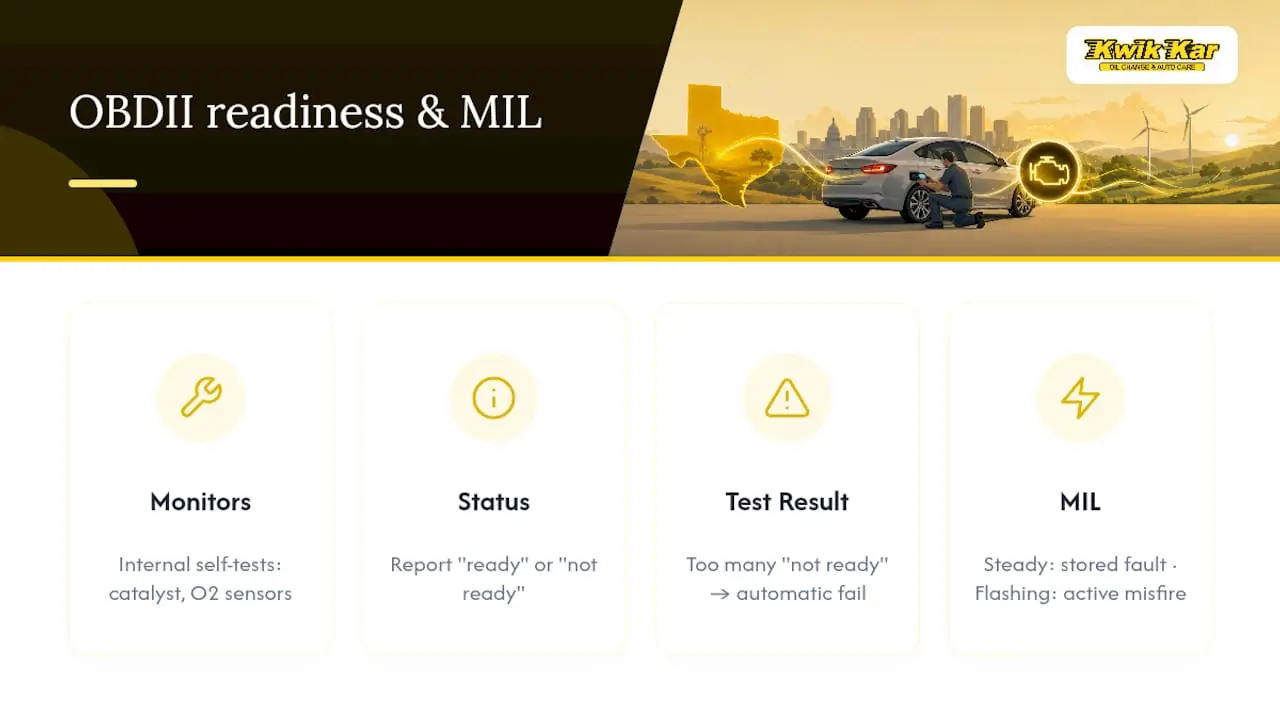
Your check engine light, known formally as the malfunction indicator lamp (MIL), tells a similar story in a different way. A steady MIL usually signals a completed diagnostic trouble code, something the system has confirmed. A flashing MIL is more urgent. It typically points to active engine misfires that can damage the catalytic converter if you keep driving.
Pro Tip: If you’ve recently had a battery disconnected, a code cleared, or a repair done, your monitors are almost certainly “not ready.” Drive 50 to 100 miles of mixed city and highway conditions before you test. Clearing codes right before a retest doesn’t fool the system. It resets your monitors to “not ready” and guarantees a failed attempt.
Your Pre-Test Checklist Before Registration Renewal
A little groundwork before you head to a testing station saves you a wasted trip and a second visit. Start with the basics you can check yourself:
- Confirm your check engine light isn’t on, and if it is, note whether it’s steady or flashing.
- Walk around the vehicle and check headlights, taillights, and brake lights.
- Check tire tread depth and inflation, since underinflated tires strain fuel systems and throw off sensor readings.
- Test brake responsiveness on a quiet street before you’re relying on them in traffic.
- Verify your gas cap is sealed tightly. A loose cap is one of the most common causes of an evaporative system failure.
- Check oil level and condition, and confirm your battery terminals are clean and secure.
Beyond the visual check, confirm your OBDII readiness status before you drive to a testing station. A scan tool at home works if you own one, but an ASE-certified shop can run the same diagnostic in minutes and tell you definitively whether your monitors are set.
- Keep your Vehicle Inspection Report (VIR) or pull a copy from mytxcar.org as proof if the county’s electronic system doesn’t sync in time.
- Some county tax office subcontractors won’t accept a VIR and require manual verification, so calling ahead saves a return trip.
- A routine maintenance checklist run before renewal season catches small issues before they become registration delays.
What to Do if You Fail or Your Monitors Are Not Ready
A failed test or a stack of “not ready” monitors isn’t the end of the process. It’s the start of a fairly standard sequence.
- Don’t clear codes. It resets readiness monitors and guarantees another failed or incomplete test.
- Drive the recommended cycle. A mix of stop-and-go and highway driving over a moderate distance lets your monitors complete naturally.
- Retest at a certified station once your scan tool or shop confirms all monitors show ready.
If repairs needed to pass emissions cost more than a set threshold, Texas offers waivers and time extensions for eligible owners, according to DPS guidance on the 2025 inspection changes. These are processed through designated waiver stations and recognized repair facilities, not every general repair shop. Keep every repair receipt. Recognized facilities that perform emissions-related repairs typically offer a free retest within a set window, which is one of the few places in this process where documentation genuinely works in your favor.
The Real Gap Between Safety and Emissions Rules
The state didn’t just simplify paperwork when it dropped the annual safety inspection. It shifted the entire burden of catching worn brake pads, bald tires, and failing headlights onto drivers who, frankly, don’t have a strong habit of checking those things without a deadline forcing them to.
That’s the part of Texas vehicle safety standards that conventional coverage tends to gloss over. Most articles treat the HB 3297 change as good news, and in terms of cost and hassle, it is. But nobody is inspecting your brake pads now unless you ask someone to. Emissions testing was never designed to catch a worn rotor or a cracked serpentine belt. It only looks at what your engine’s computer reports about pollutants.
If you own a vehicle in one of Texas’s emissions counties, the smart move isn’t just tracking your test window. It’s pairing that emissions check with an actual safety look at the components nobody is legally required to inspect anymore. Waiting for a warning light or a grinding noise to tell you something is wrong is a worse strategy now than it was in 2024, not a better one.
— Kwik Kar
Get Your Emissions Pre-Check and Safety Review Done Together
Skipping the state safety inspection doesn’t mean skipping a safety check makes sense. Kwik Kar Oil Change & Auto Care gives Richardson drivers a single stop for both sides of the equation: a full engine diagnostic scan that confirms your OBDII readiness monitors before you drive to a testing station, plus a courtesy safety look at brakes, tires, and lights while your car is already on the lift.

Our ASE-certified technicians run the same diagnostic logic emissions stations use, so you find out about “not ready” monitors or a pending trouble code before you waste a trip. Kwik Kar Oil Change & Auto Care is recognized by both CARFAX and RepairPal, and we offer discounts for military personnel and first responders. If your check engine light is on, or you just want the safety check the state no longer requires, schedule a diagnostic and pre-check visit before your registration renewal comes due.
Sources
- Vehicle Inspection Program Overview | Department of Public Safety
- Vehicle emissions inspections in Texas – TCEQ
- Register your vehicle | Texas Department of Motor Vehicles
FAQ
Do I Still Need a Safety Inspection in Texas?
No. As of January 1, 2025, Texas eliminated the annual safety inspection requirement for non-commercial vehicles under House Bill 3297.
What Is the Difference Between Safety Inspection vs Emissions Testing?
A safety inspection checks physical components like brakes and lights and no longer applies to most private vehicles, while emissions testing checks pollutant output through your car’s OBDII system and still applies in affected counties.
Which Texas Counties Require Emissions Testing?
Seventeen counties currently require emissions testing for eligible gasoline vehicles, with Bexar County joining the program starting November 1, 2026.
What Happens if My Registration Is Expired in Texas?
An expired registration tied to a failed or missing emissions test blocks renewal until you pass the required test or complete a valid waiver process, and driving on an expired registration can result in a citation.
Where Can I Get an Emissions Pre-Check Before My Official Test?
An ASE-certified shop like Kwik Kar Oil Change & Auto Care can scan your OBDII readiness monitors and run a safety review before you head to an official testing station.