Tire Rotation Patterns: Which One Fits Your Car

The right tire rotation pattern depends on your drivetrain and your tires. Front-wheel-drive cars usually use a forward cross, rear-wheel-drive cars a rearward cross or X-pattern, and AWD or 4WD vehicles a cross or X-pattern. Directional tires only move front to back on the same side, and staggered sizes cannot be rotated. Your owner’s manual has the final word, and we can confirm it for your vehicle at Kwik Kar Oil Change & Auto Care in Richardson, TX.
TL;DR
- Front-wheel drive: forward cross (fronts go straight back, rears cross to the front).
- Rear-wheel drive: rearward cross or X-pattern. AWD and 4WD: X-pattern (double X) or a cross pattern.
- Directional tires: front to back on the same side only. Staggered fitments (different front and rear sizes): no rotation.
- Interval: follow your manual. With no guidance, the standard range is 5,000 to 8,000 miles, or sooner if wear looks uneven.
Table of Contents
- Why the pattern matters
- The common tire rotation patterns, explained
- Which pattern fits your drivetrain
- Directional and staggered tires: the exceptions
- What about the spare tire?
- How often to rotate
- A step-by-step look at a rotation
- When uneven wear means more than a rotation
- Perspective: why we rotate by the book, not by habit
- Tire rotation and tire service in Richardson
- A note on Texas inspections
- FAQ
- Sources
Why the pattern matters
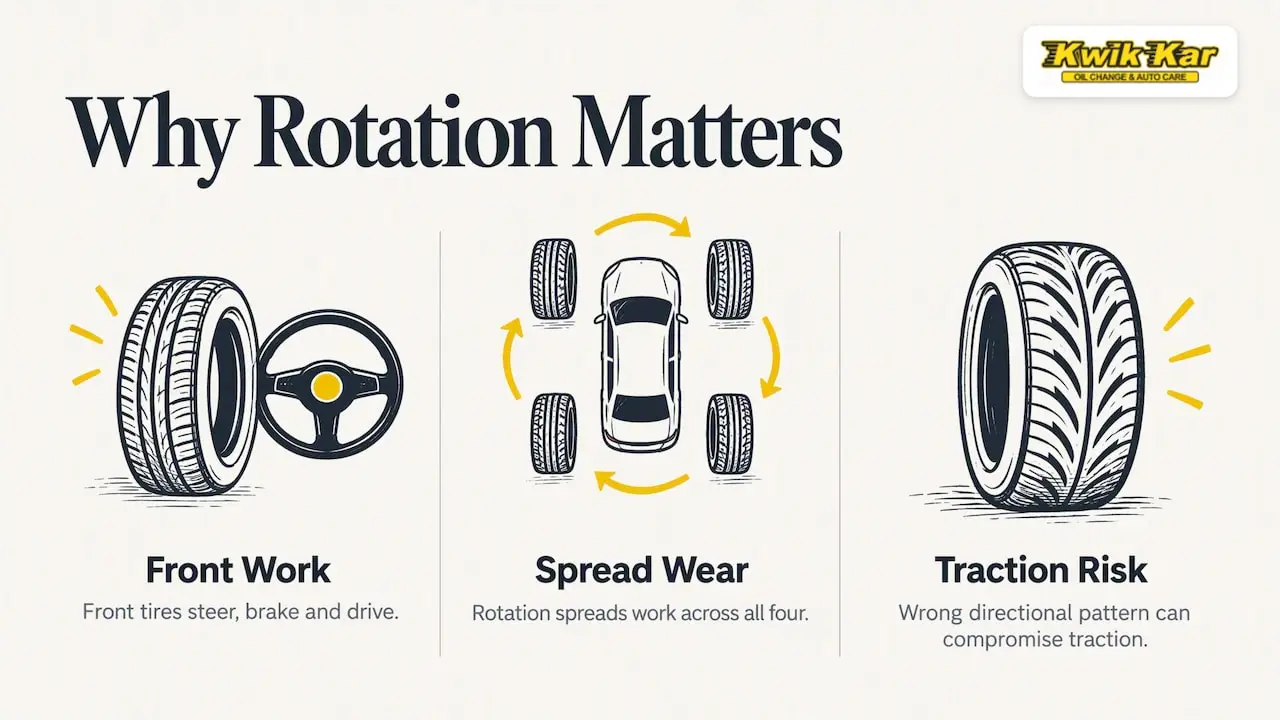
Tires on the same car do not wear at the same rate. On a front-wheel-drive car, the front tires steer, brake and drive, so they do most of the work. The Tire Industry Association explains that steering scrubs the front tires and creates lateral forces, which is why cross-rotation helps balance wear.
Moving each tire to a new position spreads that work across all four. The result is more even tread, a more predictable feel in the wet and, typically, a set of tires that wears out together instead of in pairs.
The pattern is simply the map of where each tire goes. Pick the wrong one for your drivetrain or tire type and you lose some of the benefit. Pick the wrong one for directional tires and you can actually compromise traction.
The common tire rotation patterns, explained
Three four-tire patterns cover most vehicles. Continental Tire describes them this way.
Forward cross
The front tires move straight back to the same side of the rear axle. The rear tires cross diagonally to the front. Left rear goes to right front, and right rear goes to left front.
This is the standard choice for front-wheel-drive cars, because it moves the hard-working front tires to the rear, where they get a rest.
Rearward cross
The mirror image. The rear tires move straight forward on the same side, and the front tires cross diagonally to the rear. Left front goes to right rear, and right front goes to left rear.
This suits rear-wheel-drive vehicles, where the rear tires handle the driving force.
X-pattern
Every tire moves diagonally to the opposite corner. Left front swaps with right rear, and right front swaps with left rear. For AWD and 4WD vehicles, the Tire Industry Association describes this as a double X, where both diagonal pairs switch.
Front-to-back (straight) rotation
Tires move forward or backward on the same side, with no crossing. This is the required method for directional tires, which are built to roll in one direction. It is also what you use if a tire has been mounted and balanced in a way that should not change sides.
Which pattern fits your drivetrain
| Vehicle or tire type | Typical pattern | What moves where |
|---|---|---|
| Front-wheel drive | Forward cross | Fronts straight back, rears cross to the front |
| Rear-wheel drive | Rearward cross or X-pattern | Rears straight forward, fronts cross to the rear (or all swap diagonally) |
| AWD and 4WD | X-pattern (double X) or cross pattern | All four tires swap to diagonal positions |
| Directional tires | Front to back, same side | Fronts back, rears forward, no side change |
| Staggered sizes (front and rear differ) | No rotation | Tires stay on their axle |
This table reflects general guidance from Continental Tire and the Tire Industry Association. Some manufacturers specify something different, and that specification wins.
What about the “best” pattern for a Nissan Rogue AWD?
Drivers often ask about specific models like the Rogue. For an AWD vehicle, the general guidance is a cross or X-pattern, but the exact pattern and interval come from that model year’s owner’s manual. Some Nissan manuals, for instance, give a mileage interval and say to leave the spare out of the rotation. Look in the maintenance section of your manual, or bring the vehicle in and we will check it against the manufacturer’s recommendation.
Directional and staggered tires: the exceptions
Directional tires carry an arrow on the sidewall showing the rolling direction. The tread grooves are designed to channel water out from under the tire. Swap one to the other side of the car and it spins backward, which undermines that water evacuation. The U.S. Tire Manufacturers Association says directional and asymmetrical tires may not be rotated in the illustrated cross patterns, and that different front and rear sizes carry their own restrictions.
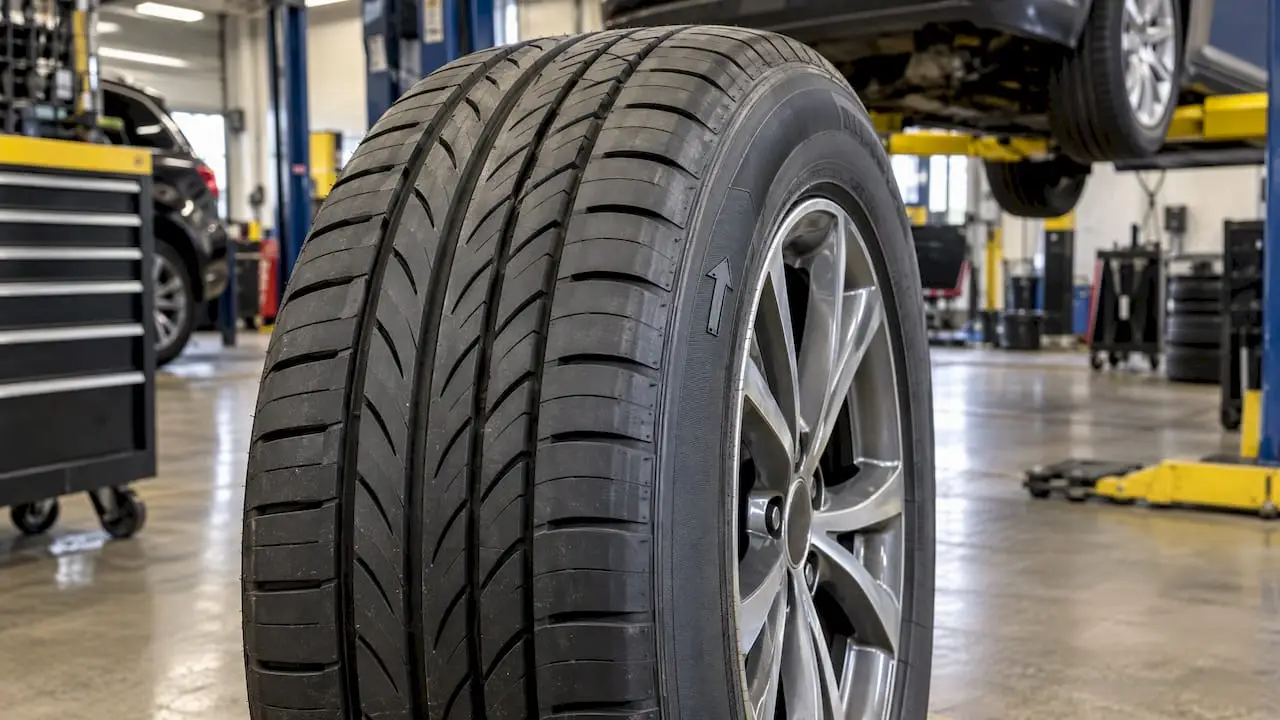
The practical rule: directional tires move front to back on the same side. If you ever want them on the opposite side, a shop must dismount and remount them so the arrow still points the right way.
Staggered setups, common on some performance and sports cars, use wider tires on the rear axle. Because the sizes differ, front and rear tires cannot trade places. In that case, the benefit comes from monitoring wear and keeping alignment right instead of rotating.
Wet roads matter in North Texas, where a sudden storm can turn a dry commute into a standing-water problem within minutes. Keeping directional tires correctly oriented is part of keeping their grooves doing the job they were designed for.
What about the spare tire?
If your vehicle has a full-size spare that matches the other four, the USTMA says it is recommended to include it in the rotation, typically inserting it at the right rear. That spreads wear over five tires instead of four.
The USTMA also warns against including a temporary-use or T-type spare in any standard rotation pattern. Those compact spares are for short emergency distances only. Some manufacturers also tell you to leave the spare out entirely, so check your manual first.

How often to rotate
Start with the manufacturer. Your manual lists the interval for your vehicle. When it gives no specific period, the U.S. Tire Manufacturers Association advises rotating every 5,000 to 8,000 miles, or at the first sign of uneven wear. NHTSA gives the same range for vehicles where rotation is recommended.
That range often lines up with an oil change, which makes it easy to remember. Not every vehicle should follow the same mileage, though, so treat any single number as a starting point. Our guide to how often to rotate your tires goes further into the schedule.
If you split your driving between short Richardson errands and longer runs up US-75 or the President George Bush Turnpike toward Plano, Garland or Addison, mileage is a better guide than the calendar. Stop-and-go driving and highway miles wear tires differently.
A step-by-step look at a rotation
Whether you do it yourself or have a technician handle it, the sequence is the same.
- Check the manual and the sidewalls. Confirm the recommended pattern, and look for directional arrows or different front and rear sizes.
- Inspect before moving anything. Look for uneven wear, bulges, nails and cracking. Measure tread depth with a gauge. A tread depth chart in 32nds of an inch helps convert gauge readings to millimeters.
- Lift the vehicle safely with a proper jack and stands, or a lift. Never work under a car supported only by a jack.
- Move each tire according to the chosen pattern.
- Torque the lug nuts to the manufacturer’s specification in a star pattern.
- Set tire pressure to the placard value on the driver’s door jamb, not the number molded on the tire sidewall.
- Reset the TPMS if your vehicle requires it, and recheck lug nuts after the first drive if your manual says so.
Pro tip: A rotation is also a convenient moment to clean the wheels. Grit and brake dust are abrasive, so a wash sequence that keeps wheel grit off paint helps protect your finish while the wheels are fresh off the car.
When uneven wear means more than a rotation
Rotation evens out normal wear. It does not fix the cause of abnormal wear. The USTMA advises that if tires show uneven tread wear, you should check for and correct misalignment, imbalance or other mechanical problems before rotating.
Signs worth a closer look include:
- One edge of a tire wearing faster than the rest
- Cupping or scalloped patches on the tread
- A vehicle that pulls to one side
- A steering wheel that vibrates at highway speed
These can point to alignment, balance or worn suspension parts. Our article on spotting uneven tire wear patterns shows what each one looks like, and tire rotation vs. wheel alignment explains why you may need both. If a tire is wearing smooth, see signs a tire is bald or dangerously worn before it becomes a safety issue.
Not every irregularity is urgent. Mild, even wear on a tire that has simply covered a lot of miles is normal. What matters is a pattern you can see and feel, and a professional can tell you which it is.
Perspective: why we rotate by the book, not by habit
At our Richardson shop, we see the same thing again and again: two tires worn nearly smooth while the other two still look healthy. Most of the time, the cause is a rotation that was skipped, or a pattern that did not suit the tires.
That is why we start with the manufacturer’s recommendation and the tires in front of us, not a one-size-fits-all routine. Our ASE-certified technicians check the drivetrain, look for directional arrows and mismatched sizes, and inspect tread and sidewalls before anything moves.
Our digital vehicle inspections let you see what we see, so a rotation can also be your early warning for alignment or suspension concerns. We would rather you catch a small issue now than replace a full set early.
Eligible repairs are backed by our 24-month/24,000-mile limited warranty, and qualifying suspension repairs by our Lifetime Suspension Warranty. Coverage applies to qualifying repairs only.
Kwik Kar
Tire rotation and tire service in Richardson
If you would rather not handle jacks and torque specs, we can rotate your tires, check the pattern against your manual and inspect for wear while the wheels are off. Our tire sales and service team also handles replacements, and our wheel alignment service helps address the causes of uneven wear. We serve drivers across Richardson, Plano, Garland, North Dallas and Addison, and offer discounts for military members and first responders.
Pricing varies by vehicle, so call us at (972) 644-1851 and we will talk through what your car needs. You can learn more about us at Kwik Kar Oil Change & Auto Care.
A note on Texas inspections
Texas ended most non-commercial passenger vehicle safety inspections in 2025. Emissions testing remains required for qualifying vehicles in applicable counties, and commercial safety inspections continue. Tires are still a safety item, since worn or damaged tires affect braking and wet-road grip regardless of whether a sticker is required. Regular rotation and tread checks are how you stay ahead of that.
FAQ
What is the best tire rotation pattern?
There is no single best pattern. The right one depends on your drivetrain and tires. Front-wheel drive typically uses a forward cross, rear-wheel drive a rearward cross or X-pattern, and AWD or 4WD a cross or X-pattern. Your owner’s manual takes priority.
What is front-to-back tire rotation?
Front-to-back rotation moves each tire to the other axle on the same side of the car, with no crossing. It is the correct method for directional tires, because they must keep rolling in the direction the tread was designed for.
What is cross rotation?
In a cross rotation, at least one axle’s tires switch sides as they move. A forward cross sends the rear tires diagonally to the front, while a rearward cross sends the front tires diagonally to the rear. An X-pattern swaps all four diagonally.
Can every vehicle have its tires rotated?
No. Vehicles with different front and rear tire sizes, known as staggered fitments, cannot swap tires between axles. Directional tires can only move front to back on the same side. NHTSA notes that rotation applies when the vehicle manufacturer recommends it.
How often should I rotate my tires?
Follow the interval in your owner’s manual. If it gives none, rotate every 5,000 to 8,000 miles or at the first sign of uneven wear. Many drivers pair it with an oil change to keep it on schedule.
If you would like a technician to confirm the right pattern for your vehicle, call Kwik Kar Richardson at (972) 644-1851 or schedule an appointment online.
Sources
- Tire Rotation: Why, When, and the Right Pattern, Continental Tire
- Tire Rotation, Tire Industry Association
- Tire Care & Safety Guide, U.S. Tire Manufacturers Association
- Tire Safety, NHTSA
- Tire Tread Depth Chart: 32nds of an Inch to mm
- Car Wash Sequence: Keep Wheel Grit Off Paint