Tire Rotation vs. Wheel Alignment: What Each Does
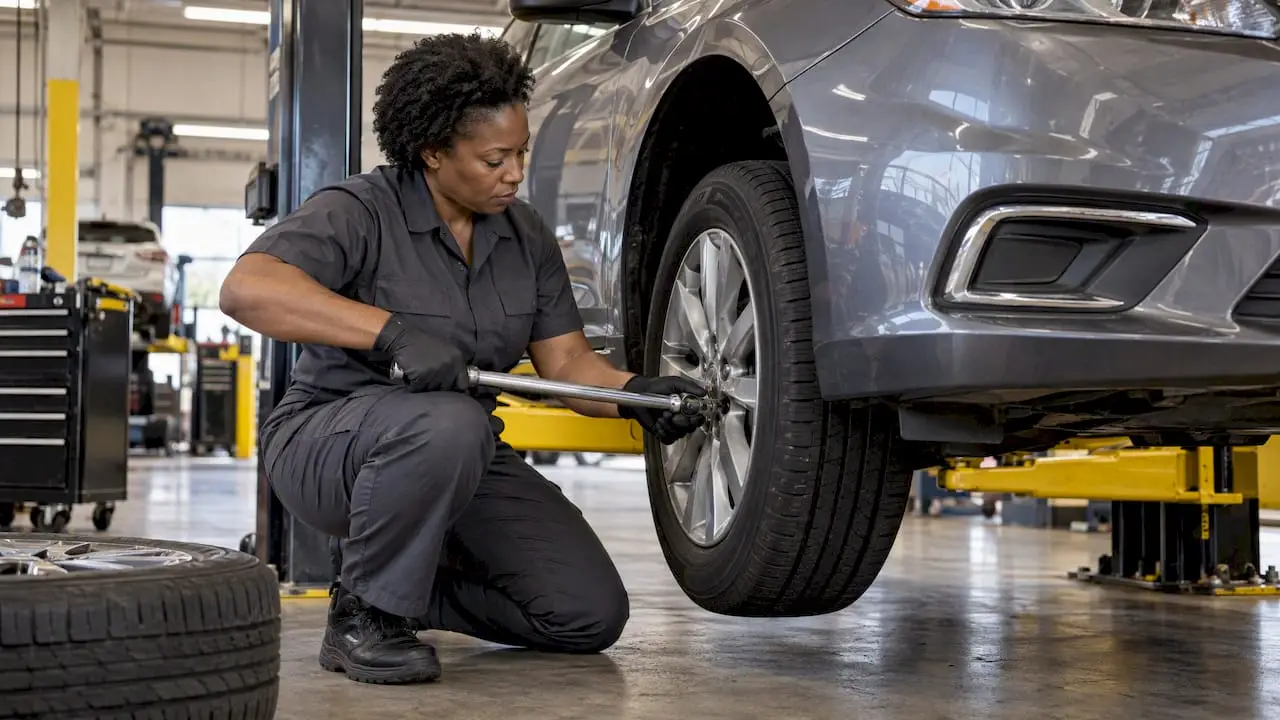
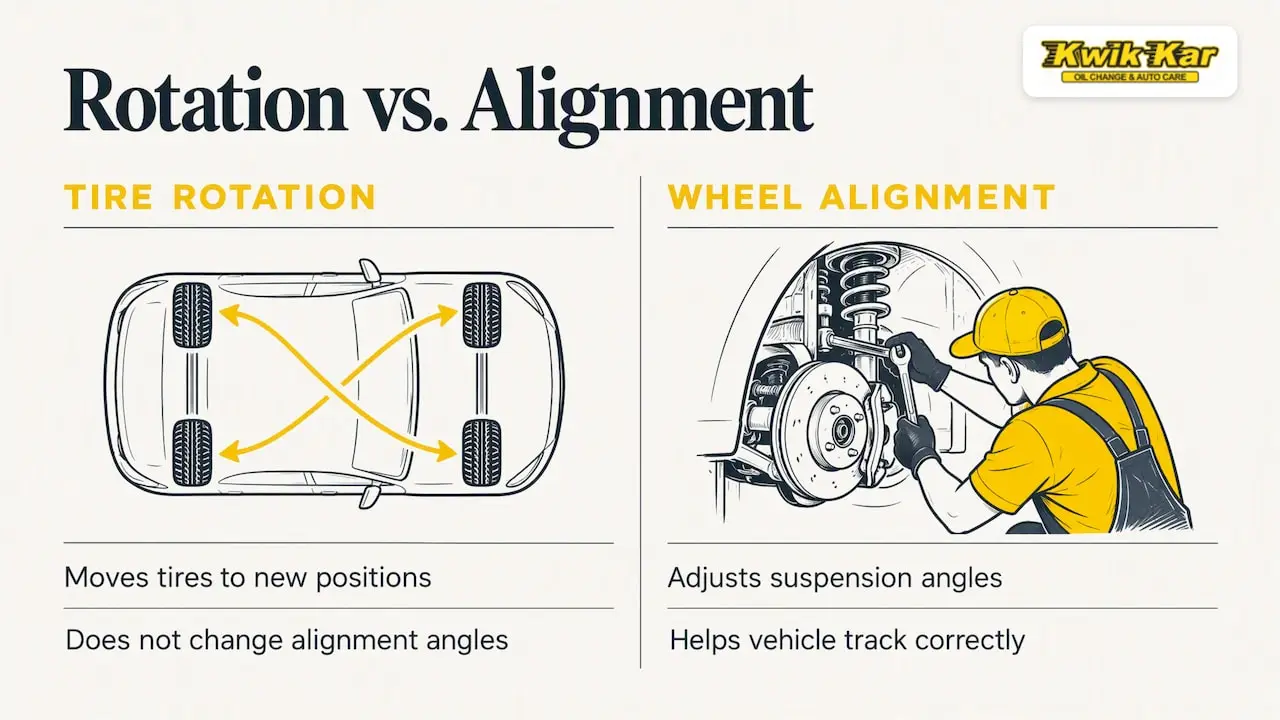
Tire rotation and wheel alignment are two different services. Rotation moves your tires from one position to another so they wear evenly. Alignment adjusts the angles of the wheels so the car tracks straight and the tires meet the road correctly. Rotation is routine maintenance on a schedule. Alignment is checked when symptoms appear and at the intervals your owner’s manual gives.
At Kwik Kar Oil Change & Auto Care in Richardson, TX, we see drivers mix the two up every week, and it is an easy mistake: both involve your wheels, and both protect your tires. This guide explains how they differ, how to tell which one you need, and what to expect on cost.
TL;DR
- Rotation swaps tire positions to even out wear. Follow your owner’s manual; if it gives no interval, 5,000 to 8,000 miles is the general guideline.
- Alignment corrects wheel angles (camber, toe and caster). Check it when the car pulls, the steering wheel sits off-center, or tires wear unevenly.
- Balancing is a third service. It stops vibration and is not the same as either of the other two.
- A rotation does not change your alignment, and an alignment does not replace a rotation. Uneven wear should be diagnosed before you assume rotation alone will fix it.
- Call Kwik Kar Richardson at (972) 644-1851 if you are unsure which one your car needs.
Table of Contents
- Tire Rotation vs. Alignment at a Glance
- What Tire Rotation Does
- What Wheel Alignment Does
- Where Tire Balancing Fits In
- Signs You Need a Rotation, an Alignment, or a Closer Look
- How Often Should You Rotate and Align?
- What Does a Wheel Alignment Cost?
- Do You Need an Alignment After a Tire Rotation?
- Our Perspective: Treat Them as a Pair
- Get Your Tires and Alignment Checked in Richardson
- FAQ
- Sources
Tire Rotation vs. Alignment at a Glance
| Tire rotation | Wheel alignment | |
|---|---|---|
| What it does | Moves tires to different positions on the car | Adjusts wheel angles to the manufacturer’s specification |
| Main goal | Even tread wear across all four tires | Straight tracking and correct tire contact with the road |
| Touches the suspension? | No | Yes, adjustments are made at suspension and steering points |
| When | On a schedule, by mileage | When symptoms appear, after impacts or suspension work, and periodically per the manual |
| Typical symptom of skipping it | Front or rear tires wearing faster than the others | Pulling, off-center steering wheel, wear on one tire edge |
The short version: rotation is about where each tire sits. Alignment is about how each wheel sits.
What Tire Rotation Does
Every position on your car loads a tire differently. Front tires on a front-wheel-drive car handle steering, most of the braking load and the engine’s power. Rear tires mostly follow along. Rotation requirements stem from these differing loads by vehicle position, so left alone, one pair wears out well ahead of the other.
Moving the tires around spreads that wear across the whole set. The U.S. Tire Manufacturers Association (USTMA) notes that rotating tires according to your owner’s manual can prevent irregular tire wear. Even wear means the set reaches the end of its life together, which is easier on your budget than replacing tires one axle at a time.
A rotation is a straightforward service: the wheels come off, the tires go back on in a new pattern, and lug nuts are tightened to specification. It does not change any suspension angle.
The rotation pattern depends on your vehicle
The correct pattern varies by drivetrain and by whether your tires are directional or your wheels are staggered (different sizes front and rear). Your owner’s manual or tire manufacturer gives the right one. Some cars with a full-size spare include it in the pattern; others do not.
What Wheel Alignment Does
Alignment has nothing to do with moving tires. It is the adjustment of the angles at which your wheels are mounted, so they point where the car is going. The three angles technicians work with are:
- Camber: the inward or outward tilt of the wheel when viewed from the front.
- Toe: whether the fronts of the tires point slightly toward or away from each other, like pigeon toes.
- Caster: the forward or backward tilt of the steering axis, which affects steering stability and return.
Proper alignment helps reduce tire wear and keeps the vehicle traveling straight, with no pull to one side. Our Richardson shop handles this on the wheel alignment service page, and our guide on how long an alignment takes sets expectations for your visit.
What knocks a car out of alignment
Most misalignment is gradual or comes from a single jolt. Potholes and curbs are a common cause. Age matters too: springs can fatigue and ride height can change as a vehicle gets older, which shifts the geometry. Worn steering or suspension parts can also keep a car from holding an alignment, which is why a technician may inspect those parts during the visit. If that inspection finds a worn component, our steering and suspension repair service covers the fix.
Dallas-area roads give this plenty of opportunity. Construction zones on US-75 and the Central Expressway corridor, plus the usual pothole season after a hard freeze, are common ways a wheel gets nudged out of spec between Richardson, Plano, Garland and Addison.
Where Tire Balancing Fits In
Balancing is the service people confuse with both of the others. It corrects weight differences around a wheel and tire assembly. NHTSA explains that balancing helps wheels rotate properly and prevents shaking or vibration, and says new tires should always be balanced at installation.
So a vibration at highway speed points toward balance, while a pull or off-center steering wheel points toward alignment. Our article on wheel alignment vs. tire balance goes deeper on that pair.
Signs You Need a Rotation, an Alignment, or a Closer Look
Your tires and steering tell you a lot, if you know what to watch for.
Signs that point to alignment:
- The car drifts to one side on a flat, straight road.
- The steering wheel is crooked when you are driving straight.
- One tire shows wear on its inner or outer edge.
Pulling, an off-center steering wheel and wear on one edge are the classic warning signs. Our 5 signs you need a wheel alignment article and the guide to a crooked steering wheel cover them in more detail.
Signs that point to rotation:
- The front tires are visibly more worn than the rears, or the reverse, but the wear is even across each tire’s width.
- You have reached the mileage your manual lists and have no record of a rotation.
Signs that call for a diagnosis first:
- Cupping, feathering, or patchy wear.
- A shake or hum that changes with speed.
Uneven wear can come from misalignment, imbalance or another mechanical problem. AAA’s tire guidance says a tire dealer should check and correct the cause before the tires are rotated. Rotating over a hidden problem just moves the damage around. Our guide to uneven tire wear patterns helps you read what you see.
You can also do a quick check at home: look at tread depth, wear patterns and sidewalls. Regular visual checks catch most problems early. Keep inflation at the pressure on your driver’s door placard too, since USTMA lists correct inflation as a foundation of tire care alongside rotation.
How Often Should You Rotate and Align?
Your owner’s manual comes first. Manufacturers set intervals for their vehicles, and some, such as all-wheel-drive models or cars with performance tires, have specific requirements.
Rotation timing
When the manual gives no period, USTMA’s general guidance is every 5,000 to 8,000 miles. NHTSA likewise points drivers to the manual for interval and pattern, and says rotation may be needed sooner if uneven wear appears. Many drivers pair it with an oil change visit, which is convenient for commuters. See our 5,000 to 8,000 mile rotation guide for more.
Alignment timing
Alignment is symptom- and event-driven. USTMA says to check it when trouble arises and periodically as your manual specifies. As a rough yardstick, AutoZone suggests about every 12,000 to 15,000 miles or once a year for most vehicles. That is a general guideline, not a rule for every car. A check also makes sense after a hard pothole or curb hit, after suspension or steering work, and when you install new tires.
What Does a Wheel Alignment Cost?
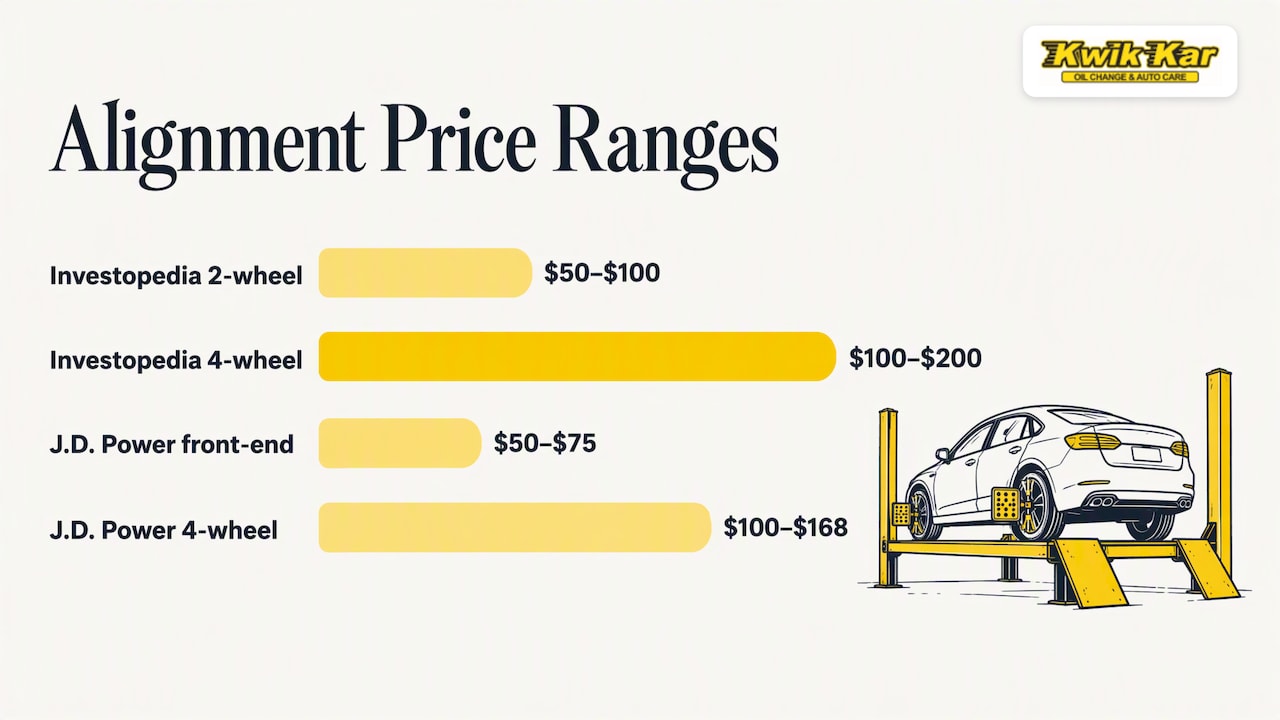
Prices vary by vehicle, shop and region. Investopedia’s February 2026 overview reports typical prices of $50 to $100 for a two-wheel alignment and $100 to $200 for a four-wheel alignment. J.D. Power’s July 2023 guide puts a front-end alignment near $50 to $75 and a four-wheel alignment at roughly $100 to $168, with luxury vehicles and added repairs costing more.
So, to answer a common question: $100 is within the normal range for an alignment, especially on four wheels. Kwik Kar does not publish a set alignment price online, because the right service depends on your vehicle and what the inspection finds. Call us at (972) 644-1851 and we will tell you what applies to your car. For rotation pricing in general, see our tire rotation cost guide.
Do You Need an Alignment After a Tire Rotation?
Not as a matter of course. Rotating tires does not move any alignment angle, so a healthy car does not need an alignment just because its tires were rotated. The two jobs are separate.
The exception is when the rotation reveals a problem. If the technician sees edge wear, or you have noticed pulling, an alignment check is the logical next step. Rotating first and aligning later is not harmful, but fixing the cause first gives the tires the best chance to wear evenly afterward.
Should you do both in the same visit?
It can make sense, depending on the situation:
- No symptoms, rotation due: rotate. Ask for an alignment check only if your manual or mileage calls for one.
- Pulling, off-center steering, or edge wear: have the alignment checked in the same visit, since the tires are already off or being inspected.
- New tires: an alignment check helps protect your investment. Our article on alignment after new tires explains the reasoning.
- After a hard impact: get the alignment and the suspension inspected, whether or not a rotation is due.
While the wheels are off for a rotation, some owners think about protecting them. If that is you, wheel ceramic coating is one option worth reading about, though it has no bearing on alignment or wear.
Our Perspective: Treat Them as a Pair
We think of rotation and alignment as a team. Rotation is the habit that keeps wear even, and alignment is what makes even wear possible in the first place. When tires wear unevenly, color tells the story: a smooth, consistent tread across the width says things are healthy, while a shoulder worn to the cords says something upstream has been quietly failing you.
Our technicians are ASE-certified, and we use digital vehicle inspections so you can see what we see before you decide anything. Not every worn tire needs an alignment, and not every alignment needs new parts. We would rather inspect, show you the evidence and let you choose than sell you work the car does not need.
Certain qualifying repairs at our Richardson location carry our 24-month/24,000-mile limited warranty, and qualifying suspension repairs may carry our Lifetime Suspension Warranty. Coverage depends on the repair, so ask us what applies to your specific service. Not every service or inspection is covered.
— Kwik Kar
Get Your Tires and Alignment Checked in Richardson
If your car is pulling, your tires look uneven, or you simply cannot remember your last rotation, we can look it over. Kwik Kar serves drivers from Richardson, Plano, Garland, North Dallas and Addison, and we offer wheel alignment along with tire sales and service. Military members and first responders can ask about our discounts when they call.
FAQ
Is tire rotation more important than alignment?
Neither outranks the other, because they solve different problems. Rotation is routine and keeps wear even. Alignment matters most when symptoms or impacts suggest the angles have shifted. A car with bad alignment will wear tires unevenly even if you rotate religiously.
Is a tire rotation the same as an alignment?
No. Rotation changes which wheel position each tire occupies. Alignment adjusts the angles of the wheels themselves. A rotation will not fix pulling or an off-center steering wheel.
Does a tire rotation include an alignment?
Usually not. They are separate services with separate procedures. Some shops bundle them or check alignment visually during a rotation, so ask what your visit includes before you approve work.
Can bad alignment ruin tires?
Yes, over time. Misalignment can wear one edge of a tire faster and shorten its life. Catching it early, when you first notice pulling or edge wear, limits the damage. A technician should confirm the cause, since imbalance or worn parts can look similar.
Do I still need to rotate tires if my car was just aligned?
Yes. Alignment corrects angles, but front and rear tires still carry different loads and wear at different rates. Follow your manual’s rotation schedule regardless of when you last had an alignment.
Have questions about your own vehicle? Call Kwik Kar Richardson at (972) 644-1851 or schedule an appointment online.
Sources
- Tire Care Essentials, USTMA
- Difference Between Alignments and Rotations, MOOG Parts
- How Often Do I Need a Wheel Alignment?, AutoZone
- June Is Tire Safety Month, NHTSA
- TIRES, AAA
- Wheel Alignment Costs: What to Expect and How to Save, Investopedia
- How Much Does A Wheel Alignment Cost On A Car?, J.D. Power