Common Types of Cooling System Repairs: 2026 Guide
Common Types of Cooling System Repairs
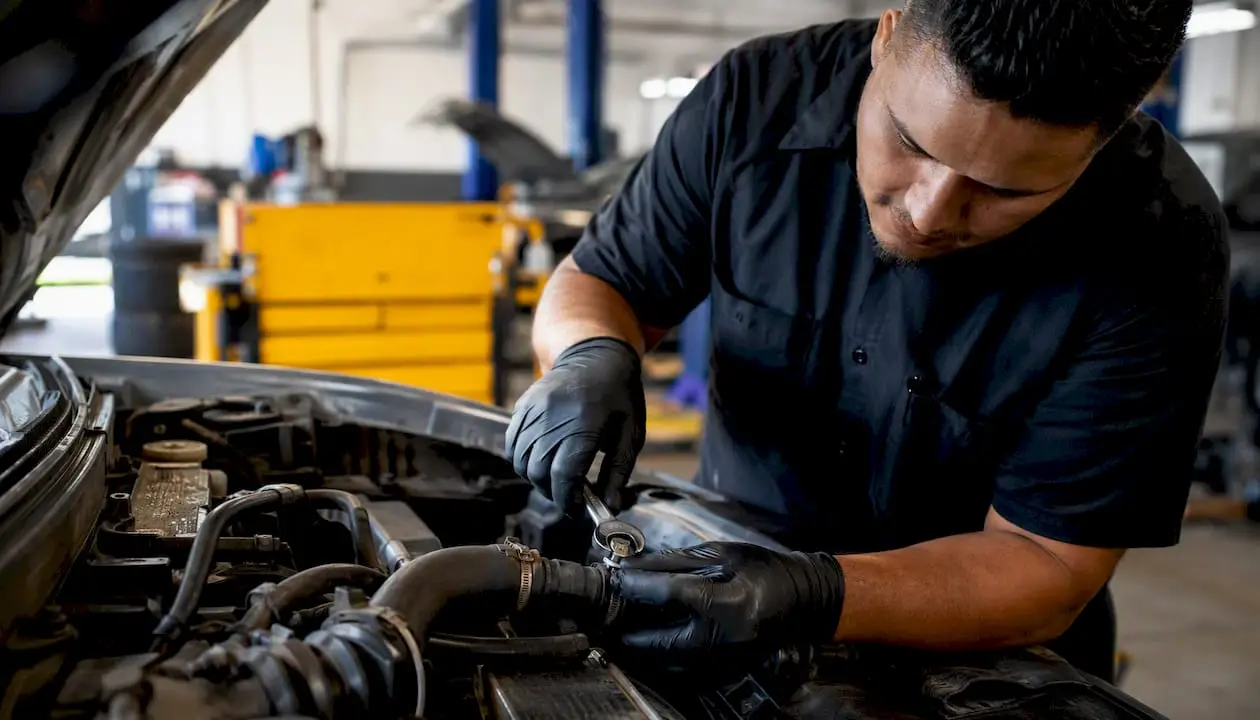
Automotive cooling systems fail in predictable ways, and knowing which type of repair you’re facing changes everything about urgency, cost, and your next move. The main types of cooling system repairs are hose and clamp replacement, radiator repair or replacement, thermostat replacement, water pump replacement, heater core replacement, head gasket repair, coolant reservoir and freeze plug repairs, and cooling fan or relay replacement. Of those, white smoke from the exhaust, milky oil, or steam rising from under the hood demand immediate shutdown and a tow. A sweet smell or puddle under the car means prompt attention within days. A loose clamp or cracked reservoir cap is non-urgent but should not sit ignored for weeks.
Cost range matters just as much as urgency. Common coolant-leak repairs in 2026 run roughly $150–$1,200 for most external failures, while internal failures like head gaskets can be very costly. A full cooling-system overhaul on a mainstream gasoline vehicle typically lands between $900 and $2,500. Here is a quick orientation before the full breakdown:
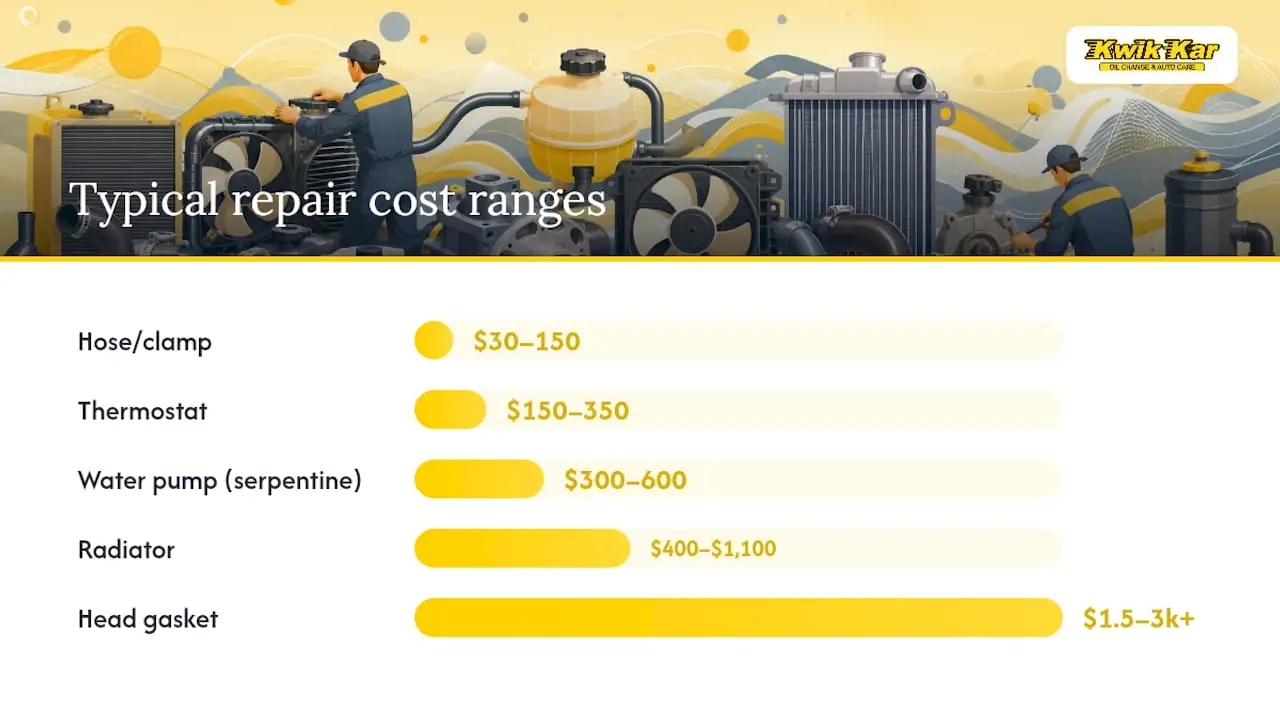
Hose/clamp replacement: $30–$150 installed, non-urgent to prompt
Thermostat replacement: $150–$350 installed, prompt to urgent
Radiator replacement: $400–$1,100 installed, prompt to urgent
Water pump replacement: $300–$900 installed, urgent
Cooling fan/relay replacement: $200–$600 installed, urgent in hot climates
Key Takeaways
Cooling system repairs range from a $30 hose clamp to a $3,000+ head gasket job, and the symptom you see determines both the urgency and the likely cost.
Point
Details
Urgency hierarchy
White smoke, milky oil, or steam require immediate shutdown; puddles and sweet smell need prompt attention within days.
Cost range
Common external repairs run $150–$1,200 installed; head gasket and internal failures can exceed $3,000.
Diagnose before authorizing
Always request a documented pressure test and UV dye confirmation before approving any major cooling repair.
Bundle when it makes sense
Timing-belt water pump jobs should include the belt, tensioner, and idler to avoid paying for the same labor twice.
Kwik Kar Oil Change & Auto Care
ASE-certified technicians in Richardson, TX provide documented diagnostics, transparent pricing, and warranty coverage on all cooling repairs.
What are the main types of cooling system repairs?
Understanding how coolant actually moves through your engine makes every symptom easier to read. The water pump is the heart of the system, circulating coolant from the engine block outward. Hot coolant travels through the upper radiator hose to the radiator, where airflow strips away heat. The thermostat sits between the engine and radiator and acts as a gatekeeper: it stays closed while the engine warms up, then opens to allow flow once operating temperature is reached. Cooled fluid returns through the lower radiator hose and the cycle repeats.
A branch off that main loop feeds the heater core, a small radiator tucked behind your dashboard that warms cabin air. The expansion tank or coolant reservoir absorbs pressure fluctuations as the system heats and cools. The radiator cap maintains system pressure, which raises the coolant’s boiling point well above 212°F. Cooling fans, either mechanical with a fan clutch or electric with a relay, pull air through the radiator when the vehicle is moving slowly or stopped.
Key components including the radiator, fan, hoses, thermostat, water pump, and heater core all wear with heat cycles and mileage, producing leaks, air pockets, thermostat failures, and pump bearing or seal problems. A few variations affect how repairs are priced and approached. On many four-cylinder engines, the water pump is driven by the timing belt rather than the serpentine belt, which means accessing it requires disassembling the timing system. Hybrids and some late-model vehicles use electric coolant pumps and require OEM-specific bleed procedures and coolant specifications, which can increase both diagnostic complexity and parts cost. Some radiators also contain an integrated transmission fluid cooler, and a failure there can allow coolant and transmission fluid to mix.
Pro Tip:Before any shop visit, check whether your vehicle uses a timing-belt-driven water pump. If it does and your pump is failing, replacing the timing belt and tensioner at the same time saves significant labor cost.
What symptoms tell you the cooling system is failing?
Your car communicates cooling problems clearly if you know what to look for. The challenge is that some symptoms overlap across multiple components, so a symptom-to-cause map helps you walk into a shop with useful information rather than just a vague complaint.
Temperature gauge climbing toward red or fluctuating: Points to a failing thermostat, low coolant level, a partially blocked radiator, or a water pump losing flow. Fluctuation is often the thermostat sticking open and closed intermittently.
Sweet smell inside the cabin or near the hood: Coolant has a distinctly sweet, almost syrupy odor. Inside the cabin, that smell almost always points to a leaking heater core. Outside, it suggests a hose, radiator, or reservoir leak nearby.
Puddle under the car: Green, orange, or pink fluid pooling under the front of the vehicle indicates an external leak. Likely sources include a radiator, hose connection, water pump weep hole, or reservoir. Check the coolant leak warning signs to narrow it down before calling a shop.
White exhaust smoke: Thin white vapor on a cold morning is normal condensation. Thick, persistent white smoke that smells sweet means coolant is burning in the combustion chamber, which points directly to a head gasket or intake manifold gasket failure.
Milky or foamy oil: Pull the dipstick. If the oil looks like a chocolate milkshake, coolant has entered the oil passages. This is a head gasket failure until proven otherwise and requires immediate attention.
Foggy windshield that won’t clear: A leaking heater core releases coolant vapor into the cabin. You may also notice a greasy film on the inside of the glass and a sweet smell with the heat on.
Heater blowing cold air: Low coolant level, a stuck-open thermostat, or a clogged heater core can all prevent warm air from reaching the cabin. Air trapped in the system after a repair is another common cause.
Before driving to a shop, do a quick visual check: look at the coolant level in the reservoir (cold engine only), note the color (bright and clear vs. brown or rusty), smell for sweetness, and look under the car for drips. These details help a technician narrow the diagnosis faster. Learning how to check car fluids takes about five minutes and can save you from a misdiagnosis.
A component-by-component guide to cooling system repair
This is where the real decision-making happens. Each component below has its own failure pattern, diagnostic approach, and cost profile. Knowing which one is failing tells you how urgent the situation is and whether a DIY fix is realistic.
Radiator repair and replacement
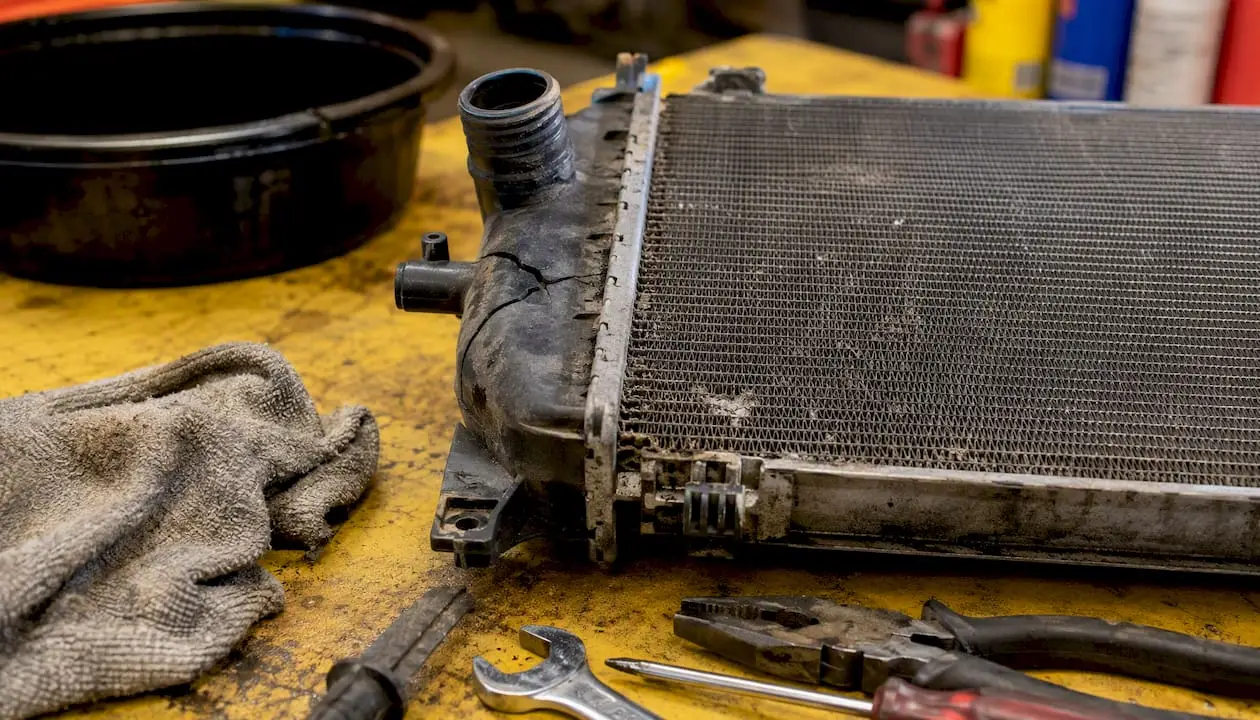
Radiators fail in three ways: pinhole leaks in the core, cracked or warped plastic end tanks, and internal corrosion that restricts flow. Modern aluminum radiators with plastic end tanks rarely respond well to patch repairs; once the plastic cracks or the core corrodes, replacement is the standard recommendation. A shop will pressure-test the system, visually inspect the core fins, and check for the strawberry-milkshake appearance in coolant that signals transmission fluid contamination through an internal cooler failure. Installed cost typically runs $400–$1,100 depending on vehicle make and whether the integrated transmission cooler requires flushing. Urgency is prompt to urgent: a slow drip can be monitored briefly, but a cracked tank can fail suddenly. More detail on what causes radiator leaks is worth reading before you authorize a replacement.
Hose and clamp replacement
Coolant hoses harden, soften, crack, or collapse with age. Clamps corrode and lose tension. These are among the most accessible repairs on any vehicle, and hose replacement is generally DIY-suitable for someone comfortable with basic hand tools. A shop will squeeze hoses to check for soft spots, inspect clamp condition, and look for seepage at connection points. Installed cost is typically $30–$150 per hose. Urgency depends on severity: a weeping connection is non-urgent, a split hose is immediate.
Thermostat replacement
A thermostat costs $10–$30 as a part, but labor to access it varies widely by engine layout. Some thermostats are accessible in 30 minutes; others require removing intake components. A stuck-closed thermostat causes rapid overheating. A stuck-open thermostat causes slow warm-up, poor fuel economy, and a heater that never gets fully warm. Shops will bench-test a removed thermostat in hot water or use scan-tool data to confirm it is not opening at the correct temperature. Installed cost runs $150–$350. Urgency is prompt; a stuck-closed thermostat becomes urgent quickly. Component temperature protection thresholds explain why the ECU responds aggressively when coolant temperature exceeds its programmed limits.
Water pump replacement
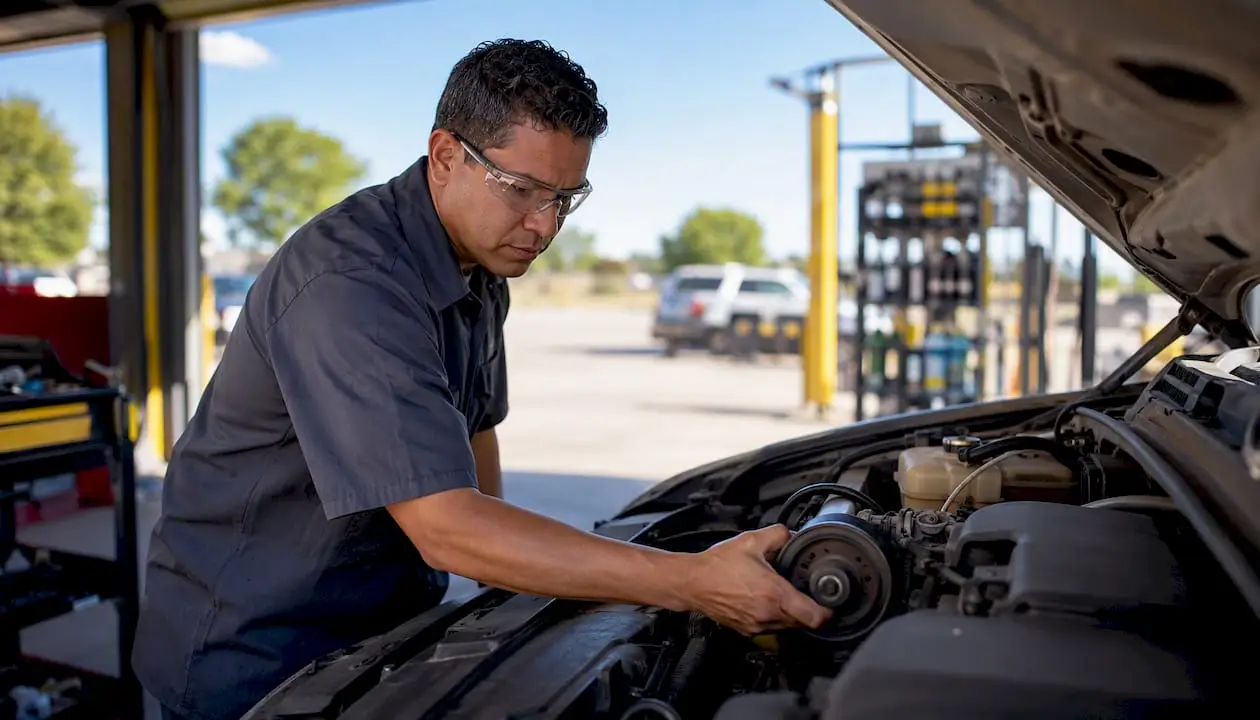
The water pump circulates coolant under pressure, and it fails in two ways: the bearing wears and causes a grinding noise or wobble at the pulley, or the shaft seal fails and coolant weeps from the pump’s weep hole. Either failure will eventually leave you stranded. Serpentine-belt-driven pumps are moderately labor-intensive. Timing-belt-driven pumps require full timing system disassembly, and shops almost always recommend replacing the belt, tensioner, and idler at the same time because the labor overlaps completely. Installed cost for a serpentine-driven pump generally ranges in the several hundred dollar range; timing-belt-driven pumps with the timing kit typically run $600–$900 or more. Urgency is urgent: a failing pump will overheat the engine within miles of full failure.
Heater core replacement
The heater core sits deep behind the dashboard, often requiring the entire dash assembly to be removed. That labor intensity is why heater core replacement is one of the more expensive cooling repairs despite the part itself being relatively inexpensive. Symptoms are a sweet smell in the cabin, a foggy windshield, coolant loss with no visible external leak, and cold air from the heater. Shops confirm the diagnosis by pressure-testing the system and checking for coolant residue behind the dash. Installed cost for heater core replacement commonly runs into the several hundred to over a thousand dollar range, with luxury vehicles and trucks often at the high end. Urgency is prompt: a leaking heater core will eventually deplete coolant and cause overheating, but it rarely fails catastrophically without warning. For a deeper look at how heater core issues intersect with cabin comfort, the car AC diagnostic guide covers related HVAC symptoms.
Head gasket and intake manifold gasket repair
Head gasket failure is the repair most vehicle owners dread, and for good reason. The gasket seals the combustion chamber from the coolant passages, and when it fails, coolant enters the cylinders or oil passages. White exhaust smoke, milky oil, and unexplained coolant loss without visible external leaks are the classic signs. Shops confirm with a compression test, leakdown test, and often a combustion gas test on the coolant (a chemical test that detects exhaust gases in the coolant). Repair involves removing the cylinder head, machining or replacing it if warped, and installing a new gasket set. Installed cost for head gasket repair is high due to labor and can reach several thousand dollars depending on whether the head needs machining. Urgency is immediate: driving with a blown head gasket risks catastrophic engine damage within minutes. Understanding what happens when coolant enters the engine makes the stakes concrete.
Intake manifold gasket failures are less severe but produce similar symptoms on some V6 and V8 engines. They are less labor-intensive and typically cost $300–$700 installed.
Coolant reservoir and freeze plugs
The expansion tank or coolant reservoir is a plastic component that cracks with age and UV exposure. Replacement is straightforward and inexpensive, typically $80–$200 installed. Freeze plugs (also called core plugs) are metal discs pressed into the engine block to allow for coolant expansion. They corrode over time and can develop pinhole leaks. Replacement requires draining the cooling system and, depending on location, may require removing other components for access. Cost ranges from $200–$500 depending on how many plugs are affected and their location on the block.
Cooling fan and relay replacement
Electric cooling fans are controlled by relays and temperature sensors. A failed relay or fan motor means the fan won’t run at low speeds or at idle, causing overheating in traffic while the car runs fine at highway speeds. Mechanical fans with a fan clutch fail when the clutch locks up (causing a loud roar) or slips (causing overheating). Shops test relays with a multimeter and check fan operation with a scan tool. Installed cost for cooling fan or relay replacement typically falls into a moderate price range for electric fan assemblies; fan clutch replacement is typically $200–$400.
Stop-leak products and temporary sealants deserve a direct note here. Stop-leak additives can temporarily seal small leaks but often clog narrow passages in the heater core, radiator, and water pump, creating a more expensive repair down the road. Use them only as a short-term measure to get the vehicle to a shop, never as a permanent solution.
Repair Type
Common Symptoms
Urgency
Typical Installed Cost (U.S.)
DIY Suitable?
Hose/clamp replacement
Puddle, low coolant, visible crack
Non-urgent to prompt
$30–$150
Yes
Thermostat replacement
Overheating, slow warm-up, cold heater
Prompt to urgent
$150–$350
Moderate
Radiator repair/replacement
Puddle, overheating, discolored coolant
Prompt to urgent
$400–$1,100
No
Water pump (serpentine)
Grinding noise, weep hole drip, overheating
Urgent
$300–$600
Moderate
Water pump (timing belt)
Same as above, timing belt due
Urgent
$600–$900+
No
Heater core replacement
Sweet cabin smell, foggy glass, cold heater
Prompt
$600–$1,500
No
Head gasket repair
White smoke, milky oil, coolant loss
Immediate
$1,500–$3,000+
No
Intake manifold gasket
Coolant loss, overheating on V6/V8
Prompt to urgent
$300–$700
Moderate
Coolant reservoir
Visible crack, low coolant
Non-urgent
$80–$200
Yes
Freeze plugs
External drip from block
Prompt
$200–$500
No
Cooling fan/relay
Overheating at idle, fan not running
Urgent
$200–$600
Moderate
How does a shop diagnose cooling system problems?
Professional diagnostics follow a logical sequence, and understanding that sequence helps you read a shop report and ask the right questions. Here is what a thorough diagnostic workflow looks like:
Visual inspection. The technician checks coolant level and color, looks for external leaks at hoses, the radiator, the water pump weep hole, and the reservoir. Rust-colored or brown coolant signals contamination or neglect. A greasy residue near the heater core area or a sweet smell inside the cabin narrows the diagnosis quickly.
Pressure test. The shop attaches a hand pump to the coolant system and pressurizes it to the radiator cap’s rated pressure, typically 13–16 PSI. If pressure drops, there is a leak. Shops commonly use pressure tests as the primary leak-detection method, and a diagnostic pressure test generally costs a moderate fee, though some shops apply the fee toward the repair.
UV dye leak detection. When a leak is small or intermittent, technicians inject UV dye into the coolant, run the engine, and scan with a UV light. The dye fluoresces bright yellow-green at the leak point, making it visible even when the leak is too small to produce a visible drip.
Coolant analysis. A test strip or refractometer checks freeze protection level and pH. Acidic coolant (low pH) corrodes aluminum components from the inside. A combustion gas test, using a chemical kit that changes color in the presence of exhaust gases, confirms whether combustion gases are entering the coolant, which is the definitive sign of a head gasket failure.
Infrared thermography and temperature scan. A thermal camera or infrared thermometer identifies cold spots in the radiator (blocked tubes), uneven temperature distribution across the engine, and whether the thermostat is opening at the correct temperature. This is especially useful for diagnosing partial blockages that a pressure test won’t catch.
Thermostat bench or scan test. A removed thermostat can be submerged in hot water to verify it opens at the correct temperature. Alternatively, a scan tool monitors coolant temperature in real time to confirm the thermostat opens within the expected range.
Compression and leakdown test. When head gasket failure is suspected, a compression test checks each cylinder for pressure loss. A leakdown test goes further, pressurizing each cylinder and listening for air escaping into the coolant, oil, or adjacent cylinders. This confirms the location and severity of the gasket failure before any teardown begins.
Pro Tip:Ask the shop for a photo of the pressure-test gauge reading and, if UV dye was used, a UV photo of the leak point. Reputable shops document this routinely, and having the evidence makes it easier to understand the repair recommendation and compare estimates.
Repair time varies considerably by fault. A loose clamp can be fixed in under 30 minutes, while radiator, water pump, or heater-core jobs commonly take multiple hours, and head gasket repairs can take substantially longer depending on whether the cylinder head needs machining.
What does cooling system repair actually cost in 2026?
Labor is the dominant cost driver in most cooling repairs. U.S. shop labor rates in 2026 commonly fall between $110 and $220 per hour, and a repair that takes four hours at a shop charging $160/hour adds $640 in labor before a single part is purchased. Vehicle type matters too: a water pump on a compact sedan may take two hours, while the same job on a luxury SUV with a timing-belt-driven pump can take six or more.
The timing-belt water pump scenario is the clearest example of why bundling repairs saves money. When a water pump driven by the timing belt fails, the timing belt, tensioner, and idler are already exposed. Replacing those components together adds relatively little labor cost but prevents a second teardown that would otherwise cost as much as the first. Shops that recommend this bundle are giving sound advice, not upselling.
Luxury and high-performance vehicles sit at the top of every range. A heater core replacement on a European luxury sedan can exceed $2,000 in labor alone because the dashboard removal is more complex. Hybrids with electric coolant pumps require OEM parts and OEM bleed procedures, which adds both parts cost and diagnostic time.
For larger repairs, Kwik Kar Oil Change & Auto Care offers $50 off any service over $500, which applies directly to water pump, heater core, and head gasket work.
How do you prevent cooling system failures?
Most catastrophic cooling failures are preceded by months of ignored warning signs or skipped maintenance. A consistent routine catches problems before they strand you.
Coolant flush intervals: Most manufacturers recommend a coolant flush every 30,000 miles or every 2–3 years for conventional green coolant. Extended-life OAT and HOAT coolants used in most vehicles built after 2000 can go 50,000–100,000 miles or 5 years, but that does not mean the system should go uninspected. Check your owner’s manual for the specific interval, and use the correct coolant type. Mixing coolant types degrades inhibitor packages and accelerates corrosion. The difference between engine coolant and antifreeze matters when you are topping off.
Hose inspection: Squeeze every hose at each service interval. A hose that feels rock-hard, mushy, or shows surface cracking is overdue for replacement. Most hoses last 4–6 years but can degrade faster in extreme heat climates like Texas summers.
Clamp inspection: Check for corrosion and confirm clamps are snug. A clamp that has lost tension will allow seepage under pressure even if the hose itself is fine.
Radiator cap test: A pressure tester can verify the cap holds its rated pressure. A cap that releases pressure too early causes the system to run at lower pressure, which lowers the coolant’s boiling point and increases the risk of vapor lock.
Coolant color check: Bright green, orange, or pink coolant is healthy. Brown, rusty, or oily coolant signals contamination or inhibitor depletion and warrants an immediate flush and system inspection.
Professional flush with machine bleed: A shop flush machine exchanges coolant more completely than a drain-and-fill and allows proper bleeding of air pockets. Air trapped in the system after a flush or repair causes hot spots and false temperature readings. The process for bleeding air from the cooling system is straightforward but easy to skip incorrectly.
Annual visual inspection: At every oil change, a technician should glance at hoses, clamps, the reservoir level, and the radiator for fin damage or corrosion. A vehicle inspection checklist covers these items systematically.
When should you stop driving and call for help?
Some cooling symptoms allow you a window to schedule service. Others require you to pull over immediately. Knowing the difference protects your engine from damage that turns a $400 repair into a $4,000 one.
Stop driving immediately if you notice:
The temperature gauge is in the red or the warning light is on
Steam or smoke rising from under the hood
White smoke from the exhaust that smells sweet
Milky or foamy oil on the dipstick
A sudden loss of coolant with no visible external source
When any of those symptoms appear, the sequence is: signal, pull over safely, shut the engine off. Do not open the radiator cap while the engine is hot. The system is pressurized, and releasing that pressure on a hot engine can spray scalding coolant. Wait at least 30 minutes for the engine to cool before inspecting anything. Call for a tow or a mobile mechanic, and document what you saw: the gauge reading, any smoke color, any smell, and whether any warning lights came on. That information shortens the diagnostic process at the shop.
What not to do:
Do not continue driving while the gauge is climbing, even “just to the next exit.” Engine damage from overheating can occur within minutes.
Do not add cold water to a hot engine. Thermal shock can crack the cylinder head.
Do not rely on stop-leak products as a substitute for a proper repair. They may seal a small leak temporarily, but they can clog the heater core and narrow passages in the radiator, creating a more expensive problem.
Do not assume the problem resolved itself because the gauge came back down. A thermostat that sticks and then releases will show a normal reading until the next failure cycle.
How Kwik Kar approaches cooling system diagnosis and repair
At Kwik Kar Oil Change & Auto Care, every cooling system concern starts with a documented inspection, not a guess. Our ASE-certified technicians follow a structured diagnostic workflow before recommending any repair:
Documented pressure test: We pressurize the system and photograph the gauge reading so you can see the result, not just take our word for it.
UV dye detection when needed: For intermittent or small leaks, we inject UV dye and scan with a UV light to pinpoint the source precisely.
Scan-tool data review: We pull live coolant temperature data and any stored fault codes to confirm thermostat behavior and sensor accuracy.
Written repair recommendation: Every recommended repair comes with a written estimate listing OEM and quality aftermarket parts options, labor time, and warranty terms.
When a water pump is driven by the timing belt, we recommend replacing the timing components together because the labor overlap makes it the most cost-effective path. When a radiator shows cracked plastic tanks or significant corrosion, we recommend replacement over patch repair because patches on aluminum-and-plastic radiators rarely hold under sustained pressure cycling.
All cooling system repairs at Kwik Kar Oil Change & Auto Care carry warranty coverage, and our digital reporting means you receive a clear record of what was found, what was done, and what was used. Military personnel and first responders receive special discounts on all services.
Kwik Kar Oil Change & Auto Care: cooling system services in Richardson, TX
When your temperature gauge is climbing or your coolant is disappearing without explanation, you need a shop that diagnoses the actual problem rather than replacing parts until the symptom stops. Kwik Kar Oil Change & Auto Care in Richardson, TX offers the full range of cooling system repair services: engine diagnostics and cooling system testing, coolant flush and exchange, radiator service, water pump replacement, heater core repair, thermostat replacement, and head gasket diagnosis, all performed by ASE-certified technicians with transparent digital reporting.
Bring your symptom notes and any photos you took of leaks or warning lights. Our technicians use that information to prioritize the diagnostic steps and get you an accurate estimate faster. For repairs over $500, use the $50 service coupon to reduce the cost on larger jobs like water pump or heater core replacement. Schedule your appointment at Kwik Kar Oil Change & Auto Care and get a documented diagnosis from a shop recognized by CARFAX and RepairPal.
Sources
The following sources informed the cost ranges, diagnostic methods, and repair guidance in this article:
The most common failures are hose deterioration, thermostat sticking, water pump seal or bearing failure, and radiator leaks, all of which worsen with heat cycles and mileage. Head gasket failure is less common but the most expensive to repair.
How much does cooling system repair cost?
Most external coolant-leak repairs run $150–$1,200 installed; a full system overhaul on a mainstream vehicle typically costs $900–$2,500, and head gasket repairs can exceed $3,000 depending on whether the cylinder head needs machining.
What are the three main types of automotive cooling systems?
Passenger vehicles use liquid cooling (the most common), air cooling (rare in modern production cars), and, on some hybrids, a combination of liquid cooling with supplemental electric pump circuits for battery thermal management.
How long does a cooling system repair take?
A loose clamp takes under 30 minutes; radiator, water pump, and heater core jobs typically take multiple hours; head gasket repairs can take a full day or longer depending on whether the head requires machining.
When should I take my car to a shop instead of attempting a DIY repair?
Hose replacement, thermostat swaps, and coolant flushes are reasonable DIY jobs for mechanically inclined owners. Heater core replacement, head gasket repair, and timing-belt water pump jobs require professional tools, OEM procedures, and significant labor experience, and mistakes on any of them can cause engine damage that costs far more than the original repair.
 Automotive cooling systems fail in predictable ways, and knowing which type of repair you’re facing changes everything about urgency, cost, and your next move. The main types of cooling system repairs are hose and clamp replacement, radiator repair or replacement, thermostat replacement, water pump replacement, heater core replacement, head gasket repair, coolant reservoir and freeze plug repairs, and cooling fan or relay replacement. Of those, white smoke from the exhaust, milky oil, or steam rising from under the hood demand immediate shutdown and a tow. A sweet smell or puddle under the car means prompt attention within days. A loose clamp or cracked reservoir cap is non-urgent but should not sit ignored for weeks.
Cost range matters just as much as urgency. Common coolant-leak repairs in 2026 run roughly $150–$1,200 for most external failures, while internal failures like head gaskets can be very costly. A full cooling-system overhaul on a mainstream gasoline vehicle typically lands between $900 and $2,500. Here is a quick orientation before the full breakdown:
Automotive cooling systems fail in predictable ways, and knowing which type of repair you’re facing changes everything about urgency, cost, and your next move. The main types of cooling system repairs are hose and clamp replacement, radiator repair or replacement, thermostat replacement, water pump replacement, heater core replacement, head gasket repair, coolant reservoir and freeze plug repairs, and cooling fan or relay replacement. Of those, white smoke from the exhaust, milky oil, or steam rising from under the hood demand immediate shutdown and a tow. A sweet smell or puddle under the car means prompt attention within days. A loose clamp or cracked reservoir cap is non-urgent but should not sit ignored for weeks.
Cost range matters just as much as urgency. Common coolant-leak repairs in 2026 run roughly $150–$1,200 for most external failures, while internal failures like head gaskets can be very costly. A full cooling-system overhaul on a mainstream gasoline vehicle typically lands between $900 and $2,500. Here is a quick orientation before the full breakdown:
 Bring your symptom notes and any photos you took of leaks or warning lights. Our technicians use that information to prioritize the diagnostic steps and get you an accurate estimate faster. For repairs over $500, use the $50 service coupon to reduce the cost on larger jobs like water pump or heater core replacement. Schedule your appointment at Kwik Kar Oil Change & Auto Care and get a documented diagnosis from a shop recognized by CARFAX and RepairPal.