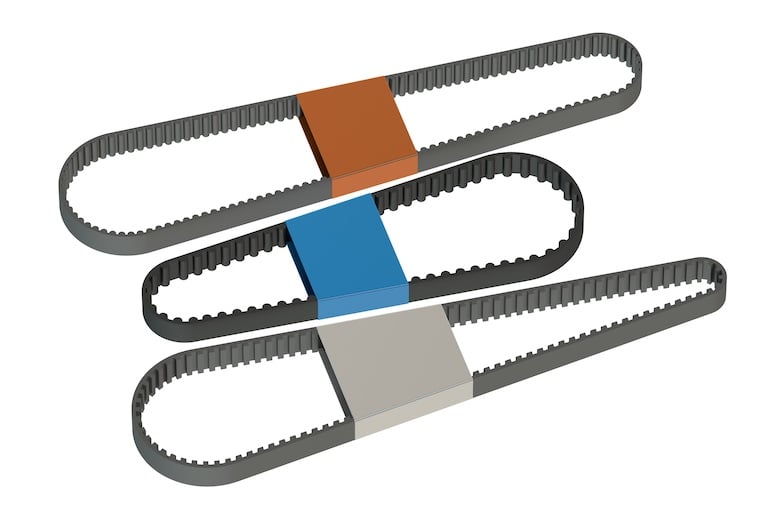
Think of your car's timing belt as the silent, unsung conductor of your engine's orchestra. It might just look like a simple rubber belt, but it has one of the most critical jobs in the entire vehicle: making sure every moving part of the engine performs in perfect, synchronized harmony. Understanding what it does is the first step to appreciating why replacing it on time is one of the most important things you can do for your car.
What a Timing Belt Does and Why It Matters
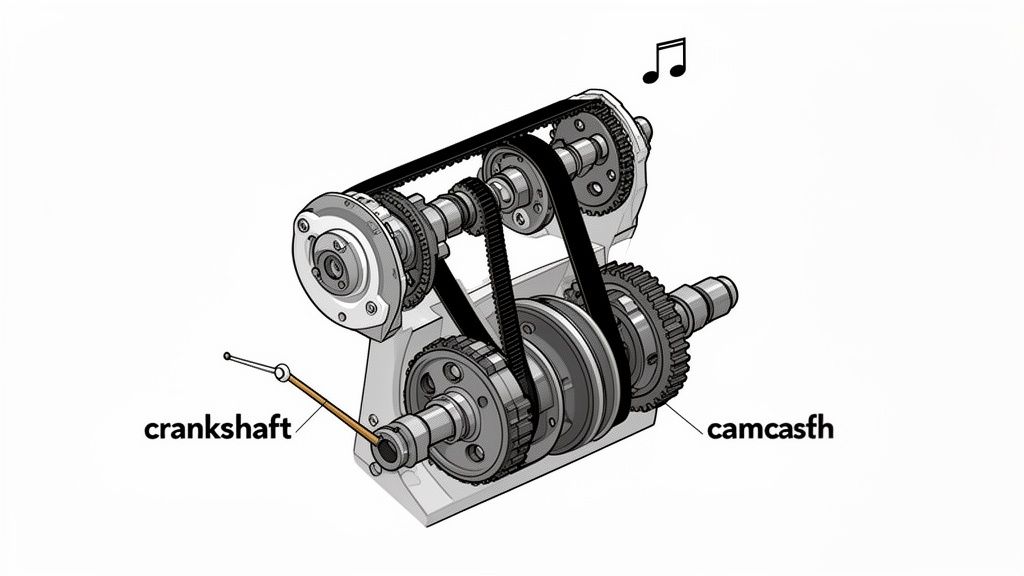
Deep inside your engine, the whole show is run by two key players: the crankshaft and the camshaft. The crankshaft takes the explosive, up-and-down force from the pistons and turns it into the rotational power that moves your wheels. At the same time, the camshaft is in charge of opening and closing the engine's valves, letting the air-fuel mix in and pushing exhaust gases out.
The timing belt is the crucial link connecting these two shafts. It's a tough, toothed rubber belt that locks their movements together with pinpoint precision. This perfect timing ensures the valves open and close at the exact right moment as the pistons fly up and down. When that rhythm is spot-on, your engine purrs along smoothly and efficiently.
The Risk of a Snapped Belt
But what happens if the conductor—the timing belt—suddenly breaks? That perfect harmony instantly becomes a mess of mechanical chaos. With nothing keeping them in sync, the fast-moving pistons will slam into the open valves with incredible force.
This is a particularly nasty scenario in what’s called an interference engine, which is the design you'll find in the vast majority of modern cars. In these engines, the pistons and valves are designed to occupy the very same space inside the cylinder, just at different milliseconds.
A snapped timing belt in an interference engine is almost always catastrophic. The collision can bend valves, shatter pistons, and wreck the cylinder head, instantly turning a standard maintenance job into a multi-thousand-dollar engine rebuild or a complete replacement.
Understanding the Financial Stakes
The fallout from a broken timing belt goes way beyond just being stranded on the side of the road. The internal damage is severe, and the repair bills are, too. A proactive timing belt replacement is a maintenance task that might cost a few hundred to maybe a thousand dollars.
On the other hand, the repair bill for the damage caused by a snapped belt can easily soar past $2,000, and often, the damage is so bad that swapping in a new engine is actually the cheaper option. This massive difference in cost is exactly why you need to know your vehicle’s replacement schedule. It's not just about routine maintenance; it's about preventing a financial nightmare and protecting the very heart of your car.
The Official Guide for When to Replace Your Timing Belt
So, what’s the magic number for a timing belt replacement? While there isn't a single, one-size-fits-all answer, car manufacturers give us a pretty reliable window to follow to avoid a complete disaster. The general rule of thumb is to replace your timing belt every 60,000 to 100,000 miles.
Think of it like this: your timing belt is constantly spinning under incredible tension and heat inside a hot engine bay. Over thousands of miles, the reinforced rubber it's made from naturally starts to degrade, stretch out, and become brittle. Pushing it past its recommended lifespan is a huge gamble against catastrophic engine failure.
But it’s not just about how many miles you’ve driven. Time is just as important. The rubber compounds in the belt break down over the years, even if the car is just sitting in the garage. That’s why most manufacturers also recommend a time-based schedule, usually somewhere between 7 and 10 years—whichever comes first.
Manufacturer Recommendations at a Glance
To give you a clearer idea of what this looks like for different cars, we've put together a quick-reference guide. These are common intervals for some popular brands, but always remember: your owner's manual is the final word on what your specific vehicle needs.
Common Timing Belt Replacement Intervals by Manufacturer
| Vehicle Manufacturer | Typical Mileage Interval (Miles) | Typical Time Interval (Years) |
|---|---|---|
| Honda | 60,000 – 105,000 | 7 |
| Toyota | 60,000 – 90,000 | 7 – 9 |
| Ford | 100,000 – 120,000 | 10 |
| Volkswagen | 80,000 – 120,000 | 8 – 10 |
| Hyundai | 60,000 – 90,000 | 6 – 8 |
These service intervals are key parts of your car’s overall maintenance plan. To get a better look at what other work is due at these major milestones, check out our guide on critical 60k, 90k, and 120k auto maintenance.
Why Sticking to the Schedule Matters
Just imagine you’re cruising down the highway, Richardson traffic behind you, when your engine suddenly makes a horrifying clattering noise and dies. That’s what can happen when a timing belt snaps. This isn't just a minor inconvenience; it's an engine catastrophe. A broken belt can cause pistons to slam into valves, bending them and potentially wrecking the entire engine.
This kind of failure can leave you stranded with a repair bill that averages between $2,000 and $4,000, and sometimes even more. It’s a completely avoidable expense if you just follow the maintenance schedule.
Your Owner's Manual is Your Best Friend: The single most accurate source for your car's timing belt replacement schedule is right there in your glove box. Flip to the "Scheduled Maintenance" or "Service" section in your owner's manual to find the exact mileage and time recommendations from the engineers who built your car.
Telltale Signs Your Timing Belt Is About to Fail
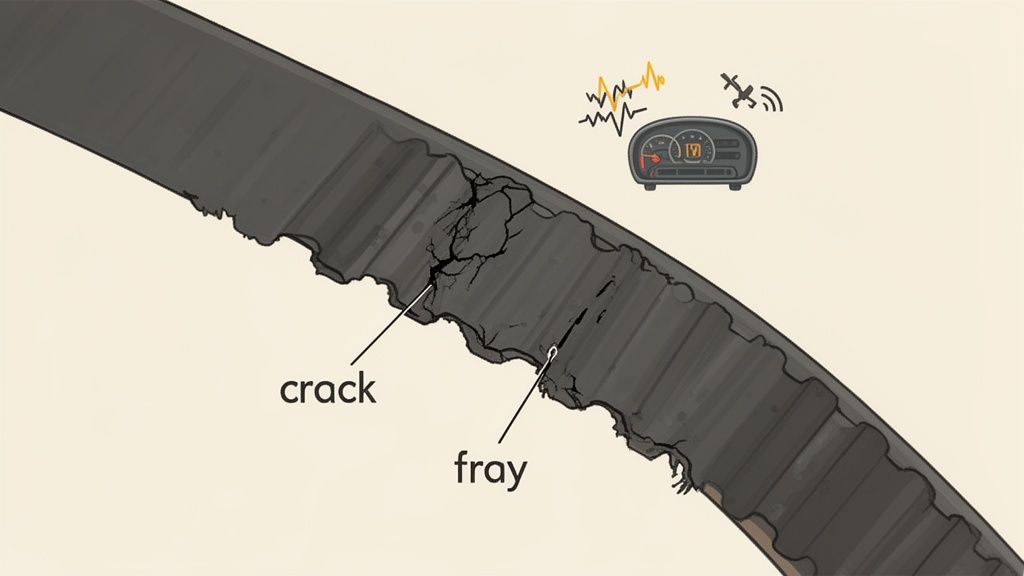
While your owner's manual provides a reliable schedule, your car has its own ways of telling you something is wrong. A timing belt doesn't usually fail without giving a few warning signs first. Learning to recognize these subtle (and not-so-subtle) cues is the key to catching a problem before it turns into a catastrophic breakdown.
Think of these signs as your engine's cry for help. Ignoring them can be the difference between a planned maintenance visit and a very, very expensive engine repair bill.
Strange Noises from the Engine
One of the most common red flags of a worn timing belt is a distinct sound coming from the front of your engine. The belt runs on a series of pulleys and tensioners, and as these components wear out, they can start making some pretty noticeable noises.
You should listen carefully for:
- A high-pitched whining or squealing sound: This often pops up when you start the car or accelerate. It can signal that the belt's tension isn't right or that the bearings in a tensioner pulley are on their last legs.
- A steady ticking or clicking noise: Sometimes described as sounding a bit like a sewing machine, this is often a direct symptom of the belt itself starting to fray or come apart.
These sounds are your first auditory clue that it's time for a professional to take a look. Trust us, they won't go away on their own—they'll only get worse.
A worn timing belt can't maintain perfect synchronization. Even a slight slip can cause pistons and valves to move out of their precise rhythm, creating engine performance problems long before the belt actually breaks.
Degraded Engine Performance
Since the timing belt is the conductor of your engine's orchestra, a failing one will have a direct impact on how your car runs. If the belt has stretched or slipped even a single tooth on its gears, the engine's timing will be off, leading to several very noticeable performance issues.
You might experience a general sluggishness or a lack of power when you hit the gas. This happens because the valves aren't opening at the perfect moment to let the air-fuel mixture in, which robs the engine of its efficiency.
Other performance-related signs include:
- Rough Idling: Your car may vibrate or shake more than usual when you're stopped at a red light.
- Engine Misfires: A mistimed engine can cause fuel to ignite at the wrong time, leading to a sputtering or hesitant feeling while you're driving.
- Difficulty Starting: If the camshaft and crankshaft aren't perfectly aligned, the engine can really struggle to turn over.
- Check Engine Light: Modern cars have sensors that can detect when the camshaft and crankshaft are out of sync, which will trigger the check engine light on your dashboard.
If you notice any of these symptoms, especially if they're combined with strange engine noises, you should schedule a diagnostic check immediately. Catching these signs early is the absolute best way to determine when to replace a timing belt before it's too late.
Factors That Can Wear Out a Timing Belt Faster
The factory-recommended service interval is a great starting point, but it assumes your car lives a pretty charmed life under ideal conditions. The reality is that your daily drive is probably a lot more demanding, and several factors can shorten your timing belt's lifespan significantly. That 100,000-mile guideline is less of a hard-and-fast rule and more of a best-case scenario.
Think of it like a rubber band you leave outside. In a perfect, climate-controlled room, it stays flexible for ages. But expose it to blazing sun, constant stretching, and dirt, and it'll crack and snap in no time. Your timing belt faces a similar battle every day inside a scorching hot engine bay.
Driving Conditions and Your Local Environment
Your daily commute has a massive impact on when you should replace a timing belt. The endless acceleration and deceleration of stop-and-go city traffic puts way more stress on the belt than cruising at a steady speed on the highway. Every single red light and traffic jam is another cycle of tension and release, and that wear and tear adds up.
Where you live also plays a surprisingly big role.
- Extreme Heat: Here in Texas, high ambient temperatures push under-hood temperatures through the roof. This heat slowly bakes the belt's rubber compounds, causing them to degrade and turn brittle much faster.
- Extreme Cold: On the flip side, frigid temperatures can make the rubber stiff and less pliable. This increases the risk of it cracking, especially during a cold start when the engine components are at their least flexible.
- Dust and Debris: Frequently driving on dusty or gravel roads isn't great, either. Abrasive particles can find their way into the engine bay and slowly grind away at the belt's material.
Engine Leaks and Contamination
A timing belt is engineered to do its job in a clean, dry space. When other parts of your engine start to fail, they can create a toxic environment for the belt, dramatically speeding up its demise.
An oil leak from a camshaft or crankshaft seal is a major red flag. A coolant leak from a failing water pump is just as bad. These fluids are corrosive to the rubber compounds in timing belts, causing them to get soft, swell up, and lose their strength. A contaminated belt is a belt that's on a fast track to failure.
A timing belt that’s been soaked in oil or coolant can easily slip, jump a tooth, or snap completely with almost no warning. This is exactly why a quick visual inspection during any routine service is so critical—it helps a technician spot the leaks that put your belt at risk.
The scale of this kind of maintenance is huge, fueling a massive service industry. The global automotive timing belt market is on track to grow from over $7 billion to nearly $10 billion within the decade, mostly because the majority of belts need to be replaced every 60,000-100,000 miles. With millions of cars in the U.S. hitting that service window every year, proactive replacement has become a key part of modern car ownership. You can explore more about these market trends and how they impact vehicle maintenance.
Timing Belt vs. Timing Chain: Uncovering the Difference
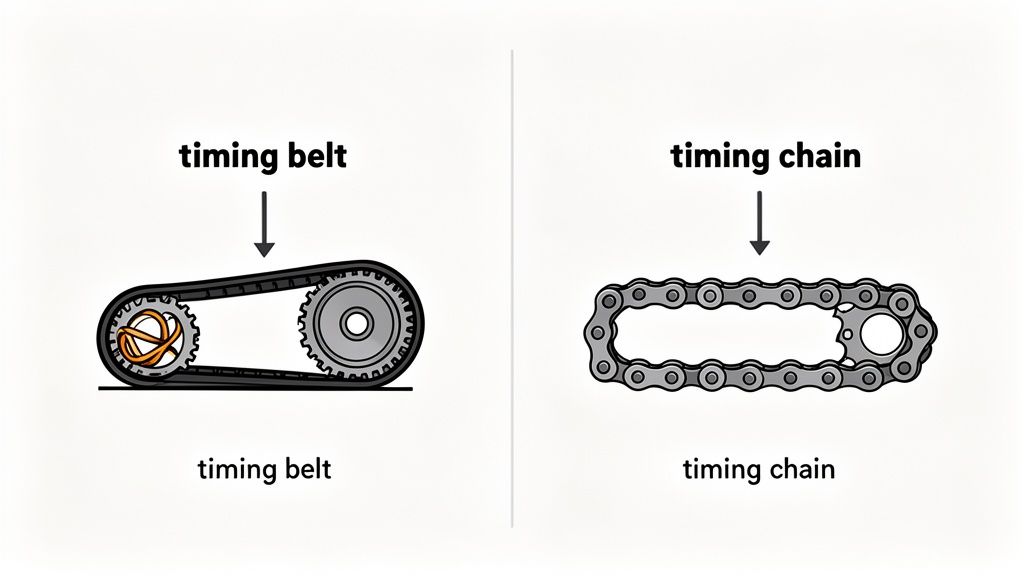
While timing belts and timing chains do the exact same critical job—keeping your engine's moving parts in perfect sync—they are completely different components. Knowing which one is in your vehicle is a game-changer, because their maintenance needs and lifespans are worlds apart.
The easiest way to think about it is this: a timing belt is like a super-strong, toothed rubber band, while a timing chain is a lot more like a sturdy bicycle chain made of metal. This simple difference in what they're made of explains everything else, from how noisy they are to when (or if) you need to replace them.
Belts are made from tough rubber composites, which makes them very quiet and cheaper for car manufacturers to use. The downside? Rubber breaks down over time from engine heat and constant stress, which is why every timing belt has a strict replacement schedule. Chains, on the other hand, are made of metal and are constantly lubricated by your engine oil, making them incredibly durable.
Key Differences at a Glance
For a car owner, the single most important difference is how long they last. A timing chain is generally engineered to last the entire life of your engine. But a timing belt is a consumable part, meaning it wears out and must be replaced on schedule to prevent disaster.
To make it even clearer, here’s a quick breakdown of what sets them apart.
Timing Belt vs. Timing Chain at a Glance
| Feature | Timing Belt | Timing Chain |
|---|---|---|
| Material | Reinforced Rubber Composite | Hardened Metal Links |
| Typical Lifespan | 60,000 – 100,000 miles | Often the life of the engine |
| Noise Level | Very quiet operation | Can be slightly noisier |
| Maintenance | Mandatory scheduled replacement | Generally maintenance-free |
The table above really spells it out. With a belt, you have a critical maintenance task on your to-do list. With a chain, you usually don't.
Now, while timing chains are built to last, they aren't totally indestructible. The plastic guides and hydraulic tensioners that keep the chain running smoothly can wear out over many miles, sometimes causing a rattling noise or performance problems. Still, this is much less common than a timing belt simply reaching the end of its service life.
Ultimately, knowing whether your engine has a belt or a chain changes everything. If you have a timing belt, sticking to its replacement schedule isn't just a suggestion—it's a non-negotiable part of owning your car. If you have a chain, you can usually breathe a little easier, as it isn't a standard maintenance item you need to worry about.
What to Expect from a Timing Belt Replacement Service
Walking into a repair shop for a timing belt replacement can feel a little intimidating, especially when you hear the price. This isn't a quick fix like an oil change; it's a major service that takes precision and several hours of skilled labor. Understanding what goes into the job helps explain the cost and shows why it’s such a critical investment in your engine’s health.
The main reason this job is so labor-intensive comes down to one word: access. Your timing belt is buried deep inside the engine, tucked away behind protective covers, engine mounts, and other accessory belts. A technician has to carefully disassemble a good portion of the engine's front end just to get to it, and that accounts for most of the time you're billed for.
The Smart Way to Replace Your Belt
Once the technician finally has access, the real work begins. This is where a savvy car owner can save a ton of money and prevent future headaches down the road. While the timing belt is being replaced, several other critical components that live in that same crowded space are now easy to get to. It just so happens that these parts often have a similar lifespan to the belt itself.
Replacing them at the same time is a smart, preventative move. Since the mechanic is already "in there," you only pay for the parts—not the hours of duplicate labor it would take to access that area all over again a year or two later.
This usually means replacing:
- The Water Pump: It's often driven by the timing belt, and if it fails, it can leak coolant directly onto your brand-new belt, ruining it in short order.
- Tensioner Pulleys: These parts are responsible for keeping the belt at the perfect tightness. A worn-out tensioner can let the new belt slip or fail completely.
- Idler Pulleys: These guide the belt along its path. Just like any part with bearings, they wear out over time and can seize up.
Opting for a "timing belt kit" that bundles the belt, tensioners, and pulleys together is the industry best practice. Adding a new water pump to the job at the same time is the gold standard for a repair you can count on for years to come.
Understanding the Cost Breakdown
The total cost for a timing belt replacement typically falls somewhere between $500 and over $1,500, depending heavily on your vehicle. The final price is shaped by your engine's complexity—V6 or V8 engines are almost always more expensive than four-cylinders simply because they are more difficult and time-consuming to work on. Your car’s make and model also play a big role in the final bill.
While it’s a significant expense, remember what you’re paying to prevent: catastrophic engine damage that can easily run into the thousands. To get a clear picture of what this service involves for your car, you can learn more about professional timing belt services and see why trusting a certified technician is the only way to go. Proactive replacement is always the smarter and more affordable choice in the long run.
Protecting Your Engine with Proactive Care
Knowing when to replace your timing belt is the difference between being a passenger and being the pilot of your car's long-term health. It’s not about nervously waiting for something to go wrong; it’s about preventing a massive headache with smart, proactive maintenance. The trick is to blend the manufacturer's schedule with a real-world awareness of how your car performs every day.
By now, you get what’s at stake. A snapped timing belt isn't a minor hiccup—it's an engine-destroying disaster that comes with a jaw-dropping repair bill. Staying ahead of it is your single best defense against that kind of catastrophic failure, ensuring your vehicle stays a reliable partner for years to come. Your car's heart is worth protecting.
Your Action Plan for a Healthy Engine
Feeling confident about what to do next is key. Instead of guessing, just follow this simple checklist to take control of your timing belt maintenance.
- Step 1: Check Your Owner's Manual: This is your number one source of truth. Find the exact mileage and time interval recommended by the engineers who designed your car.
- Step 2: Assess Your Driving Habits: Are you a city driver dealing with constant stop-and-go traffic? Do you live in the brutal Texas heat? If so, you should probably aim for the earlier side of that recommended service window.
- Step 3: Schedule a Professional Inspection: If you're getting close to the recommended mileage, hearing strange noises from the engine, or just aren't sure, a professional inspection is the only way to know for sure. A trained mechanic can spot signs of wear that are completely invisible to the rest of us.
This flowchart can help you visualize whether you might just need the belt or a full kit when it's time for service.
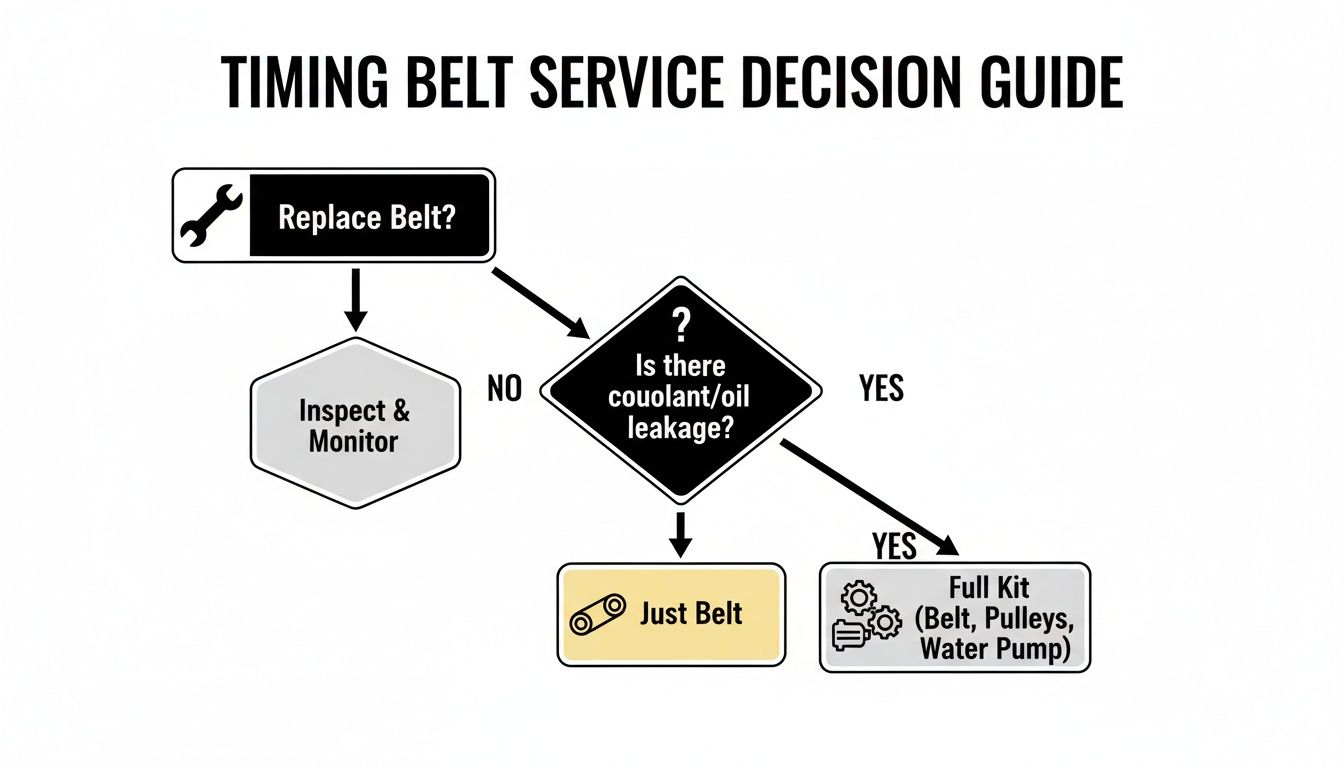
The big takeaway here is that choosing a complete kit—which often includes a new water pump—is usually the smartest financial move in the long run. For anyone managing multiple cars, a solid strategy also includes a detailed fleet vehicle maintenance checklist. You can find more great tips in our own routine car maintenance checklist to keep your vehicle running smoothly.
Don't leave your engine's health to chance. If you have any doubts about your timing belt, the certified technicians at Kwik Kar Oil Change and Auto Care are here to provide a thorough inspection and expert service you can trust.