Texas temperature swings change tire pressure in a predictable, physics-driven way: expect roughly 1 PSI for every 10°F shift in ambient temperature. On a typical Texas summer day, that means your tires can gain or lose several PSI between a cool morning and a scorching afternoon. The immediate action is simple: check your tire pressure when the tires are cold (first thing in the morning, before you’ve driven), and match the PSI printed on your driver-door placard, not the number molded into the tire sidewall.
- The rule: ~1 PSI change per 10°F of temperature change
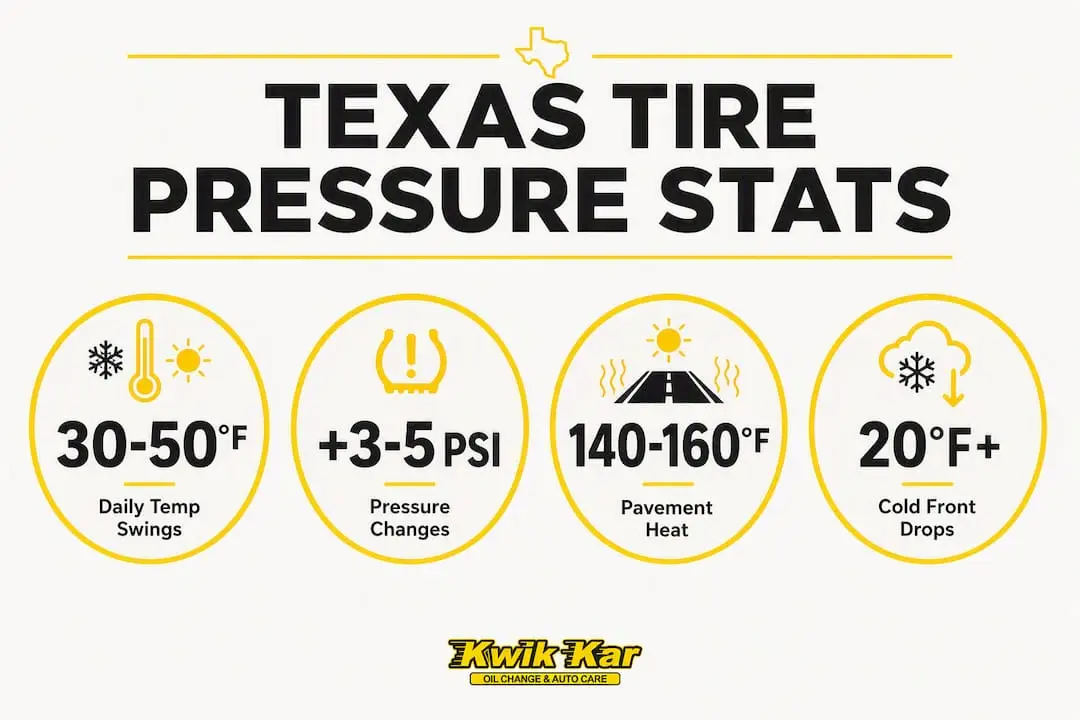
- Texas daily swing: 30–50°F between morning and afternoon = 3–5 PSI of fluctuation
- Your target: the cold PSI on your vehicle’s door placard
- Best check time: morning, before driving, or after 3+ hours stationary
Table of Contents
- Why Texas weather impacts tire pressure: the physics behind it
- How Texas conditions amplify tire-pressure swings
- How to check tire pressure correctly in Texas heat
- What to do when pressure is too low or too high
- What your TPMS warning light is actually telling you
- What ASE-certified technicians recommend for Texas drivers
- Key Takeaways
- A local technician’s perspective on Texas tires
- Tire pressure concerns? Kwik Kar in Richardson has you covered
- Useful sources
- FAQ
Why Texas weather impacts tire pressure: the physics behind it
Air inside your tire behaves like any gas sealed in a container. When temperature rises, the molecules move faster and push harder against the walls, so pressure climbs. When temperature drops, they slow down and pressure falls. Because a tire’s volume stays nearly fixed, pressure changes directly with temperature — a direct application of the Ideal Gas Law (PV = nRT).
The practical rule of thumb: 1 PSI per 10°F. Here’s what that looks like on a Texas summer day:
| Morning Temp (°F) | Afternoon Temp (°F) | Temp Swing | Estimated PSI Change |
|---|---|---|---|
| 70 | 100 | 30°F | 3 PSI |
| 65 | 95 | 30°F | 3 PSI |
| 68 | 103 | 35°F | 3–4 PSI |
| 55 | 90 | 35°F | 3–4 PSI |
So if your placard calls for 32 PSI cold, your tires may read 35–36 PSI by mid-afternoon — not because you over-inflated them, but because the air inside expanded with the heat. Driving adds another layer: friction from the road flexes the rubber, generating internal heat that pushes pressure even higher than ambient temperature alone would suggest. Underinflated tires flex more, which creates more heat, which accelerates wear — a cycle that starts with a few missed PSI checks.
Pro Tip: Never bleed air from a hot tire to hit your target PSI. Wait until the tire cools to get an accurate reading; releasing hot air will leave you underinflated once temperatures drop.
How Texas conditions amplify tire-pressure swings
Most states see moderate seasonal shifts. Texas throws daily extremes at your tires. A North Texas morning in July might start at 68°F and reach 103°F by 3 PM — a 35°F swing before you factor in pavement heat. Blacktop in direct sun can reach 140–160°F, and that radiant heat transfers directly into the tire’s contact patch, pushing internal temperatures well above ambient air readings.
| Season / Condition | Typical Temp Swing | PSI Swing Risk | Primary Hazard |
|---|---|---|---|
| Summer (June–August) | 30–50°F daily | 3–5 PSI | Overinflation, blowout risk |
| Spring/Fall cold snaps | 20–30°F overnight | 2–3 PSI | TPMS warnings, underinflation |
| Winter cold fronts | 30–50°F in hours | 3–5 PSI | Sudden pressure loss, handling |
The blowout risk in summer is real, but it’s rarely heat alone that causes a failure. Pavement temperatures of 140–160°F accelerate failure when combined with underinflation, worn tread, or overloading. Think of it as a vicious cycle: low pressure causes more flexing, more flexing generates more heat, more heat degrades the rubber faster. Texas summer is the worst possible environment to be running tires that are even slightly neglected.
Cold snaps flip the script. A fast-moving cold front can drop temperatures 30°F overnight, and drivers across a region wake up to TPMS warning lights simultaneously. The tires haven’t developed a leak — the air inside simply contracted with the cold.
Pro Tip: After any overnight temperature drop of 20°F or more, check all four tires before your morning commute. A quick gauge reading takes 90 seconds and can prevent a TPMS-triggered panic on the highway.
How to check tire pressure correctly in Texas heat
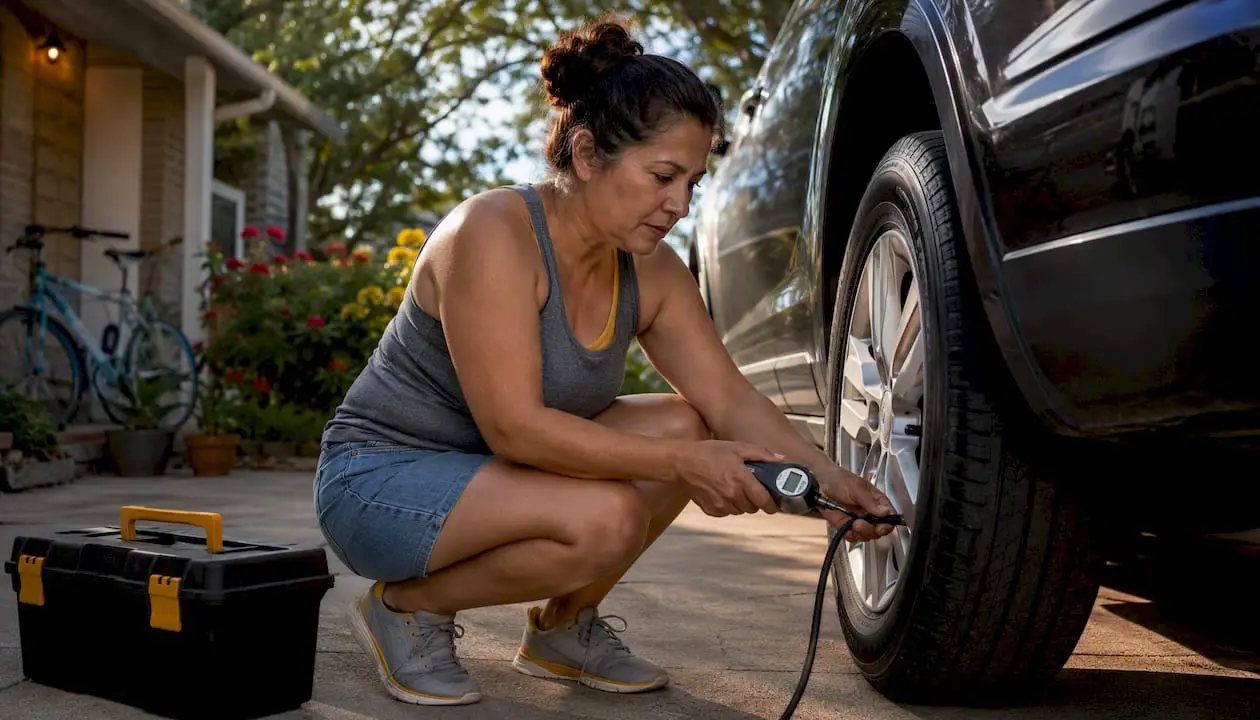
Getting an accurate reading requires one non-negotiable condition: cold tires. “Cold” means the vehicle has been parked for at least three hours, or you’ve driven fewer than a mile at low speed. Here’s the exact sequence:
- Find your target PSI. Open the driver-side door and read the placard sticker on the door jamb. That number is your cold inflation target. Ignore the larger number molded into the tire sidewall — that’s the tire’s maximum pressure, not your vehicle’s recommended setting.
- Grab a quality gauge. A digital or dial gauge gives you a precise reading. Your eyes and the TPMS light are not substitutes. A quality gauge costs under $20 and pays for itself the first time it catches a slow leak.
- Remove the valve cap and press the gauge firmly onto the valve stem. A hissing sound means the seal isn’t tight — reposition and try again.
- Read the PSI and compare to your placard. Write it down if you’re checking all four tires; it’s easy to forget which tire read what.
- Add air if needed. Use a gas station air pump or a portable compressor. Add in small bursts, recheck after each, and stop at the placard PSI.
- Replace the valve cap. Valve stems without caps collect dirt and can develop slow leaks over time.
For Texas drivers, check every one to two weeks during summer and monthly the rest of the year. After any significant temperature swing — a cold front, a heat wave, or a trip from the Texas Hill Country to the coast — check again before the next long drive.
What to do when pressure is too low or too high
When pressure reads low: Add air to reach your placard cold PSI, then walk around the tire and inspect the sidewall and tread for visible damage, bulges, or embedded objects. If the tire holds pressure after you inflate it, you’re likely fine until your next check. If it drops again within a day or two, that’s a slow leak and needs professional attention.
When pressure reads high: Do not release air from a hot tire. The reading is inflated by heat, and bleeding it down will leave you underinflated once the tire cools. Wait until the tire is cold, then recheck. If the cold reading is still more than 4–5 PSI above your placard target, have a technician inspect the tire for damage or a faulty valve stem.
Safety threshold: If any tire is more than 4 PSI below the placard PSI, or if you see a bulge, crack, or object embedded in the tread, treat it as a same-day service situation. Driving on a structurally compromised tire in Texas summer heat is not a risk worth taking.
Do’s and don’ts at a glance:
- Do check pressure cold, every time
- Do inspect sidewalls and tread when you check pressure
- Don’t drive extended distances on a tire that’s more than 4 PSI low
- Don’t release air from a hot tire to hit your target
- Don’t ignore a TPMS light that returns after you’ve already added air
What your TPMS warning light is actually telling you
Your Tire Pressure Monitoring System is a useful early-warning tool, but it has real limits. Most systems trigger a warning only when pressure drops below a set threshold — they won’t alert you to dangerous overinflation caused by Texas afternoon heat. Some vehicles display a numeric PSI for each tire; many show only a generic warning light. Either way, the light is a floor, not a ceiling.
When the TPMS light comes on:
- Check all four tires cold with a manual gauge before assuming it’s a false alarm
- Add air to the placard PSI on any tire that reads low
- Inspect each tire for visible damage, slow leaks, or valve-stem issues
- If the light returns within 24 hours after you’ve corrected the pressure, schedule a professional leak test
A Texas cold front can trigger TPMS warnings across thousands of vehicles on the same morning. If your light came on overnight after a temperature drop, the cause is almost certainly thermal contraction, not a puncture. Still, confirm with a gauge — don’t assume.
Pro Tip: If your vehicle shows individual tire PSI readings on the dashboard, screenshot them before driving. That baseline helps a technician quickly identify whether a drop is thermal or a genuine leak.

What ASE-certified technicians recommend for Texas drivers
A professional tire inspection covers more than just PSI. At Kwik Kar Oil Change & Auto Care, ASE-certified technicians run through a structured sequence during every tire service:
- Cold PSI verification on all four tires against the vehicle placard
- Tread depth measurement to identify tires approaching the replacement threshold
- Sidewall and shoulder inspection for cracking, bulging, or impact damage
- Valve-stem check for corrosion, loose cores, or missing caps
- Slow-leak detection using a soapy-water test or electronic sensor
- Wheel balance and alignment assessment when wear patterns suggest a problem
Texas heat accelerates rubber degradation, so tires that look acceptable in a northern climate may already be compromised here. A tire’s age matters as much as its tread depth — most manufacturers recommend replacement at six years regardless of appearance, and Texas UV exposure and heat can shorten that window. Scheduling a tire inspection before summer peaks and again before winter cold snaps is the most cost-effective way to stay ahead of pressure problems.
Pro Tip: Ask your technician to check the spare tire’s pressure too. Spares sit for months and lose pressure quietly. Discovering a flat spare during a roadside emergency is a preventable problem.
Key Takeaways
Texas tire pressure changes are predictable and manageable: check cold, expect roughly 1 PSI per 10°F of temperature swing, and bring your vehicle to a professional when pressure swings are large, repeated, or accompanied by visible tire damage.
| Point | Details |
|---|---|
| 1 PSI per 10°F rule | Texas daily swings of 30–50°F can shift tire pressure by 3–5 PSI in a single day. |
| Always check cold | Measure tire pressure in the morning or after 3+ hours parked for an accurate reading. |
| Use the door placard | The placard PSI is your inflation target; the sidewall number is the tire’s maximum, not your goal. |
| TPMS has limits | TPMS warns about low pressure but won’t catch dangerous overinflation from Texas afternoon heat. |
| Kwik Kar Oil Change & Auto Care | ASE-certified technicians in Richardson perform full tire inspections, leak detection, and pressure checks year-round. |
A local technician’s perspective on Texas tires
Every summer, the pattern repeats itself at the shop. A driver pulls in after a TPMS warning, convinced they have a leak, and the real story is simpler: the tires were already running 3–4 PSI low before the heat wave hit, and the combination of underinflation and 100°F pavement finished the job. The tire that failed wasn’t a surprise — it had been quietly telling that story for weeks through uneven wear on the shoulders and a sidewall that had started to show fine surface cracking.
The cases that require same-day service almost always share one trait: the driver noticed something earlier (a warning light, a slightly soft feel, a vibration) and waited. Texas heat doesn’t give tires a grace period the way a mild climate might. When the warning comes, act on it the same day.
Tire pressure concerns? Kwik Kar in Richardson has you covered
Repeated TPMS alerts, a tire that won’t hold pressure, or a pressure swing you can’t explain — these are exactly the situations where a quick professional check saves you from a costly roadside failure.

Kwik Kar Oil Change & Auto Care in Richardson offers same-visit tire pressure checks, slow-leak detection, full sidewall and tread inspections, and wheel alignment service — all performed by ASE-certified technicians with transparent pricing and no surprises. Military personnel and first responders receive special discounts, and every service comes backed by warranty coverage. Whether you need a fast pressure check before a summer road trip or a full tire inspection after a Texas cold snap, the team at Kwik Kar is ready.
Schedule your appointment online, or stop by for a same-day visit at our Richardson location. Your tires work hard in this climate — give them the attention they deserve before the Texas heat makes the decision for you.
Useful sources
These are the primary sources behind the guidance in this article, each worth bookmarking for further reading:
- How Texas temperature swings trigger tire pressure warnings — CBS Austin local reporting on mass TPMS events during cold fronts; explains the Ideal Gas Law connection in plain terms.
- Protecting your car from Texas heat: tires, battery, and coolant — Austin American-Statesman guide covering the 1 PSI per 10°F rule and overinflation risks.
- Why the tire pressure light comes on in cold weather — KUT Radio (Austin’s NPR station) on TPMS behavior during Texas cold snaps.
- Tire blowouts in Texas heat: causes and prevention — Flag Towing’s breakdown of why underinflation plus heat causes failures, and TPMS limitations.
- What tire pressure should be in summer — Tire Advise guide on cold-check timing, placard vs. sidewall PSI, and summer check frequency.
- Cold inflation pressure — Wikipedia — Technical reference on the Ideal Gas Law applied to tires, with NHTSA underinflation data.
- Car tires heating up — Physics Van, University of Illinois — University-level physics explanation of how driving friction raises internal tire pressure.
FAQ
Why does Texas weather mess with my tire pressure?
Texas produces some of the largest daily temperature swings in the country — often 30–50°F between morning and afternoon — and tire pressure changes roughly 1 PSI for every 10°F shift, so a single Texas day can move your pressure by 3–5 PSI without any leak or damage.
Why does tire pressure drop in colder weather?
When air temperature falls, the gas molecules inside the tire slow down and exert less force, so pressure drops. A sudden overnight cold front of 30°F can reduce tire pressure by about 3 PSI, which is often enough to trigger a TPMS warning.
Should I add air to my tires in cold weather?
Yes — if a cold-morning check shows your tires are below the placard PSI, add air to reach that target. Check the pressure after the tires have been stationary for at least three hours so you’re measuring true cold inflation pressure, not heat-inflated pressure from driving.
Do I need all-weather tires in Texas?
Most Texas drivers manage well on standard all-season tires, but if you regularly drive in the Panhandle or Hill Country during winter cold snaps, all-weather tires rated for light snow provide an added margin of safety during the brief freezing periods Texas does experience.
How often should I check tire pressure in Texas summers?
Check every one to two weeks during peak summer months, and always after a significant temperature swing. Monthly checks are sufficient in fall and winter unless a cold front passes through.