
You leave home in Richardson before sunrise. The roads looked fine when you checked the window, but a thin glaze of ice has settled on the overpasses, side streets, and shaded intersections. The SUV ahead of you starts to slide at a stoplight. Traffic slows. Everyone gets tense fast.
That’s the kind of North Texas winter problem people underestimate. We don’t live in a place where most drivers keep dedicated winter gear in the trunk, but we do get sudden ice events that turn an ordinary commute into a real safety issue. If you’ve never dealt with chains on tires, that’s normal. Most local drivers haven’t.
Still, it helps to know what chains are, when they help, when they can damage a vehicle, and when they’re the wrong choice entirely. If cold weather has already affected your car in other ways, it’s also worth checking basics like how tire pressure drops in cold weather, because grip starts with the tire itself.
That Sudden Texas Ice Storm Are Your Tires Ready
A North Texas ice storm doesn’t give you much warning. One day it’s just cold rain. By the next morning, bridges, ramps, and neighborhood turns are slick enough to send a perfectly normal sedan sideways.
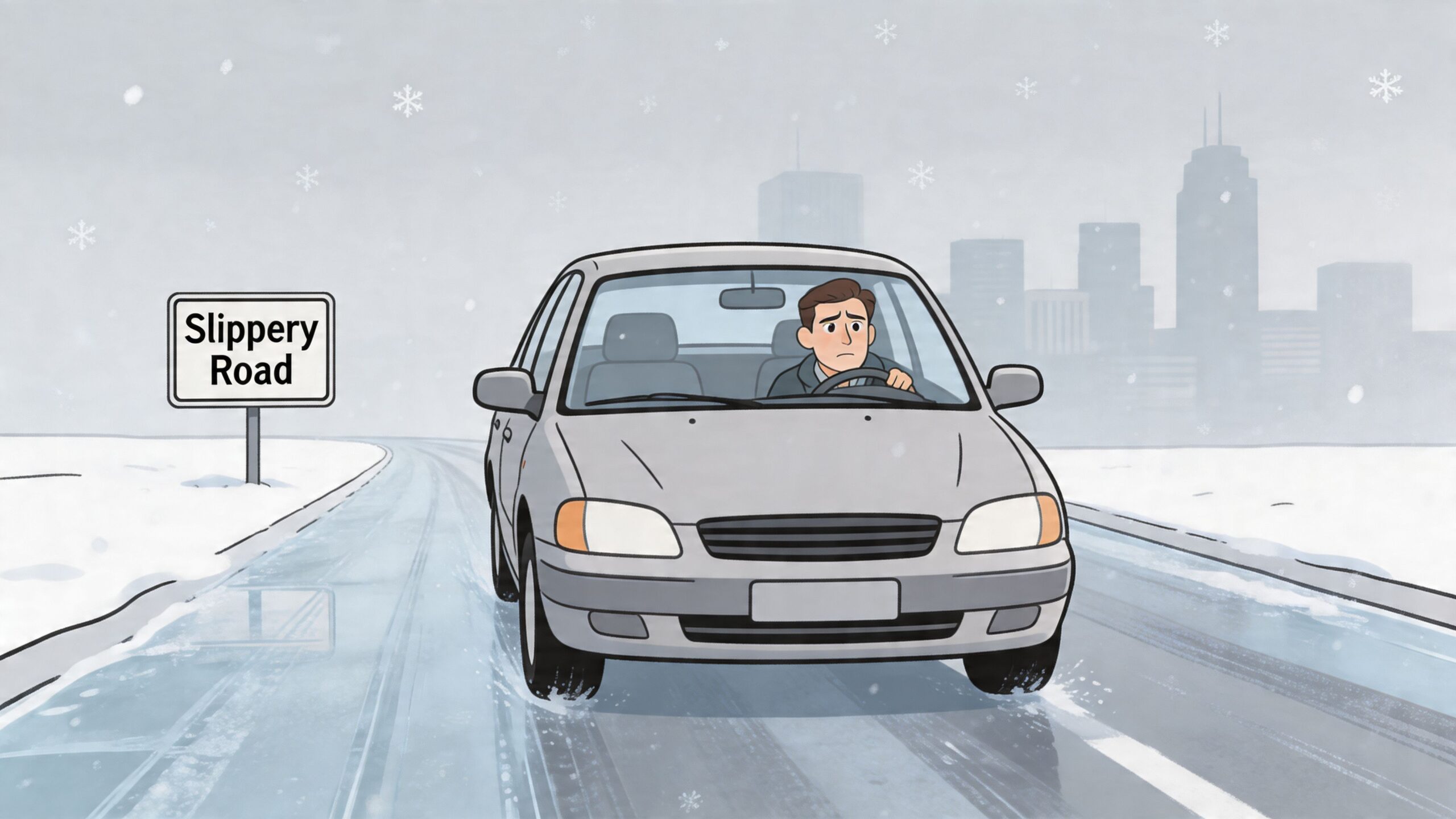
That’s where a lot of Richardson drivers get stuck mentally. They hear “tire chains” and picture mountain highways, not Central Expressway, Campbell Road, or an iced-over parking lot exit. But the basic question is the same anywhere. How do you get mechanical grip when rubber alone isn’t enough?
What local drivers usually get wrong
The most common mistake is assuming any traction device will work on any car. It won’t.
Another is thinking chains are something you can figure out for the first time in freezing weather on the shoulder of a road. That usually leads to loose fitment, damaged wheel wells, or a set that never really seats on the tire.
A third mistake is believing chains are automatically the best answer. Sometimes they are. Sometimes cables are the better fit. Sometimes the owner’s manual says not to use traditional chains at all.
Practical rule: If you’ve never tested your traction device on your vehicle in dry conditions, don’t count on that first install going smoothly in sleet.
Why this matters in Richardson
Most North Texas drivers don’t need chains every winter. Some may never need them at all. But if you travel north, head into hill country during a freeze, relocate for work, or want an emergency plan, you should know your options before weather turns ugly.
That’s especially true for:
- Families with daily school and work routes: Ice usually hits the roads you use every day, not just highways.
- Drivers of older vehicles: Tire condition, suspension wear, and braking performance matter more when surfaces get slick.
- Fleet and service vehicles: Even a short route becomes a problem if one vehicle can’t maintain traction.
What Are Tire Chains and How Do They Actually Work
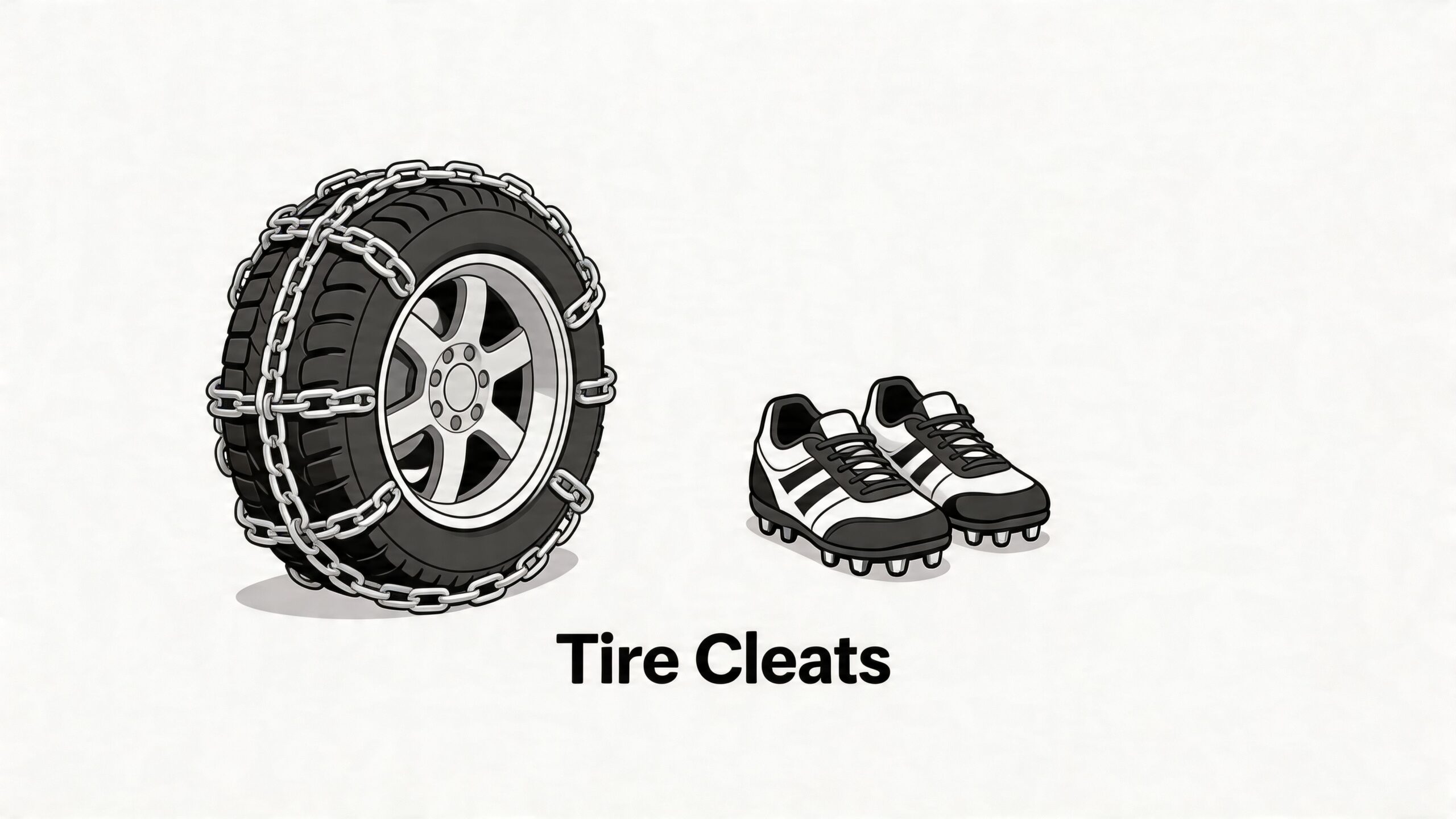
Tire chains are metal traction devices that wrap around the tread of a tire. The easiest way to think about them is cleats for your tires. A normal tire depends on rubber compound and tread design to grip the road. On packed snow or ice, that grip can drop off fast. Chains add a harder, sharper contact point that can bite into the slippery surface.
The basic physics in plain English
Rubber does well when it can deform into the road surface and create friction. Ice works against that. It creates a slick layer where the tire can spin or slide with very little bite.
Chains help because the cross links interrupt that smooth slide. They create mechanical traction, not just friction. That’s why chains can make the difference between a vehicle crawling forward and a vehicle sitting still with the tires spinning.
On snow, the links can dig in. On ice, they can break through the top layer enough to improve control. They don’t turn a vehicle into a tank, but they do change the contact patch in your favor.
They’ve been around longer than most drivers realize
Snow chains aren’t new gadgetry. Harry D. Weed invented snow chains, known as “Grip-Tread for Pneumatic Tires,” in 1904 in Canastota, New York, and received U.S. patent 768,495. The idea came after he saw drivers wrapping ropes around tires to get more grip, according to the history summarized here.
That early design solved a real winter problem, and the core idea still holds up today. Add a traction device over the tire when the road surface defeats rubber alone.
To see how the fitment and layout look on an actual wheel, this quick visual helps:
What chains do well and what they don’t
Chains work best when conditions justify them. They’re for snow, packed snow, and ice. They are not for normal dry-road driving.
Here’s the practical trade-off:
- They improve traction in severe low-grip conditions
- They’re noisy
- They limit speed
- They can damage tires and vehicles if loose or mismatched
- They’re unpleasant to install in bad weather
Chains are a specialized tool. Use them for the conditions they’re built for, then remove them when the road clears.
For a driver in Richardson, that’s the key mindset. Don’t think of chains as everyday equipment. Think of them as an emergency traction solution that only works when the vehicle, the fitment, and the road conditions all line up.
Comparing Your Winter Traction Options Chains Cables and Socks
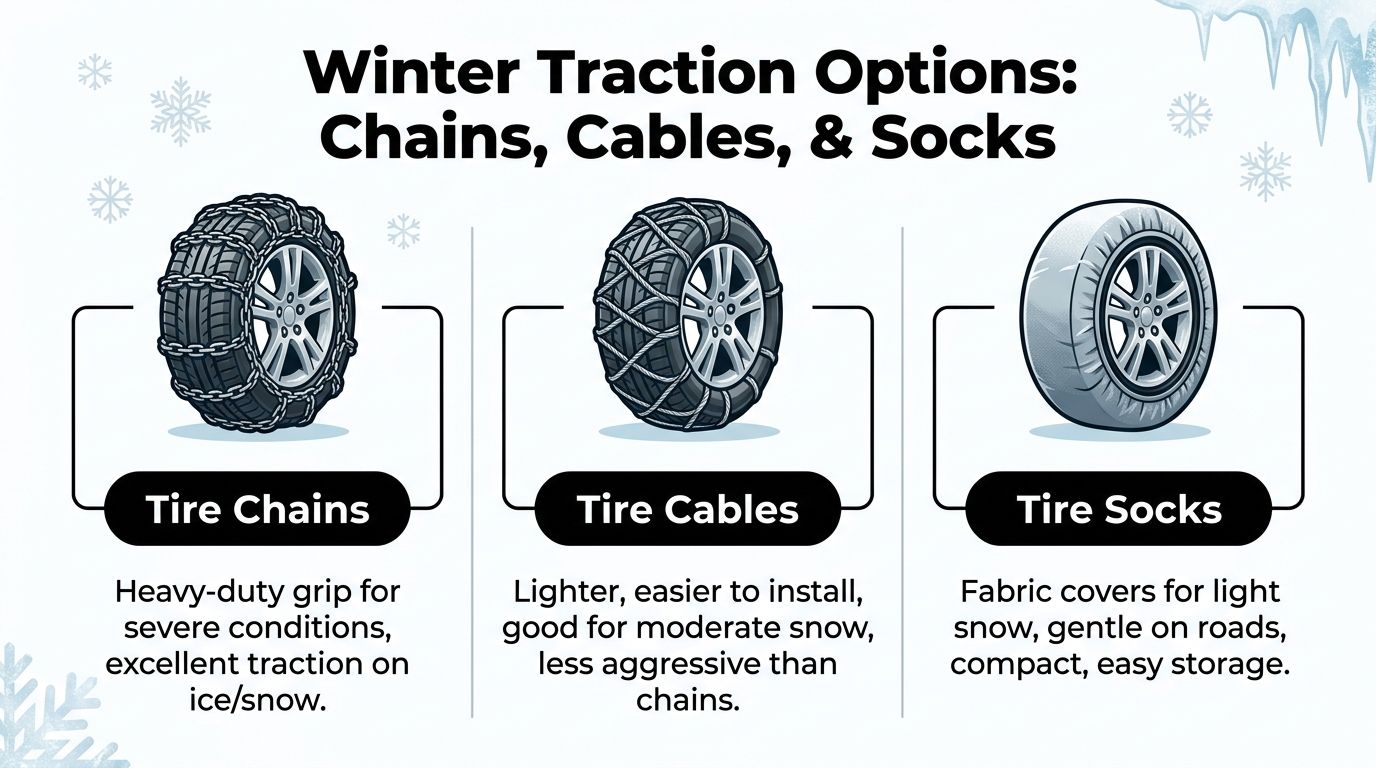
If you’re shopping for traction help, you’ll usually end up comparing traditional chains, cable-style devices, and snow socks. They’re not interchangeable in real-world use, even if they get grouped together online.
Traditional chains
Steel link chains are the heavy-duty option. They usually offer the strongest bite in snow and ice, and they’re the first thing many people picture when they hear “chains on tires.”
They also bring the most drawbacks. They’re heavier, rougher riding, and more likely to create clearance problems on modern vehicles. If the chain quality is poor, performance suffers too. National Association of Chain Manufacturers compliance matters, because some non-compliant products swap standard 3/8-inch cross-chain links for smaller 5/16-inch material and increase spacing between cross-segments, which can reduce traction and durability, as explained by Laclede Chain’s discussion of tire chain specs.
Cables
Cables use steel cable with rollers or smaller traction elements instead of heavier chain links. For a lot of passenger cars, they’re the practical middle ground.
They’re usually easier to store, lighter to handle, and often a better fit where space is tight. But they’re generally less aggressive than full chains in severe conditions. If your vehicle has limited wheel well clearance, cables may be the only metal traction device that fits safely.
Snow socks
Snow socks are fabric covers that slip over the tire tread. They’re much easier to handle than metal chains, and they’re gentler on the vehicle.
For light snow or a short emergency use case, they can be appealing. But they’re not what I’d choose first for repeated use on rough winter routes. They wear faster, and once road conditions get harsher, they’re not as confidence-inspiring as a well-fitted metal setup.
Traction Device Comparison
| Traction Type | Best For | Pros | Cons |
|---|---|---|---|
| Tire Chains | Severe snow and ice, heavier-duty traction needs | Strong grip, durable when built to spec | Harder to install, heavier, more clearance risk |
| Tire Cables | Passenger vehicles with tighter space, occasional winter travel | Lighter, easier to handle, often better for modern cars | Less aggressive traction than full chains |
| Tire Socks | Light snow, emergency carry item, easy storage | Simple to store, easier install, gentler on vehicle | Less durable, limited performance in tougher conditions |
Which one usually makes sense for a Richardson driver
Most local drivers aren’t preparing for daily mountain driving. They’re trying to answer a narrower question. What should I keep in mind if I might face occasional ice, travel out of state, or need a traction backup?
In that situation:
- Choose chains if your vehicle allows them and you expect the toughest conditions.
- Choose cables if your owner’s manual limits clearance or your car has a tighter wheel well.
- Choose socks if you want compact storage and the mildest-use option.
If your tires are already worn, don’t expect any traction device to fully compensate. A worn tire plus a fancy accessory is still a worn tire. If you’re already comparing replacement costs, this guide on the average price for new tires can help you frame the bigger decision.
The best traction device on paper is useless if it doesn’t fit your tire, your wheel well, and your actual driving conditions.
Understanding Tire Chain Laws and Road Restrictions
Texas drivers often assume tire chain laws are simple because Texas rarely centers around them. The moment you travel into snow country, that assumption can get expensive or dangerous.
Laws change by state, and they change fast by weather
Some states only require chains when signs are posted. Others build seasonal rules into mountain travel. Some focus heavily on commercial vehicles. A few handle traction very differently from the states around them.
One clear example: Colorado’s Traction Law runs from September 1 to May 31, and it can require chains or adequate snow tires in certain conditions. Ohio, by contrast, bans tire chains and allows studded tires only during a specific winter window, according to the source summarized in this state-law overview video.
That contrast matters because many drivers assume “winter equipment” means the same thing everywhere. It doesn’t.
Practical law issues drivers run into
Here are the problems I’d watch for before a winter trip:
- Posted chain controls: If signs say chain up, local assumptions don’t matter.
- Vehicle type differences: Passenger cars, commercial trucks, and heavier vehicles can fall under different rules.
- Carry requirements: In some areas, you may need to carry chains even if you’re not using them at that moment.
- Alternative devices: Some roads accept alternatives, but not every alternative is accepted everywhere.
Speed and road-surface restrictions still matter
Even where chains are legal or required, they are for low-speed use. They are not meant for normal cruising. A significant danger isn’t just a ticket. It’s what happens when a driver leaves chains on after the road clears.
Long-term use on dry pavement can chew up both the road and the tire. Broken links can also damage the vehicle. That’s why drivers need to treat chains as a temporary traction tool, not a winter accessory that stays on all day.
If you’re crossing state lines in winter, check both your route and your vehicle manual before you leave. Chain legality and chain compatibility are two different issues.
For Richardson drivers, the big takeaway is simple. You probably won’t deal with chain control often around home. But if your work, family travel, relocation, or fleet routes take you into snow states, you need to know the local rule set before weather forces the decision.
Is Your Vehicle Compatible With Tire Chains
Most costly mistakes happen when a driver buys a set of chains, sees the tire size match on the package, and assumes that’s the whole story. It isn’t.
Tire size match is only step one
Yes, the chain must match the tire size exactly. If your sidewall reads something like 205/55R16, that size matters and the chain must be chosen for that exact tire format. But fitment doesn’t stop there.
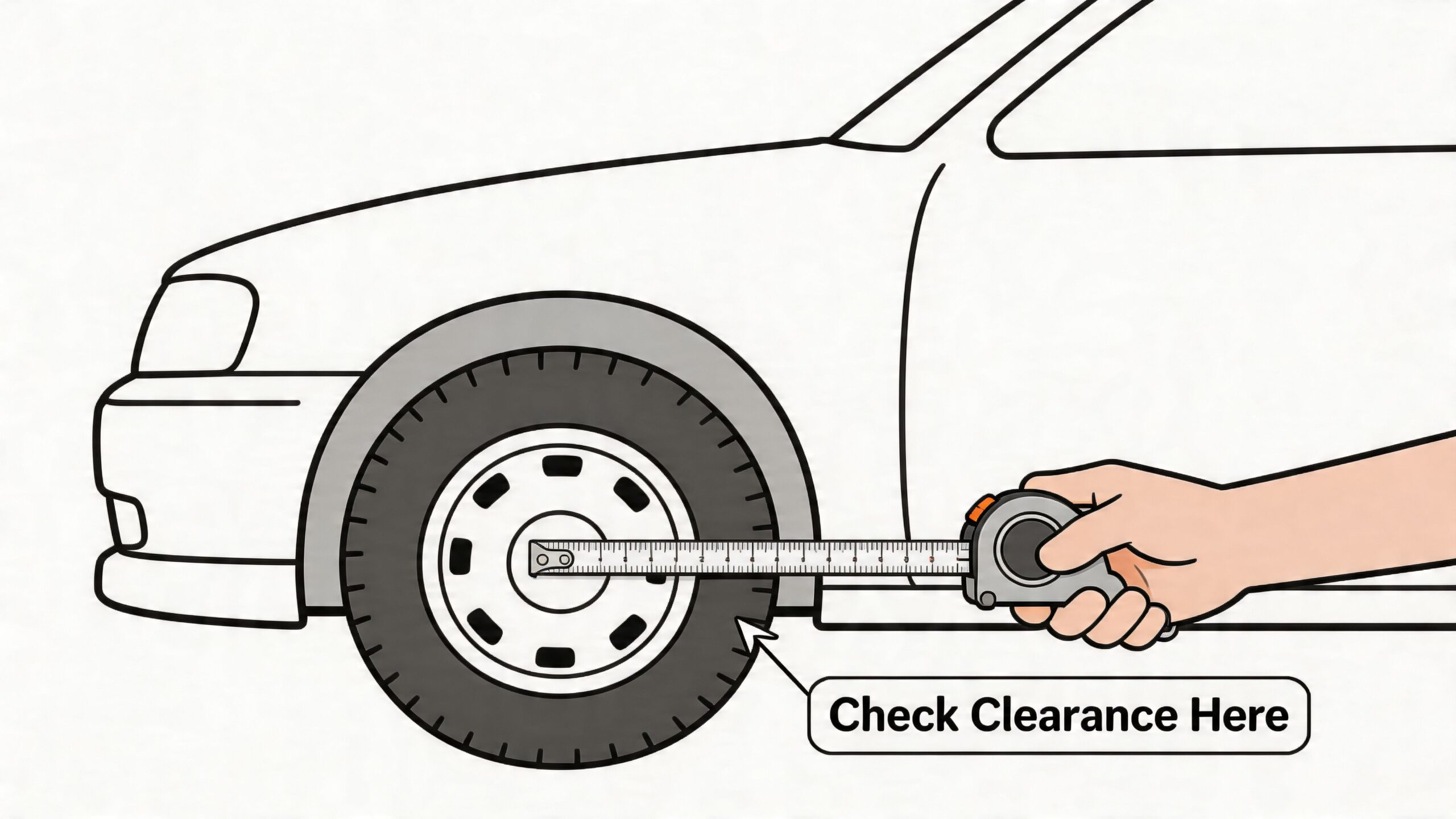
Modern vehicles often have very tight clearance between the tire and nearby components. The danger areas include:
- Brake lines
- Struts
- Inner fender liners
- ABS wiring and sensors
- Suspension components
A chain that’s too bulky, too loose, or installed incorrectly can hit those parts and do real damage.
Low-clearance vehicles need special attention
Some modern cars are built for low-profile packaging, not for bulky external traction devices. That’s where SAE Class S products come in. They’re designed for tighter spaces, with 1.46 inches of vertical clearance and 0.59 inches of lateral clearance as noted in AAA Oregon’s winter traction guidance.
That doesn’t mean every Class S product is automatically safe for every car. It means you may need a lower-profile option if the vehicle allows traction devices at all.
The owner’s manual matters more than the box
I’ve seen plenty of drivers focus on the package and ignore the manual. That’s backwards.
Your owner’s manual may say:
- chains are permitted only on one axle
- only low-profile devices may be used
- cable chains are allowed but standard chains are not
- no chains should be used at all
If the manual prohibits them, respect that. That warning usually exists because of clearance, braking-system sensitivity, steering travel, or bodywork risk.
Run-flat tires and newer electronic systems add another layer
Run-flat tires can complicate things. Their stiff sidewalls can change how a traction device seats and tensions around the tire. Add ABS and electronic stability control into the mix, and a poor fit can create more trouble than help.
That’s why pre-fitting matters. You want to know if the device stays centered, whether the inner side clears components, and whether it remains tight after the wheel rotates.
A chain that “almost fits” is the one that tears up a wheel well.
What 2WD and 4WD drivers should think about
The practical rule is to follow the owner’s manual and the road authority’s instructions. On a two-wheel-drive vehicle, traction devices are typically installed on the drive axle. On all-wheel-drive or four-wheel-drive vehicles, the answer can be more specific and vehicle-dependent.
Drivers run into trouble by copying what worked on someone else’s truck. Same tire size doesn’t mean same suspension layout, same brake clearance, or same manufacturer guidance.
If you own a front-wheel-drive sedan, compact crossover, or luxury vehicle with run-flats, don’t guess. Compatibility is a safety issue, not just a convenience issue.
A Guide to Tire Chain Installation and Maintenance
Installing chains for the first time during freezing rain is a miserable way to learn. Practice in dry weather, on level ground, with gloves on. You’ll spot fitment problems before they become roadside problems.
Before installation
Start with the sidewall. The traction device must match the exact tire size listed there, including width, aspect ratio, and rim diameter. If the package range is confusing, stop and verify before you install anything.
Then lay the chains or cables out flat. Make sure nothing is twisted and the fasteners are oriented correctly. A twisted chain won’t seat evenly and usually becomes loose once the tire starts turning.
Basic install routine
Most systems wrap around the tire and secure with an inside connection, an outside connection, and some form of tensioning. The exact hardware varies by brand, but the universal habits stay the same:
- Position the device evenly: Don’t let one side carry all the slack.
- Connect the inner side first if the design calls for it: That’s usually the awkward part.
- Tighten the outer side fully: Hand-tight isn’t always enough if a tensioner is included.
- Use the tensioning system correctly: Many failures start with skipped tensioners.
Most designs require manual tensioning, and you need to re-check the fit after driving a short distance, as explained in this guide on what info you need to purchase tire chains.
After the first short roll
This step gets skipped all the time, and it’s one of the most important.
Drive a short distance, stop safely, and inspect the fit again. If the device has shifted, loosened, or started slapping the tire, fix it immediately. A loose chain can strike the fender, suspension, or brake components fast.
If you’d rather have a shop inspect your tires and fitment before winter travel, a certified tire shop can help you confirm the basics before you’re dealing with bad weather.
Re-tensioning after the first short drive isn’t optional. It’s part of the install.
Maintenance that keeps them usable
Chains and cables don’t last well if you toss them back in the trunk dirty and wet.
Use these habits:
- Rinse off salt and grime: Corrosion starts quickly.
- Inspect links and connectors: Bent, cracked, or worn pieces can fail under load.
- Dry before storage: Wet storage shortens life.
- Store as a complete set: Missing parts make the next install harder.
Also remove them as soon as the road surface no longer calls for them. Leaving them on clear pavement is hard on the tire, hard on the device, and risky for the vehicle.
Winter Driving in Richardson and When to Visit Kwik Kar
For most Richardson drivers, the first line of defense isn’t a set of chains in daily use. It’s a vehicle that’s already in good shape before the weather turns. Good tread, proper inflation, healthy brakes, a strong battery, and realistic driving decisions matter more in North Texas than buying hardware you may never need.
That said, understanding chains on tires is still useful. Ice storms here are infrequent, but when they arrive, they create exactly the kind of low-traction situation that exposes weak tires, poor maintenance, and bad assumptions. If you travel out of state, drive an older vehicle, manage a small fleet, or own a car with tight wheel clearances, it’s smart to sort out compatibility before winter rather than during it.
A pre-winter check is especially worthwhile if:
- Your tires are worn or aging: Grip starts there.
- You drive a vehicle with limited clearance: Chain fitment may be restricted.
- Your owner’s manual is unclear to you: Better to confirm than guess.
- You rely on your vehicle for work or family transport: Downtime in bad weather hits harder.
The goal isn’t to convince every North Texas driver to buy chains. The goal is to avoid being unprepared, uninformed, or stuck with the wrong equipment when roads get slick.
If you need help deciding whether your vehicle can safely use chains, cables, or another traction option, ask before the weather event. That’s the safest time to make the call.
Kwik Kar Oil Change and Auto Care helps Richardson drivers get ready for the road with practical, safety-focused service. If you want an expert look at your tire condition, battery health, brake performance, or winter readiness, schedule a visit with Kwik Kar Oil Change and Auto Care.