
A healthy, fully charged 12V car battery should read 12.6 volts or higher when it's resting. If you see a reading around 12.2V, that means you're at about a 50% charge. Anything below 12.0V is a red flag, signaling that your battery is seriously discharged and needs immediate attention.
Your 12-Volt Battery State of Charge Chart
Getting a handle on your battery's health really starts with a simple voltage reading. Using a multimeter gives you a quick snapshot of its State of Charge (SoC), which is just a fancy way of saying its available power, expressed as a percentage. For instance, a reading of 12.6V doesn’t just mean the battery is “good”—it means it's holding 100% of its stored energy and is ready for anything.
On the flip side, a reading of 12.0V means your battery is only at a 25% charge. At this point, it's considered deeply discharged and will probably struggle to start your engine, especially when the weather gets cold. Letting a battery sit with a low SoC is also a recipe for sulfation, a chemical process that can permanently cripple its ability to hold a charge.
This chart breaks down the key voltage points with a simple color-coded system to help you quickly figure out where your battery stands.
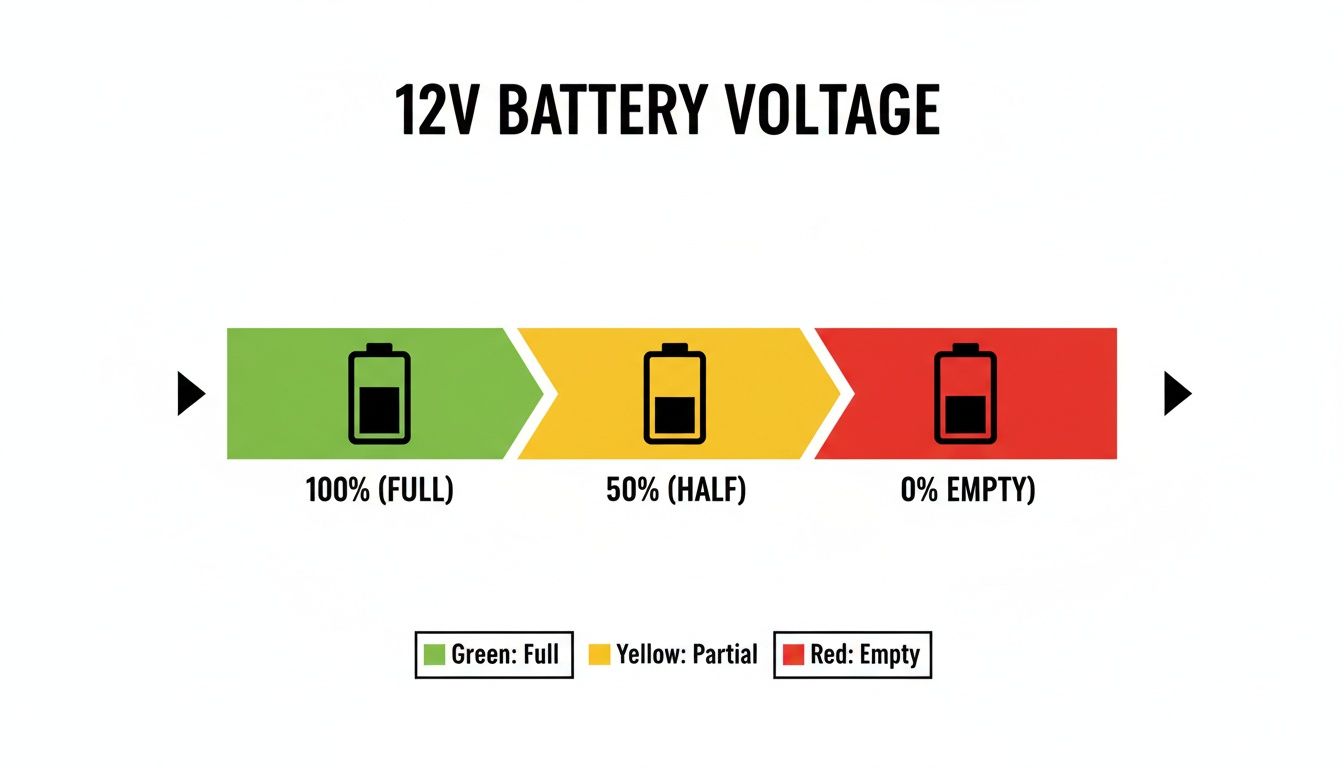
As you can see, the green zone means you've got a healthy, full battery. Yellow indicates a partial charge that you should look into, while red is a critical warning that you need to take action right away. Use this as a quick reference to make sense of your battery's voltage and decide what to do next.
Interpreting Your Readings
To make it even clearer, we’ve put together a detailed table. Just find your battery's resting voltage below to see its approximate charge level and what we recommend doing about it.
| Resting Voltage | Approximate State of Charge | Recommended Action |
|---|---|---|
| 12.6V or above | 100% (Full Charge) | Good to Go. Your battery is healthy. |
| 12.4V | 75% | Okay. Consider topping off with a charger. |
| 12.2V | 50% | Charge Soon. The battery is low and should be recharged. |
| 12.0V | 25% (Deeply Discharged) | Charge Immediately. Risk of damage and starting issues. |
| 11.8V or below | 0% (Effectively Dead) | Needs Testing. The battery may be faulty or sulfated. |
Remember, these numbers are for a battery that has been resting for a few hours. If you've just been driving, the voltage will be temporarily higher due to the alternator's charge. For the most accurate reading, let the car sit for a while before testing.
Decoding Your Battery Voltage Chart Readings
A battery voltage chart gives you a vital snapshot of your vehicle's health, but just looking at the numbers only tells part of the story. To really get what's going on, you have to understand the science behind those readings. At its core, a lead-acid battery’s voltage is a direct reflection of its internal chemical reaction—basically, its ability to store and dish out power when you need it.
A fully charged 12-volt battery is actually made up of six individual cells, with each one producing about 2.1 volts. When you add them all up, a healthy, fully charged battery should give you a resting voltage of 12.6V or even a little higher. If you check your battery with a multimeter a few hours after turning the car off and see 12.6V, that’s a great sign. It means the battery's chemistry is stable and it's holding its maximum potential charge.
Why Small Voltage Drops Matter
It's easy to dismiss a small drop in voltage, but it can signal a major loss in your battery's charge. For instance, a reading of just 12.2V means your battery is only at a 50% state of charge. At this point, the lead sulfate crystals that form during discharge start to harden on the battery plates. This process, called sulfation, permanently cripples the battery's ability to hold a full charge.
If your battery ever reads 11.8V or lower, it's considered completely discharged. It has almost no power left to crank the engine and is at serious risk of being damaged for good.
While nearly every car today uses a 12V system, that wasn't always the standard. For decades, most American cars relied on 6-volt batteries, which were plenty for the simpler electronics of the era. The industry-wide shift to 12V systems happened around the mid-1950s to support more powerful engines that demanded higher cranking power.
Think of a battery's voltage like the water pressure in a tank. Full pressure (12.6V+) means it can deliver a powerful, immediate flow. Low pressure (below 12.2V) means it's going to struggle to do its job, even if there's still some juice left inside.
To get a better handle on what these voltage readings mean for your battery's state of charge, you can check out this definitive eBike battery voltage chart and guide. The core principles of voltage and charge state are pretty similar across different battery types. Knowing these key thresholds on a voltage chart helps you catch problems early, keeping your vehicle reliable day in and day out.
How to Accurately Test Your Car Battery Voltage
Grabbing a digital multimeter is a quick and easy way to get a snapshot of your battery's health. Before you get started, though, safety first. Always slip on some protective gloves and safety glasses. Car batteries contain corrosive acid, and it's always better to be safe than sorry.
For an accurate resting voltage reading, you need to let the car sit with the engine off for at least an hour—overnight is even better. This gives any surface charge from the alternator time to fade away, leaving you with the battery's true state of charge.
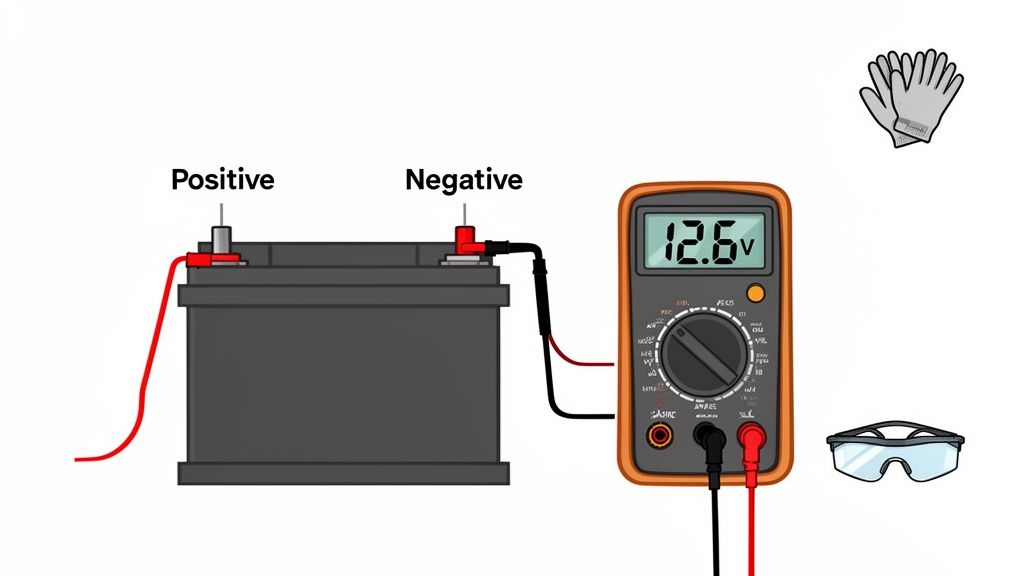
Step-by-Step Testing Guide
Following these simple steps will give you a reliable voltage reading. If you want a deeper dive, check out our full guide on how to test a battery with a multimeter.
- Set Up Your Multimeter: First, turn the dial on your multimeter to the DC voltage setting, which looks like this: V⎓. Make sure to select the 20V range. This setting is perfect for the standard 12V batteries found in most cars.
- Connect the Probes: Attach the red probe clamp to the positive (+) terminal on your battery. Next, connect the black probe to the negative (-) terminal. Make sure you get a solid connection on the metal posts themselves, not on any built-up corrosion.
- Read the Voltage: Take a look at the multimeter's screen. A healthy, fully charged battery should give you a reading of 12.6V or a little more.
Interpreting Cranking Voltage
While the resting voltage tells you how much charge the battery is holding, a cranking test shows you how well it performs under pressure. For this, you'll need a friend to turn the ignition key while you keep an eye on the multimeter.
As the engine cranks, the voltage on a healthy battery shouldn't dip below 9.6V. If you see it drop lower than that, it's a strong sign the battery is on its last legs and can't supply the power needed to start the car.
If your tests show a low charge, the next step might be a recharge. This helpful guide on how to charge a car battery can walk you through it.
Understanding Voltage Under Different Conditions
A battery's voltage reading isn't a static number; it changes dramatically depending on what your car is doing at that exact moment. Getting a handle on these different states is the key to accurately diagnosing whether you've got a battery problem or an issue somewhere else in your car's electrical system. Think of it like a person's heart rate: you get a different reading at rest versus during a workout, and both tell an important part of the story.
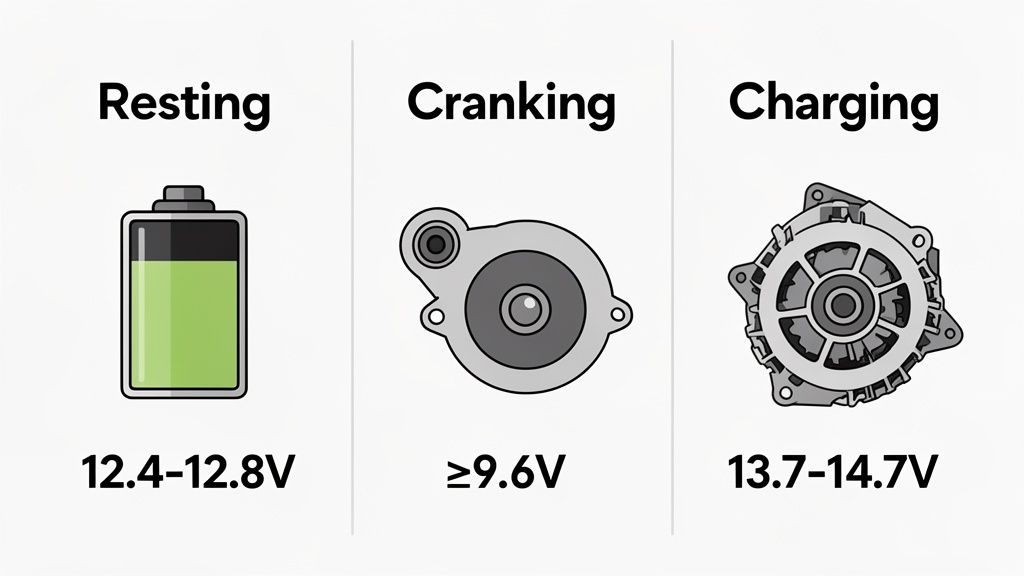
There are three key scenarios you’ll run into when testing your battery, and each one has its own healthy voltage range to look for.
The following table breaks down what you should expect to see on your multimeter under each of these common test conditions.
| Test Condition | Healthy Voltage Range | What It Indicates |
|---|---|---|
| Resting Voltage | 12.4V – 12.8V | The battery's true state of charge. |
| Cranking Voltage | Above 9.6V | The battery's ability to deliver power under heavy load. |
| Charging Voltage | 13.7V – 14.7V | The alternator's health and ability to recharge the battery. |
Seeing numbers within these ranges is a great sign. If your readings are falling short, it's time to dig a little deeper into what might be going on.
Resting Voltage: The Baseline Test
Resting voltage is the measurement you take when the engine has been completely off for at least an hour. This lets any surface charge dissipate and gives you the most honest picture of the battery's actual state of charge, without the alternator muddying the waters.
A healthy, fully charged 12V battery should show a resting voltage between 12.4V and 12.8V. If your reading dips below 12.4V, it's a clear signal that the battery is discharged and needs a good charge or further testing. A consistently low resting voltage can also point to a parasitic drain that's slowly bleeding it dry overnight.
Cranking Voltage: The Under-Load Test
Cranking voltage is measured right at the moment you turn the key to fire up the engine. This is the ultimate stress test, showing you if the battery has the muscle to deliver that massive jolt of power the starter motor needs.
During this intense, brief demand, the voltage will naturally drop. The key is how much it drops. A strong battery should not fall below 9.6V while cranking. If you see it dip lower than that, the battery is likely on its last legs and could fail you at any time, especially when cold weather hits.
Charging Voltage: The Alternator Health Test
Charging voltage is the reading you get while the engine is up and running. This test isn't really about the battery's stored power; instead, it tells you how well the alternator is doing its job of recharging the battery and powering all your car's electronics.
A properly working alternator should produce a steady voltage somewhere between 13.7V and 14.7V. If your multimeter reads below 13.7V, your alternator probably isn't charging the battery effectively, which will eventually leave you stranded. On the flip side, a reading above 14.7V means it's overcharging the battery, which can boil the internal electrolyte and cause serious, irreversible damage. This is just one of many ways a battery can fail; you can learn more about issues like corrosion on car battery in our other guides.
How Temperature Impacts Battery Performance
The numbers you see on a battery voltage chart aren't absolute; they can shift quite a bit depending on the weather. Both extreme heat and freezing cold mess with the battery's internal chemistry, directly changing its voltage and its ability to give you power when you need it most.

This is a huge factor here in Texas, where we bounce between scorching summers and the occasional freezing winter snap. Understanding how the thermometer impacts your battery is key to avoiding a surprise no-start situation.
The Impact of Cold Weather
When the temperature plummets, everything slows down—including the chemical reactions inside your battery. This sluggishness makes it much harder for the battery to deliver the high amperage needed to crank a cold engine.
Here’s a practical look at what that means:
- Reduced Cranking Power: At 32°F (0°C), a battery loses about 35% of its starting power.
- Deep Freeze Effect: Drop that to 0°F (-18°C), and its strength is cut by a staggering 60%.
So, a battery that reads a healthy 12.5V in your garage on an 80°F day might perform like one reading 12.2V or less once a cold front rolls through. It’s still technically charged, but it just can't deliver the power effectively.
The Impact of Hot Weather
While cold weather makes a battery struggle, hot weather actively destroys it. High temperatures, especially the kind we see in a Richardson summer, accelerate the chemical processes inside the battery. This leads to faster fluid evaporation and internal corrosion.
The damage from heat is often silent and cumulative. Your battery might work perfectly fine all summer, but the heat is slowly cooking it from the inside out. Once the first cold day of fall arrives, that weakened battery finally gives up. This is why you often see a spike in battery failures right after a heatwave ends.
When to Seek Professional Battery Diagnostics
While a multimeter gives you a great starting point, the reading on your battery voltage chart only tells you part of the story. A battery can show a perfectly healthy resting voltage, like 12.6V, but still lack the guts to reliably crank your engine. This happens because voltage measures electrical potential, not the battery's actual ability to deliver sustained power under a heavy load.
When symptoms pop up, it’s a clear sign that a simple voltage check just isn’t enough. If you’re dealing with a slow, sluggish engine crank, it means the battery is struggling to push out the necessary amperage. Dimming headlights when you turn the key is another classic sign of a weak battery failing under pressure.
These warning signs are your car's way of telling you it's time to move beyond a DIY voltage test and get a professional opinion. An expert technician can perform a comprehensive diagnostic check that goes much deeper than a simple multimeter reading.
The Limits of Voltage and the Need for a Load Test
The most important tool in a professional's diagnostic kit is a load tester. This device simulates the intense electrical demand of starting your engine, revealing the battery's true health in a way a multimeter simply can't. It measures the battery's Cold Cranking Amps (CCA), which is its real-world ability to deliver power when it's needed most. A battery might have good voltage but completely fail a load test, confirming it's on its last legs.
Think of it this way: Voltage is like knowing a water bottle is full. A load test is like squeezing the bottle to see if it can actually deliver a strong, steady stream.
A professional diagnosis at Kwik Kar will pinpoint whether the problem is a dying battery, a weak alternator, or even a parasitic drain pulling power when the car is off. Catching these problems early is the key to not getting stranded. If you see your battery light on the dashboard, that's a definite signal to get your system checked out right away.
Consider bringing your car in for a professional test if you notice any of these red flags:
- Your engine has a slow, hesitant, or groaning crank.
- The battery is more than three years old.
- Your headlights dim significantly when you start the car.
- You’ve recently needed a jump-start to get going.
Don’t wait for a complete failure to leave you stuck. Stop by Kwik Kar in Richardson for a professional battery and charging system test to make sure your vehicle is reliable and ready for whatever the road throws at you.
Frequently Asked Questions About Car Battery Voltage
Even with a detailed battery voltage chart in front of you, a few questions might still pop up. Let's run through some of the most common points of confusion so you can feel more confident when checking on your vehicle's battery.
Can a Battery Show Good Voltage But Still Be Bad?
Absolutely. This is a classic scenario that trips up a lot of people. A battery can show a perfectly healthy resting voltage, like 12.6V, but then completely fall on its face the moment you ask it to do some real work.
Voltage just measures electrical potential; it doesn't tell you anything about the battery's ability to deliver the massive current (amperage) needed to crank your engine. Think of it like a water pipe that's full but has a blockage—the pressure is there, but the flow is weak. The only way to know for sure is with a professional load test, which simulates the heavy demand of starting the engine and measures the battery's actual performance under stress.
Is 14.5 Volts Too High When My Car Is Running?
Nope, that's actually right in the sweet spot. When your engine is on, a reading between 13.7V and 14.7V is perfectly normal. This isn't the battery's voltage you're seeing, but rather the charging voltage coming straight from your alternator. It's working to recharge the battery and power all your car's electronics at the same time.
Now, if you see that voltage consistently creeping above 14.8V, that's a red flag. It could point to a faulty voltage regulator in the alternator. This is a serious problem because overcharging can literally boil the acid inside your battery, causing permanent damage that can get expensive fast.
What Does a 12.2 Volt Reading Mean?
A resting voltage of 12.2V means your battery is only at about a 50% state of charge. While your car might still turn over at this level, especially on a warm day, the battery is significantly drained and needs to be recharged right away.
Consistently letting a battery sit this low is a bad habit. It leads to a nasty process called sulfation, where crystals form on the battery plates, permanently crippling its ability to hold a full charge. A reading this low could also hint at a bigger problem, like a weak alternator that isn't recharging properly or a parasitic drain that's slowly sucking power when the car is off.
If your battery tests are giving you questionable results, don't leave it to chance. The ASE-certified technicians at Kwik Kar Oil Change and Auto Care can perform a comprehensive diagnostic test on your entire charging system. Schedule your appointment today and drive with confidence.