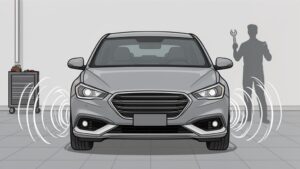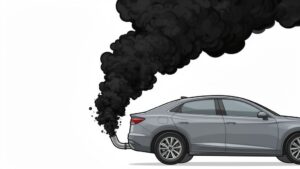
That puff of blue smoke from your car is a direct signal your engine is burning oil, and you're right to be concerned. The main culprits are typically worn-out internal parts that can no longer keep the oil where it belongs. While it definitely needs attention, it's a diagnosable issue that can be fixed.
What Blue Smoke From Your Exhaust Really Means

Seeing blue smoke drift from your exhaust can be alarming, but understanding its message is the first step toward a solution. Unlike other exhaust colors, blue has a very specific meaning: engine oil has leaked into the combustion chamber, where it absolutely doesn't belong.
Think of your engine’s combustion chamber as a hot skillet. Normally, only a precise mix of air and fuel goes in to create power. When oil seeps onto that hot surface, it burns right alongside the fuel, producing that unmistakable bluish-gray smoke. This isn't just a cosmetic problem; it's a clear symptom of an internal issue that hurts your engine's health and efficiency.
Key Clues to Watch For
When and how the smoke appears are critical clues that help us pinpoint the exact problem. Paying attention to these details can give a technician a huge head start on the diagnosis.
- Smoke just at startup? This classic sign often points to worn valve stem seals.
- Smoke when you accelerate? This could indicate failing piston rings.
- Constant smoke while driving? This might suggest a clogged PCV valve or a more serious internal issue.
Blue smoke is a common problem, especially in older vehicles. In the US, where the average vehicle age hit 12.5 years in 2023, millions of drivers are dealing with worn seals and rings.
Important Takeaway: Blue smoke is always a sign of burning oil. Ignoring it can lead to fouled spark plugs, a damaged catalytic converter, and eventually, catastrophic engine failure from oil starvation.
While blue smoke means an oil problem, don't confuse it with other colors. You can learn about what different exhaust colors mean by checking out our guide on black smoke coming from an exhaust. Addressing the root cause quickly is always the best way to protect your engine and your wallet.
The Three Main Causes of Engine Oil Burn

A puff of blue smoke from your car’s exhaust is never a good sign. It's a clear signal that engine oil has found its way into the combustion chamber, where it's burning up right alongside the fuel.
You might only see that blue smoke on startup, or maybe it appears when you're accelerating. Each pattern tells a different story about what’s going on under the hood. We’re going to look at three of the most common failure points that let oil get where it doesn't belong.
By understanding how valve stem seals, piston rings, and the PCV system work, you'll be able to spot the difference between a minor startup puff and a more serious, continuous haze.
Valve Stem Seal Failure
Think of valve stem seals as tiny, crucial gaskets that sit at the top of each engine valve. Their job is simple but important: keep engine oil where it belongs, out of the combustion chamber.
Over time, these little seals get brittle. They harden, crack, or shrink, creating tiny pathways for oil to seep through. When your engine is off and cold, gravity does its work, pulling oil down past these worn seals and onto hot engine surfaces. The moment you start the car, that oil burns off instantly, creating that classic puff of blue smoke.
- Startup Behavior: You'll see a single cloud of smoke for just 2–3 seconds right after you start the engine as the pooled oil burns off.
- Mileage Trigger: This is a common issue in high-mileage engines, often appearing after 80,000 miles or more.
- Preventive Tip: Having the seals replaced proactively during other major engine work can save you a headache down the road.
Piston Ring Wear
Next up are the piston rings. These rings wrap around each piston and act like a squeegee, scraping excess oil off the cylinder walls as the piston moves up and down. A good set of rings leaves just a razor-thin film of oil for lubrication while stopping the rest from entering the combustion zone.
But when these rings wear out, they lose their tension or get stuck in their grooves. Imagine trying to clean a window with a worn-out, flimsy squeegee—it just smears grime around. Worn piston rings do the same thing with oil, allowing it to flood into the air-fuel mixture with every stroke of the piston. The result? Continuous blue smoke.
- Steady Smoke: The smoke is most noticeable when you accelerate or put the engine under load.
- Power Drop: You'll likely feel a loss of power and a sluggish throttle response.
- Increased Oil Use: Your oil consumption might jump by 0.5 to 1 quart every 1,000 miles.
If you see a steady stream of blue smoke every time you hit the gas pedal, failing piston rings are the prime suspect. Ignoring this can lead to scored cylinder walls, which is a fast track to a full engine rebuild—one of the most expensive repairs your car can have.
PCV System Malfunction
Your engine's Positive Crankcase Ventilation (PCV) system is basically its breathing apparatus. It's designed to vent gases that "blow by" the piston rings back into the intake manifold so they can be burned cleanly.
Think of it like a snorkel for a diver. If that snorkel gets clogged, pressure builds up. In your engine, a blocked PCV valve or hose forces this pressure to find a way out, and it will push oil past perfectly good seals and gaskets, right into the combustion chamber.
This problem often causes intermittent blue smoke, especially at idle or low speeds, which can make it tricky to diagnose.
- Idle Smoke: You might see blue smoke when you're stopped at a red light.
- Rough Idle: The engine may run rough or make hissing sounds at low RPMs.
- Inspection Method: You can often check the valve by removing it and giving it a shake. If it rattles, it’s likely still good.
Key Takeaway: The PCV valve is a simple part. Regularly cleaning or replacing it every 30,000 miles is a cheap and easy way to prevent pressure buildup and stop oil leaks before they start causing blue smoke.
Each of these failures leaves its own clues in your exhaust. Paying attention to when you see the smoke can help you and your mechanic zero in on the root cause much faster.
If you spot any of these oil-burning signs, bring your vehicle to Kwik Kar. Our ASE-certified technicians can run precise diagnostics to find the problem and deliver a reliable fix, so you can get back on the road with confidence.
How a Failing Turbocharger Causes Blue Smoke
For folks with turbocharged engines, seeing blue smoke from a car can point to a very specific—and urgent—problem. A turbocharger is a brilliant piece of engineering that crams more air into your engine to make more power. To do this, it spins at mind-boggling speeds, often hitting over 150,000 RPM, and it absolutely depends on a steady stream of pressurized engine oil to stay lubricated and cool.
That high-speed, high-heat environment is incredibly tough on its parts. The oil is kept in check by a set of delicate, precision seals on the turbo’s central shaft. Over time, all that heat and pressure take their toll, causing these seals to wear out. Once they fail, oil has a direct path to leak into places it was never meant to be.
The Two Leak Paths From a Failing Turbo
Once those seals are shot, oil can escape into two critical areas, and both will result in thick plumes of blue smoke. Paying attention to when you see the smoke can help figure out exactly where the leak is happening.
The two main ways oil can escape are:
- Into the Intake System: The seal on the compressor side of the turbo fails, allowing oil to mix with the clean air being pushed into the engine. This oily air gets burned up during combustion, creating that tell-tale blue smoke.
- Into the Exhaust System: Oil seeps past the seal on the turbine side, dripping directly into the scorching-hot exhaust housing. The oil instantly vaporizes, creating dense blue smoke that pours out of your tailpipe.
A failing turbocharger isn’t something you can put off. What starts as a small seal leak can quickly get worse, starving the turbo’s internal bearings of oil. This can lead to catastrophic failure of the turbo’s delicate fins, sending bits of metal straight into your engine.
Why Turbo Smoke Demands Immediate Attention
This kind of blue smoke from a car often shows up most when you accelerate hard or suddenly take your foot off the gas. These moments cause big pressure changes inside the turbo system, which forces more oil past the worn-out seals.
In many modern vehicles, you might see these critical turbo seals start to fail somewhere between 80,000-120,000 miles. Ignoring that constant blue haze can lead to some seriously expensive problems, like a clogged diesel particulate filter or catalytic converter. As lubricant experts from Repsol have pointed out, getting it checked quickly is key to avoiding costly turbo rebuilds that can easily run over $2,000. You can find more of their insights on turbocharger issues on their website.
If you think your turbocharged car or truck is burning oil, don’t wait. Schedule an inspection at Kwik Kar right away. Our ASE-certified technicians have the right diagnostic tools and experience to pinpoint a failing turbo and stop a minor leak before it turns into a major, engine-destroying disaster.
Simple Diagnostic Checks You Can Do at Home
Seeing blue smoke puffing out of your exhaust is definitely a sign to pay attention, but it doesn't mean you're powerless. Before you even think about calling a mechanic, there are a few straightforward, safe checks you can do right in your own driveway.
These steps won't replace a full professional diagnosis, but they will arm you with some solid information. Think of yourself as a detective gathering the first crucial clues. Knowing what's happening and when will help a technician figure out the problem much faster, saving you time and money.
Check Your Engine Oil Level
The simplest check is also one of the most important: your engine oil level. Make sure your car is parked on a flat surface and the engine is cool. Pull out the dipstick, wipe it clean with a rag, push it all the way back in, and then pull it out again for an accurate reading.
If the oil level is below the "add" or "minimum" line, that's your confirmation: the engine is using oil it shouldn't be. A really big drop in a short amount of time—like losing a quart in under 1,000 miles—is a major red flag. This points to a significant leak or a serious internal burning issue.
Keeping an eye on your dipstick is the best way to track how bad the problem is. If you see a sudden drop, you might have another warning light to look out for. Learn more in our guide on what to do when your check engine light comes on.
Become a Smoke Detective
Now it's time to observe the smoke itself. The timing and conditions when the blue smoke appears are the most telling clues you can possibly gather. Pay close attention and take a mental note of the following scenarios:
- Smoke at Startup: Do you see a distinct puff of blue smoke for just a few seconds when you first start the engine, which then disappears? This is a classic symptom of worn-out valve stem seals.
- Smoke During Acceleration: Does the blue smoke show up mainly when you hit the gas pedal to speed up or when the engine is working hard? This is a very common sign of failing piston rings.
- Smoke During Deceleration or Idling: Do you notice the smoke when you take your foot off the gas and coast, or while you're just sitting at a stoplight? This could point to high engine vacuum pulling oil past worn guides or a problem with the PCV system.
This flowchart shows how a technician might diagnose smoke that's specifically related to a turbocharger, which follows a similar logic.

As you can see, the diagnostic process is all about observing symptoms under very specific conditions, like acceleration, to narrow down the potential cause before digging into a repair.
Understanding Blue Smoke Repair Costs
Alright, let's get to the question everyone asks: what’s it really going to cost to fix the blue smoke from your car? The honest answer is, it depends. Repair costs can swing wildly from a relatively minor expense to a major investment, and it all comes down to what’s causing the oil to burn in the first place.
The huge price range is mostly due to labor. Swapping out a simple, easy-to-reach part is a completely different job than one that requires tearing down half the engine. Your vehicle's specific make and model also play a big part in the final bill.
Low-Cost and Mid-Range Repairs
On the more budget-friendly end of things, you've got fixes that don't require deep engine surgery. These are often the first things a good mechanic will investigate, because catching them early can save you a ton of money.
- PCV Valve Replacement: A clogged PCV valve can create all sorts of pressure problems, but thankfully, the fix is usually quick and easy. This is often the most affordable repair, typically running between $75 and $200 for parts and labor.
- Valve Stem Seals: This one is a bit more involved. The seals themselves aren't expensive, but getting to them means removing parts of the engine's top end. You can expect this job to be in the $500 to $1,500 range, depending on how complex your engine is.
High-Cost Repairs and Turbo Issues
This is where things can get pricey. When the problem is buried deep inside the engine, the cost goes up fast because of the sheer amount of work involved. We're talking about serious repairs for major mechanical wear.
A blown turbo is another common culprit, and it’s a specialized fix. Turbos operate under intense heat and speed, so when they fail, it's a big deal. A new turbocharger unit alone can be over $1,000, and with labor, the total repair often lands in the $1,500 to $3,500 ballpark.
If the diagnosis points to worn-out piston rings, you're looking at a major engine-out repair. This kind of job, sometimes called an in-frame rebuild, is one of the most extensive and expensive repairs, typically starting at $2,500 and going up to $6,000 or more.
To help you get a clearer picture of what to expect, we've put together a table outlining the most common repairs and their typical cost ranges.
Typical Repair Costs for Blue Smoke Issues
This table breaks down the potential repair costs to help you budget for the necessary services if you're dealing with blue smoke. Remember, these are general estimates, and the final cost will depend on your specific vehicle and the extent of the damage.
| Repair Type | Typical Cost Range (Parts & Labor) | Commonly Affects |
|---|---|---|
| PCV Valve Replacement | $75 – $200 | Most gasoline engines |
| Valve Stem Seals | $500 – $1,500 | Higher-mileage or older engines |
| Turbocharger Replacement | $1,500 – $3,500 | Turbocharged vehicles |
| Piston Rings (Engine Rebuild) | $2,500 – $6,000+ | Engines with severe internal wear |
Because these repairs can represent a significant financial commitment, it’s absolutely critical to get a detailed, written estimate from a trusted professional. Here at Kwik Kar, we make sure you understand exactly what work is needed and why before we pick up a single tool.
Proactive Maintenance to Prevent Blue Smoke
When it comes to your car, the best repair is always the one you never have to make. After digging into what causes blue smoke and how much it can cost to fix, the smartest move is to focus on prevention. A little proactive care for your engine goes a long way and is always far less expensive than fixing a major problem.
The single most important defense you have against oil-burning issues is simply getting your oil changed on time. Think of engine oil as your car’s lifeblood. When it’s fresh, it’s packed with detergents and additives that protect crucial components like piston rings and valve seals, keeping them clean, lubricated, and working just right.
Over many miles, that oil breaks down and gets saturated with gunk. Old, dirty oil becomes gritty and abrasive, losing its ability to protect your engine and actually speeding up wear and tear on the very parts that are supposed to keep oil out of your combustion chamber.
Strategic Oil Choices and Early Warnings
For cars that have seen a lot of road, a basic oil change might not be the whole story. This is where picking the right type of oil can make a huge difference in heading off future headaches.
- Follow Manufacturer Specs: Always, always use the oil weight and type recommended in your owner’s manual. Using the wrong viscosity can starve parts of proper lubrication and lead to premature failure.
- Consider High-Mileage Oils: If your car has over 75,000 miles on the odometer, switching to a high-mileage oil is a fantastic idea. These specialized formulas include conditioners designed to help rejuvenate aging seals, making them more flexible and better at preventing leaks.
Finally, one of the best habits you can build is to never, ever ignore your dashboard warning lights.
The check engine light is your vehicle’s main way of telling you something is wrong. It often gives you an early heads-up on issues like a bad sensor or a clogged PCV system—problems that, if ignored, can lead to the kind of internal pressure buildup that causes blue smoke.
Sticking to a regular oil change schedule is the foundation of a healthy engine, and you can learn more about all the benefits an oil change provides right here on our blog. By staying on top of this simple service and listening to what your car is telling you, you give your engine its best shot at running clean for many years and miles to come.
Common Questions About Car Smoke
When you see blue smoke coming from your exhaust, it’s natural to have a lot of questions. We get it. Here are some straightforward answers to the concerns we hear most often from drivers, helping you figure out what to do next.
Can I Still Drive My Car If It's Blowing Blue Smoke?
Honestly, it’s a bad idea. That blue smoke is a clear signal your engine is burning oil it shouldn't be. Continuing to drive means you're actively losing the very lubricant that keeps your engine's metal parts from grinding themselves into oblivion.
This can quickly lead to overheating and major, sometimes irreversible, engine damage. On top of that, the burning oil can ruin your spark plugs and clog up your expensive catalytic converter. The best move is to check your oil level immediately, top it off if it's low, and get your car to a trusted shop as soon as possible.
Will an Oil Additive or "Stop Leak" Product Fix Blue Smoke?
For a very small leak caused by old, hardened seals, a high-quality "stop leak" additive might temporarily slow things down. Think of it as a band-aid, though, not a cure.
These products are designed to swell rubber seals, but they can't magically fix a broken piston ring, a bad turbo seal, or a clogged PCV valve. Using an additive might just delay the inevitable, allowing the real problem to get worse. A professional diagnosis is always the safest bet when you see blue smoke from your car.
Key Insight: While additives can sometimes help with minor leaks from aging seals, they are not a substitute for addressing the mechanical failure that causes significant blue smoke. A proper repair is the only long-term solution.
Does Blue Smoke Mean I Need a New Engine?
Not necessarily, so don't panic just yet. While a worst-case scenario like worn-out piston rings on an older, high-mileage engine might make a replacement the most practical option, many other causes are much simpler to fix.
Something like a clogged PCV valve is a quick and inexpensive repair. Even replacing valve stem seals, which is a more involved job, is a manageable repair that doesn't require a full engine removal. The only way to know for sure is to have a certified technician properly diagnose the issue.
If you're seeing blue smoke and need answers you can trust, bring your vehicle to Kwik Kar Oil Change and Auto Care. Our ASE-certified technicians will perform a thorough diagnostic to pinpoint the exact cause and provide a clear, honest repair estimate. Visit us online to schedule your appointment today at https://www.kkrichardson.com.