Trying to pin down a fair change oil in car price can feel like you're chasing a moving target. The truth is, there's no single answer. For a standard service in 2026, you might pay anywhere from $35 for a basic conventional oil change to over $120 for a high-performance full synthetic service.
The final cost really comes down to what your specific vehicle needs and the type of oil you decide to use.
Your Quick Guide to 2026 Oil Change Prices
Before we get into the nitty-gritty, it’s good to have a solid understanding of the general landscape of oil change services and what's usually included. This knowledge is key to recognizing the real value behind different price points.
When you see a price quote, you’re not just paying for the oil. The cost is a package deal that covers several crucial parts of the service. These are the main ingredients that make up your final bill.
What Determines the Price
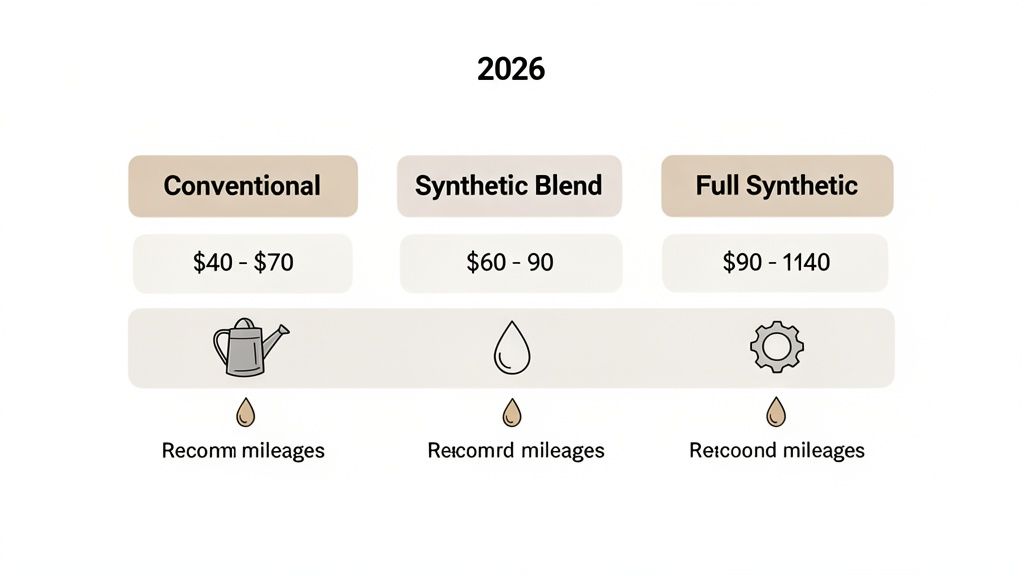
Several factors have a direct impact on the cost. In 2025-2026, the average cost for an oil change in major U.S. markets varies quite a bit by oil type. You can expect to see ranges from $35-$55 for conventional, $50-$75 for synthetic blends, and $70-$120 for full synthetic. These numbers typically include 5 quarts of oil, a new filter, and the labor to get it done right.
The core elements driving that final price are:
- Oil Type: Conventional, synthetic blend, or full synthetic oil.
- Vehicle Needs: The amount of oil your engine requires.
- Labor: The time and skill of a certified technician.
Think of it like ordering coffee. A simple black coffee is always cheaper than a large, specialty latte with extra shots and flavored syrup. In the same way, a basic oil change for a small sedan will cost less than a full synthetic service for a heavy-duty truck that needs twice the oil.
The table below gives you a clear, at-a-glance comparison. Understanding the relationship between the upfront cost and how long the oil actually lasts is the secret to making a smart decision for your car and your wallet. If you want to dive deeper into the specific options available, you can explore our professional oil change services right here in Richardson.
2026 Average Oil Change Price at a Glance
This table breaks down the average costs and recommended service intervals for the three main types of oil changes.
| Oil Type | Average Price Range | Recommended Change Interval (Miles) |
|---|---|---|
| Conventional | $35 – $55 | 3,000 – 5,000 |
| Synthetic Blend | $50 – $75 | 5,000 – 7,500 |
| Full Synthetic | $70 – $120 | 7,500 – 15,000 |
As you can see, while full synthetic has a higher initial cost, it can last two to three times longer than conventional oil, often making it a better value in the long run.
Why Oil Changes Cost More Today
If you can remember paying just $20 for an oil change, you’re not imagining things. Seeing a modern invoice can definitely feel like sticker shock, but the price hike isn't just random. It’s a direct result of huge leaps in engine technology and the simple reality of economics.
That $20 service from back in the day? It was almost certainly for conventional motor oil. But today's engines are a different breed entirely. They run hotter, operate under immense pressure, and require far more advanced lubrication to keep them running smoothly and reliably. This has pushed the entire auto industry toward more sophisticated synthetic oils.
The Impact of Inflation on Materials
A big piece of the puzzle is simple inflation, which has touched every single part of the service. Crude oil, the base for all motor oils, costs more to get out of the ground. The same goes for the metals, plastics, and high-tech filter materials used in every oil filter. On top of that, the wages for skilled technicians have risen with the broader economy.
Just how big has the impact been over the decades? According to data from the U.S. Bureau of Labor Statistics, the price for motor oil, coolant, and other vital fluids has absolutely soared. In fact, prices are a staggering 641.60% higher today than they were in 1977.
That means the $20 worth of motor oil you bought back then would set you back $148.32 today. This trend has helped grow the U.S. oil change market into a $7.6 billion industry. You can dig deeper into how these costs have changed over time in recent industry analyses.
The bottom line is this: you are not just paying for oil and a filter. You're paying for decades of research and development, higher-quality materials, advanced engine protection, and the skilled labor needed to service a modern vehicle correctly.
The Shift to Advanced Synthetic Oils
Beyond inflation, the oil itself has fundamentally changed. Conventional oil is a basic lubricant that's refined directly from crude oil. Full synthetic oil, on the other hand, is engineered from the ground up in a lab, with pure, uniform molecules designed for maximum performance.
This high-tech engineering delivers some serious benefits:
- Enhanced Durability: It stands up to extreme heat without breaking down, protecting your engine for longer.
- Improved Flow: It circulates easily in cold weather, which is critical for reducing wear and tear during startups.
- Superior Cleanliness: It has far fewer impurities, helping prevent the buildup of sludge and nasty deposits in your engine.
Because of these clear advantages, nearly all car manufacturers now require synthetic oil for their new vehicles. It’s not an upsell—it’s a necessity to keep your engine healthy and your warranty intact. To get a better handle on what makes these oils different, check out our guide on synthetic vs. conventional oil.
What Really Goes into Your Oil Change Bill
When you get the bill for an oil change, it can sometimes feel a bit mysterious. What exactly are you paying for? The final change oil in car price is much more than just a few quarts of motor oil; think of it as a recipe with several key ingredients that all add up to the total cost.
The primary components are the oil itself, the new filter, the exact volume your engine requires, and the skilled labor needed to get the job done right. Just like a simple sheet cake costs less to make than a multi-tiered wedding cake, the price of an oil change adjusts based on your specific vehicle's needs.
It's also impossible to ignore how much the cost of automotive fluids and parts has climbed over the years due to simple economics and inflation.
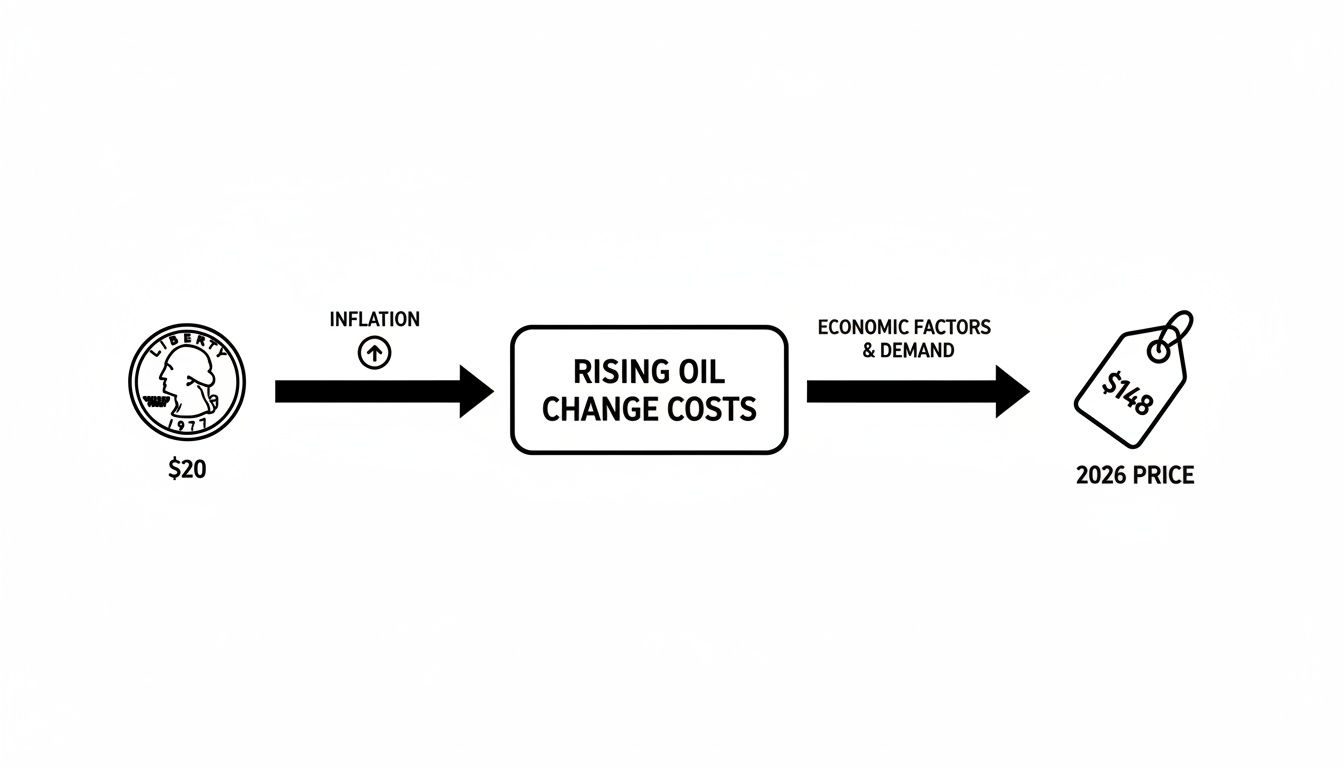
As this shows, an oil change that might have run you about $20 back in the late 1970s would be closer to $150 today when adjusted for inflation. That’s a stark reminder of how much the cost of raw materials has risen.
The Type and Volume of Oil
The single biggest factor driving the price is the type of oil your car needs. Full synthetic oil costs more upfront than a conventional or synthetic blend because it’s engineered in a lab for superior performance, protection, and a longer lifespan. It’s the difference between a standard ground beef patty and a dry-aged steak—they’re both beef, but the quality, process, and price are worlds apart.
Next up is oil volume. A little four-cylinder engine in a compact sedan might only take 4 or 5 quarts of oil. On the other hand, a big V8 engine in a truck or a large SUV can easily require 8 quarts or more. Since you pay by the quart, the cost of the oil alone can nearly double for a larger vehicle.
The Oil Filter and Labor Costs
The oil filter is another critical piece of the puzzle. It might seem like a small, insignificant part, but its design can absolutely affect the price. For most common vehicles, a standard spin-on filter is used. These are generally inexpensive and straightforward to replace.
But many newer vehicles, especially European models, use a cartridge-style filter. These are often tucked away inside a housing that requires more time, and sometimes special tools, to get to. These filters tend to cost a bit more, and the extra complexity adds to the labor time.
A professional oil change isn't just about draining old fluid and pouring in new. It's a precise service where a technician ensures the correct oil type and volume are used, a quality filter is installed properly, and the vehicle is inspected for other potential issues.
Finally, there are the labor costs. This portion of the bill, which usually accounts for $20 to $60, pays for a trained technician’s time and expertise. You’re paying for a professional to do the job safely, dispose of the used oil responsibly, and spot other potential problems you might have missed. Understanding all the parts of a full-service oil change helps you see the true value behind the price tag.
Price Examples for Common Cars Trucks and SUVs
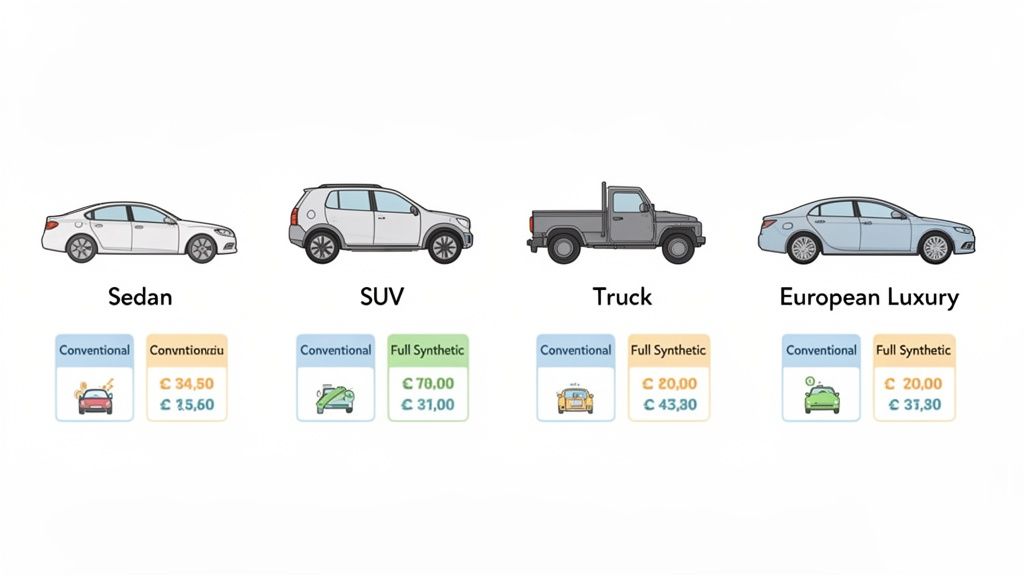
Knowing the factors that go into a change oil in car price is a great start, but seeing some real-world examples is what really helps with budgeting. The final cost you’ll see on the invoice is tied directly to your specific vehicle. It just makes sense—a small commuter car won't have the same service needs as a heavy-duty work truck.
To bring those numbers to life, let’s walk through a few common scenarios you’ll see driving around Richardson, TX. Seeing how these vehicle types compare will give you a much clearer picture of what to expect when you pull into the service bay.
Daily Driver Sedans
First up, think about a reliable commuter sedan like a Toyota Corolla or Nissan Sentra. These cars are built for efficiency, which means their engines are typically smaller and only need about 4 to 5 quarts of oil. They are usually the most straightforward and affordable vehicles to service.
For a sedan, a standard conventional oil change will typically run you between $35 to $55. If you choose the superior protection of full synthetic oil—which we strongly recommend for most newer models—the price generally settles between $70 and $90.
Family SUVs and Crossovers
Now, let's look at a popular family SUV, maybe a Ford Explorer or a Nissan Rogue. These vehicles have larger engines than sedans to handle more passengers and cargo, often requiring 5 to 6 quarts of oil. That extra volume of oil is a primary reason for the higher service cost.
A conventional oil change for an SUV might range from $45 to $65. However, given the heavier loads and stop-and-go driving these vehicles often endure, a full synthetic oil change is a smart investment, usually costing between $85 and $110.
Keep in mind that these are general estimates. The final price can be influenced by the specific filter your vehicle uses and local labor rates. A modern cartridge filter, for example, often costs more than a traditional spin-on filter.
Workhorse Trucks
Trucks like the Ford F-150 or Chevy Silverado are built to work hard, and their powerful engines reflect that. A V8 engine in a full-size truck can easily demand 7 to 8 quarts of oil or more. This significant volume is a major driver of the higher service price.
Because these engines work under such high stress, nearly all services use synthetic blends or full synthetics. A full synthetic oil change is a critical investment in a truck's longevity, and you can expect it to fall in the $100 to $130 price range.
To make it even clearer, the table below breaks down the typical change oil in car price across these different vehicle types, so you can easily compare the costs.
Estimated Oil Change Cost by Vehicle Type
| Vehicle Type | Example Model | Conventional Oil Change Price | Full Synthetic Oil Change Price |
|---|---|---|---|
| Commuter Sedan | Toyota Corolla | $35 – $55 | $70 – $90 |
| Family SUV | Ford Explorer | $45 – $65 | $85 – $110 |
| Full-Size Truck | Ford F-150 | N/A | $100 – $130 |
| European Luxury | BMW 3 Series | N/A | $120 – $180+ |
As you can see, the price aligns closely with the vehicle's size, performance, and engine requirements. No matter what you drive, there’s an oil change plan that fits your car and your budget.
How to Save Money on Your Next Oil Change
Now that you have a better idea of what goes into the price of an oil change, let's talk about how to keep that cost down without cutting corners on quality. Being a smart car owner isn’t about chasing the absolute rock-bottom price; it’s about getting the most value for your money and protecting your engine for the long haul.
The good news is that a little planning goes a long way. Many trusted auto shops, including Kwik Kar, offer coupons and promotions online or in local mailers. A quick search before you head out can easily save you $10 to $25 right away.
Bundle Services for Greater Value
One of the smartest ways to save is by bundling services together. Your car has a whole list of routine needs beyond just oil, like tire rotations, state inspections, and fluid top-offs. Instead of booking these appointments one by one, ask about package deals.
When you get your oil changed at the same time as another service, shops often give you a better price than if you paid for each one separately. This saves you money and, just as importantly, saves you from making multiple trips to the shop.
- Tire Rotation: Pairing this with an oil change is a classic move. It helps your tires wear evenly and can significantly extend their lifespan.
- State Inspection: If your annual inspection is coming up, getting it done during your oil change is a perfect way to check two things off your list at once.
- Filter Replacements: Your engine and cabin air filters are usually inspected during an oil change, and replacing them at the same time is often more cost-effective.
The Long-Term Savings of Synthetic Oil
It might seem strange, but spending more on a full synthetic oil change can actually put money back in your pocket over time. Conventional oil has to be changed every 3,000-5,000 miles, but a good full synthetic can last for 7,500 to 15,000 miles—sometimes even longer.
This means fewer trips to the auto shop every year. If a synthetic oil change costs twice as much but lets you drive three times longer between services, you’re already winning on both cost and convenience.
Prevention Is the Best Financial Strategy
At the end of the day, the best way to save money on your car is to treat regular maintenance as a non-negotiable investment. The cost of a timely oil change, even a premium synthetic one, is just a drop in the bucket compared to what it costs to fix a neglected engine.
Skipping oil changes allows sludge to build up, increases friction, and can cause your engine to overheat. These problems can lead to catastrophic failures that run into the thousands of dollars. A $100 oil change today is always a smarter choice than a $4,000 engine replacement down the road. By staying on top of your service schedule, you are actively choosing the most affordable path for your vehicle.
What to Expect at a Certified Auto Care Center
Deciding where to get your oil changed is about more than just finding the lowest change oil in car price. While a bargain from a generic quick-lube chain can be tempting, a certified auto care center delivers a totally different experience built on value and trust. It’s the difference between a simple transaction and starting a long-term partnership with a team that knows your car.
At a certified shop, your vehicle is in the hands of ASE-certified technicians. You can think of them as specialists who have passed demanding exams to prove their knowledge. They’re trained to understand the specific requirements of your make and model, so you can be confident the right type and amount of oil is used every single time.
This level of professional care is more important than ever. Industry data reveals the average driver pushes their car to 4,500 miles between services, often going well past the manufacturer's recommendation and risking engine health. Working with a dependable shop makes staying on schedule simple. You can explore the full oil change industry statistics to see just how common these delays are.
The Value of Certifications and Quality Parts
When you see logos for CARFAX or NAPA AutoCare on the wall, they’re not just for show. These certifications are a real promise of quality and accountability. They signal that the shop follows high industry standards, uses premium parts, and usually backs its work with a nationwide warranty.
This provides a level of peace of mind that you just won't find with a budget oil change or a DIY job. A certified center guarantees:
- Correct Equipment: They have professional-grade tools to handle any job, from standard spin-on filters to the more complex cartridge filters found in many newer vehicles.
- Guaranteed Parts: You get access to high-quality oil filters and manufacturer-approved fluids that protect your engine and keep your warranty intact.
- Detailed Inspections: Technicians perform multi-point inspections to catch small issues like worn belts or low fluids before they turn into major, expensive repairs.
A certified shop acts as a guardian for your vehicle's health. They don't just change your oil; they provide a comprehensive check-up that helps ensure your car remains safe and reliable on the road.
Understanding the bigger picture of the automotive industry helps put the value of a certified oil change into perspective. Ultimately, when you invest in certified care, you’re not just paying for a service—you’re investing in expertise, reliability, and the long-term health of your car.
Frequently Asked Questions About Oil Change Prices
Even after breaking down the costs, a few common questions always seem to come up when it’s time for an oil change. Let's tackle them head-on so you can feel confident about your next service.
Is a Full Synthetic Oil Change Really Worth the Extra Price?
For most cars on the road today, the answer is a definite yes. While you’ll notice a higher price tag upfront, full synthetic oil is an investment in your engine’s health. It provides far superior protection against wear and tear, holds up better in both scorching summer heat and freezing winter cold, and lets you go much longer between services—often 7,500 to 15,000 miles.
Ultimately, this means fewer appointments and less hassle. The extended life of the oil and the added engine protection can actually lead to long-term savings, turning a simple expense into a smart investment.
Does My Car Really Need More Than 5 Quarts of Oil?
It all comes down to what's under your hood. The standard five-quart oil change is a common benchmark, but many larger engines in trucks, SUVs, and high-performance cars simply require more oil to run correctly. Your vehicle’s manufacturer sets the exact amount needed to keep everything lubricated and protected.
A certified technician will always follow the manufacturer’s specific recommendations for your make and model. Using the precise volume and type of oil is crucial for protecting your engine from damage and ensuring it runs at its best.
Can I Bring My Own Oil to a Shop to Save Money?
We get this question a lot, and while it seems like a clever way to cut costs, most professional auto shops bundle their oil change service. This package isn't just about the oil—it includes a high-quality, warranty-approved oil and filter, the expertise of a skilled technician, and the proper, environmentally safe disposal of the old fluids.
This all-in-one approach allows shops to stand behind their work and guarantee the quality of every part used. A better way to save is to keep an eye out for coupons, seasonal promotions, or service bundles that offer the best overall value.
Ready to give your car the expert care it deserves? At Kwik Kar Oil Change and Auto Care, our ASE-certified technicians provide dealership-quality service with transparent pricing. Book your oil change in Richardson, TX, today!