You’re cruising at road speed, traffic is moving, and then you catch a flicker on the dash. It’s the oil light, or maybe the engine oil pressure gauge just dropped lower than you’ve ever seen it. Most drivers have the same first thought: Is this a sensor acting up, or am I about to lose the engine?
That question matters because oil pressure problems don’t give you much room for guessing. Some warnings turn out to be gauge or sender issues. Others mean the engine isn’t getting the oil film it needs right now. The safest move is to think like a technician: read the symptom, check the context, and decide what action protects the engine first.
Why Your Oil Pressure Gauge Is Your Engine's Most Important Signal
A lot of dashboard warnings can wait long enough for you to finish the drive. Oil pressure isn’t one of them. If the engine oil pressure gauge drops suddenly, or the oil can warning light comes on and stays on, your engine may be losing the lubrication that keeps metal parts separated.
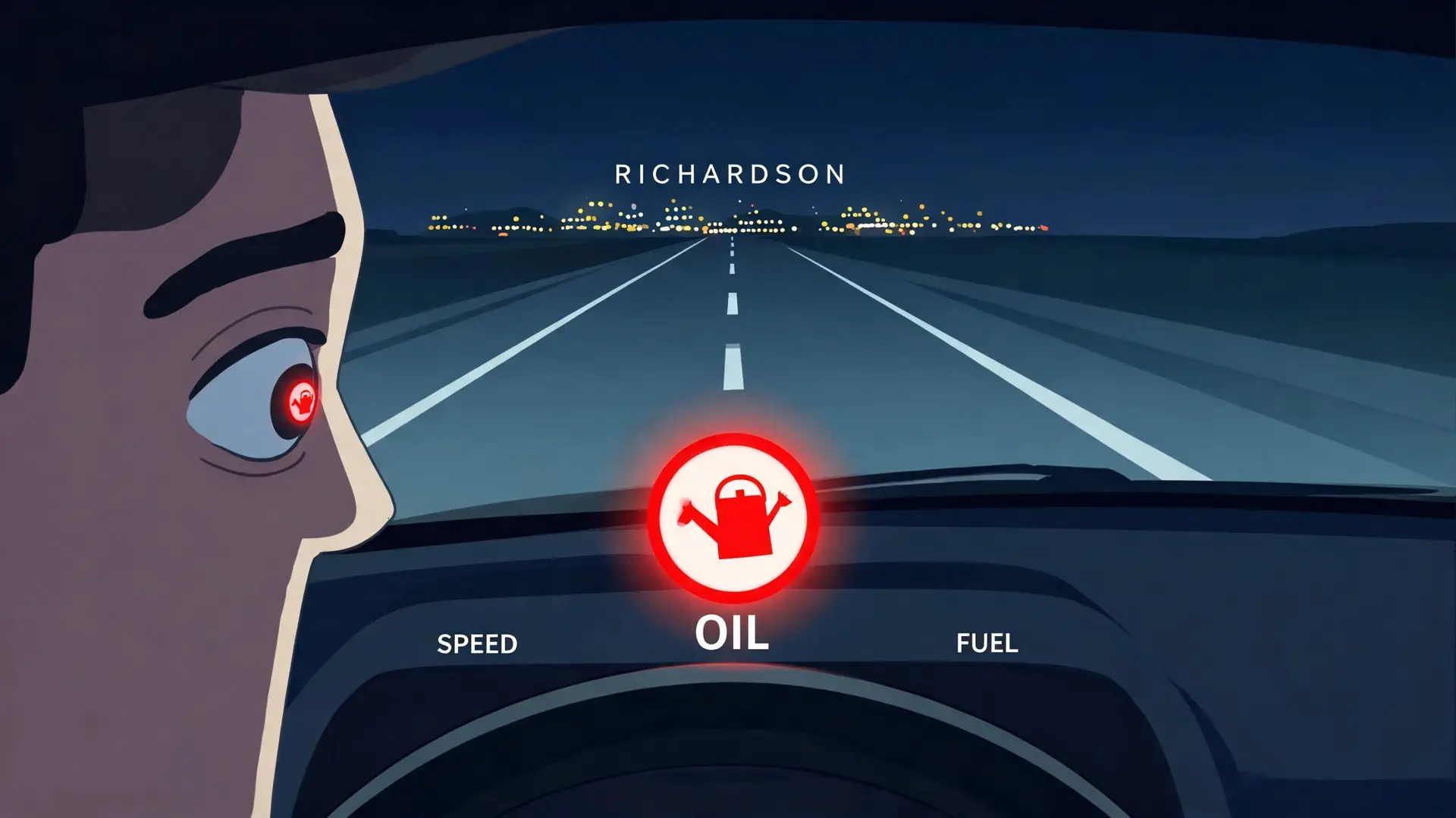
Think of it as your engine’s blood pressure cuff. It doesn’t tell you everything about engine health, but it does tell you whether oil is being pushed through the system with enough pressure to protect bearings, cam surfaces, and other moving parts.
Why this warning changes the whole decision
When drivers see a battery light or a maintenance reminder, they often plan a stop later in the day. An oil pressure warning is different because continued operation can take a manageable problem and turn it into internal engine damage.
Practical rule: If the engine oil pressure gauge shows a serious drop during driving, treat it as a lubrication problem until proven otherwise.
The gauge itself has a long history. The modern idea traces back to the 1643 mercury barometer by Evangelista Torricelli, and later the 1849 Bourdon tube invented by Eugène Bourdon, which became a foundation for pressure measurement in automotive use, as explained in this history of pressure gauges.
What concerned drivers usually get wrong
It's common to make one of two mistakes:
- They panic over normal movement. Oil pressure changes with temperature and engine speed.
- They ignore an abnormal warning. A flicker at idle may be one thing. A low reading at cruising speed is another.
That’s why the gauge matters so much. It’s not just a warning device. It’s an early clue. Read correctly, it helps you separate normal behavior from a condition that needs immediate shutdown.
How the Engine Oil Pressure System Works
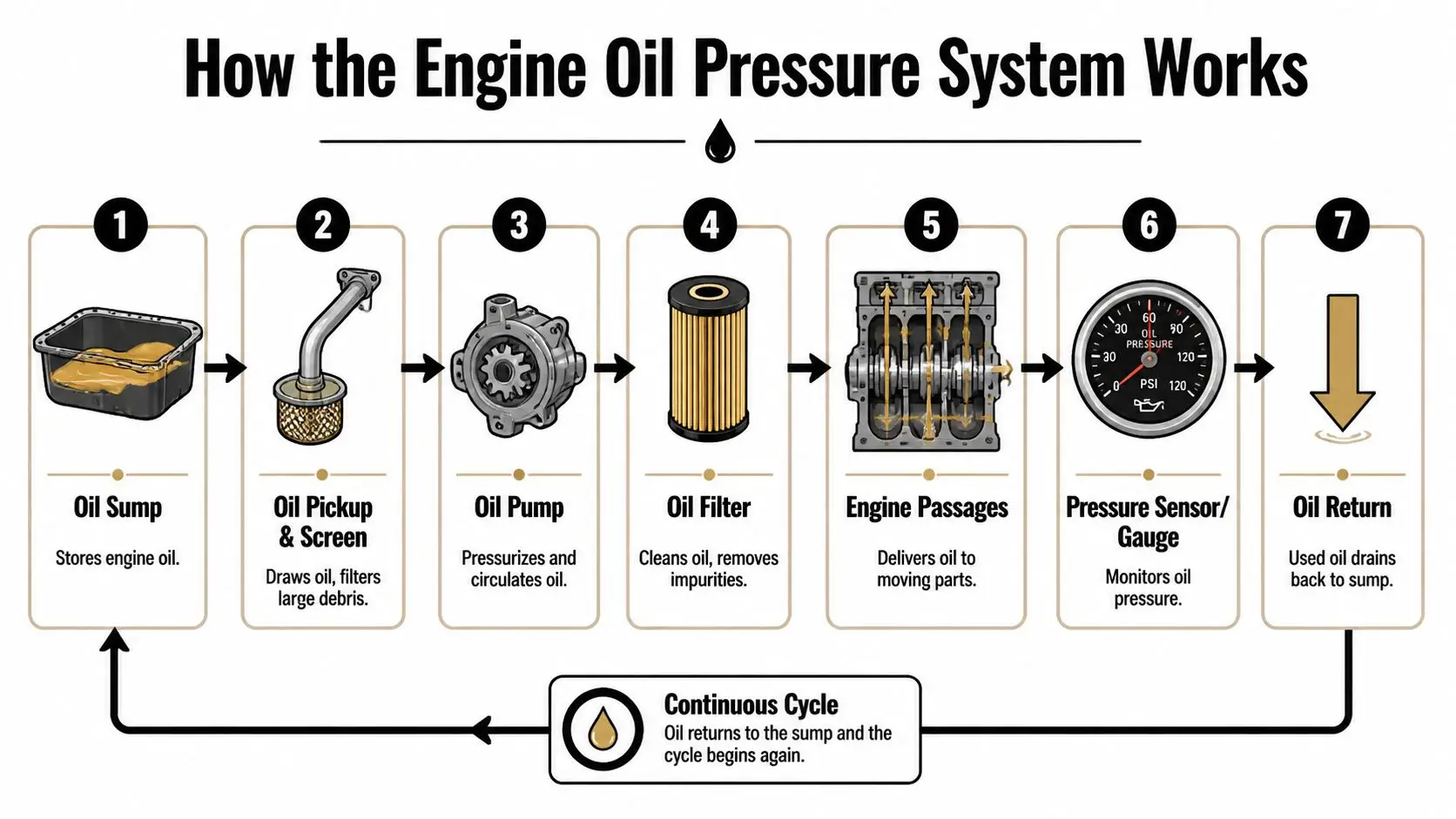
Your oil pressure system has one job: move oil from storage to the parts that need protection, then return it to start again. If you understand that cycle, the engine oil pressure gauge becomes much easier to interpret.
The three parts that matter most
The simplest way to think about it is this:
- The oil pump pulls oil from the pan and pressurizes it.
- The engine passages carry that oil to bearings and other moving parts.
- The sender and gauge report what’s happening.
Oil starts in the sump. The pickup tube draws it through a screen. The pump pressurizes it and sends it through the filter, then through the engine’s internal passages. After the oil does its job, it drains back down and the cycle repeats.
Why pressure matters more than many drivers realize
Pressure is what tells you the oil is being delivered through those narrow passages. Low pressure can mean the oil isn’t reaching parts with enough force or consistency. High pressure can also be a problem if a blockage or relief issue is building strain inside the system.
If you want a good companion explanation for how oil thickness affects this whole process, this guide on engine oil viscosity explained is worth reading alongside gauge behavior.
The gauge doesn’t measure how much oil is in the pan. It measures the pressure of oil movement through the system.
Mechanical gauges and electric gauges
Not all systems report pressure the same way. Some vehicles use a simple warning light. Others use an analog or digital engine oil pressure gauge. In the trade, the big distinction is mechanical versus electric.
Mechanical gauges use direct Bourdon tube sensing and can maintain up to 2% accuracy. Electric senders are common in modern vehicles, but if the sender is faulty, signal drift can create a 15% to 20% error rate, according to Hewitt Industries gauge specifications and notes.
That difference matters during diagnosis. A bad electric sender can scare a driver with a false reading. A mechanical test gauge is often the fastest way to find out whether the dashboard is lying or the engine is.
Decoding Normal Engine Oil Pressure Readings
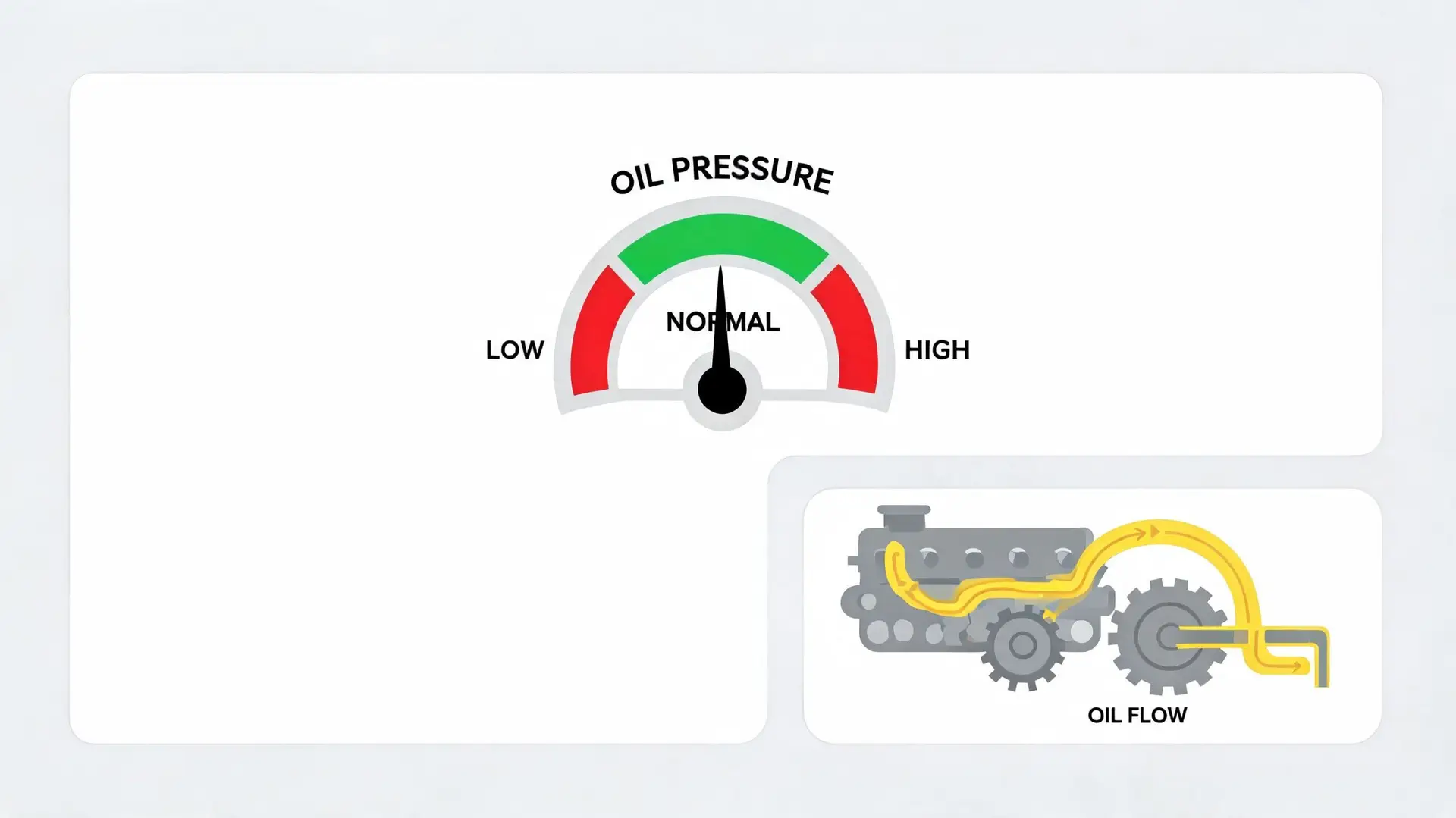
A healthy engine oil pressure gauge doesn’t hold one fixed number all day. Pressure rises and falls with temperature, rpm, and engine condition. The key is knowing what movement is normal and what movement means stop driving.
The safe range to look for
A widely accepted operating range is 25 to 65 PSI during operation, with the important caveat that a gauge may sit near or below the green arc at idle without signaling trouble. A low reading at cruise power is the more serious warning sign, as noted in this discussion of what the oil gauge tells you.
That distinction is where many drivers get tripped up. They see a lower hot idle reading and assume the worst. In reality, idle pressure is naturally lower because the engine is turning slower and oil is warm.
What normal movement looks like
Watch for patterns, not just numbers.
- Cold start behavior: Pressure often starts higher because cold oil is thicker.
- Warm engine behavior: The reading usually settles as the oil reaches operating temperature.
- Idle behavior: Pressure is lower at a stoplight than it is on the highway.
- Acceleration behavior: Pressure should generally rise with engine speed.
A stable pattern matters more than obsessing over one momentary swing.
Here’s a useful visual overview before the next part gets more diagnostic:
What deserves closer attention
A technician doesn’t ask only, “Is the number low?” The better question is, “Is the reading reasonable for this engine, at this temperature, at this rpm?”
If the gauge is calm at idle but drops too far during steady road speed, that’s a more serious clue than a brief low reading while sitting at a stop.
Drivers of older and high-mileage vehicles should be especially pattern-focused. A gradual change over time can reflect wear. A sudden change usually deserves faster action.
Diagnosing Low and High Oil Pressure Problems
Good diagnosis starts with one principle: low pressure and high pressure are different failures. They don’t point to the same parts, and they don’t carry the same risks. If you lump them together, you waste time and often replace the wrong thing.
When the reading is low
A reading below 20 PSI often points toward problems such as worn engine bearings or oil leaks, and if it’s left unaddressed, engine life can be reduced by up to 50%. On the other side, readings above 65 PSI can indicate blockages or incorrect viscosity and may risk damage to seals and the oil pump, based on Midwest Instrument’s oil pressure interpretation guidance.
Low pressure doesn’t always mean the engine is finished. It does mean the oil film may be too weak to protect internal parts properly.
Common low-pressure logic usually goes like this:
- Low oil level: If the pump can’t pick up oil consistently, pressure can fall off.
- Worn bearings: Increased clearance makes it easier for oil to escape, which lowers pressure.
- Leaks in the system: Pressure can’t hold if oil is leaving where it shouldn’t.
- Oil diluted or too thin for the condition: The pump moves it, but the engine may not maintain pressure as expected.
If you’re dealing specifically with pressure that trends high instead of low, this companion article on high oil pressure helps frame the opposite side of the problem.
When the reading is high
High pressure sounds safer than low pressure, but it isn’t automatically good news. If pressure stays too high after warmup, a technician starts thinking about restriction, relief valve function, and oil viscosity.
Real trade-offs matter. Some drivers assume thicker oil will “protect better” in every situation. Sometimes it only masks wear or creates pressure behavior the engine wasn’t designed for.
A high reading can point toward:
Oil that’s too thick for the application
Especially right after service, this is worth checking first.
A blockage in oil passages or filter flow
The pump is working against restriction instead of circulating cleanly.
A relief valve issue
If the system can’t regulate pressure properly, the gauge may stay abnormally high.
What works in diagnosis and what doesn’t
What works is reading the symptom with context. Hot or cold? Idle or cruise? Sudden or gradual? Fresh oil change or long interval? Noise present or absent?
What doesn’t work is replacing the sender first and hoping the problem disappears. That occasionally gets lucky. It’s not a diagnostic method.
Start with the operating condition that produced the warning. A pressure complaint at hot idle points you in one direction. A pressure complaint at highway speed points you in another.
Your Immediate Action Plan for Oil Pressure Warnings
If the engine oil pressure gauge suddenly drops, your first minute matters more than your next internet search. Protect the engine first. Diagnose second.
What to do right away
Use this sequence:
Get off the road safely
Don’t keep driving to “see if it clears up.”
Shut the engine off
If pressure is low, every extra second of operation increases risk.
Check the oil level when it’s safe
A quick dipstick check can tell you whether the engine is obviously low. This guide on checking engine oil level is a useful refresher if you haven’t done it in a while.
Look for obvious signs
Fresh oil under the vehicle, a loose filter area, smoke, or new engine noise all change the urgency.
Don’t assume the gauge is wrong
Drivers often struggle to separate a faulty gauge from a true pressure problem. The definitive step is comparison with a mechanical test gauge, as explained in AOPA’s discussion of engine gauge interpretation.
DIY checks vs professional diagnosis
Here’s the line between what a driver can reasonably do and what needs shop equipment.
| Symptom / Check | What You Can Do (DIY) | When to See a Kwik Kar Pro |
|---|---|---|
| Oil warning light came on once briefly | Note whether it happened at idle, during a turn, or at speed | If it repeats, have the pressure verified with proper testing |
| Gauge dropped suddenly and stayed low | Pull over, shut off engine, check oil level if safe | Immediately, especially if the engine made noise or ran rough |
| Oil level is low on dipstick | Add the correct oil only if you know the right specification and recheck carefully | If the level was very low, or the warning remains after correction |
| Gauge reads strangely but engine sounds normal | Avoid long trips and avoid assuming it’s only a sender | Have the sender circuit and actual pressure tested |
| High reading after service | Confirm the correct oil was used if you have the paperwork | If pressure stays abnormally high after warmup |
| Fleet vehicle stuck on route | Remove it from service if the warning persists | For mobile support in the field, some operators also rely on resources like 24/7 on-site fleet repair when a unit can’t safely continue |
The decision most people delay too long
The biggest mistake is restarting over and over to “double-check.” If the engine really has low pressure, repeated restarts add more wear. If the issue is only electrical, proper testing will find that without gambling with the engine.
Shut it down first. A no-start inconvenience is cheaper than a no-lubrication engine failure.
Drive Confidently with Kwik Kar Expert Diagnostics
An engine oil pressure gauge is one of the few dashboard signals that can point directly to immediate engine risk. That doesn’t mean every warning equals disaster. It means the warning deserves a disciplined diagnosis instead of a guess.
That diagnosis should answer a short list of questions clearly. Is the engine producing proper pressure? Is the sender lying? Is the oil grade correct? Is there a blockage, leak, or internal wear problem? Until those are answered with testing, replacing parts at random is expensive and unreliable.
Drivers who stay on top of overall vehicle care usually avoid a lot of confusion when warning lights show up. That includes basics outside the engine bay too, such as vehicle security maintenance, because dependable driving comes from paying attention to the whole vehicle, not just the loudest symptom of the day.
If you drive a high-mileage vehicle, manage family transportation, or keep work vehicles moving, pressure warnings are worth taking seriously but calmly. The right tools and a methodical approach can separate a faulty gauge circuit from a genuine lubrication problem before the damage gets expensive. That’s where ASE-certified diagnosis, transparent explanations, and a shop that documents what it finds make all the difference. Military members, first responders, and healthcare professionals should also ask about available service discounts when scheduling care.
If your engine oil pressure gauge has you second-guessing what’s safe, schedule an inspection with Kwik Kar Oil Change and Auto Care. Their ASE-certified team can verify actual oil pressure, inspect the sender and wiring, and explain exactly what they find so you can make the right repair decision with confidence.