You turn the key before work, school drop-off, or a quick run down Belt Line, and the car answers with a click, a grind, or nothing at all. That moment gets stressful fast. Most drivers immediately wonder if the battery died, if the starter gave up, or if the whole repair is about to get expensive.
The good news is that many engine starter problems leave clues before complete failure. If you know what sound to listen for and what to check safely at home, you can narrow it down before you pay for parts you may not need. That matters even more on older, high-mileage vehicles, which we see a lot of around Richardson.
That Dreaded Silence When You Turn the Key
A no-start never happens at a convenient time. It’s usually in your driveway when you’re already late, in a grocery store parking lot with kids in the back, or during a quick stop when the car was running fine ten minutes earlier.
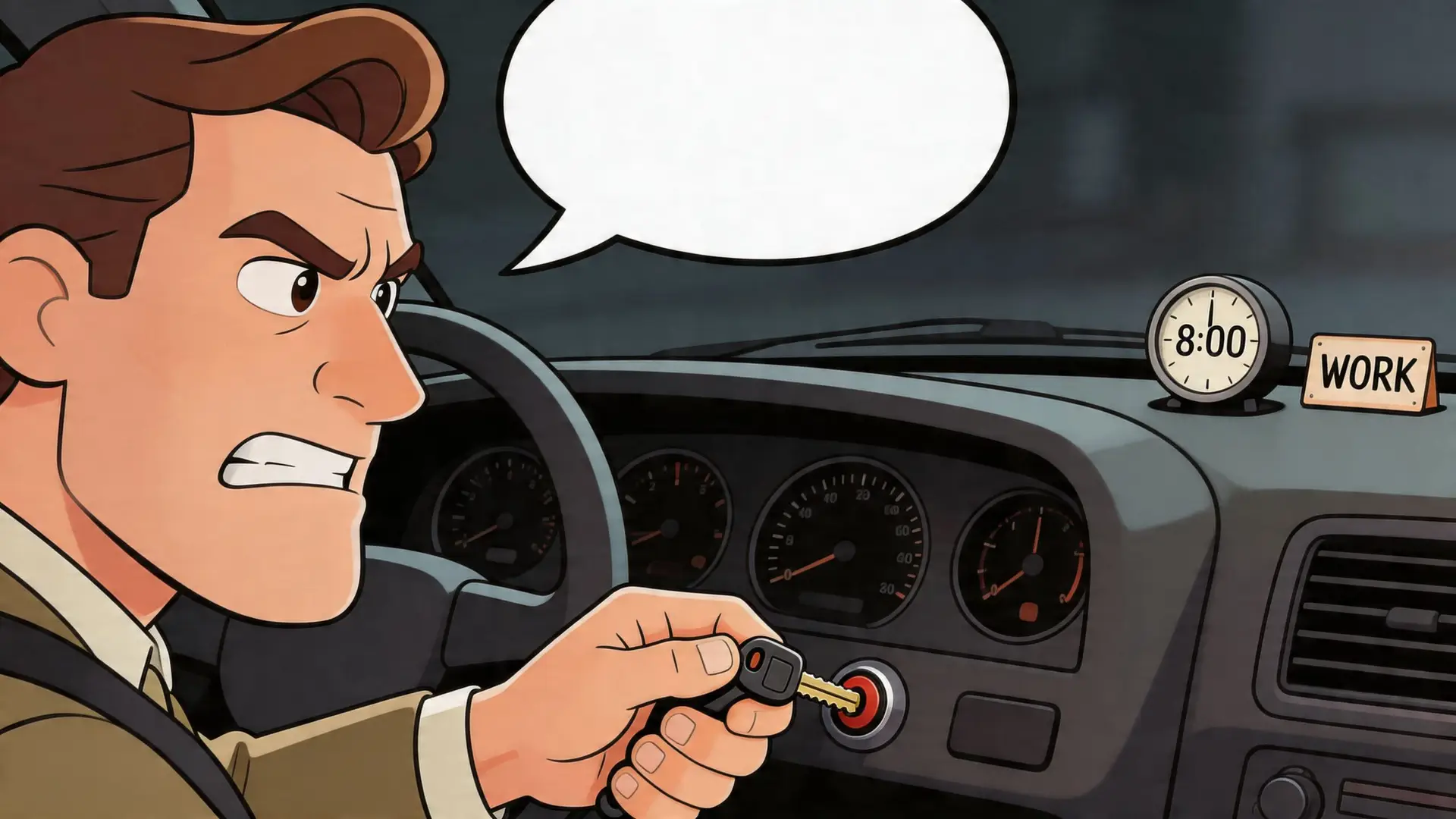
When drivers describe engine starter problems, they often use the same words. “It just clicked.” “The lights came on, but it wouldn’t crank.” “It sounded weak.” Those details matter. A dead battery and a failing starter can feel similar from the driver’s seat, but they usually behave differently once you know what to notice.
A battery issue often affects the whole car. Lights may dim hard, electronics may act weak, and the engine may crank slowly. A starter issue can be more selective. The dash may light up normally, yet the engine still won’t turn over.
Practical rule: If the lights and accessories seem normal but the engine won’t crank, the starter circuit moves higher on the suspect list.
You don’t need a full shop setup to begin sorting that out. A flashlight, a basic multimeter, and a careful look under the hood can tell you a lot. The key is staying systematic instead of guessing and throwing parts at the problem.
Decoding Your Car's Starting Symptoms
Starter diagnosis starts with sound, or the lack of it. Industry analysis shows five common starter failure indicators: weak cranking, grinding noises, intermittent starting, clicking with no crank, and electrical burning smells. It also notes that high current draw with low cranking speed is a classic sign of defective internal starter components (starter failure indicators from James Toyota).
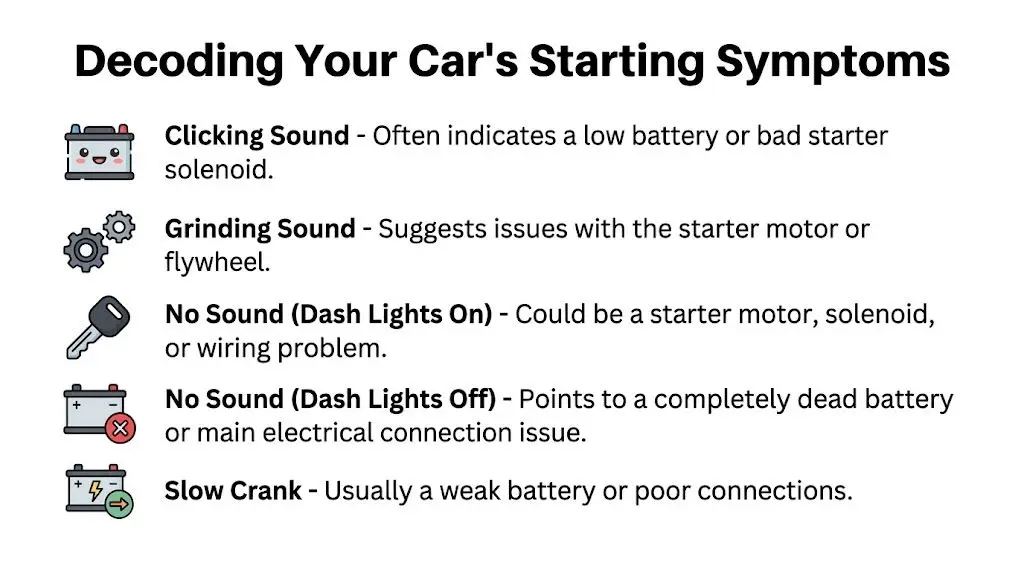
The single click
One solid click with no engine crank often points toward the starter solenoid or a starter that isn’t engaging properly. The battery can still be part of the story, especially if voltage drops under load, but a single heavy click usually tells me the car is at least trying to send power to the starter assembly.
If the headlights stay bright and the click is repeatable, the battery becomes a little less suspicious and the starter circuit becomes more suspicious.
Rapid clicking
Rapid-fire clicking usually sends me toward the battery first. That sound often happens when there’s enough power to trigger the solenoid, but not enough sustained power to spin the starter motor. Loose or corroded battery terminals can create the same symptom.
If you want a deeper battery-focused walkthrough, this guide on battery and alternator warning signs is a useful next step.
Grinding or whirring
Grinding is the sound you don’t want to ignore. It can mean the starter gear isn’t meshing correctly with the flywheel. A free-spinning whir can mean the starter motor is turning but not engaging the engine the way it should.
Those sounds matter because repeated attempts can make a small problem more expensive. If the gear teeth are slipping or clashing, every extra start attempt risks more wear.
Stop cranking if you hear grinding. That sound is a warning, not a challenge.
Slow crank
Slow crank feels like the engine is dragging itself awake. Sometimes that’s just a weak battery. Sometimes it’s cable resistance or bad grounds. Sometimes it’s the starter pulling hard but not producing enough torque because internal parts are worn.
A slow crank after the vehicle has sat overnight points in a different direction than a slow crank after a hot drive. Pattern matters as much as the symptom.
Dead silence
No sound at all splits into two different paths.
| Symptom | Most likely direction |
|---|---|
| No sound, dash lights off | Dead battery, disconnected cable, or main power issue |
| No sound, dash lights on | Starter, solenoid, ignition switch signal, or wiring issue |
Smell and smoke
A burning electrical smell or visible smoke is not a DIY moment. Shut the vehicle off, stop trying to start it, and have it inspected. Oil contamination and internal electrical faults can create that smell, and continuing to crank can make the damage worse.
Your At-Home Diagnostic Toolkit
Start with safety. Put the vehicle in park or neutral, set the parking brake, keep loose clothing away from belts and fans, and don’t crawl under a vehicle supported only by a jack.
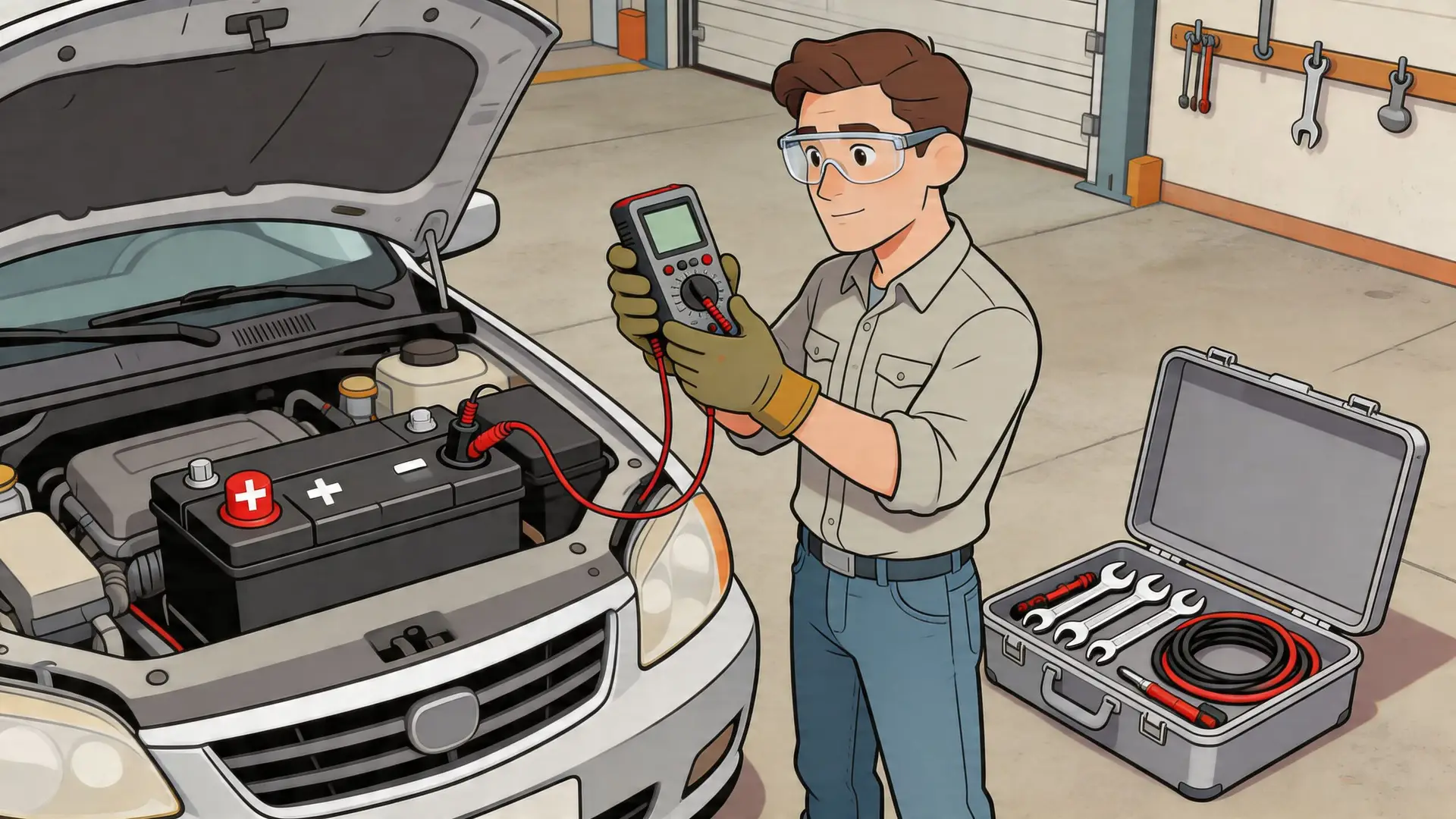
You don’t need a scan tool to do the first round of checks. For most Richardson drivers, a multimeter, a battery terminal brush, a flashlight, and a couple of common hand tools are enough to separate a simple connection problem from a deeper starting issue.
Check the battery before blaming the starter
Most good diagnosis begins with examining the battery posts and cable ends. White or bluish crust, loose terminals, swollen cables, or an obviously damaged clamp can create starter symptoms without a bad starter.
Use this order:
- Inspect the terminals. If they’re crusted with corrosion, current flow can drop when the starter tries to draw power.
- Wiggle the cable ends by hand. They should feel secure, not loose on the posts.
- Look at the ground cable where it bolts to the body or engine. A bad ground can mimic a bad starter.
If you have a multimeter, test battery voltage with the engine off. Then compare that with voltage during cranking if the vehicle will attempt to crank at all. If you want a more detailed step-by-step process, use this guide on how to test a battery with a multimeter.
Clean what you can actually see
Cleaning terminals is a fair DIY job. Disconnect the negative terminal first, then the positive. Clean the posts and cable ends, reinstall them tightly, and try again. That fix works more often than people think.
What doesn’t work is guessing. Replacing a starter because the battery cables looked “kind of okay” is how people spend money and still end up stranded.
A clean, tight battery connection can solve a no-start. A dirty or loose one can fool you into condemning the starter.
Check cable condition, not just battery condition
A battery can test okay and still fail to deliver power to the starter if the cables have internal corrosion or the ground path is poor. On older vehicles, I pay close attention to:
- Ground strap condition. If it’s frayed, green under the insulation, or loose where it mounts, starter performance drops.
- Positive cable heat damage. Hard, brittle insulation near the engine can point to resistance or age.
- Starter cable connection. If it’s loose at the starter itself, the motor may click and do nothing.
Rule out engine lockup before replacing parts
This is the check many drivers never hear about, and it can save a very expensive wrong turn. A frequent misdiagnosis is replacing a starter when the engine is mechanically locked. A technician will try to rotate the crankshaft by hand first. If the engine won’t turn, the starter isn’t the root cause, which can save a needless $300-600 repair (engine lockup check explained in this video reference).
Here’s the basic idea. With the ignition off and the correct socket on the crankshaft pulley bolt, the engine should rotate by hand with steady force. If it won’t move at all, the problem may be internal to the engine, not the starter.
This is the point where DIY gets risky. If you don’t know exactly where the crank bolt is, don’t force the wrong fastener, and don’t lean over a hot engine guessing.
A visual reference helps if you want to understand what technicians are checking:
A simple decision guide
| What you find at home | What it usually means |
|---|---|
| Loose or corroded battery terminals | Start with cleaning and tightening |
| Good lights, single click, no crank | Starter or solenoid moves up the list |
| Rapid clicking and weak lights | Battery or cable issue is more likely |
| Grinding noise | Stop testing and have it inspected |
| Engine won’t rotate by hand | Don’t replace the starter first |
Diagnosing Intermittent and Heat-Related Failures
The toughest engine starter problems aren’t the ones that fail every time. They’re the ones that behave perfectly in the morning, then leave you stuck after a short stop for gas, coffee, or a pickup run.
What heat soak feels like
Heat soak is a primary cause of intermittent no-starts after short stops, especially in high-mileage vehicles. The hot starter or solenoid clicks but won’t engage, then works again after cooling. It’s often misdiagnosed as a simple battery or solenoid failure (heat soak diagnosis details from Dakota Ridge Auto).
That pattern is common in Texas driving. You run errands with the engine fully hot, shut it off for a short time, come back, and get a click or weak engagement. Then, later, the car starts like nothing happened. Drivers understandably think the problem “went away.” It didn’t. It just cooled down.
Why Richardson heat makes this worse
Our local climate doesn’t cause every starter failure, but heat absolutely changes the pattern. A starter that’s already aging can act normal on a cool morning and struggle once the engine bay is heat-soaked after traffic and stop-and-go driving.
High-mileage vehicles are especially prone to this because the starter, solenoid contacts, cable ends, and mounting points have all seen years of heat cycles. Add oil seepage or road grime, and the problem gets harder to reproduce on demand.
How to separate heat soak from a weak battery
Use the timing of the failure.
- Cold morning no-start often points toward battery weakness, poor overnight charge, or connection issues.
- Hot restart failure after a short stop puts heat soak higher on the list.
- Works again after sitting is one of the strongest clues that heat is involved.
That doesn’t mean the battery is automatically innocent. It means the symptom pattern matters more than one random start attempt.
If your car starts fine before work but refuses after a short errand, tell the technician exactly that. Intermittent failures are easier to diagnose when the pattern is clear.
What helps and what doesn’t
Helpful information to gather:
- How long the vehicle was driven before the failure
- How long it sat before you tried restarting
- Whether you heard one click, repeated clicks, or a slow drag
- Whether it restarted normally after cooling off
What doesn’t help is replacing parts based on a hunch. Heat-related failures can look like a battery issue, a solenoid issue, bad cable resistance, or a worn starter motor. If you replace one piece without confirming the pattern, you can still end up with the same no-start a week later.
A shop-level check you may hear about
On diesel fleets and commercial applications, technicians can go deeper with non-invasive starting system analysis. One study reported 92% accuracy across 10 bus engines using battery voltage, starter current, and crankshaft RPM signals during starts (non-invasive starter diagnostics study). That kind of testing is more advanced than most DIY setups, but the takeaway is simple. Starter diagnosis works best when someone measures the system under real starting load, not when they guess from symptoms alone.
Simple Fixes Versus When to Call Kwik Kar
Some no-start problems are worth handling at home. Some aren’t. The smart move is knowing where that line is.
Good DIY candidates
If the issue is visible and straightforward, DIY can make sense.
- Loose battery terminal. Tighten it correctly.
- Surface corrosion on battery posts. Clean it and retest.
- Dirty ground connection you can access safely. Remove, clean, reinstall.
- Battery charge issue. Recharge or test the battery before condemning the starter.
These are low-risk checks. They don’t require removing the starter, getting under the vehicle, or probing live circuits near hot exhaust parts.
Leave these to a technician
Once the problem moves beyond basic connection checks, the risk changes.
| Situation | Why professional diagnosis matters |
|---|---|
| Grinding during start attempts | Possible flywheel or starter drive damage |
| Intermittent hot no-start | Needs testing under the right conditions |
| No crank with good battery power | Could be starter, solenoid, wiring, or ignition signal |
| Burning smell or smoke | Electrical fault risk |
| Starter replacement on tight engine bays | Access can be difficult and unsafe without proper tools |
Argonne National Laboratory found the average starter motor is designed for around 45,000 start cycles, and frequent daily starts can bring that point closer on high-mileage vehicles (starter cycle lifespan research from Argonne). That’s why patching an old, inconsistent starter usually isn’t the best long-term move. If a vehicle has reached the stage where the starter is weak, heat-sensitive, or unreliable, replacement is often more sensible than repeated temporary fixes.
For drivers who don’t want to guess, starter and alternator service at Kwik Kar Richardson is one local option for proper testing and repair.
Temporary fixes are fine for dirty terminals. They’re not a strategy for an aging starter that’s already showing repeat symptoms.
Starter Repair Costs and Prevention Tips
Starter repair costs vary a lot because access varies a lot. On some vehicles the starter is fairly open. On others it’s buried under intake components, near the exhaust, or packed into a tight front-wheel-drive engine bay. Parts quality also matters. A cheap replacement may solve today’s no-start and create a new one later.
The practical way to budget is to ask for a complete estimate that separates parts, labor, and related electrical checks. If the shop can explain whether they’ve confirmed battery condition, cable condition, and starter operation before replacement, you’re less likely to pay twice for the same problem.
Prevention that actually helps
A few habits can extend the life of the starting system:
- Keep battery terminals clean so the starter gets full available current.
- Address slow crank early instead of waiting for a complete no-start.
- Avoid repeated long crank attempts when the engine won’t start.
- Fix oil leaks above the starter if your vehicle has them.
- Pay attention to hot restart patterns because intermittent failure often gets worse, not better.
If your car has started showing a repeat pattern, especially after short stops in warm weather, don’t wait for the total failure. Starter problems usually become more frequent before they become permanent.
If your vehicle is clicking, grinding, or refusing to crank in Richardson, Kwik Kar Oil Change and Auto Care can inspect the starting system, rule out battery and cable issues, and determine whether the problem is the starter, solenoid, or something deeper in the engine.